
Water flow stabilization means maintaining consistent pressure and flow rate across a pipeline network, regardless of demand spikes or elevation changes. When it breaks down, the culprits are usually aging pipes, poor original design, valve or pump malfunction, or maintenance that got pushed to next quarter one too many times.
This guide walks through the common failure patterns, how to diagnose root causes, step-by-step fixes, and when repair beats replacement.
Key Takeaways
- Leaks, clogs, faulty valves, pump/pressure imbalance, turbulence, and air entrainment cause most unstable flow
- Most instability is fixable once you pin the root cause—replacement is rarely the first step
- Diagnose the symptom, isolate the cause, apply a targeted fix, then test under load
- Call a pro for SCADA-level diagnostics, structural pipe damage, or certified equipment installation
What Is Water Flow Stabilization?
Water flow stabilization is the ongoing process of keeping flow rate and pressure consistent despite changing demand, elevation, and system wear. Treat it as an ongoing discipline, not a one-time fix.
Flow and pressure are interdependent. Per the continuity equation, flow rate equals pipe area times velocity, so a narrower section forces higher velocity at the same flow rate. Add in friction losses, elevation changes, and pump behavior, and you get a system where a pressure reading alone tells you almost nothing without context.
Pipeline systems are working infrastructure. They degrade. That means:
- Pressure gauges and flow meters need regular monitoring
- Correction devices (valves, regulators, conditioning equipment) need periodic calibration
- Preventive maintenance isn't optional if you want consistent output
Common Problems That Disrupt Water Flow
Flow instability usually shows up in a few recognizable patterns. Here's what to watch for.
Pressure Surges and Water Hammer
Symptoms:
- Loud banging noises
- Pipe movement or vibration
- Sudden pressure spikes on gauges
Likely causes:
- Abrupt valve closure
- Pump start/stop events
- Check-valve slam
ASPE identifies these as the primary triggers of transient pressure changes in ASPE's water hammer guidance.

Weak or Inconsistent Flow
Symptoms: Adequate static pressure but poor output under flow, especially at remote or elevated fixtures.
Likely causes:
- Undersized piping
- Excessive friction loss
- Sharp bends
- Scale buildup restricting the passage
Turbulent Flow and Air Entrainment
Symptoms:
- Noise and vibration
- Unstable meter or gauge readings
- Intermittent flow during filling operations
Likely cause: Rapid filling can shift open-channel flow to pressurized flow and trap air at the interface — a mechanism documented in ASCE hydraulic engineering research.
Leaks and Undetected Water Loss
Symptoms:
- Falling pressure in an isolated section
- Unexplained continuous flow
- Wet spots
- Water bills that don't match usage
Likely cause: Physical pipe leakage (real loss) versus metering or data errors (apparent loss). These are different problems and need different fixes.
Why Pipeline Flow Becomes Unstable (Root Causes)
Instability rarely comes from one single failure. It usually stems from several factors at once:
- Operational stress: demand spikes, peak usage hours, pump cycling
- Environmental exposure: elevation changes, temperature swings, ground movement shifting buried pipe
- Poor installation: undersized piping, miscalibrated valves or pumps from day one
- Deferred maintenance: no monitoring schedule, no inspection cadence
Ignoring these issues compounds costs. Pumping systems already account for an estimated 25% of industrial motor electricity use, with roughly 20% potential savings identified in DOE-funded studies of the chemical industry.
Left unaddressed, instability also drives:
- Higher pumping and energy costs from inefficient operation
- Inflated water/sewer bills from turbulence and air entrainment distorting meter readings
- Compliance and safety risks tied to pressure transients
- Emergency repair costs that dwarf preventive maintenance budgets

How to Stabilize Water Flow (Step-by-Step)
Jumping straight to a fix without diagnosing the exact pattern wastes time and money. Isolate the root cause first, then apply the matching remedy.
Step 1: Identify the Exact Flow Problem
- Observe symptoms directly — banging, fluctuating pressure, weak output, visible leaks
- Note when it happens: at startup, during peak demand, or continuously
- Check meter readings, gauges, or SCADA alarms for anomalies
- Document frequency and severity for pattern recognition
Step 2: Confirm the Root Cause Category
Determine whether the problem is:
- Mechanical — pumps, valves, pipe material or diameter
- Hydraulic — turbulence, air entrainment, pressure imbalance
- Operational — demand fluctuation, elevation, peak usage patterns
- Infrastructure-related — leaks, clogs, aging pipe
Rule out external factors like municipal supply fluctuations first. This step alone prevents unnecessary part swaps that don't actually fix anything.
Step 3: Apply the Right Fix
Mechanical:
- Inspect and repair or replace pumps, valves, or corroded piping
- Adjust pump calibration and replace worn seals
- Verify alignment before restoring flow
Hydraulic:
- Trapped air and turbulence distort meter readings and cut efficiency
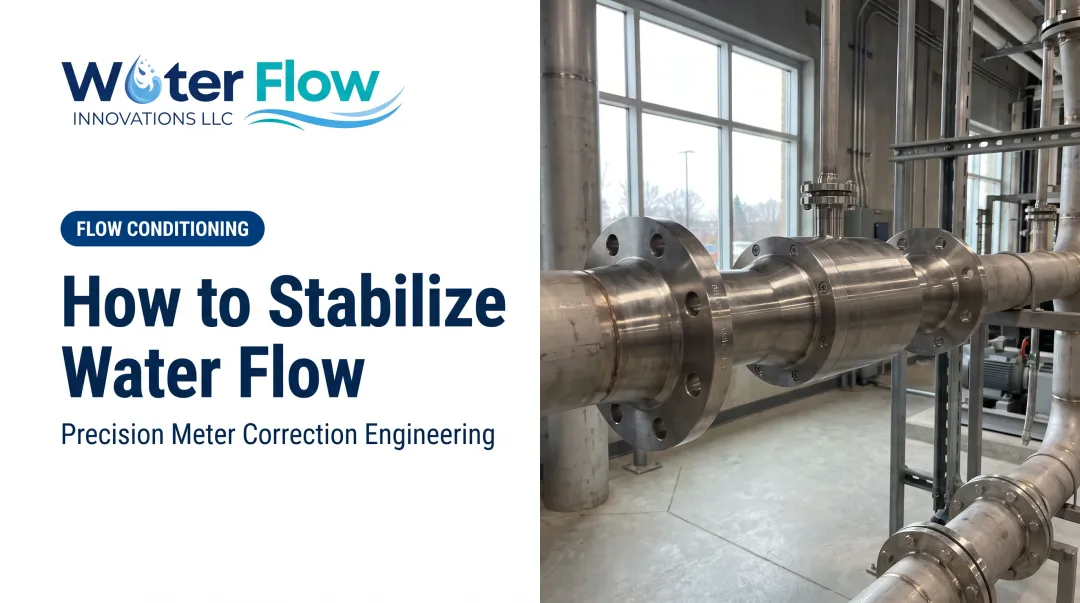
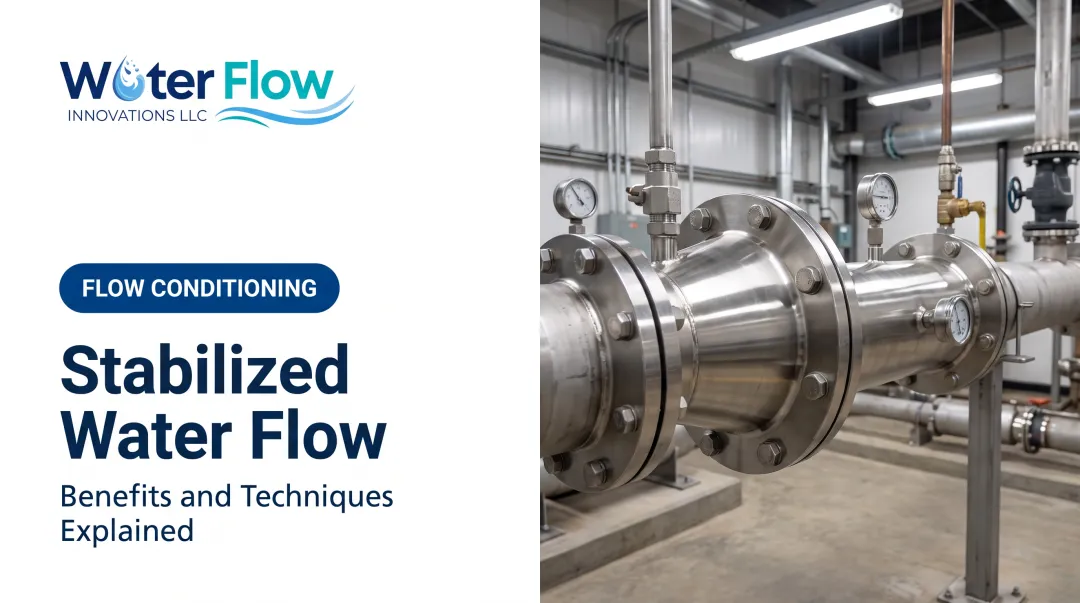
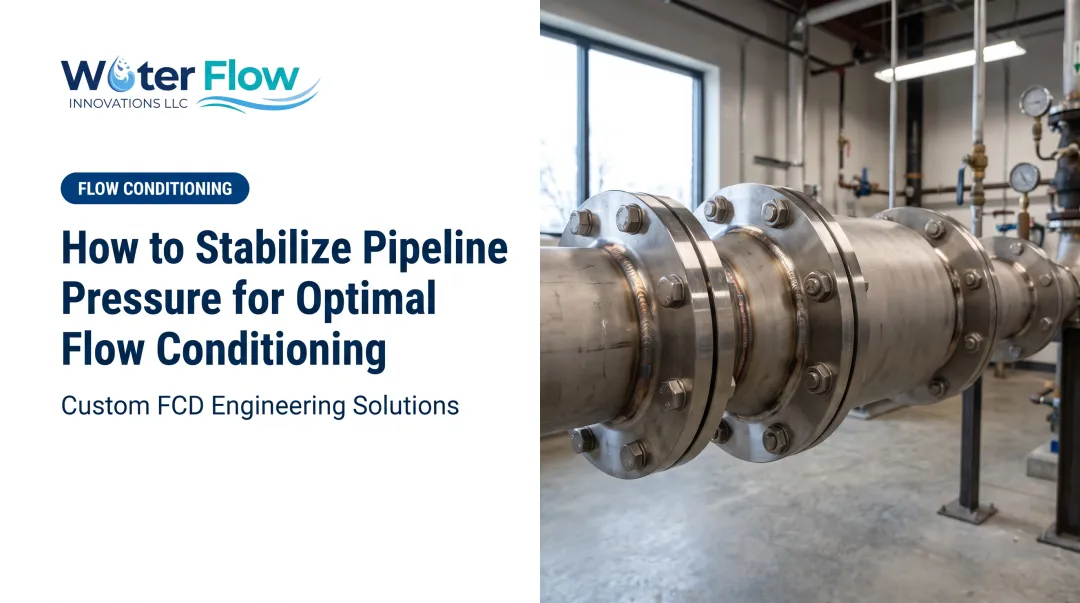
- Install flow conditioning equipment immediately after the meter to smooth flow, remove entrained air, and regulate pressure
Water Flow Innovation's certified Flow Conditioning Device combines four functions in one unit: air/gas separation, pressure regulation, a check valve, and turbulence elimination, with negligible pressure loss downstream.

Operational:
- Stagger high-demand activities across the day
- Install pressure-reducing valves for high-pressure zones
- Add booster pumps for low-pressure zones
- Reprogram control systems to match actual demand cycles
Infrastructure:
- Use leak detection tools to pinpoint losses
- Clear clogs or replace corroded, undersized sections
- Flush lines and clean valves of mineral buildup
Step 4: Test and Validate
Monitor flow rate and pressure under both normal and peak conditions. Compare readings against expected benchmarks using gauges or data loggers. Watch for recurring noise or fluctuation over a defined observation period before you close out the work.

When Should You Fix vs Replace Pipeline Components?
This comes down to weighing cost, risk, and long-term performance, not just age.
| Scenario | Fix | Replace |
|---|---|---|
| Isolated valve/fitting malfunction | Recalibrate or swap the single component | If beyond serviceable life or incompatible with upgrades |
| Recurring network-wide pressure surges | Install pressure-reducing valves or flow conditioning | Entire pump station, if equipment is outdated |
| Aging or corroded pipe sections | Patch or line the affected segment | Full replacement if corrosion is widespread |
| Meter inaccuracy from turbulence/air | Install a certified flow conditioning device immediately after the meter | Meter itself, only if physically damaged or obsolete |
Isolated, localized problems get repaired. Widespread or systemic problems get replaced. For meter inaccuracy specifically, replacing the meter rarely solves anything if the actual cause is turbulent flow upstream — you'd just be measuring the same distorted flow with a new device.
Common Mistakes to Avoid When Stabilizing Water Flow
Even a sound stabilization plan can fail if you hit one of these common traps:
- Treating symptoms, not root causes — quieting hammer or vibration without fixing the pressure, air, or turbulence behind it only delays the real repair
- Skipping post-repair testing under peak load — a fix that holds at low demand can fail completely during peak usage
- Using undersized or incompatible replacement parts — mismatched components reintroduce the same instability
- Ignoring certification standards — IAPMO, NSF/ANSI, and CAN 61 aren't interchangeable; skipping them risks equipment not rated for your application
Preventive Measures to Maintain Stable Flow Long-Term
Prevention costs less than emergency repair, and it shows up directly on your utility bill.
- Schedule regular pressure and flow monitoring or inspections
- Maintain valves, pumps, and meters on a set calendar — not a reactive one
- Match operating conditions (pressure, flow rate) to original system design specs
- Consider certified flow conditioning solutions that prevent meter over-reading without disrupting operations
Water Flow Innovation builds certified flow conditioning devices that stabilize the flow the meter sees. Buy and lease options, flexible financing, and a six-month money-back guarantee keep the trial low-risk. Documented results show 5–30% average water and sewer bill reductions, with 90% of customers reaching ROI in under 12 months.
Conclusion
Most pipeline flow instability is fixable once you correctly diagnose the root cause. Whether it's mechanical, hydraulic, operational, or infrastructure-related, it changes everything about the fix that follows.
Skip the diagnosis step, and you risk replacing parts that were never the problem. Get the diagnosis right, and you know when to repair versus replace. Where turbulence and air entrainment are involved, certified flow conditioning technology cuts both immediate repair costs and long-term water and sewer bills.
Frequently Asked Questions
How do I reduce water flow noise in pipes?
Noise like banging or water hammer is often caused by trapped air, sudden valve closure, or excess pressure. Air chambers, water hammer arrestors, or pressure-reducing valves usually quiet the line and steady the flow.
How do I fix poor water flow?
Poor flow usually stems from clogs, closed valves, mineral buildup, or leaks. Verify isolation valves are fully open, clear strainers and aerators, and rule out leaks before considering a pump upgrade.
What causes water pressure to fluctuate in pipeline systems?
Demand changes, pump cycling, and elevation differences all alter the available pressure at any given point. As demand rises and falls, friction loss changes with it—so pressure at fixtures and meters can swing even when the supply source is steady.
Can flow instability increase my water bill even if usage hasn't changed?
Yes. Turbulence and entrained air can cause meters to over-register flow that was never actually used. Certified flow conditioning devices correct this by stabilizing the water column at the meter.
How often should pipeline systems be inspected for flow issues?
Intervals depend on facility type, system age, material, and criticality. There's no universal number. High-use industrial or municipal systems generally warrant more frequent checks than low-demand commercial buildings.
Is it better to repair or replace an aging pipeline section?
Isolated damage, like a single corroded fitting, can usually be repaired or lined. Widespread corrosion across a network segment typically warrants full replacement to avoid repeat failures.
What does stabilizing the column recover financially?
Documented installations average a 5–30% cut in combined water and sewer charges, with a highest documented single result of 46%, landing on the first bill after installation.
How much of the pipeline has to come offline for that?
None beyond the connection itself. A licensed plumber or mechanical contractor fits the custom-built unit at the municipal supply point in about an hour, with a brief water shutoff at the meter connection.