
Here's the uncomfortable part: even certified, code-compliant meters over-report. Air entrainment, turbulence, and poor installation geometry can push readings well past a meter's stated accuracy tolerance. One lab study on pipe-filling events found trapped air caused registers to log volumes over 400% of the meter's low-flow threshold, with the meter performing exactly as designed.
This guide breaks down meter types, what accuracy ratings actually mean, how to read your register, and how commercial and industrial facilities correct inflated billing without replacing hardware.
Key Takeaways
- Coriolis, magnetic, and ultrasonic meters hit ±0.1%–2% accuracy; turbine and orifice types run ±1.5%–5%
- Certified, calibrated meters can still over-register: high-velocity flow through the meter itself causes localized pressure drop and vapor formation, not meter defects
- Straight-run distance, installation conditions, and flow conditioning drive real-world accuracy
- Correcting flow disturbances, not replacing meters, is usually the faster and cheaper fix
- The FCD installs immediately after the meter, on the consumer side of the connection, and corrects the reading by creating static back pressure that forms a laminar flow backward through the meter itself
What Flow Meter Accuracy Actually Measures
Accuracy is the gap between displayed flow and true flow, expressed as a percentage. It is not repeatability, and it is not resolution. Three different specs that get conflated constantly:
- Accuracy — how close the reading lands to the true value
- Repeatability — how consistent the reading is, even if consistently wrong
- Resolution — the smallest change in flow the meter can detect
A meter can be highly repeatable and still inaccurate: consistently wrong in the same direction, every time.
The Percentage Trap
Accuracy specs get published three different ways, and they are not interchangeable:
| Basis | What it means |
|---|---|
| % of Reading (%R) | Error scales with actual flow rate |
| % of Full Scale (%FS) | Error is fixed relative to the meter's maximum range |
| % of Calibrated Span (%CS) | Error tied to a set calibration range, not full capability |
A meter spec'd in %FS can show large relative error at low flow, since the fixed error allowance becomes a bigger fraction of a small reading. Two meters both advertising "1% accuracy" on different bases are not directly comparable. No flow meter reads with zero error: every technology carries a margin.
Flow Meter Accuracy by Type

| Meter Type | Typical Accuracy | Best Fit |
|---|---|---|
| Coriolis | ±0.1%–0.5% | High-value fluids, mass flow critical |
| Magnetic | ±0.2%–2% | Conductive liquids, wide pipe range |
| Ultrasonic | ±0.7%–1% | Clamp-on, non-invasive applications |
| Venturi | ±0.5%–1% | DP measurement, lower permanent loss |
| Vortex | ±0.7%–2.5% | Steam, process flow control |
| Turbine | ±1.5%–5% | Clean liquids, moderate cost |
| Orifice/DP | ±3%–5% | Low-cost, simple installations |
Coriolis meters are the most accurate on this list, routinely holding ±0.1%–0.5% of reading where mass flow matters.
Venturi vs. Orifice: The Direct Answer
Venturi beats orifice on both counts that matter. Venturi meters run ±0.5%–1% of reading with 75–80% pressure recovery. Orifice plates create more permanent pressure loss from their abrupt restriction, while the venturi's smoother transition keeps more energy in the line and cuts the turbulence-driven error orifice designs are prone to.
Vortex Meters: Mid-Range Accuracy Tradeoffs
Vortex meters sit mid-range at ±0.7%–2.5% and are a dependable choice for steam and process applications, with one weak spot: performance drops at low flow, since vortex shedding needs sufficient velocity to generate a clean signal.
Published accuracy is one input, not the whole decision. Coriolis units cost significantly more and often demand specific pipe configurations. For most facilities, a mid-accuracy magnetic or ultrasonic meter delivers better total value once installation, pipe size, and maintenance are factored in.
A Quick Note on Analog Meters
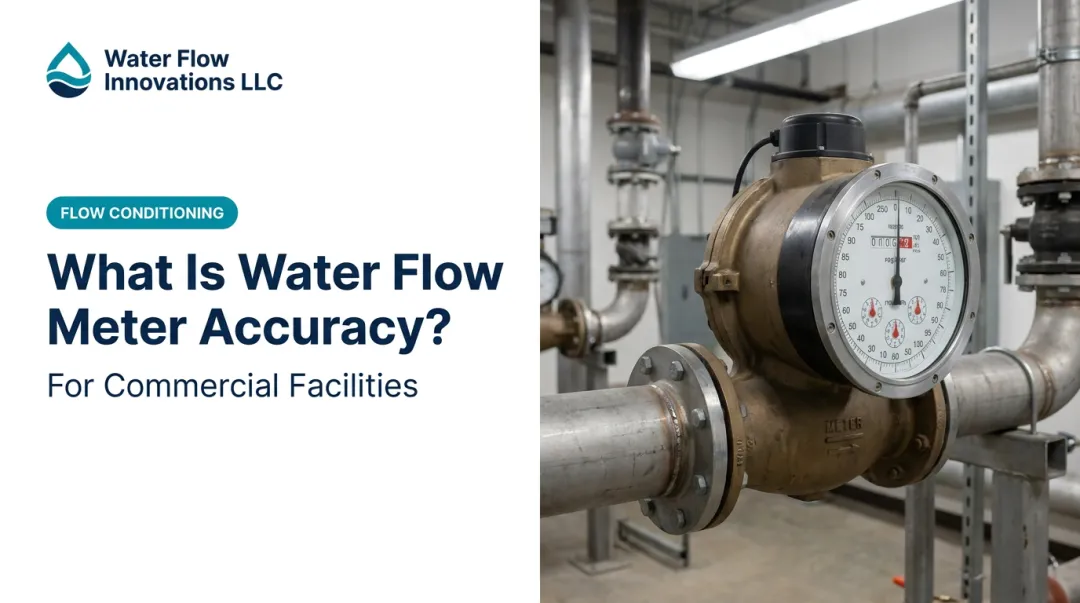
Analog meters, with a mechanical dial or odometer-style register and no electronics, are still what most commercial and industrial buildings run. Their moving registers are especially vulnerable to air- and turbulence-driven over-spin, so real-world accuracy can drift well past the published spec when the flow profile entering the meter is unstable.
Why "Accurate" Meters Still Over-Bill
A meter can be perfectly calibrated, fully certified, and installed to code in a commercial or industrial facility and still cause overpayment. The problem isn't something the water carries in from the incoming supply line; it's created at the meter itself, in the instant water passes through it.

Cavitation at the Meter
When water moves through a meter's internal constriction at high velocity, local pressure drops sharply, the same Venturi effect that speeds flow through any narrowed pipe section. If that pressure drop is steep enough, the water flashes to vapor: it's still the same H₂O, just momentarily changing state from liquid to gas rather than gaining volume as water. Gas takes up far more space than the same mass of liquid, and the meter reads that expanded volume as billed water. Once the vapor clears the constriction and pressure recovers downstream, it collapses back to liquid, but the meter has already counted it.
Upstream conditions don't cause this directly; they set it up. Piping curves, pipe and fixture size changes, valve closures, and process demand spikes are what push water through the meter at the velocity needed to trigger that pressure drop in the first place. A related, well-documented cause of over-registration is entrained air during pipe-filling events: a peer-reviewed study of single-jet and multi-jet meters found over-registration reaching 424%–1,403% of the meter's low-flow threshold in some test cases. Both mechanisms are why many turbine-style meters require 10 pipe diameters upstream and 5 downstream of straight, unobstructed pipe to hit rated accuracy, a standard most retrofit installations never meet.
Why This Happens Even to Compliant Meters
The meter passes every lab calibration test, run at controlled, steady velocities that never trigger this effect. Once installed, real demand patterns push water through the meter fast enough to flash it to vapor at the constriction, a condition the lab never simulated. The meter faithfully reports what it "sees": a larger volume passing through, because for that instant, it is one.
Over months this compounds into inflated water and sewer charges. Most municipalities calculate sewer charges as a percentage or multiple of metered water use, so the same over-registration inflates both bills at once.
How Flow Conditioning Corrects It
Commercial water meters don't just measure water. They measure everything that passes through them. Entrained air, micro-bubbles created by pressure changes, and turbulent flow from on-off cycling and variable demand all pass through the meter alongside actual water, and the meter counts all of it as billed volume. This happens in every commercial and industrial facility: food processing plants, semiconductor fabs, hospitals, hotels, apartment buildings, car washes, golf courses, stadiums, data centers. The triggering operation varies by facility; the mechanism and the fix are the same everywhere.
The FCD installs immediately after the water meter, on the consumer side of the connection. A licensed plumber or mechanical contractor sets it directly at the meter, not between the meter and the incoming supply. Where a pressure-reducing valve (PRV) is present, the best setup is Water Meter → FCD → PRV → Building, conditioning the water at full incoming pressure before the PRV steps it down. When site conditions require installing the FCD after the PRV instead, it still works, but performance is typically 20–40% lower, since the FCD is then working with pressure the PRV has already reduced.
The FCD creates static back pressure that forms a laminar flow extending backward through the meter itself. That is the correction mechanism: it produces a homogeneous water column through the measurement zone, so the meter reads only water, not a mixture of water, air, and turbulence. Four components do this together:
- Air and gas separation — removes entrained air and gas before it can be counted as volume
- Pressure regulation — regulates flow and pressure at the meter entry point, reduces water hammer and pressure surges from on-off cycling and variable demand, and protects downstream plumbing
- Check valve — reduces water hammer and prevents reverse flow through the meter, since reverse flow and pressure spikes are two of the primary ways air and turbulence re-enter the line after initial purging. Not present on all configurations.
- Turbulence elimination — slows water velocity at the meter and prevents vortex flow, particularly effective during CIP cycles, tank filling, and sprinkler or irrigation operation
Pressure loss is negligible by design rather than merely as a performance target: system pressure at every downstream connection is effectively the same before and after installation, though rare cases show a few psi drop at the meter itself. Nothing changes in the building, the process line, or for occupants, which is why it is viable in pressure-sensitive operations like hospitals, semiconductor fabs, food processing, and data center cooling.
One thing worth being precise about: the FCD corrects the meter reading. It is not a general turbulence cure-all for the rest of the piping system. Pump wear, drainage buildup, and general pressure loss elsewhere in the building need their own fixes, such as long-radius elbows, additional straight pipe, or a better layout. The FCD also applies to the metered municipal supply connection only, so it has no effect on NPDES-regulated discharge or blowdown lines.
Water Flow Innovation offers a certified Flow Conditioning Device (FCD) used across hotels, multifamily buildings, industrial manufacturing plants, and municipal facilities to correct exactly this measurement error. The FCD:
- Is certified to IAPMO, NSF, ANSI, CAN 61, KIWA, GMP, and SQF standards
- Is custom-fabricated in 316L stainless steel, with titanium and specialty alloys available for some applications, and made in the USA
- Covers ½″ through 12″ pipe as standard, with larger custom sizes available up to 32″
- Requires no power
- Installs in about an hour, with a brief water shutoff at the meter connection and no access to internal facility systems, process equipment, or operational areas required
- Is backed by a 6-month money-back guarantee on the purchase price, with installation cost non-refundable, plus a lifetime transferable warranty
- Documents a 5–30% average reduction in combined water and sewer bills, with 46% the highest documented single result
Savings appear on the very next billing cycle. There is no ramp-up period, because the fix corrects measurement error rather than actual consumption. About 90% of customers reach full ROI in under 12 months.
How to Read an Analog Water Meter

Most analog meters use an odometer-style register, similar to a car's mileage counter:
- Read the numbers left to right for total usage, in gallons or cubic feet depending on your utility's register type.
- Locate the sweep hand, a small dial or triangle that moves continuously with any flow, even a trickle.
- Check for movement with everything off. If the sweep hand is spinning with no water-using equipment running, that points to a leak or to over-registration.
Register units aren't standardised. Some utilities use cubic feet, where one full sweep revolution equals 1 ft³ (7.48 gallons); others use a gallon-based register with a 10-gallon sweep. Confirm your utility's specific register type before drawing conclusions.
Tracking tip: record readings before and after a high-usage period, such as irrigation season or a hotel's peak occupancy week, to catch abnormal consumption before it shows up as a billing shock.
Choosing the Right Meter for a Facility
Commercial and industrial buyers, including facility managers, plant engineers, and operations directors, should prioritise in this order:
- Accuracy class matched to the application's actual error tolerance
- Pipe size compatibility — undersized meters create pressure drop; oversized meters miss low flow
- Application-specific requirements — chemical resistance, high temperature, hygienic material
Specs alone don't tell the full story. Turbulent or air-entrained flow can make even a well-matched meter over-read, so a facility-specific analysis before buying or replacing hardware is worth doing first.
Water Flow Innovation offers a free Water Bill Review examining billing cycles, pipe size, and operating conditions such as CIP cycles, cooling-tower makeup, and irrigation demand. The review classifies the facility against 60+ industry categories, flags whether over-registration is likely, and recommends an appropriately sized FCD when one will help.
The right fix isn't always a new meter. Often it is correcting the flow conditions feeding the one already installed.
Frequently Asked Questions
Which type of flow meter is most accurate?
Coriolis meters lead at ±0.1%–0.5% accuracy, followed by magnetic and ultrasonic types. Cost and application requirements often override pure accuracy specs when choosing a meter.
What is the best water flow meter for commercial buildings?
Magnetic, ultrasonic, and positive displacement meters are the common commercial choices, on the strength of accuracy, durability, and manageable installation requirements.
Which is more accurate, venturi or orifice?
Venturi. It is more accurate and causes less permanent pressure loss than an orifice plate, making it the preferred choice for critical measurement applications.
How accurate are vortex flow meters?
±0.7%–2.5%, reliable for steam and general process flow control, with reduced performance at low flow rates.
What are the different types of flow meters?
Magnetic, ultrasonic, Coriolis, vortex, turbine, positive displacement, and differential pressure or orifice designs.
How do you read an analog water meter?
Read the odometer-style numbers left to right for total usage. Watch the sweep hand: continuous movement with no water running usually signals a leak.
Can a meter with a tight accuracy spec still inflate the bill?
Yes. Accuracy describes how the meter measures water it correctly identifies as water. It says nothing about entrained air or gas. Pump starts, valve closures, and rapid demand cycling push air through the line, and the meter records it as delivered volume.
What does correcting that over-registration recover?
Documented FCD installations average a 5–30% reduction in combined water and sewer charges, with 46% the highest documented result. Installation takes about an hour and requires only a brief water shutoff at the meter connection, with no access to internal facility systems, process equipment, or operational areas needed, and no meter replacement required.