
Introduction
Wash-down lines often deliver air, pressure swings, and turbulence with the water. When that unstable flow hits the meter and spray equipment, cleaning weakens, utility reads drift high, and sanitation checks get harder to hold.
A water flow conditioning device manages air, pressure, and turbulence so flow reaches the meter and downstream equipment in a more stable, predictable state. Operators, facility managers, engineers, and maintenance teams running commercial and industrial wash-down systems across the United States rely on that stability for cleaning performance, accurate billing, compliance, and uptime.
Flow conditioning is easy to mix up with wash-down pumps, filters, softeners, or water-saving devices—those solve different problems. This article covers how conditioning works, where it installs, how to select the right unit, where it falls short, and how to verify results.
Key Takeaways
- Flow conditioners manage flow quality; wash-down pumps create pressure and volume—not interchangeable.
- Air entrainment and turbulent flow distort meter readings and downstream water behavior.
- Setup depends on pipe size, meter type, pressure, flow rate, water quality, and compliance needs.
- Evaluate performance with baseline utility data and real measurements, not assumptions.
What Is a Water Flow Conditioning Device?
A water flow conditioning device is an inline assembly installed in a water line to manage unwanted air, pressure variation, turbulence, and reverse-flow conditions before water reaches a meter or downstream equipment.
The goal is simple: deliver a more stable, predictable flow profile at the meter and at wash-down points, without requiring operators to change how they clean anything. Spray pressure, nozzle coverage, and cleaning throughput stay the same.
What a conditioner does not do:
- Manufacture additional water or create pressure like a pump
- Remove contaminants, sediment, or particulates like a filter
- Soften hard water or alter mineral content
- Reduce a facility's legitimate water demand
How It Differs from Measurement and Switching
A meter measures volume or flow rate. A flow switch triggers an action at a set point: an alarm, a pump start, or a valve closure. A conditioner does neither. It influences the conditions under which water travels through the pipe, which can in turn affect how accurately a downstream meter registers that flow.
This distinction matters for billing. Commercial and industrial water meters register everything that passes through them, including entrained air and turbulent vortex flow. In many systems, that registered volume is billed as water use.
If a meter's response is affected by air or unstable flow, conditioning may help produce a more representative reading. Actual results still depend on meter technology, piping configuration, and local utility billing rules, not on the conditioner alone.
A 2023 laboratory study published in Water Resources Management tested large water meters under various upstream piping configurations. It found both under-registration (up to 12% with a convergent cone) and over-registration (around 5% with a divergent cone), depending on the specific setup.

These are configuration-specific lab results, not universal error rates, but they confirm the underlying mechanism is real.
Why Flow Conditioning Matters in Wash-Down Systems
Wash-down systems are tough on flow stability. Frequent starts and stops, hose reels, multiple spray outlets, pressure swings, long pipe runs, and variable simultaneous demand all create conditions that disturb flow.
Common disturbance sources in wash-down lines:
- Air pockets introduced during pump cycling or valve changes
- Entrained air from intake conditions or intermittent demand
- Sudden valve closures that cause turbulence or water hammer
- Elbows, tees, and fittings close to the meter
The Billing Connection
Sewer charges are often tied to metered water use. Portland's utility billing rules, for example, base commercial sewer volume charges on metered water consumption unless the account participates in a separate submeter program. That's one city's rule, not a national standard, but it illustrates why meter accuracy can affect two bills at once, not just one.
Why Consistent Flow Matters Beyond Billing
Across food and beverage plants, healthcare, hospitality, vehicle washes, schools, and municipal buildings, consistent wash-down flow supports:
- Cleaning repeatability across shifts and operators
- Hygiene and sanitation verification
- Faster work with fewer pressure-drop interruptions
- Longer life for downstream valves, nozzles, and spray equipment
Federal food-processing rules under 21 CFR 117.37 require running water at a suitable temperature and pressure for cleaning equipment and food-contact surfaces. The regulation does not specify a flow conditioner. It is a sanitation requirement, not a product mandate.
Treat flow conditioning as an operational and financial optimization step. Before you add a device, weigh investigation, installation, and monitoring cost against documented utility charges and your operational goals.
How a Flow Conditioning Device Works and Where It Is Installed
Water enters the assembly, the device corrects unstable conditions, manages pressure and direction, and cuts turbulence. Conditioned flow then continues downstream to the wash-down system.
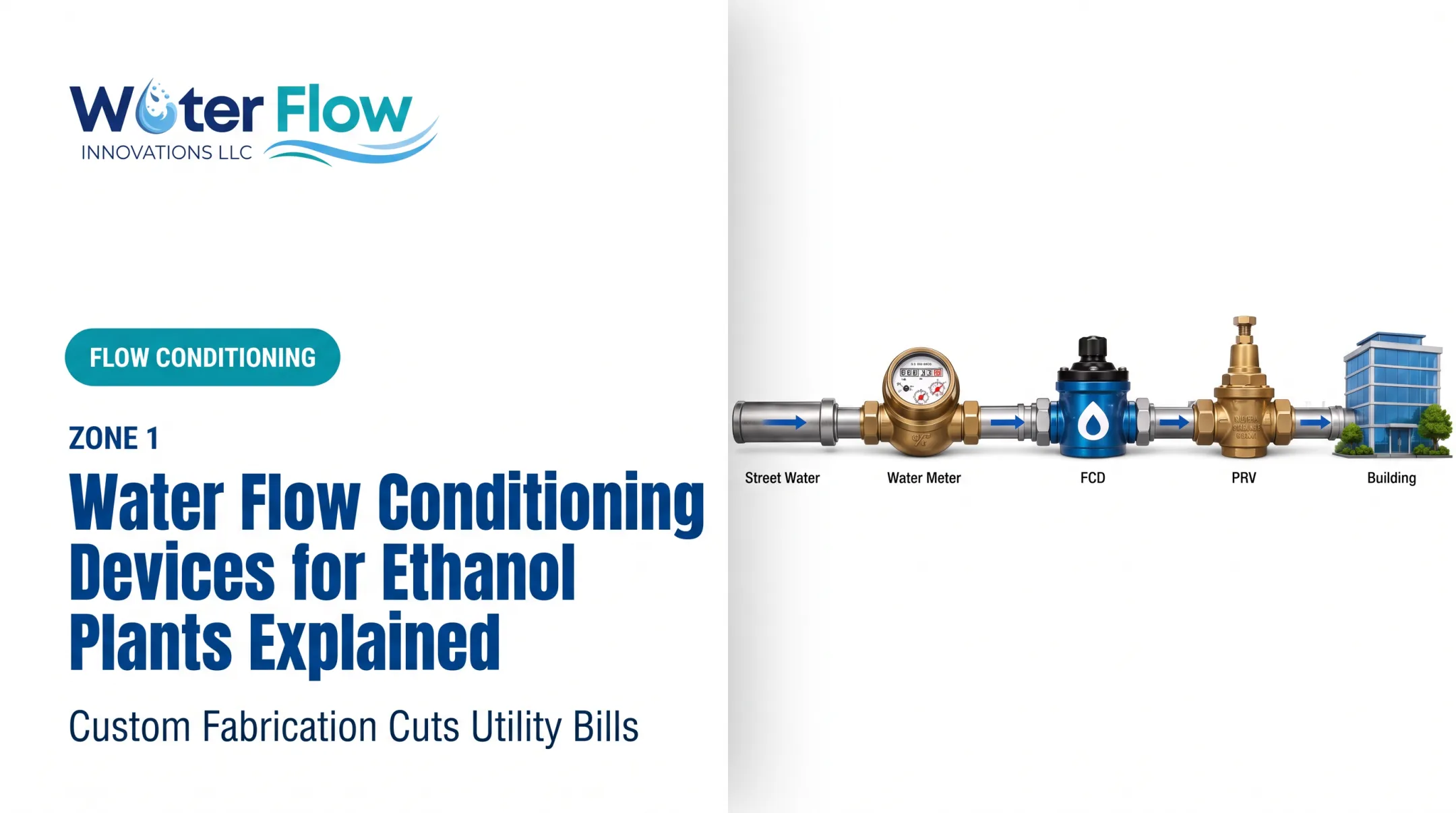
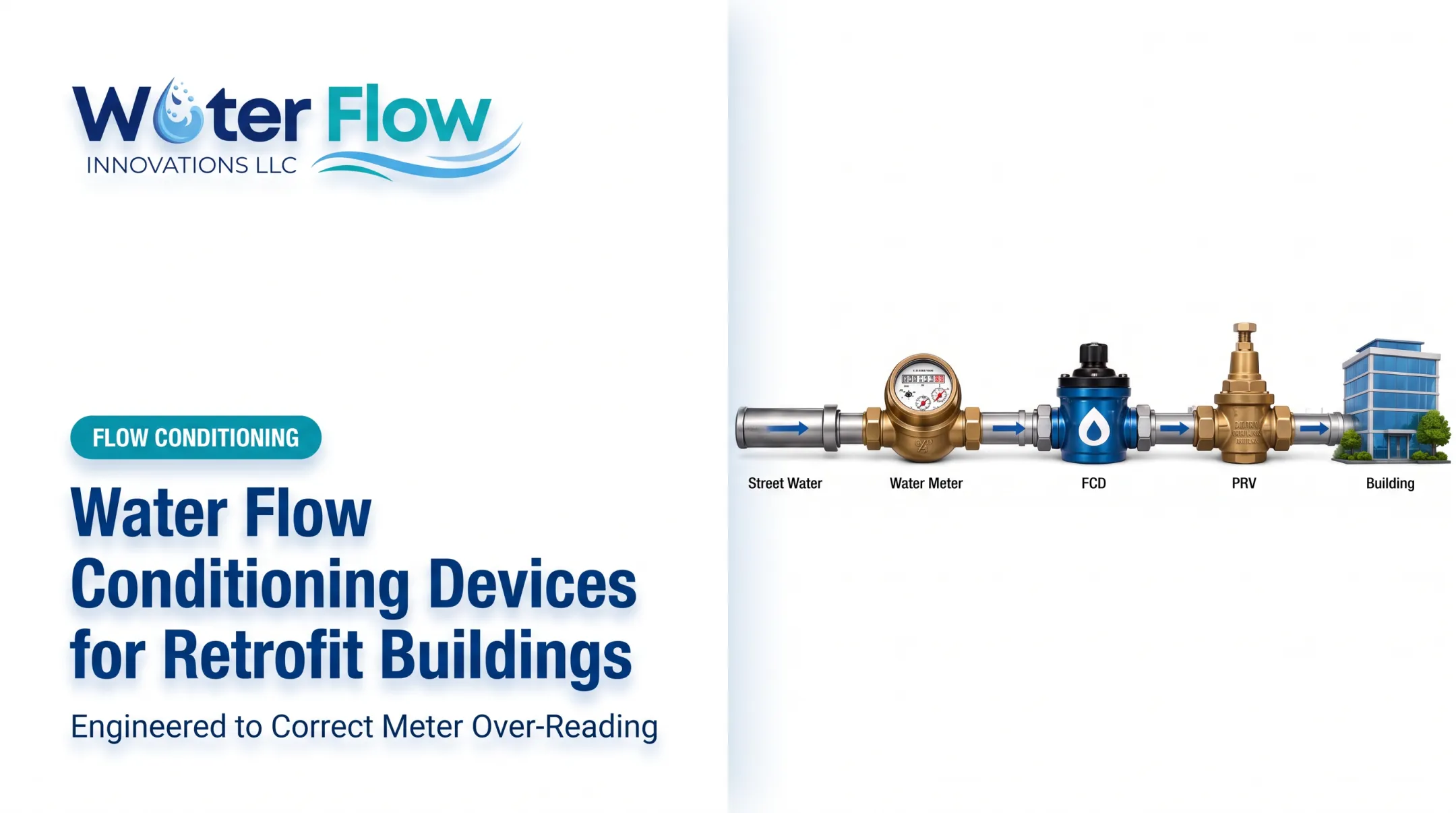
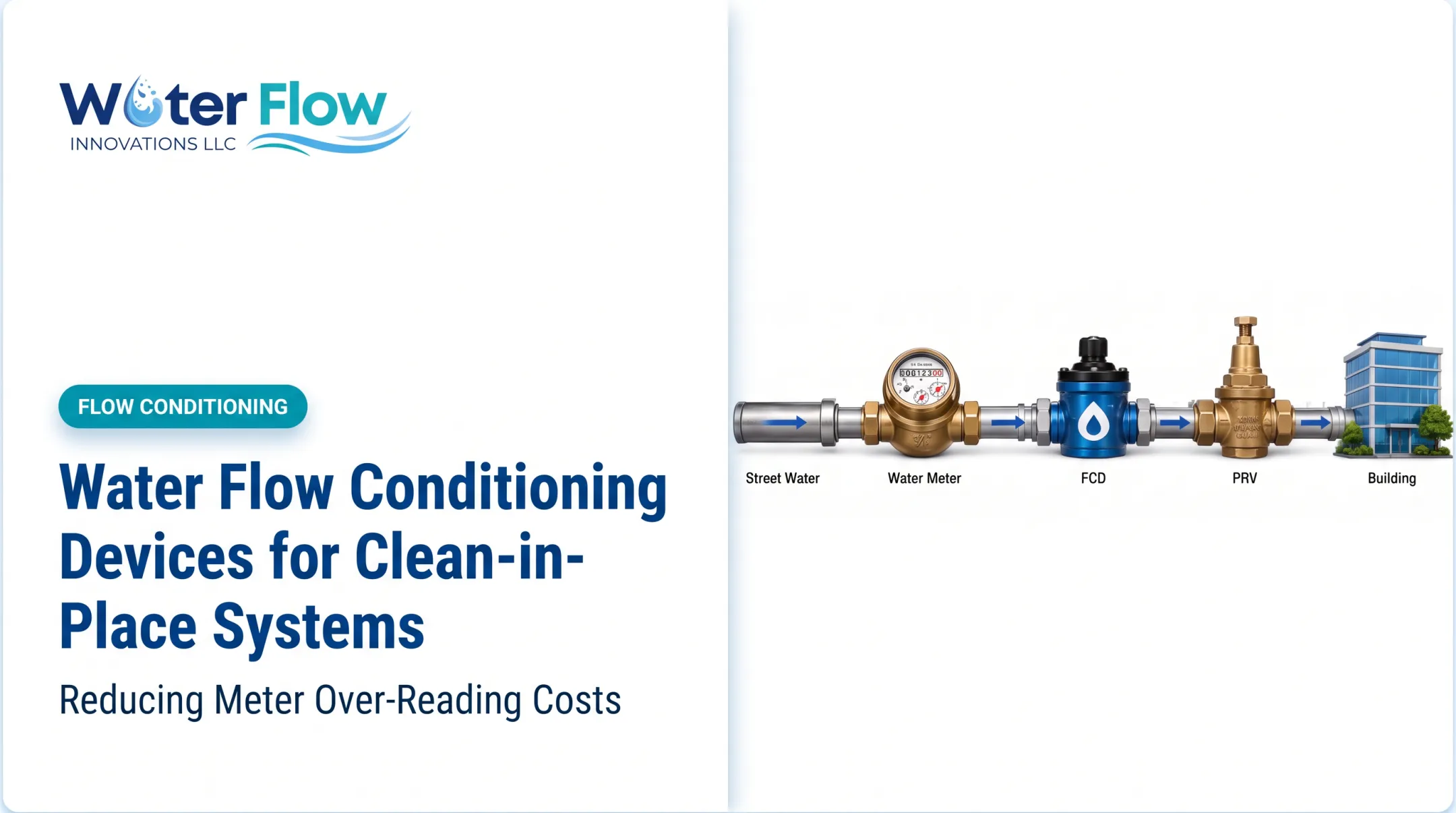
Water Flow Innovation's Flow Conditioning Device (FCD) organizes this around four functional elements:
- Air or gas management — addresses entrained air and micro-bubbles in the line, helping create a more uniform water column in the line.
- Pressure regulation — keeps line conditions within an intended operating range and reduces water hammer from on-off cycling.
- Check valve — controls unwanted reverse flow through the assembly (not always required, depending on the installation).
- Turbulence reduction — slows velocity enough to reduce vortex flow patterns near the meter.
These four components work together in the FCD, but the exact arrangement, sizing, and performance have to match the facility's pipework, meter type, pressure, and flow rate. They're not a one-size-fits-all kit.
Placement Relative to the Meter
Correct placement depends on where air or turbulence originates and what the meter manufacturer requires. Water Flow Innovation's FCD typically is installed immediately after the water meter, on the consumer side of the connection. Other configurations may call for placement upstream of the meter or at another engineered point, depending on the source of the disturbance.

Installation as a System Modification
Installing a conditioner isn't a quick bolt-on job. It's a system modification that generally involves:
- Isolating and depressurizing the line
- Confirming pipe direction, flange type, and access
- Installing compatible connections matched to the pipe material
- Restoring the system and checking for leaks
- Verifying pressure and wash-down performance afterward
Licensed plumbing professionals should handle the connection work itself. For straightforward configurations, FCD installation typically runs about one hour; larger industrial setups may take longer.
Plan the work around sanitation windows, production schedules, and lockout/tagout procedures so cleaning operations aren't disrupted.
Before specifying any flow conditioning solution, including Water Flow Innovation's FCD, confirm application fit, available certifications, and installation requirements with the manufacturer directly.
Key Design Factors, Selection Considerations, and Verification
Choosing the right device starts with collecting the right information, not picking a model off a spec sheet.
Data an engineer or facility manager should gather:
- Pipe diameter, material (steel, copper, PVC, CPVC, ductile iron), connection type, and access for service
- Meter make, model, orientation, and upstream/downstream piping conditions
- Minimum and maximum flow rates, static and operating pressure, and simultaneous wash-down demand
- Water temperature, suspended solids, chemical exposure, and wetted-material compatibility
- Backflow prevention setup, applicable plumbing code, and any potable-water, food-contact, GMP, SQF, or healthcare standards relevant to the facility
Water Flow Innovation builds each FCD to order from a site survey. That survey documents meter size (1/2 inch through 12 inches), pipe material, flange type and bolt pattern, PSI readings before and after backflow, and flow direction.
Standard units use 316L stainless steel. Titanium and specialty alloys are available by special order.
Building a Verification Plan
Don't assume performance. Measure it.
| Step | What to Record |
|---|---|
| Before installation | Water and sewer bills, meter readings, operating hours, pressure, flow rate, wash-down practices |
| After installation | Same measurements, repeated over at least one full billing cycle |
| Ongoing | Seasonal production or occupancy shifts that could affect usage independent of the device |
The 2023 meter study referenced earlier used this same controlled, before-and-after comparison method in a lab setting. It is a useful model for field verification planning, even though lab results do not translate into guaranteed field savings.
Water Flow Innovation reports a 5-30% average water-and-sewer bill reduction, with a documented high of 46% at one site. The company also states that 90% of customers reach ROI in under 12 months.

These are company-reported figures from specific installations, not guaranteed outcomes. Confirm them against your own baseline and post-installation data.
Common Misconceptions and When a Flow Conditioning Device May Not Be Appropriate
What It's Often Confused With
A flow conditioning device is not a water-saving nozzle, pressure booster, pump, or filtration system. It can improve flow conditions at the meter without reducing the gallons a facility actually needs for cleaning.
It also won't fix:
- Leaks in the distribution system
- Incorrectly sized piping
- Blocked strainers or screens
- A genuinely faulty meter
- Excessive spray pressure from equipment settings
- Poor wash-down technique or uncontrolled simultaneous demand
When You Probably Don't Need One
Skip it when all of the following are true:
- The meter installation already meets the manufacturer's straight-run requirements
- Flow is stable and air entrainment isn't present
- There's no measurable billing or operational issue to begin with
Not every facility has a problem worth solving.
When to Call in an Engineer Instead
Call an engineer when the root problem is outside flow conditioning:
- Severe pressure instability beyond what regulation can address
- Contaminated or chemically aggressive water
- Complex backflow arrangements
- High-temperature service
- Inadequate pipe access for a retrofit
- A genuine need for filtration, softening, disinfection, or more pump capacity
Bills vs. Actual Usage
Keep these separate. Improved meter measurement affects what you're billed for; it doesn't change how many gallons your wash-down system actually consumes. Track the two independently using meter data and utility statements — don't let one number stand in for the other.
Real usage and meter health still depend on system condition. Check periodically for leaks, confirm valve function, watch for fouling, and verify pressure readings still align with the meter manufacturer's requirements.
Conclusion
Water flow conditioning devices are inline components built to manage air, pressure, reverse flow, and turbulence so wash-down water moves more consistently through the meter and distribution system. They don't create pressure, filter water, or replace a pump.
Their value depends on verified site conditions, correct placement, compatible materials, and before-and-after measurement. Install only when those factors support a real performance case.
Before deciding, document:
- Meter type
- Piping layout
- Wash-down demand
- Utility charges
- Operational constraints
Then consult a qualified water-system professional. If you need a unit matched to your meter and pipe specs, evaluate a custom-fabricated FCD from Water Flow Innovation.
Frequently Asked Questions
What does a water flow conditioning device do?
It manages air, pressure, reverse flow, and turbulence to create more stable conditions in a water line. It is not a pump, filter, softener, or a guaranteed water-reduction device.
Can a flow conditioning device reduce water pressure?
Any inline device can introduce some pressure loss, typically negligible, though a drop of a few PSI has been recorded in high-volume open-discharge conditions. Verify manufacturer data and your site's pressure requirements before installing.
Where should a flow conditioning device be installed?
Placement depends on the meter location, the source of air or turbulence, piping layout, and the meter manufacturer's requirements. Get a professional site assessment rather than assuming one universal location works.
Will a flow conditioning device reduce water usage?
No — it's designed to improve meter accuracy and flow conditions, not cut actual consumption. Confirm any usage change through baseline and follow-up meter readings, not assumptions.
What is a wash-down pump for?
A wash-down pump supplies or boosts water flow and pressure for cleaning surfaces and equipment. It creates the system's primary flow, while a flow conditioning device manages the conditions of flow already moving through the line. They solve different problems.
Which saltwater wash-down pump is best for a boat?
Marine pump selection depends on voltage, flow rate, pressure-switch cutoff, duty cycle, hose length, and strainer requirements specific to your boat's intake system. This is a separate product category from commercial or industrial flow conditioning devices and shouldn't be confused with one.