
This guide breaks down what downstream pressure actually means, what causes it to become unstable, and the mechanical and technological methods facility managers, plant engineers, and operations teams use to keep it under control.
Key Takeaways
- Downstream pressure—measured after a valve, regulator, or meter—must stay stable for safe, efficient operation
- Unstable pressure causes equipment wear, safety risks, inaccurate metering, and inflated utility bills
- Regulators use force balance (outlet pressure versus spring tension) to automatically hold a setpoint
- Turbulence and air entrainment near meters distort pressure readings and cause water meters to over-register usage
What Does Downstream Pressure Mean?
Downstream pressure is the pressure measured after fluid or gas passes through a control point, whether that's a valve, regulator, or meter. Upstream pressure is what comes before it.
Think of a river with a dam. Upstream, water backs up and can vary with rainfall or snowmelt. Downstream, the dam's gates regulate the flow, releasing water at a steadier, controlled rate. A pressure regulator works the same way: it takes an unpredictable supply and turns it into a stable output.
Downstream pressure matters more than upstream pressure for one simple reason: it's what your equipment actually experiences. Pumps, fixtures, and process machinery don't care what's happening on the supply side. They care about what's hitting them directly.
A regulator's job is converting a higher, often erratic upstream pressure into a lower, controlled downstream pressure. The outlet side protects your systems, not the inlet.
What Is Upstream Pressure?
Upstream pressure is the incoming supply-side pressure before it reaches a regulator or control valve. It can swing due to:
- Municipal supply changes throughout the day
- Pump cycling on and off
- Elevation changes across a distribution system
A well-designed regulator isolates everything downstream from these fluctuations. That's its core function: absorb upstream swings so stable pressure reaches the equipment downstream.
Why Downstream Pressure Stability Matters
Stable downstream pressure isn't a nice-to-have. It's what protects pumps, fixtures, and process machinery from repeated stress cycles that shorten their lifespan. Every pressure spike is a small hammer blow to seals, gaskets, and joints.
Safety is on the line too. In steam and gas distribution systems especially, pressure spikes are inefficient and hazardous. A regulator that can't hold its setpoint under variable demand creates real risk for personnel and equipment alike.
Then there's the efficiency angle. Manufacturing, food and beverage, and healthcare facilities all depend on predictable flow rates to get consistent process outcomes. Pressure that wanders means output that wanders too.
The Overlooked Metering Cost
Here's the piece most facility teams miss: instability and turbulence don't just stress equipment, they can distort what your meter records.
According to AWWA's research on flow measurement, velocity profile distortion, swirl, and turbulence affect nearly all flowmeters. Even a single elbow near the meter can create non-ideal flow conditions.
Entrained air compounds the problem. Electronic and inferential meters can struggle to distinguish air bubbles from water volume.
The result: meters that register more volume than what's actually delivered, quietly inflating water and sewer charges every billing cycle.
Common Causes of Downstream Pressure Instability
Several factors, often overlapping, drive instability:
- Fluctuating demand — consumption patterns change throughout the day as fixtures, pumps, and pneumatic actuators cycle on and off
- Pipeline friction losses — pipe diameter changes, elbows, and valve restrictions all create pressure drop
- Equipment wear — worn regulator diaphragms, springs, or seats lose responsiveness over time
- Air entrainment and turbulence — near meters and fittings, this causes both pressure swings and inaccurate readings
What Causes a Pressure Drop in a Pipeline?
Pressure drop comes down to four things: friction against pipe walls, elevation changes, fittings and valves, and flow velocity. NIST's research on pipe fitting losses confirms that both straight-pipe friction and fittings/valves are major, scalable contributors to pressure loss. Both get worse as velocity increases.
Longer, narrower pipes amplify these losses. More elbows and valves mean more cumulative drop. These factors rarely act alone. Friction, geometry, and demand usually compound each other.
How Regulators and Flow Conditioning Maintain Stable Pressure
The Force Balance Principle
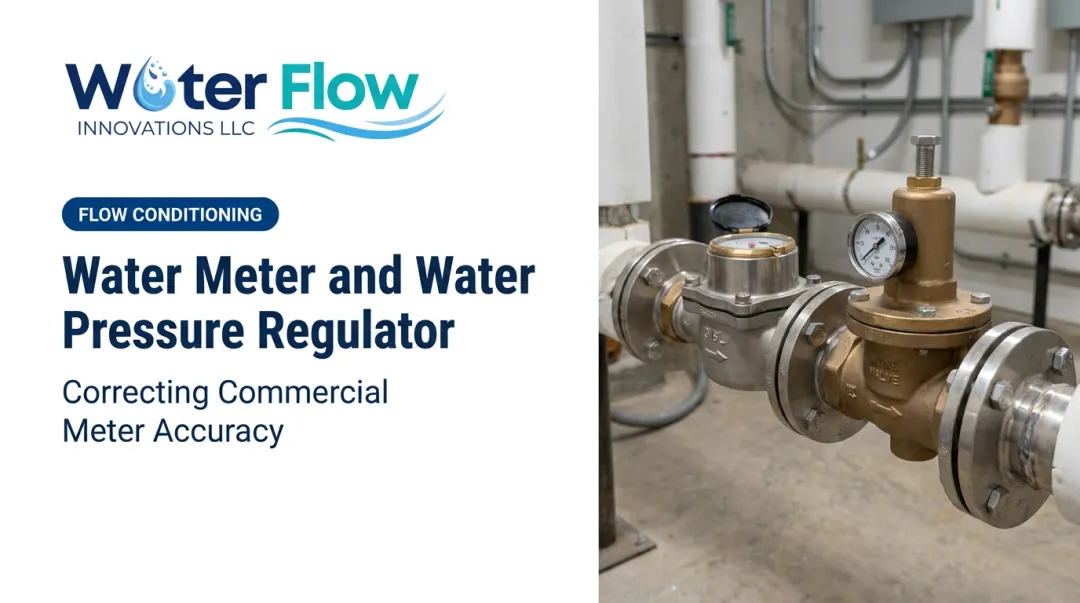
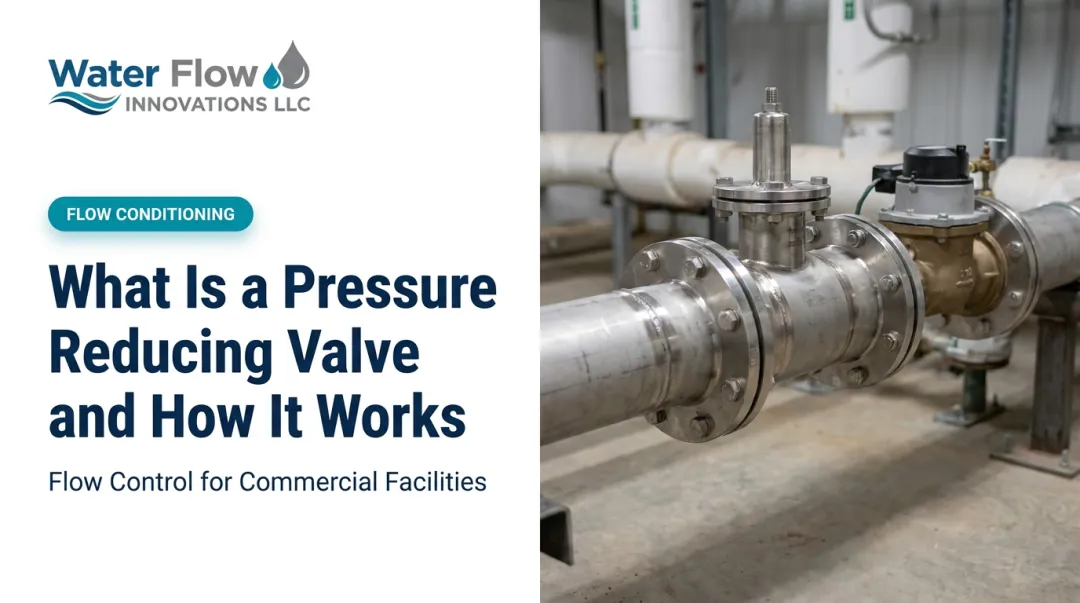
A pressure regulator senses downstream pressure through a diaphragm or piston connected to an adjustable spring. When downstream pressure drops, the diaphragm force weakens and the spring pushes the valve open further. When pressure rises, the opposite happens: the valve closes toward equilibrium.

This is continuous mechanical feedback with no external power required. The setpoint itself comes from the spring tension, which operators adjust to define their target downstream pressure.
Flow Conditioning: A Complementary Layer
Regulators solve pressure control. They don't solve turbulence at the meter. That's a separate problem, and it's where flow conditioning comes in.
Water Flow Innovation's Flow Conditioning Device (FCD) combines four functions in one unit:
- Air/gas separation — creates static back-pressure that keeps bubbles out of the measurement zone, producing a homogeneous water column
- Pressure regulation — smooths surges from on/off cycling at the meter entrance
- Check valve — reduces water hammer and blocks reverse flow (on select units)
- Turbulence elimination — slows velocity enough to prevent the vortex flow that causes meter over-counting
The FCD works with any pipe size (½" to 12" NPS, standard) and any meter type. It installs in about an hour with negligible pressure loss, making it a practical retrofit for facilities already dealing with pressure-related inefficiencies—without changing how the rest of the system operates.

Signs and Risks of Unstable Downstream Pressure
Watch for these warning signs:
- Banging pipes or silent water hammer, which can occur without audible noise (Plant Engineering)
- Inconsistent equipment performance across shifts or demand periods
- Unexplained spikes in utility bills with no matching usage increase
- Frequent valve or fixture repairs
Left unaddressed, these risks compound. Overpressure threatens safety, equipment wears out sooner than expected, and operating costs climb.
Municipal evidence supports the pattern: a documented Australian pressure-management program reported 215 fewer burst repairs in one year, saving $0.37 million in repairs plus $2.75 million in deferred main renewal. That's utility-scale data, but the same principle holds in commercial buildings. Pressure problems left alone get expensive.

Best Practices for Ensuring Stable Pressure Control
1. Inspect and calibrate regularly. Cashco recommends annual inspection as a general baseline, adjusted for service severity, corrosive conditions, or high-pressure applications. Catching diaphragm or spring drift early prevents failure later.
2. Pair regulation with flow conditioning. Regulators stabilize pressure. Flow conditioning corrects the turbulence and air entrainment that skews metering. Water Flow Innovation's FCD holds IAPMO, NSF, ANSI, CAN 61, KIWA, GMP, and SQF certifications. Documented results include 5–30% average utility bill reduction (up to 46% in the best case), with 90% of customers reaching ROI in under 12 months.
3. Monitor bills and flow data over time. Subtle upward drift in utility bills, without a matching increase in actual usage, is often the earliest sign of pressure-related metering trouble. Trend bills against production or occupancy so you catch drift within a cycle or two—not a year later.
Frequently Asked Questions
What does downstream pressure mean?
Downstream pressure is the pressure measured after fluid or gas passes through a valve, regulator, or meter. It's contrasted with upstream pressure, which is measured before that control point.
What is upstream pressure?
Upstream pressure is the supply-side pressure before regulation occurs. It can fluctuate due to municipal supply changes, pump cycling, or elevation, which is why regulators exist to isolate downstream systems from it.
What is the 3% rule for pressure relief valves?
The 3% rule refers to inlet piping design: most codes recommend inlet piping be sized so pressure loss doesn't exceed 3% of the relief valve's set pressure. It's not a general operating-to-set-pressure margin.
What causes a pressure drop in a pipeline?
Pressure drop results from friction against pipe walls, elevation changes, fittings and valves, and flow velocity. Longer or narrower pipes amplify all of these effects.
How often should pressure regulators be inspected or serviced?
Annual inspection is a common baseline, but frequency should scale with service severity, water quality, and manufacturer guidance. Harsh or high-pressure applications need more frequent checks.
Can unstable pressure affect water meter accuracy?
Yes. Turbulence and air entrainment caused by pressure instability can distort the flow profile at the meter, leading to over-registration and inflated water and sewer bills without any real increase in usage.
Where does a conditioning device sit relative to the regulator?
At the municipal supply connection, immediately after the billing meter and upstream of the building's distribution, with each unit custom-built for the site. The existing regulator stays where it is and keeps doing its own job.
What does correcting that distortion typically return?
Documented installations average a 5–30% reduction in combined water and sewer charges, with a highest documented single result of 46%, from measurement accuracy rather than reduced consumption.