This guide covers system fundamentals briefly, then focuses on what most facility teams overlook entirely: water meter accuracy at the makeup and blowdown lines.
Key Takeaways
- Open-loop and closed-loop systems carry different cost tradeoffs, so your optimisation plan should match your system type
- Meter over-reading at cooling tower connections can silently inflate water and sewer bills for years
- Correcting billing accuracy produces the fastest, most measurable return of any lever available: savings on the next billing cycle, with no capital project required
Open-Loop vs. Closed-Loop, Briefly

Open-loop (evaporative) towers expose water directly to air, rejecting heat through evaporation. Lower upfront cost, higher ongoing treatment expense, and continuous water loss from evaporation, drift, and blowdown. Common in large industrial plants and cooling water systems serving HVAC loads.
Closed-loop systems circulate water or glycol through a sealed loop, usually paired with chillers. Higher upfront cost, lower long-term water consumption, though many still use closed-circuit towers or evaporative-assist exchangers that draw makeup water on the spray side. Typical in data centres, healthcare, pharma, and precision manufacturing.
The Component Most Teams Overlook: Water Meters
Cooling towers, chillers, pumps, and heat exchangers all affect efficiency, but makeup and blowdown meter accuracy drives both your utility billing and the reliability of every efficiency calculation built on that data. If the meter over-registers, every downstream calculation is skewed before you even start.
That makes the flow measurement points at makeup and blowdown the highest-leverage place to look first, ahead of any mechanical upgrade.
Correct Water Meter Over-Reading With Flow Conditioning
Turbulent flow and air entrainment at makeup water and blowdown meters commonly cause over-registration, inflating both water and sewer charges. Most municipalities calculate sewer charges as a percentage or multiple of metered water use, so every over-registered gallon is billed twice. Cooling tower makeup cycling is one of the strongest triggers, since every demand event creates a pressure surge that draws air into the line.
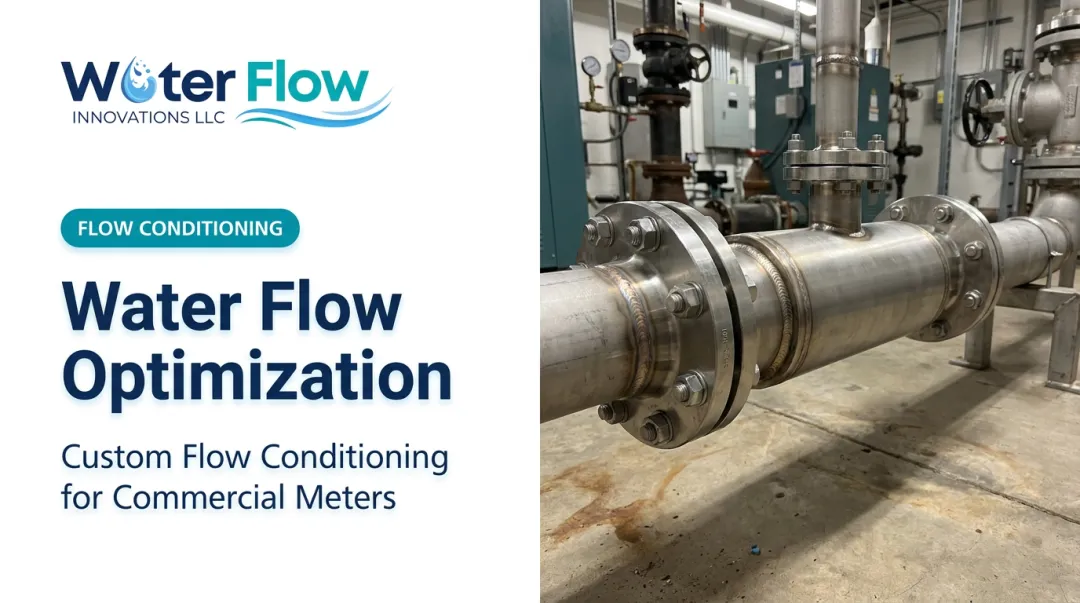
Water Flow Innovation offers a certified Flow Conditioning Device (FCD) built to correct this. It installs immediately after the water meter, on the consumer side of the connection. Where a pressure-reducing valve is present, the preferred configuration is Water Meter → FCD → PRV → Building; installing after the PRV is a fallback that runs roughly 20–40% less effective.

Its four-component system handles:
- Air and gas separation — stabilises turbulence so the meter reads a homogeneous water column
- Pressure regulation — dampens surges from repeated demand cycling
- Check valve — blocks reverse flow that reintroduces air between draw events, on configurations where it is specified
- Turbulence elimination — slows velocity just enough to prevent vortex flow at the measurement zone
The device is custom-fabricated in the USA from 316L stainless steel for pipe sizes ½″ through 12″ as standard, with larger custom sizes available up to 32″, and works with the meter types used in commercial and industrial facilities. It installs in about an hour, with a brief water shutoff at the meter connection and no access to internal facility systems, process equipment, or operational areas required. Cooling tower basin levels, chiller performance, and blowdown cycling remain completely unchanged.
Two limits worth stating plainly. The FCD corrects the meter reading; it is not a general fix for turbulence elsewhere in the piping system, which needs long-radius elbows, more straight pipe, or a better layout. And it applies to the metered municipal supply connection only, so it has no effect on NPDES-regulated discharge or blowdown lines.
Documented outcomes:
- 5–30% average water and sewer bill reduction, with the highest single result documented at 46%
- Savings visible on the very next billing cycle, with no ramp-up period
- About 90% of customers reaching full ROI in under 12 months
Facilities with cooling towers tend to land at the higher end of that range, since makeup water cycling is one of the strongest sources of the air entrainment and turbulence the FCD corrects. The before-and-after billing data also supports ESG reporting, LEED submissions, and Water Usage Effectiveness documentation.
Other Proven Levers (Mechanical, Treatment, Controls)
These move the needle too, but on longer paybacks and with capital investment. Worth knowing, not the focus here:
- VFDs on pumps — one documented retrofit cut pump energy 74%, with roughly a three-year payback
- Free cooling and heat recovery — ENERGY STAR reports up to 70% lower chilled-water costs during economiser operation, with a 2.3-year average payback, though results vary heavily by climate and site
- Water treatment and cycles of concentration — DOE estimates raising cycles from 3 to 6 cuts makeup water 20% and blowdown 50%, within your site's chemistry limits
- Automated controls — only as good as the sensors feeding them; one ASHRAE case saved a documented amount annually through control changes alone, with no capital required
Monitoring and Maintenance Baseline
- Test water quality routinely for pH, conductivity, and biological growth
- Follow a preventive maintenance schedule for pumps, chillers, and towers
- Plan for redundancy with backup pumps and multiple chiller configurations
- EPA recommends monthly mechanical inspections at minimum, and some jurisdictions require more: New York City calls for water chemistry checks three times a week and Legionella testing every 31 days
Set your frequency from your water management plan, local regulations, and OEM guidance. The baseline habit is tracking your numbers consistently enough to notice when they drift.
Frequently Asked Questions
What devices cool water in cooling water systems?
Cooling towers, chillers, heat exchangers, and fluid coolers are the primary devices, depending on whether your system is open-loop or closed-loop. Towers reject heat through direct air contact, while fluid coolers and closed-circuit towers keep the process fluid isolated from outside air.
What is a cooling water flow meter?
It measures the rate of water moving through a cooling system, typically at the makeup or blowdown lines. Accuracy at these points matters because it directly affects both your utility billing and your ability to trust operational data used for chemistry and cycles-of-concentration decisions.
What is a cooling water treatment plant?
It is the system or programme that treats circulating water to control corrosion, scale, and microbial growth, either before it enters or after it leaves the cooling loop. In practice it is a coordinated set of dosing, monitoring, and blowdown controls rather than a single appliance.
What is a cooling water recirculation system?
It is a system that reuses the same water repeatedly through a closed or semi-closed loop, reducing overall water consumption compared with a single-pass design. Evaporation still concentrates dissolved minerals over time, so controlled blowdown and makeup water keep the chemistry balanced.
How often should a cooling water system be assessed for optimization opportunities?
Plan for annual mechanical and water treatment audits at minimum. Check metering and flow accuracy more often, since billing errors from meter over-reading compound quickly and quietly.
What kind of ROI can facilities expect from cooling water system optimization?
Mechanical upgrades like VFDs and heat recovery often take one to five years to pay back, depending on scale and climate. Flow conditioning fixes for meter over-reading tend to move faster, showing savings on the very next billing cycle with no operational disruption.
How much does correcting makeup-line over-reading recover?
Documented installations average a 5–30% reduction in combined water and sewer charges, with a highest documented single result of 46%, without altering cycles of concentration or treatment chemistry.
Does the device interfere with cooling water treatment?
No. It does not treat, filter, or alter water composition, and it connects to no dosing equipment. It corrects the accuracy of the incoming municipal meter, leaving corrosion, scale, and biocide control exactly as configured.