
For commercial and industrial facilities, the math is brutal. A 15% rate increase on a small residential bill is annoying. That same increase on a facility running thousands of gallons daily can mean tens of thousands in added annual cost. Understanding what's driving the increase, and what you can actually control, matters more than ever.
This article breaks down why bills are climbing, the warning signs that you're overpaying beyond the rate hikes, and practical steps to bring your costs back down.
Key Takeaways
- Rising bills stem from aging infrastructure, expiring federal funding, drought and climate stress, and treatment compliance costs
- Local rate hikes (San Diego, Bloomington, and others) reflect utilities recovering debt and capital investment
- Leaks, inefficient fixtures, and meter over-reading can silently inflate bills beyond rate increases
- Facilities cut costs with leak audits, efficiency upgrades, and flow correction that stops meter over-reading
- Flow correction and similar fixes can show savings on the very next billing cycle
Common Causes of High Water Bills in 2026
A "high" bill in 2026 isn't just about your usage. In the 12 months through July 2026, water and sewerage maintenance prices rose 5.0%, compared to 3.4% for overall consumer prices. That 1.6-point gap has been widening for years, according to Bureau of Labor Statistics data.
Rising bills generally come from two buckets:
- External causes — utility rate hikes, infrastructure surcharges, regulatory compliance costs
- Internal causes — leaks, inefficient fixtures, meter inaccuracies, and behavioral waste
Most facilities are dealing with both at once, which is why bills feel like they're compounding.
Cause 1: Aging Infrastructure and Utility Capital Costs
Utilities are passing along the cost of pipe replacement, plant upgrades, and debt servicing. The American Water Works Association estimates $2.4 trillion in U.S. water infrastructure needs by 2050, and 46% of utilities plan rate increases within five years, with 24% planning one within the next year.
Bloomington, Illinois offers a stark local example: rates jumped 33% for a third consecutive year to fund a $400 million capital plan covering lead-service replacement, distribution upgrades, and plant improvements.
Timing adds pressure: 2026 is the final year of supplemental Bipartisan Infrastructure Law water funding. Once that $10.231 billion in federal support dries up, expect more local utilities to lean harder on rate increases to cover the gap.

Cause 2: Drought, Climate Volatility, and Regional Supply Costs
Regions dependent on imported or desalinated water face steeper per-unit costs. San Diego imports as much as 90% of its water, and roughly 40% of its public utilities budget goes toward imported-water purchases.
The regional Water Authority approved an 8.3% wholesale rate increase for 2026, citing supply costs, aging delivery infrastructure, and climate volatility across the Southwest.
Hotter, drier seasons also push irrigation and cooling-water use into higher-cost usage tiers faster than in milder years, compounding the problem for facilities with large landscaping or cooling loads.
Cause 3: Rate Structure and Tiered Pricing Increases
Many utilities use increasing block pricing, where usage above a certain threshold triggers a steeper per-unit rate. Common rate structures include:
- Uniform rates: one flat price for all volume
- Increasing block/tiered: price climbs as usage rises, designed to encourage conservation
- Decreasing block: rare, sometimes used for large industrial users
- Seasonal/drought rates: higher pricing during peak demand or drought conditions
Under tiered pricing, a small usage increase can push additional volume into a higher bracket. The marginal cost of that extra water is much higher than your average rate suggests.

Cause 4: Leaks, Inefficient Fixtures, and Behavioral Waste
Undetected leaks in toilets, pipes, and cooling towers can waste thousands of gallons a month without anyone noticing. Outdated appliances and irrigation controllers compound the waste, especially across large facilities with extensive plumbing networks.
Providence St. Peter Hospital, a 340-bed, 750,000-square-foot facility, cut water use by 59% and saved $1.5 million over 10 years through a portfolio of efficiency retrofits, sterilizer upgrades, and condensate reuse.
Cause 5: Water Meter Over-Reading and Inaccuracy
This is the cause most facility managers never think to check. Air entrainment, turbulent flow, and aging meters can cause a meter to register more water than actually passed through it.
Peer-reviewed testing found valve-induced turbulence produced over-registration above +30% under certain conditions, with some extreme test cases showing errors far higher. Researchers caution these results are installation-specific, not universal.
Still, the mechanism is real: turbulent, air-laden flow near a meter can inflate both your water charge and your sewer charge, since sewer fees are often billed on metered water volume.

What Happens If Rising Water Costs Go Unaddressed
Ignoring these cost drivers compounds fast. Unchecked bills strain budgets, shrink margins, and make sustainability and ESG targets harder to hit.
Left alone, the damage stacks—higher operating costs, deferred maintenance, and weaker efficiency metrics that boards and lenders track. Catching overpayment early limits how far those costs run.
Warning Signs You May Be Overpaying
Watch for these red flags:
- Bills rising faster than usage or occupancy would explain. If the facility hasn't grown but the bill has, something else is driving the increase.
- The meter keeps moving with everything shut off. That usually points to a leak or a faulty meter.
- Metered usage doesn't match internal consumption estimates. A persistent gap between expected use and billed volume deserves a closer look.
The EPA's shut-off test is simple: turn off every water-using fixture and piece of equipment, record the meter reading, wait 30 minutes, then check again. Any movement points to a leak or meter issue.
How to Reduce Your Water Bill in 2026
Cutting costs comes down to four levers: reducing usage, fixing leaks and infrastructure, correcting meter over-reading, and watching bills for spikes and rebate opportunities.
Measure 1: Conduct Regular Leak Audits
What to do: Schedule routine leak detection on pipes, fixtures, and irrigation systems.
How it helps: Catches waste before it accumulates into thousands of wasted gallons and dollars.
When to implement: Quarterly for large facilities, annually for smaller properties.
Measure 2: Upgrade to Water-Efficient Fixtures and Appliances
What to do: Install low-flow toilets, faucet aerators, and efficient dishwashers or laundry systems. WaterSense-labeled commercial flushometer toilets use no more than 1.28 gallons per flush, 20% below the federal maximum.
How it helps: Reduces baseline consumption without disrupting daily operations.
When to implement: During scheduled maintenance or renovation cycles.
Measure 3: Correct Water Meter Over-Reading with Flow Conditioning
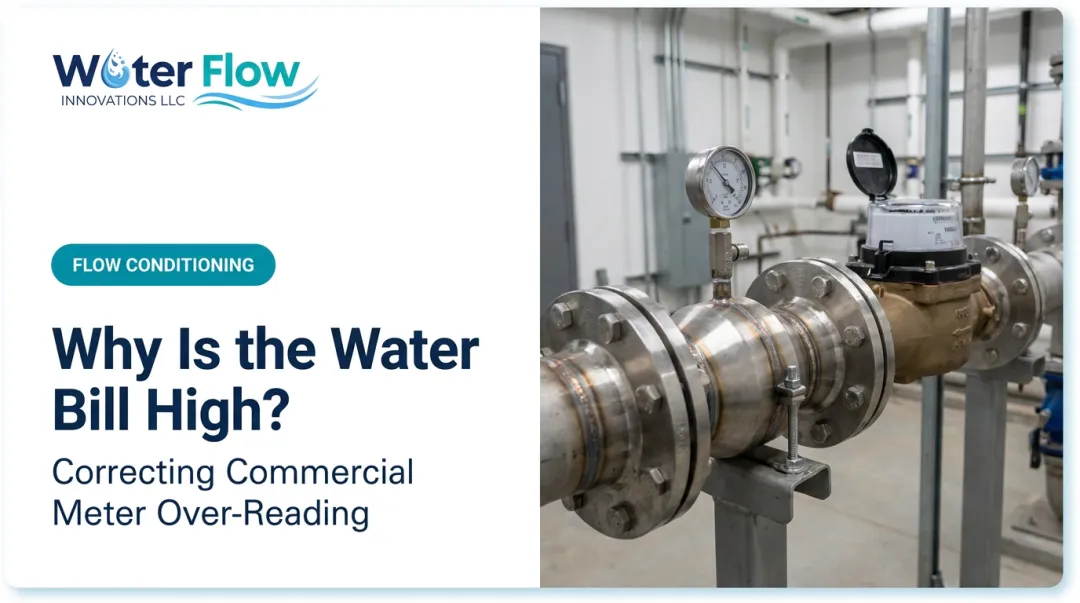
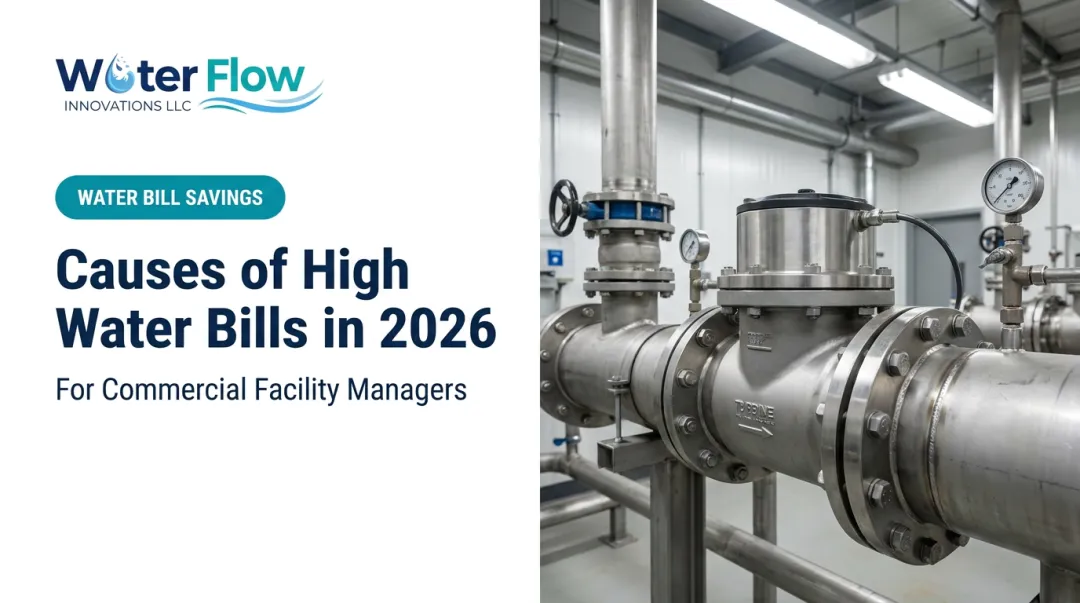
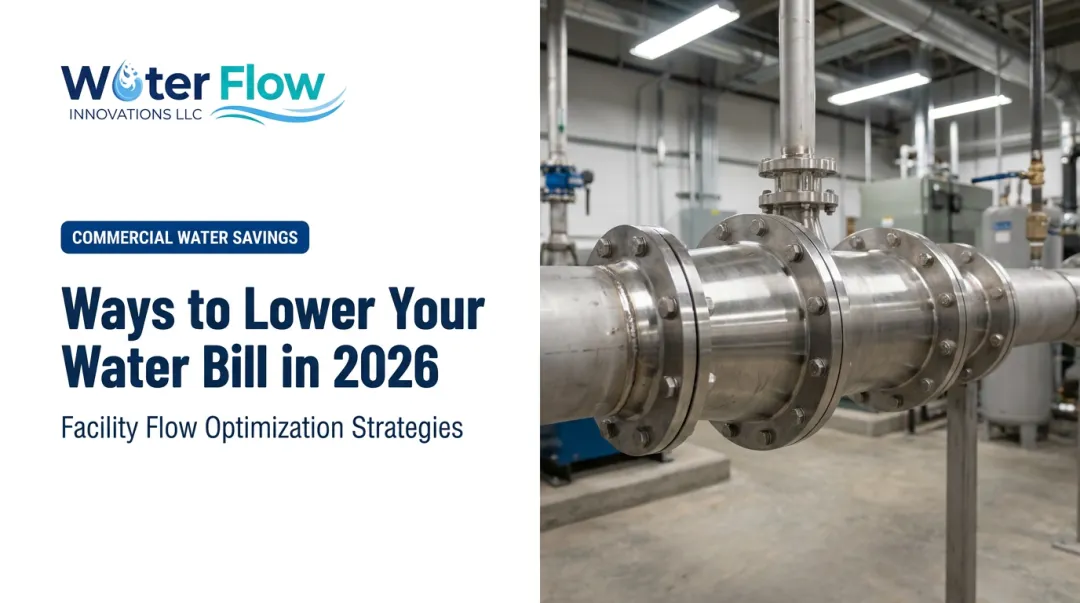
What to do: Install a certified flow conditioning device (FCD) that removes air and gas entrainment and smooths turbulent flow at the meter.
How it helps: Because an FCD corrects the reading—not your actual usage—it lowers water consumption charges and sewer discharge fees at the same time when sewer billing is based on metered volume. Water Flow Innovation builds certified units (IAPMO, NSF, ANSI, CAN 61, KIWA, GMP, and SQF) in 316L stainless steel, custom-fabricated for your pipe size and meter setup. Install is typically about an hour after the meter, with negligible pressure loss and no operational disruption.
Documented results:
- 5–30% average bill reduction
- 46% highest recorded reduction
- 90% of customers reach ROI within 12 months
When to implement: As soon as inflated readings are suspected. Savings typically appear on the very next billing cycle, with no ramp-up period.

Measure 4: Monitor Usage Data and Enroll in Utility Assistance Programs
What to do: Track consumption trends through submeters or utility dashboards, and check for conservation rebates. Denver Water offers up to $100 per fixture for qualifying toilets and urinals; Riverside Public Utilities offers rebates starting at $200–$240 for high-efficiency units.
How it helps: Catches spikes early and spreads costs more predictably across budget cycles.
When to implement: Ongoing, with monthly bill reviews.
Long-Term Tips for Managing Water Costs
Beyond immediate fixes, build these habits into your facility’s standard operating practices:
- Schedule annual plumbing and irrigation inspections to catch leaks and inefficiencies early
- Train facility staff on water-conscious procedures that cut waste in daily operations
- Document usage and savings data for ESG reporting or LEED certification goals
- Adopt smart metering and sensors for real-time alerts when consumption spikes
Conclusion
2026's high water bills come from forces largely outside your control—rate hikes, expiring federal funding, and drought-driven supply costs—and from factors on your side of the meter: leaks, inefficient fixtures, and meter inaccuracies.
You can't negotiate your utility's capital plan. You can fix what happens inside your facility.
Pair conservation habits with flow conditioning to correct meter over-reading, and you get the fastest path to a lower bill—often on the very next statement.
Frequently Asked Questions
What can cause a facility's water bill to increase?
Rate hikes, seasonal usage spikes, leaks, inefficient fixtures, and meter over-reading are the most common causes. Reviewing your bill against actual usage patterns helps pinpoint which one applies to you.
Why are water rates increasing so much in 2026 compared to previous years?
Expiring federal infrastructure funding, rising treatment and compliance costs, and drought conditions are combining to push rates up faster than historical averages.
How can I tell if my water meter is reading inaccurately?
Try the shut-off test: turn off every water source in the facility and check whether the meter still registers movement. Continued movement suggests a leak or a faulty meter.
Can businesses get a refund or credit for inflated water bills?
Direct refunds are rare. Fixing the root cause, such as meter over-reading, prevents future overpayment. Some utilities also offer conservation rebates worth pursuing.
How quickly can facilities see savings after fixing water bill issues?
Fixes like leak repairs and flow conditioning devices often show measurable savings on the very next billing cycle, with no waiting or adjustment period.
Are there certifications to look for when choosing equipment that reduces water and sewer bills?
Look for NSF, IAPMO, and ANSI certifications. They indicate a product meets recognized safety and performance standards for potable water systems.
Can a correction be rolled out across several buildings at once?
Yes. Every building with its own metered municipal connection is a separate installation opportunity, so savings compound across a portfolio and sites can be prioritized by consumption volume. Documentation can be aggregated for corporate utility benchmarking and capital planning.
Which warning signs point to the meter rather than usage?
Bills that stop tracking with production or occupancy, sewer charges disproportionate to actual discharge, several high-frequency demand sources drawing on one meter, and charges that stayed high after the utility replaced the meter.