The scale of this requirement is written into code. The 2015 Uniform Plumbing Code mandates an approved pressure regulator, preceded by a strainer, whenever static water pressure exceeds 80 psi — and the reduced pressure must land at 80 psi or below.
Yet most facility managers and plumbers still think of a regulator as simply "the thing that lowers pressure." That surface-level understanding leads to undersized units, slow troubleshooting, and regulators that fail years before they should. This guide breaks down exactly what happens inside a regulator, stage by stage, not just what it accomplishes on paper.
Key Takeaways
- A spring-loaded regulator uses force-balance mechanics to turn high inlet pressure into stable, lower outlet pressure.
- Three components drive the process: a reference spring, a sensing diaphragm, and a restricting poppet valve.
- Downstream demand shifts continuously rebalance the spring and valve position to hold a set pressure.
- Setpoints vary widely: roughly 50 psi for water, far lower for gas appliances, and much higher for industrial panels.
- Correct sizing and upkeep prevent water hammer, pressure surges, and premature equipment wear.
What Is a Pressure Regulator?
A pressure regulator is a self-operating control valve. It reduces and stabilizes fluid pressure between an inlet and outlet using purely mechanical feedback: no electricity, no software, and no external power source.
It exists because supply-side pressure is almost always too high for the equipment on the receiving end. Municipal water mains, gas pipelines, and compressed air systems run at pressures far beyond what process equipment, gas appliances, or pneumatic tools can handle. The regulator bridges that gap automatically.
Not All Pressure Devices Do the Same Job
It's easy to lump regulators, back-pressure devices, and safety valves together. They're not interchangeable:
| Device | What it controls |
|---|---|
| Pressure-reducing regulator | Downstream (outlet) pressure |
| Back-pressure regulator | Upstream (inlet) pressure, continuously |
| Relief/safety valve | Opens only during an overpressure event |
Despite the rise of electronic pressure controllers, mechanical spring-loaded regulators remain the industry standard. They need no power, they're mechanically reliable, and they cost far less to install and maintain across a building or plant.
Single-Stage, Two-Stage, and Three-Stage Designs
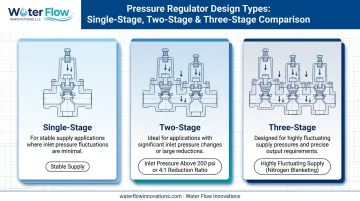
- Single-stage regulators reduce pressure in one step, fine for stable supply conditions.
- Two-stage regulators use two reductions in series, which Watts recommends when inlet pressure exceeds 200 psi or the reduction ratio tops 4:1.
- Three-stage designs handle specialized, highly fluctuating supply conditions, such as nitrogen-blanketing systems.
For context, a typical water pressure regulator ships with a 50 psi setpoint, adjustable between roughly 25 and 75 psi. That range is a useful benchmark before diving into the mechanics.
How Does a Pressure Regulator Work?
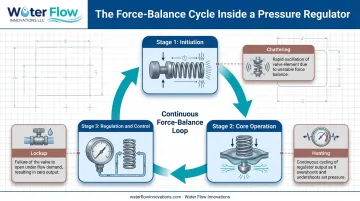
A regulator doesn't just "open" once and stay put. It runs a continuous force-balance cycle between a spring, a sensing diaphragm, and a restricting valve, adjusting itself many times per second as conditions change.
Initiation: Setting the Desired Pressure
The cycle starts manually. Turning the set screw compresses or releases the reference spring, which mechanically defines the target outlet pressure. Once that setpoint is dialed in, everything after it happens automatically.
This initiation step is also where problems often begin. An incorrect initial setpoint, or a corroded and stuck adjustment screw, is one of the most common causes of inconsistent downstream pressure. It is frequently mistaken for a failed regulator when the fix is as simple as freeing or resetting the screw.
Core Operation: Valve Opening and Flow
Here's the central mechanic: the compressed spring pushes against the diaphragm, and the diaphragm's movement opens the poppet valve. That opening lets higher-pressure fluid flow from inlet to outlet.
As fluid passes through the narrowed valve orifice, basic fluid dynamics take over — pressure drops and velocity increases. That orifice restriction is the mechanism that reduces pressure.
Orifice size and poppet geometry set flow capacity (Cv) at full opening and how quickly the regulator reacts to demand swings.
Regulation and Control: Maintaining Balance
Once fluid is flowing, the regulator has to keep adjusting. Rising outlet pressure pushes back against the diaphragm, compressing the spring further and closing the valve. Falling pressure lets the spring push back open.
This ongoing correction produces a phenomenon called droop: the natural, expected drop in outlet pressure as flow demand increases. According to Swagelok's technical bulletin on flow curves, understanding a regulator's specific droop characteristics is essential to selecting the right unit for the application.
When force balance breaks down, three failure patterns show up:
- Chattering: rapid mechanical oscillation of the poppet, often from excessive liquid force
- Hunting: slow pressure oscillation around setpoint, usually from oversized orifices or turbulence
- Lockup: the valve snaps fully shut at no-flow conditions
Each one can damage downstream equipment or waste product if left unaddressed.
The result is controlled, stable outlet pressure to fixtures, appliances, or process equipment, even when supply pressure fluctuates moderately upstream. That stability protects pipe joints, valves, and meters from surges, extends system lifespan, and cuts water hammer risk. It also means fewer leaks and lower maintenance costs over time.
Pressure regulation alone still does not guarantee accurate water metering. Turbulence and air entrainment elsewhere in a plumbing system can cause a meter to over-register consumption, even when pressure is steady at the point of use. In commercial and industrial facilities, pressure regulation is often paired with air/gas removal and turbulence elimination for that reason.
Water Flow Innovation builds that combined approach into its Flow Conditioning Device (FCD). The four-component system pairs pressure regulation with air separation, a check valve, and turbulence elimination. Stabilizing pressure at the meter entry point reduces the surges that form air bubbles and vortex flow, the two conditions most responsible for meter over-reading. The pressure regulation stage does this with negligible pressure loss, so downstream flow rates and system performance stay intact.
Where Are Pressure Regulators Used?
Pressure regulators show up anywhere a system needs to step down from high supply pressure to a lower, stable delivery pressure:
- Municipal water service — building supply lines and commercial plumbing
- Natural gas distribution — from pipeline pressure down to appliance-safe levels
- Compressed air and pneumatic systems — tools, actuators, and process lines
- Oxy-fuel welding and propane/LP appliances — cylinder pressure to torch or burner pressure
- Industrial process lines — chemical, pharmaceutical, and manufacturing systems
Regulators perform best where there's a clear high-to-low pressure differential and a genuine need for consistent delivery. That describes commercial buildings, multifamily housing, hotels, hospitals, and industrial facilities protecting sensitive equipment from main-line surges. In those same buildings, flow conditioning and meter accuracy often become priorities alongside pressure control.
Setpoints vary sharply by application:
- Water systems typically target around 50 psi
- Gas end-use appliances run at far lower pressures
- Industrial gas panels can require controlled outlet ranges in the hundreds or thousands of psi
There's no single "correct" regulator. Sizing depends entirely on the system it's protecting.
Conclusion
A pressure regulator's reliability comes down to a simple, continuous mechanical loop: spring, diaphragm, and valve, constantly rebalancing against each other. No electronics or software updates required. Physics handles the rest.
Once you understand that loop, sizing, troubleshooting, and maintenance get simpler. A correctly sized, well-maintained regulator prevents pressure-related waste, protects downstream equipment, and keeps water, gas, and industrial systems running efficiently for years.
Frequently Asked Questions
How do you tell if you have a bad pressure regulator?
Watch for fluctuating outlet pressure, banging or rattling pipes (water hammer), pressure readings noticeably above the setpoint, or visible leaking from the regulator body. Any of these warrants inspection.
Do pressure regulators fail open or closed?
It depends on the failure mode. A diaphragm rupture or spring break usually causes the regulator to fail open, while debris on the seat can cause erratic regulation or a partial closure. The specific component that fails determines the outcome.
Can water flow backwards through a pressure regulator?
Yes. A standard pressure-reducing regulator is not a check valve and doesn't reliably block backflow. Most codes require a separate, dedicated backflow preventer for that function.
What is the ideal water pressure setting for a commercial building?
Most commercial systems target around 50 psi, which manufacturers like Watts identify as sufficient for typical use. Code requires a regulator once static pressure exceeds 80 psi, but 50 psi isn't a code mandate; it's practical guidance.
How often should a pressure regulator be replaced or serviced?
There's no universal replacement interval backed by code or manufacturer data. Watts describes well-maintained PRVs as long-service-life products, often rebuilt with a kit rather than replaced outright. Inspect whenever pressure symptoms appear.
What's the difference between a pressure-reducing regulator and a back-pressure regulator?
A pressure-reducing regulator controls and maintains downstream (outlet) pressure. A back-pressure regulator does the opposite: it maintains upstream (inlet) pressure by opening proportionally as that pressure rises.
Can a regulator correct a meter that is over-registering?
No. Regulating pressure does not remove the entrained air and turbulence that cause a meter to count air as water. Those are separate faults, and correcting the reading calls for a conditioning device rather than a regulator adjustment.
What approvals should such a device carry on a potable supply?
Certification to IAPMO, NSF, ANSI, CAN 61, KIWA, GMP, and SQF, plus EPA WaterSense compliance. The unit is built from 316L stainless steel in the USA.