Commercial water and sewer bills vary enormously. A small office pays a fraction of what a hospital or bottling plant sees, depending on facility size, fixture age, and local rate structure. But the pattern holds across almost every industry: bills rarely balloon because water costs more. They balloon because of decisions made years ago, conditions that quietly worsen, and oversight gaps nobody catches until the bill lands.
This guide breaks down how those costs actually build up, what drives them, and a structured set of strategies, spanning decisions, daily management, and infrastructure context, that can bring them back down.
Key Takeaways
- Water bills climb from leaks, inefficient fixtures, and meter errors—not one obvious line item
- Main cost drivers: usage volume, equipment efficiency, sewer charges, rate structures, and meter accuracy
- Cut costs three ways: smarter decisions, tighter daily operations, and fixing delivery/billing issues
- Biggest overlooked savings often come from correcting meter over-reading, not from using less water
How Costs Around Water Bills Typically Build Up
A water bill rarely spikes because of one dramatic event. Instead, a small leak, an aging fixture, or a misclassified sewer charge quietly compounds month after month until the total becomes impossible to ignore.
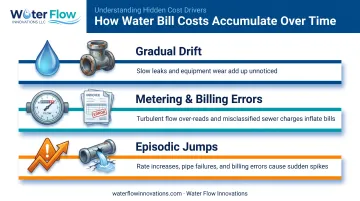
That build-up happens in a few ways:
- Gradual drift: leaks that worsen slowly, fixtures that lose efficiency with age, and equipment that wears down over time
- Metering and billing errors: turbulent flow that causes meters to over-read, sewer charges based on outdated assumptions, or rate codes that no longer match facility use
- Episodic jumps: rate increases, pipe failures, meter malfunctions, or a single billing error that persists for months before anyone catches it
The EPA estimates leaks alone average more than 6% of total facility water use, and that's before inefficient fixtures or billing inaccuracies stack on top.
Most organizations only discover these costs during a utility audit, after an unusually high bill arrives, or when a leak detection effort turns up something unexpected. By then, they've often been overpaying for months or years with no clear warning along the way.
Key Cost Drivers for Water Bills
Three forces shape almost every commercial water bill: how much water flows through the meter, how efficiently equipment uses it, and how the utility structures its rates.
These three interact. On tiered or volumetric pricing, a facility pays progressively more per gallon as usage climbs into higher blocks. Inefficient fixtures don't just waste water; they can push the account into a more expensive tier entirely.
Sewer charges compound the problem, since most utilities calculate wastewater fees as a percentage of metered water use. That means:
- Every gallon of inefficiency shows up twice: once on the water line, once on the sewer line
- A misclassified account (billing irrigation or cooling tower water for sewer service it never actually uses) inflates costs the same way
- Sewer rates often match or exceed water rates, so the double charge is usually material—not a minor add-on
Metering Accuracy: The Driver Most Facilities Overlook
Fixture efficiency and rate structure get most of the attention. Metering accuracy rarely does, even though it is a major variable on many facility bills.
Turbulence near the meter and air entrainment from pressure cycling, tank fills, or irrigation start-ups can distort the flow profile the meter needs to measure accurately. That distortion can make the meter register more flow than the facility actually receives, with no change in real usage.
Some cost drivers get locked in early: fixture choices, pipe sizing, and meter selection made at installation. Others accumulate over time as pipes age, gaskets wear, and meter accuracy drifts years after commissioning.
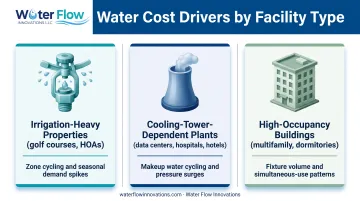
Which of those drivers dominates also depends on how the facility operates:
- Irrigation-heavy properties (golf courses, HOAs, large estates): zone cycling and seasonal demand spikes
- Cooling-tower-dependent plants (data centers, hospitals, hotels): makeup water cycling and pressure surges
- High-occupancy buildings (multifamily, dormitories): fixture volume and simultaneous-use patterns
Cost-Reduction Strategies for Water Bills
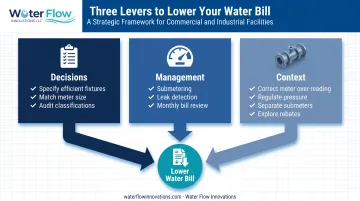
Not every water-cost problem starts in the same place. Some originate in decisions made long before water ever flows. Others build up in daily management, or hide in the infrastructure and billing setup surrounding the facility. Fixing the right one requires knowing which lever you're actually pulling.
Strategies That Reduce Costs by Changing Decisions
These work by shaping choices made before or around water use, including procurement, specification, and account setup.
- Specify water-efficient fixtures during renovations or new installations. WaterSense-labeled toilets, faucets, and high-efficiency laundry or kitchen equipment cut draw at the source. The EPA notes restroom and laundry fixtures can represent nearly 50% of total facility water use; qualifying products use at least 20% less than standard equivalents.
- Match meter size to actual demand. An oversized meter can miss low-flow periods entirely; an undersized one causes pressure loss and premature wear. Either mismatch can push a facility into unnecessary base charges or the wrong rate tier.
- Audit account classifications. Irrigation and cooling tower meters are frequently billed for sewer charges they shouldn't incur, since that water evaporates or gets absorbed by landscaping and never reaches the sewer system.
- Build efficiency requirements into procurement policy. HVAC, laundry, and kitchen equipment specifications should include water-efficiency thresholds, not just energy ratings, particularly for high-volume systems like commercial dishwashers and cooling towers.
Strategies That Reduce Costs by Changing How Water Use Is Managed
These improve visibility and control once systems are already running day to day.
- Implement submetering by zone or department. Tracking consumption at a granular level flags anomalies, such as a spike in one wing or one process line, before they become a costly surprise on the master bill.
- Establish routine leak detection and maintenance. Scheduled checks across pipes, fixtures, irrigation lines, and cooling systems catch small leaks before they compound across billing cycles.
- Create a monthly bill-review protocol. Comparing month-over-month and year-over-year usage against a one- to two-year baseline surfaces billing errors, sewer misclassifications, and unexplained spikes while they're still cheap to fix.
- Train staff and tenants on water-conscious habits. Full-load equipment use, off-peak scheduling for laundry and irrigation, and basic leak-reporting awareness cut avoidable waste without any capital investment.
Strategies That Reduce Costs by Changing the Context Around Water Use
In many facilities, the real driver of excess cost isn't consumption at all. It's the infrastructure and billing setup surrounding it.
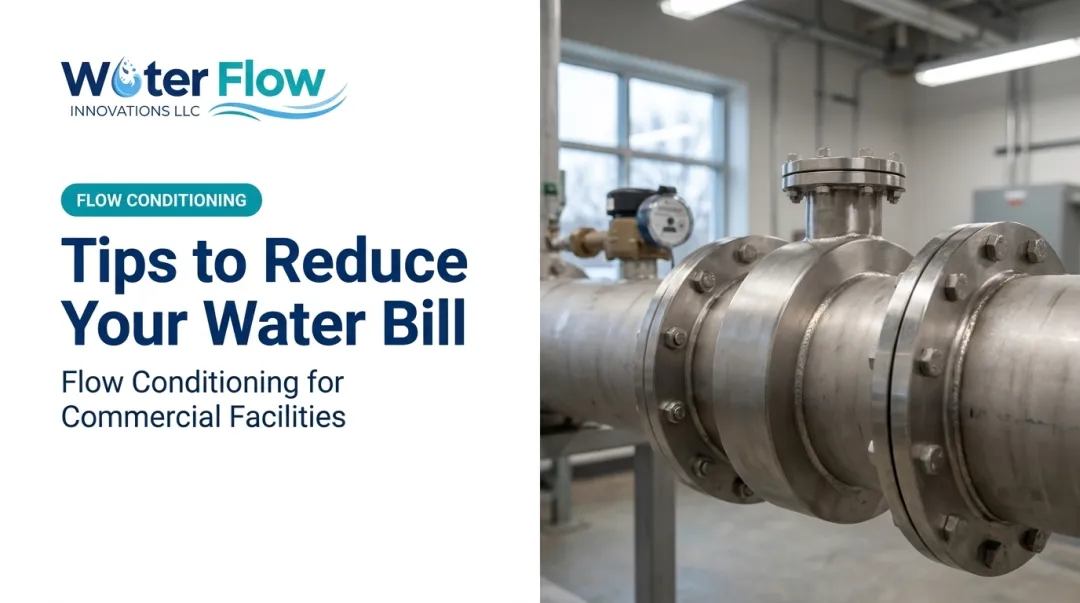
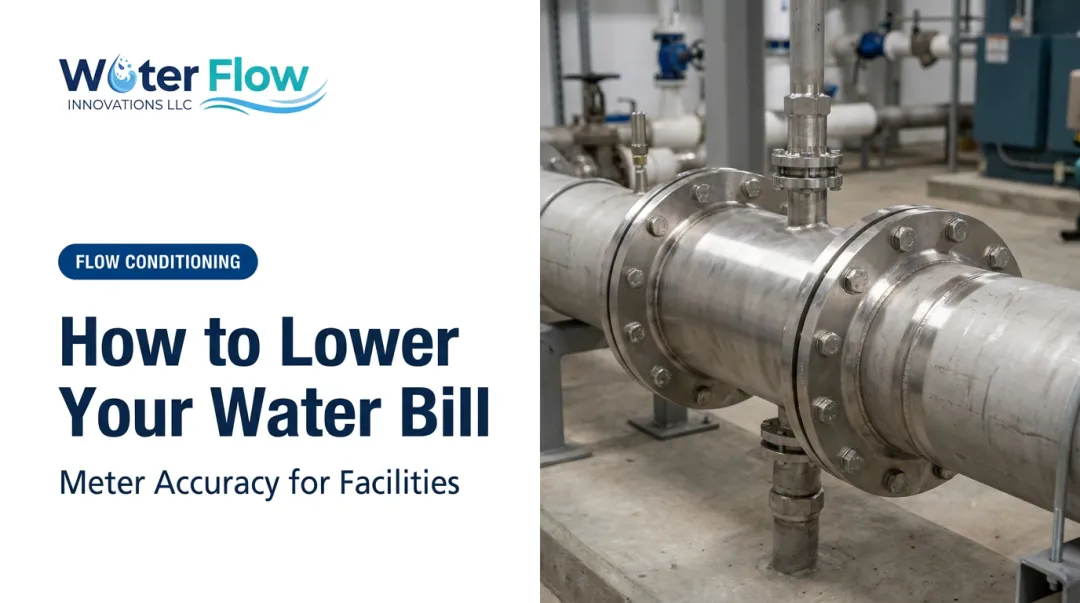
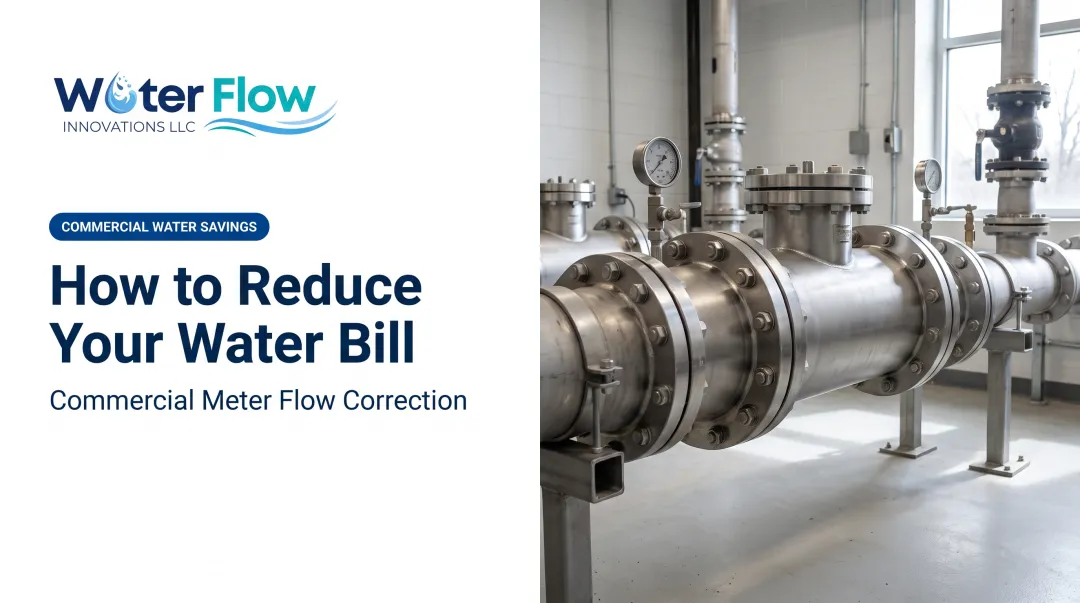
- Correct meter over-reading caused by air entrainment and turbulent flow. Pressure cycling, tank fills, CIP cycles, and irrigation start-ups can push air and turbulence through the meter and inflate readings. Certified flow conditioning solutions, such as Water Flow Innovation's FCD, fix that at the meter without changing usage or system performance—documented average bill reductions of 5–30%, with savings often visible on the next cycle.
- Evaluate and regulate incoming water pressure. Pressure above 80 psi is generally considered excessive under most plumbing codes. It accelerates wear, raises leak risk, and inflates consumption without any operational benefit.
- Separate submeter dependencies from domestic supply. Cooling towers and irrigation systems on their own submeters can qualify for sewer credits in many utility service areas, since that water never reaches wastewater treatment. Eligibility and calculation methods vary by jurisdiction, so check directly with your local utility.
- Explore utility-offered rebates and assistance programs. Many utilities offer conservation rebates, rate restructuring, or efficiency assistance for commercial and industrial customers. Check availability before funding a project entirely out of pocket.
Conclusion
Reducing a commercial water bill doesn't start with cutting usage. It starts with figuring out where the cost is actually coming from:
- A decision made years ago, like an oversized meter or a fixture that was never efficient
- A management gap: no bill reviews, no leak checks, no submetering to flag anomalies
- Infrastructure and billing context itself, including a meter that has over-read for years unnoticed Lasting savings rarely come from one fix. They come from smarter equipment choices, tighter day-to-day management, and an honest look at metering and billing accuracy—reviewed continuously, not treated as a one-time project.
Frequently Asked Questions
Is $100 a month a high water bill?
For most commercial and industrial facilities, no—monthly bills often run far higher depending on size, industry, and local rates. Compare against similar facilities in your sector rather than any flat dollar figure.
What is a typical water bill for a commercial or industrial facility?
Costs vary widely by industry, facility size, and local water-sewer rates. A small office and a hospital can differ by a factor of ten or more, so no single "typical" figure is reliable across facility types.
How can I tell if my water meter is over-reading my usage?
Watch for bills that don't line up with submetered or estimated usage, or consumption that keeps climbing despite no operational changes. A professional flow assessment can confirm whether the meter itself is the problem.
Do sewer charges factor into water bill reduction strategies?
Yes. Most utilities calculate sewer charges from metered water use, so correcting metering issues or usage inefficiencies reduces both charges at the same time.
How quickly can water-saving or metering-correction measures show results?
Behavioral and equipment changes take weeks or months to show measurable impact. Metering corrections often appear on the very next billing cycle, since they fix the reading itself rather than usage patterns.
Can documented water bill savings support sustainability or ESG reporting?
Yes. Verified consumption and billing data from these strategies can support ESG disclosures, LEED certification, and other sustainability program reporting, since the evidence comes directly from official utility records.
What savings figure should a utilities manager budget against?
Documented installations average a 5–30% reduction in combined water and sewer charges, with a highest documented single result of 46%. Build the business case on the range rather than the maximum, since site conditions drive the outcome.
What approvals should the equipment carry before procurement?
Recognized potable-water approvals. The device is certified to IAPMO, NSF, ANSI, CAN 61, KIWA, GMP, and SQF, complies with the EPA WaterSense program, is built from 316L stainless steel in the USA.