Most people never think about their PRV until something goes wrong: a mystery leak, a water heater that keeps failing, or pipes that bang every time a faucet shuts off. Few stop to consider how the valve actually manages that pressure moment to moment. This guide breaks down what a PRV is, how it mechanically regulates flow stage by stage, and where it fits into residential, commercial, and industrial water systems.
Key Takeaways
- A PRV lowers high municipal pressure to a safe, steady level for building plumbing
- A spring-loaded diaphragm opens and closes the valve as downstream pressure shifts
- Install it near the water meter, where the main line enters the building
- Failure signs include pressure swings, banging pipes, and leaks at the valve body
- Unlike relief valves that vent only in emergencies, PRVs regulate pressure continuously
What Is a Pressure Reducing Valve?
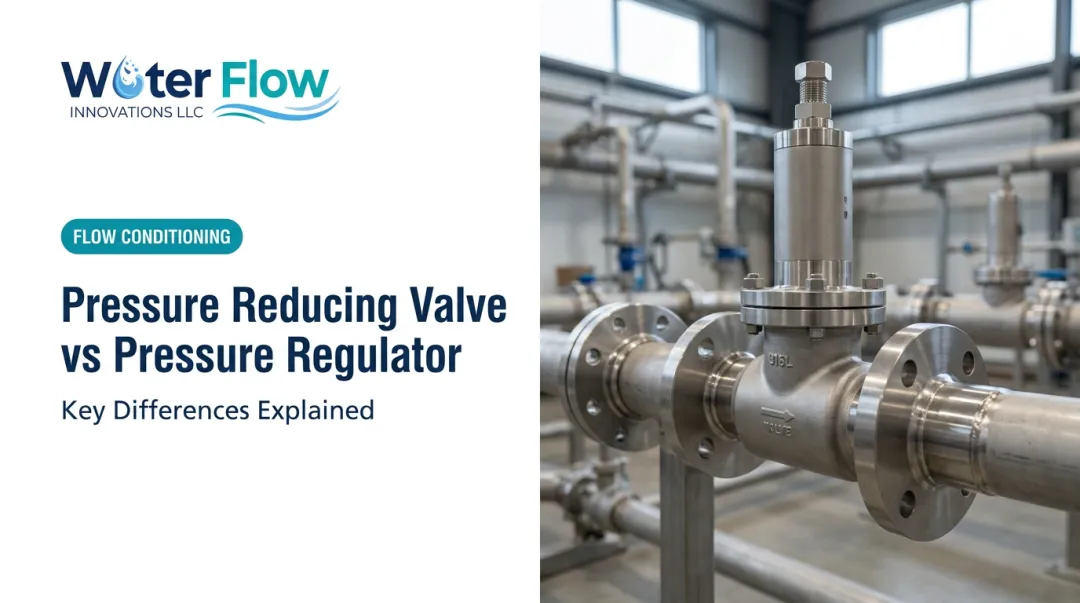
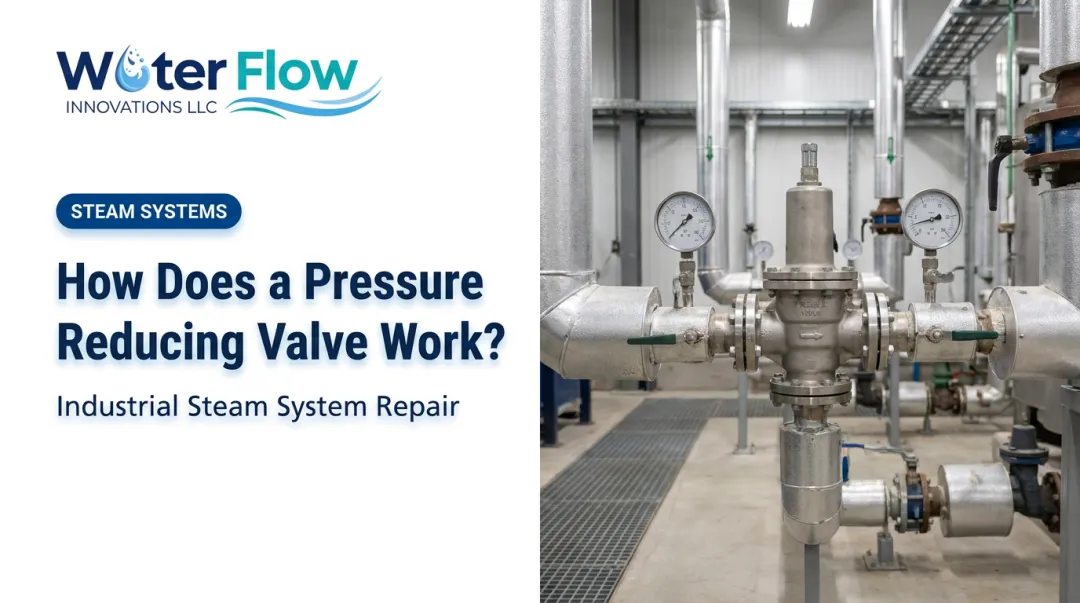
A pressure reducing valve is a mechanical, self-regulating device that automatically lowers high incoming water pressure to a consistent, lower outlet pressure. It does this without a power source and without anyone touching a dial.
Municipal water systems run at higher pressure than most buildings need. That pressure has to push water through miles of pipe and up multiple floors.
The 2021 International Plumbing Code requires pressure reduction whenever static building pressure exceeds 80 psi. Above that threshold, pressure stresses pipes, seals, and appliances not rated for it.
What a PRV Is Not
It's easy to lump pressure control devices together, but a PRV has a narrow job:
- A pressure relief valve vents excess pressure as a safety measure; a PRV modulates pressure continuously under normal conditions
- A backflow preventer stops reverse flow; a PRV never addresses flow direction
Direct-Acting vs. Pilot-Operated
Two main types exist, and the difference comes down to scale:
- Direct-acting valves use a spring-loaded diaphragm and globe-style body, the most common setup in smaller building services
- Pilot-operated valves add a secondary pilot that senses downstream pressure and modulates the main valve. They hold outlet pressure steadier under heavy or fluctuating demand and support higher flow capacity
Both rely on the same core principle. The pilot-operated design adds a control layer for larger systems. PRVs remain the standard fix: they need no power, work on their own, and satisfy code in many jurisdictions.
How Does a Pressure Reducing Valve Work?
A PRV doesn't switch on and off like a light. It runs a continuous mechanical feedback loop: sensing pressure and adjusting its opening in real time, every second water moves through it.
Initiation
The moment high-pressure water from the municipal line reaches the valve's inlet port, the process starts. There's no manual trigger involved. The valve simply reacts to whatever pressure exists at that instant.
One common installation mistake trips up this entire process: flow direction. Every PRV has a directional arrow stamped on the body. Install it backward, and the valve won't regulate anything at all, regardless of how well it's calibrated.
Core Operation
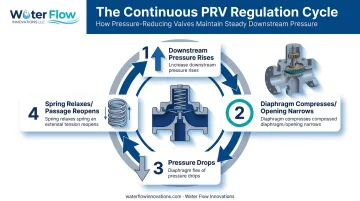
Incoming water pushes against a diaphragm connected to a calibrated spring. That spring's tension sets the valve's target pressure.
Watts describes this arrangement as a pressure-equalizing system that maintains functional downstream pressure despite fluctuations in supply, as long as inlet pressure stays above the valve's preset point.
In practice:
- Downstream pressure rises: the diaphragm compresses against the spring
- The internal opening narrows: flow is restricted, pulling pressure back down
- Downstream pressure drops: the spring relaxes and the passage reopens
- The cycle repeats: continuously, without pause
Regulation and Control
This constant push-and-pull between spring tension and water force is what lets a PRV hold a steady outlet pressure even when upstream conditions swing wildly. Peak process demand, a fire hydrant opening nearby, or municipal maintenance work can all spike incoming pressure. The valve compensates automatically.
That same response helps prevent water hammer, the pressure surge that causes banging pipes, premature seal wear, and fixture failure over time.
Output and Result
Water exits the valve at a stabilized, lower pressure. Commercial and industrial valves are calibrated to system-specific requirements. Many direct-acting models ship factory-set near 50 psi, with adjustable ranges commonly spanning 25 to 75 psi.
That regulated output:
- Protects downstream plumbing joints and fittings
- Extends the working life of water heaters, boilers, and process equipment
- Reduces leaks tied to ongoing pressure stress
Pressure Reducing Valve vs. Pressure Relief Valve
These two get confused constantly, and the mix-up is understandable since both deal with pressure. The distinction comes down to timing and purpose.
| Feature | Pressure Reducing Valve | Pressure Relief Valve |
|---|---|---|
| Function | Continuously lowers and regulates downstream pressure | Opens only when pressure crosses a dangerous threshold |
| Operating pattern | Active at all times, adjusting constantly | Dormant until triggered, then vents and reseats |
| Common example | Main water line entering a building | Water heater temperature and pressure (T&P) valve |
| Purpose | Everyday pressure management | Emergency safety protection |
A water heater's T&P valve, for instance, typically stays closed until conditions get extreme, then discharges to prevent a dangerous buildup. A PRV never waits for an emergency; it's working around the clock.
Many buildings have both installed, and that's by design. One handles routine regulation. The other is a safety net for when something goes wrong upstream or downstream.
Where Pressure Reducing Valves Are Used
Residential PRVs typically sit at the main water entry point, right at the meter, protecting household plumbing and appliances from municipal over-pressure. A single valve keeps household pressure in a safe range.
Commercial and industrial systems are more layered. PRVs there get integrated into larger water systems such as HVAC loops, irrigation, manufacturing lines, and process water, often working alongside additional flow-management equipment rather than standing alone.
Pairing a PRV With Flow Conditioning
Facilities managing large water bills often face a second issue: meter over-reading. Turbulent flow, air entrainment, and pressure cycling at the meter can cause it to register more water than actually passes through. That inflates both water and sewer charges, since sewer fees are typically calculated from metered consumption.
Water Flow Innovation's Flow Conditioning Device (FCD) is built to correct that. It combines air/gas removal, turbulence elimination, a check valve, and pressure regulation in one custom-fabricated unit sized to the facility's pipe and meter specifications. A few points define how it works with an existing PRV:
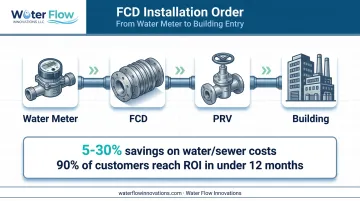
- Complementary roles: the FCD conditions water and corrects meter accuracy; the PRV regulates downstream building pressure
- Install sequence: Water Meter → FCD → PRV → Building, so the FCD uses fuller incoming pressure before the PRV steps it down
- Documented savings of 5–30% on water and sewer costs, with 90% of customers reaching ROI in under 12 months
Installing an FCD doesn't replace the building's PRV, and a PRV alone doesn't fix meter accuracy. Facilities that run both in the right order typically see the strongest combined result.
Conclusion
A PRV's logic is straightforward once you see it: constant sensing, constant mechanical adjustment, no manual input required. That spring-and-diaphragm feedback loop is why buildings can run safely on pressure that would otherwise damage pipes, seals, and appliances within months.
Understanding that mechanism pays off in practice. You can spot early warning signs before a valve fails, choose the right valve type for the application, and see how pressure regulation fits a broader water efficiency strategy.
In commercial and industrial facilities, sound pressure control is often part of cutting water and sewer costs without changing how the system operates.
Frequently Asked Questions
What is a PRV and what does it do?
A pressure reducing valve is a mechanical device that automatically lowers high incoming water pressure to a safe, consistent level for a building's plumbing system. It works continuously, without any manual adjustment during normal operation.
Do all buildings need a PRV?
Not by default. Many codes require one when supply pressure exceeds roughly 80 psi, but facilities below that threshold may still lack one. Installing a PRV can still protect plumbing, equipment, and appliances from pressure spikes.
What is the difference between a pressure reducing valve and a pressure relief valve?
A PRV continuously regulates and lowers pressure during normal operation. A pressure relief valve is a safety device that only opens briefly when pressure exceeds a dangerous threshold, like on a water heater.
How do you adjust a pressure reducing valve?
Adjustment typically involves loosening a locknut and turning an adjustment screw while monitoring outlet pressure, then retightening once the target is reached. Professional calibration is recommended to avoid damaging the valve or over-pressurizing the system.
Where is a pressure reducing valve located?
It's almost always installed where the main water line enters the building, near the meter or main shutoff valve. This position lets it regulate pressure before water reaches any internal plumbing.
How long do pressure reducing valves last?
Lifespan varies based on valve quality, water conditions, and maintenance. Mineral buildup, scale, and corrosion are documented causes of premature wear, so periodic inspection matters more than any fixed replacement schedule.
Does a PRV have any effect on what the meter registers?
Not on the phantom portion. Regulating pressure does not remove entrained air or turbulence from the supply, and the meter continues to count that air as delivered water. A separate conditioning device corrects the reading.
What does correcting that reading typically save?
Documented installations average a 5–30% reduction in combined water and sewer charges, with a highest documented single result of 46%, appearing on the very next billing cycle.