
Water flow conditioning devices exist to address exactly this problem. They're built to stabilize the hydraulic conditions reaching a water meter, particularly in situations where air entrainment or turbulence can distort registration.
This guide is written for aquatic-center owners, facility managers, aquatics directors, and the engineers and maintenance teams who keep these facilities running. We'll cover how these devices work, where they're typically evaluated, what affects their performance, and what to verify before any installation moves forward.
Key Takeaways
- FCDs are hydraulic accessories—not sanitizers, filters, pumps, HVAC parts, or leak-repair tools.
- Air removal, pressure control, check valves, and turbulence reduction create steadier metering.
- Suitability depends on pipework, meter type, flow profile, and operating patterns—not category alone.
- Validate projected savings against billing records, meter data, and post-install monitoring.
- Confirm flow, pressure, and code compliance with a qualified engineering review.
What Is a Water Flow Conditioning Device—and Why Is It Used in Aquatic Centers?
A water flow conditioning device is equipment installed in a water line to manage hydraulic irregularities before water reaches a meter or downstream system. The goal is more consistent flow conditions and more reliable measurement. It is not a method for reducing the facility's actual water needs.
This distinction matters. Flow conditioning is separate from:
- Filtration and disinfection
- Water softening
- Leak detection
- Pump control or pressure boosting
- Conservation practices that lower actual consumption
Why Aquatic Centers Use This Technology
Pools create unusually variable demand. Make-up water, backwash cycles, water features, showers, cleaning schedules, and seasonal programming all pull from the same supply line at different rates throughout the day. That variability is exactly the kind of flow pattern that can create measurement challenges.
Disturbed flow profiles can throw meter readings off. According to manufacturer McCrometer, asymmetric velocity and swirl near elbows, valves, or reducers can cause meters to read either high or low, depending on meter type and the nature of the disturbance (McCrometer, "The Challenge of Flow Disturbances on Meter Accuracy").
Turbulence does not automatically mean a facility is being overcharged. It means the reading may not reflect actual consumption.
Flow conditioning is generally an operational or utility-management decision, not a universal regulatory requirement. Local plumbing codes, utility rules, and project specifications still apply, and any installation should be reviewed against them.
Why Accurate Water Measurement Matters in Aquatic Facilities
Reliable metering feeds into nearly every operational decision an aquatic center makes. Budgeting, utility-bill review, sustainability reporting, leak investigations, and conservation-project evaluations all depend on knowing what the meter is actually measuring.
A high water bill shouldn't automatically be blamed on meter over-reading. Before attributing a bill spike to flow conditions, operators should rule out:
- Active leaks in distribution piping or fixtures
- Programmed water use changes (new features, extended hours)
- Backwash frequency adjustments
- Irrigation schedule changes
- Seasonal attendance swings
The EPA's WaterSense guidance backs this up. It identifies substantial leaks and malfunctioning equipment as common explanations for unexpectedly high commercial water use.
EPA recommends shutting off water uses to test whether readings change before assuming a measurement problem exists (EPA WaterSense, Section 2.3: Leak Detection and Repair).
Pool water use itself follows a known pattern. EPA cites a California study attributing pool water demand to roughly 56% evaporation, 23% backwashing, and 21% mineral-buildup control (EPA WaterSense, Commercial Pool and Spa Equipment).

That breakdown applies specifically to pool water, not to a facility's total bill, and evaporation rates vary by climate.
A conditioning device cannot eliminate charges for water the facility actually receives and uses. Its role is narrower: addressing possible measurement distortion caused by flow conditions, not reducing demand.
How Water Flow Conditioning Works—and Where It Fits
The flow path is straightforward. Water enters the facility, passes through the conditioning assembly, reaches the meter under more controlled hydraulic conditions, and continues on to pool systems, locker rooms, cooling equipment, and other connected loads.
Water Flow Innovation's FCD is built around four functions:
- Air and gas separation — creates static back-pressure to keep air and micro-bubbles from reaching the measurement zone, so the meter registers water rather than a water-air blend.
- Pressure regulation — helps reduce water hammer and pressure surges caused by on-off pump cycling and variable demand.
- Check-valve action — prevents reverse flow through the meter (specified only when needed for the site).
- Turbulence reduction — slows velocity enough to prevent the vortex flow pattern associated with over-counting.
These descriptions reflect the product's documented design. Exact performance depends on site conditions, so pressure loss, flow capacity, and operating limits should always be confirmed against engineering specifications for the specific installation.
Where the Device Fits in the Line
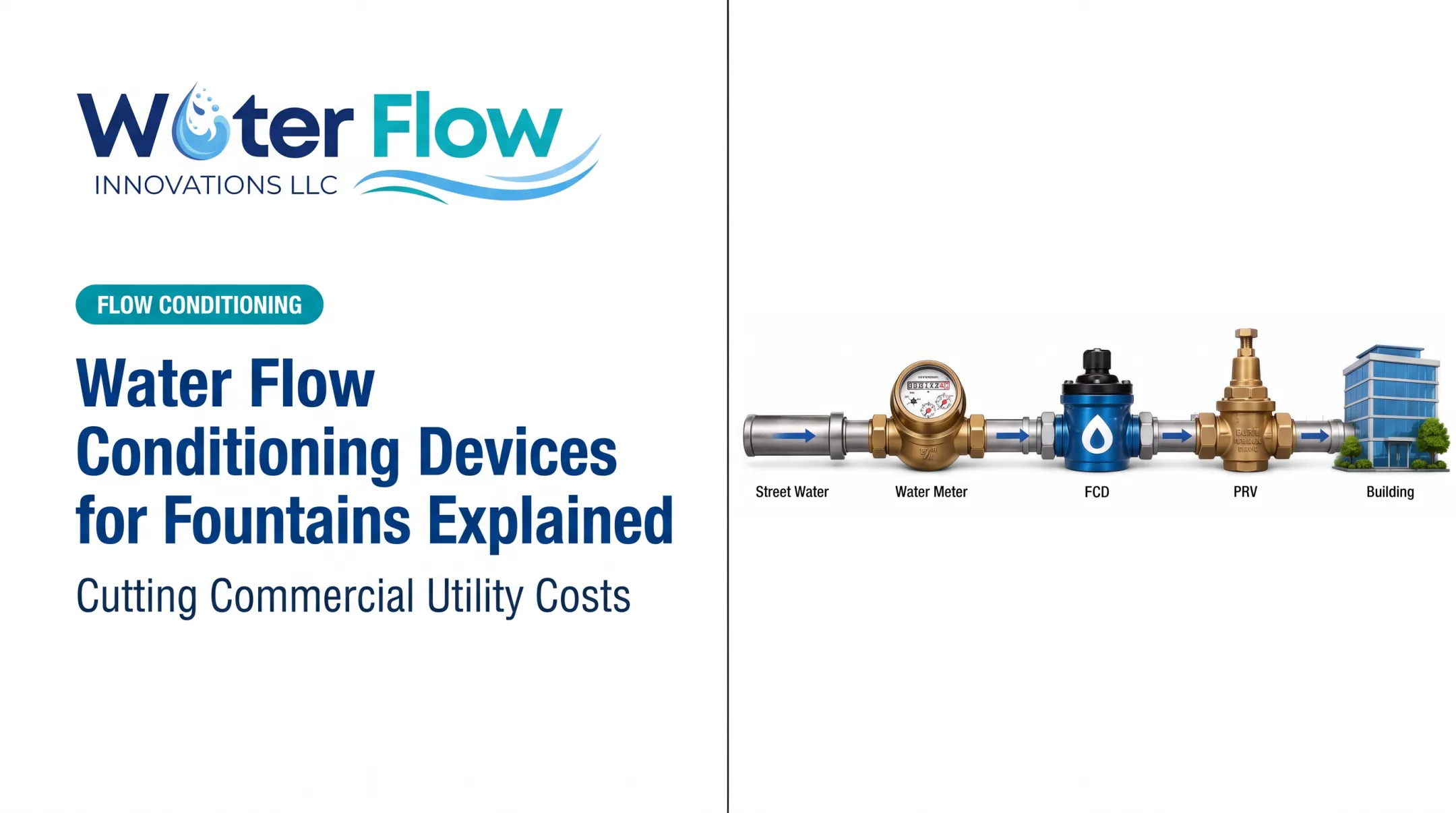
The FCD is installed directly upstream of the water meter, with the recommended sequence being FCD → meter → pressure-reducing valve → building. Each unit is custom-fabricated in 316L stainless steel to the facility's pipe size, water pressure, and installation location. It carries IAPMO, NSF, ANSI, CAN 61, KIWA, GMP, and SQF certifications.
Aquatic centers may evaluate conditioning at several points, depending on site layout:
- The main incoming water service
- Pool make-up water lines
- Backwash or replenishment lines
- Water-feature supply lines
- Locker-room branches
- Other individually metered areas
When to Investigate
Operators typically look into flow conditioning after noticing:
- Unexplained bill increases
- Gaps between expected and billed volume
- Highly variable flow or frequent pressure changes
- A utility-efficiency project, new construction, plumbing retrofit, or meter replacement
Whatever triggers the evaluation, the sequence matters: collect baseline billing and flow data first, install, then verify over a comparable operating period.

Installation itself is typically completed within an hour or two by a licensed contractor. With the right design, normal pool programming can often continue. Every site is different, though, and zero disruption shouldn't be assumed without a site-specific plan.
Key Factors, Issues, and Misconceptions
Whether flow conditioning fits an aquatic center depends on a few site-specific inputs. Review these before you treat a high bill as a metering problem.
System characteristics
- Meter type, nominal pipe size, and pipe layout
- Flow range, water temperature, and pressure swings
- Elevation changes, valves, pumps, tanks, and air-entry points
Operating conditions
- Simultaneous demand across pools, spas, and features
- Pump cycling and pool-feature schedules
- Backwash events and seasonal attendance swings
- Fast shifts between low and high flow
Equipment and compliance dependencies
- Meter manufacturer installation requirements
- Existing backflow prevention and control valves
- Plumbing-code and potable-water requirements
- Certified materials, utility approval, and maintenance access
Scale changes the evaluation. A single-meter facility is usually straightforward. Multi-meter sites need a closer look at whether over-reading shows up all the time or only during peak programs—a packed weekend swim meet versus a quiet weekday morning.
Two Misconceptions Worth Correcting
Misconception 1: Flow conditioning reduces actual water use.
It doesn't. It improves how accurately the meter measures water already moving through the line. Lower usage still needs separate steps, such as less frequent backwash or evaporation covers.
Misconception 2: A device automatically fixes every high water bill.
Rule out leaks, faulty meters, operational changes, irrigation, and unaccounted-for water first. Flow conditioning also does not replace:
- Water chemistry management
- Filtration and circulation design
- HVAC/dehumidification
- Pump maintenance
It is one piece of the utility picture—not a stand-in for the rest.
When a Water Flow Conditioning Device May Not Be Appropriate
Flow conditioning isn't a fit for every aquatic facility. It may be unnecessary when:
- Meter readings are stable and consistent over time
- Billed usage matches well-documented actual consumption
- There's little evidence of air entrainment or turbulence-related measurement issues
- No one has investigated other possible root causes yet
Certain site constraints can also limit suitability:
- Inadequate installation space
- Inaccessible pipework
- Incompatible materials
- Insufficient flow capacity
- Utility restrictions that require a broader piping redesign
Alternatives worth considering, depending on what's actually causing the issue:
- Leak detection and repair
- Meter testing or replacement
- Air-release valve improvements
- Pump and valve adjustments
- Submetering or operational scheduling changes
- Conventional water-conservation measures
A Quick Evaluation Checklist
Before moving forward, gather:
- Billing history and meter records
- Flow and pressure measurements at the relevant meter
- Pipe and meter specifications (size, material, configuration)
- Installation access and requirements
- A plan for post-installation verification
- Installation approval path and decision-maker
Water Flow Innovation offers a free water-bill review and site survey for aquatic centers that want a facility-specific assessment.
Reported figures—such as a 5–30% average bill reduction, with documented cases up to 46%—reflect company data across customer installations and are not a guarantee for any individual site. Baseline data and engineering review determine actual outcomes.

Conclusion
Water flow conditioning devices manage hydraulic conditions that can affect how a meter registers flow, particularly where air entrainment, pressure variation, or turbulence is present. Whether a device helps a specific aquatic center depends on evidence: the facility's meter, piping, operating profile, and billing history—not on the device category by itself.
A practical path forward:
- Establish a baseline of readings and bills before making any changes
- Identify the actual cause of unusual water charges rather than assuming a metering issue
- Confirm code and meter compatibility with a qualified professional
- Monitor results after installation to verify whether the change holds up
Frequently Asked Questions
What is a water flow conditioning device?
A water flow conditioning device is hydraulic equipment installed in a water line to manage air, pressure, and turbulence for more consistent metering conditions. It does not filter, treat, or reduce the water moving through the system.
How does a water flow conditioner work?
Most units combine air or gas removal, pressure regulation, check-valve action, and turbulence reduction. Confirm the exact mechanism and pressure-loss data against the manufacturer’s specifications for your meter and piping.
Can a flow conditioning device reduce water bills at an aquatic center?
Yes—when air entrainment or turbulence is causing meter over-reading, conditioning can improve measurement accuracy and lower billed usage. Results still depend on site assessment, baseline billing data, and post-install verification, so it is not a guaranteed fix for every high bill.
Is a flow conditioning device the same as a water filter or treatment system?
No. Flow conditioning manages hydraulic conditions like air and turbulence. Filtration, disinfection, and softening address water quality and are entirely separate systems.
Where should a flow conditioning device be installed?
Install location depends on meter position, piping layout, flow direction, pressure, access, and applicable code or utility rules. Have a qualified plumbing professional or engineer review the site before installation.
Will installation affect water pressure or aquatic-center operations?
Impact depends on device design, system layout, and install method. Review verified pressure-loss specs before work begins, and plan safe access during the short installation window so pool and building operations stay protected.