
Water systems nationwide lose significant volumes of water every year, and the EPA notes average system water loss sits around 14-16%, with a large share of that considered recoverable (EPA, 2013). Some of that loss traces back to leaks. Some of it traces back to metering and billing inaccuracies tied to unstable hydraulic conditions.
Here's the problem: pressure transients are usually invisible. There's no flashing warning light. Facility managers see the symptoms, banging pipes, odd meter readings, unexplained bill spikes, without understanding the cause.
This guide breaks down what pressure transients actually are, how flow stabilization corrects them, and why the physics behind it matters for both infrastructure health and utility costs.
Key Takeaways
- Pressure transients (water hammer) are sudden pressure and velocity spikes from rapid flow changes
- Turbulent flow and air entrainment near a meter can distort readings and inflate bills
- Flow stabilization—air removal, pressure regulation, and turbulence elimination—improves metering accuracy
- Stabilized flow cuts mechanical stress on pipes without sacrificing pressure or performance
- Both municipal surge control and facility-level flow conditioning play distinct, complementary roles
What Are Pressure Transients?
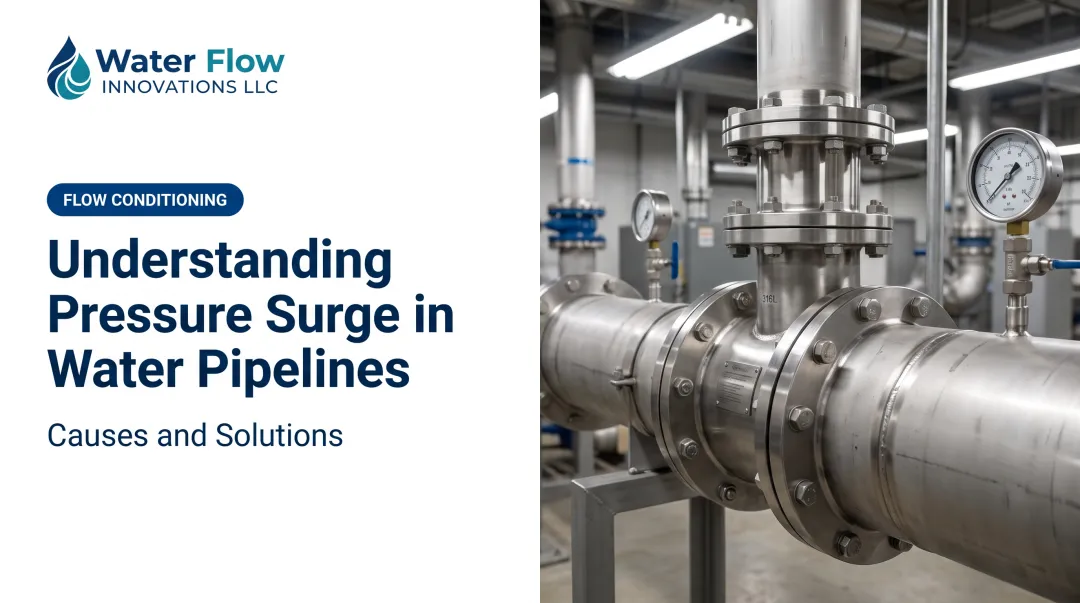
Pressure transients are rapid, short-duration pressure and velocity fluctuations inside a pipeline. Most people know them by their common name: water hammer.
They occur because water is nearly incompressible. When flow suddenly stops or changes direction, momentum has nowhere to go. That energy converts into a pressure wave that travels through the pipe at acoustic speed, not instantly, but fast enough to feel instant (National Environmental Services Center, 2003).
Transients differ from normal, gradual pressure changes that build over hours as demand rises and falls. They happen in seconds, sometimes fractions of a second.
Even modern, well-engineered systems remain vulnerable. Common triggers include:
- Pump starts and stops
- Sudden valve closures
- Elbows, tees, and fittings that disrupt flow symmetry
- Turbulent flow patterns near meters or sensitive equipment
Transients range widely in severity. Violent water-hammer events can crack joints and damage valves. Quieter problems matter too: persistent micro-turbulence and air entrainment can throw off flow measurement day after day.

How Does Flow Stabilization Work?
Flow stabilization targets the turbulence, air entrainment, and pressure irregularities that create transients and their downstream problems.
Initiation: What Triggers Flow Instability
Instability typically starts with:
- Pump cycling and valve throttling
- Pipe fittings, elbows, and tees that disturb flow symmetry
- Undersized or poorly routed piping that compounds turbulence risk
This isn't a one-time event. In busy commercial and industrial facilities, it's a condition-based, continuous issue. Every time a pump kicks on or a valve throttles, you get another disturbance.
Core Operation: Correcting Turbulent Flow
Flow conditioning devices work by smoothing chaotic, turbulent flow into a stable, more uniform pattern at the meter or sensitive equipment. Engineering research on flow conditioners confirms this function: they reduce swirl and restore a repeatable velocity profile disrupted by upstream fittings (API MPMS 5.3).
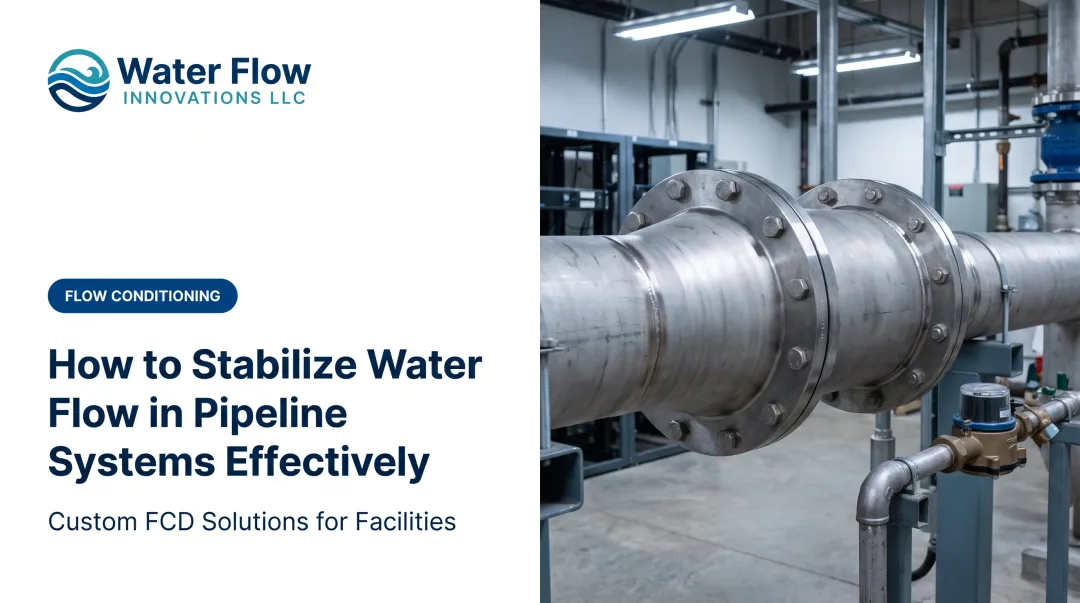
Water Flow Innovation's Flow Conditioning Device (FCD) applies this concept through a four-component design:
- Air/gas separation — creates static back-pressure and a laminar-flow condition, for a homogeneous water column back through the meter
- Pressure regulation — reduces water-hammer effects and surge pressure at the meter's entry point
- Check valve — limits reverse flow and pressure spikes (not always required, depending on the system)
- Turbulence elimination — slows velocity just enough to prevent vortex flow during CIP cycles, tank filling, or open discharge

Here's the operational impact: unstable flow with entrained air can cause certain meter types to register more volume than what's actually passing through.
Laboratory research on mechanical meters found that air passing through during pipe filling registered as billable volume. In one study, discharged air accounted for measurable over-registration under intermittent-supply conditions (IWA Publishing, 2022). That's a lab finding on intermittent supply specifically, not a blanket claim for every system, but it illustrates the mechanism clearly.
Regulation and Control
Proper systems maintain consistent flow control across shifting demand and pressure conditions. Pressure regulation and check valves prevent spikes from reflecting back through the pipe network.
Skip this stage, and facilities risk two things simultaneously:
- Physical damage — pipe fatigue, joint failure, valve wear
- Billing inaccuracy — meters registering phantom volume from turbulence or air
Output: Stabilized, Accurate Flow
The result is consistent flow that protects infrastructure and helps meters register actual usage, not turbulence artifacts. This integrates into normal operations without disrupting pressure or performance.
In most cases the FCD produces no measurable pressure drop. Under high-volume, open-discharge conditions, pressure may dip by roughly 3-5 PSI, negligible for typical facility use.
The device is certified under IAPMO, NSF, ANSI, CAN 61, KIWA, GMP, and SQF standards. It is built in 316L stainless steel and custom-fabricated to each facility's exact pipe size, flange type, and meter model.

Where Flow Stabilization Matters Most
Flow stabilization is typically applied at three key points:
- Near the main water meter: where measurement accuracy matters most
- After booster pumps: where cycling introduces the most disturbance
- At points with frequent valve operation: where throttling creates repeated turbulence
Facilities with high-cycle pump operations see the greatest benefit. Common examples:
- Food and beverage processing (breweries, dairy, bottling)
- Hospitality (hotels, resorts)
- Healthcare (sterile processing departments)
- Manufacturing with frequent CIP or fill-drain cycles
Any pipe size or meter type can experience these issues. Stabilization applies across sectors—from a 300-room hotel to a semiconductor fab to a municipal correctional facility.
Preventing Damage: Municipal-Scale Surge Control
At the pipeline-network level, utilities rely on larger anti-surge infrastructure:
| Device | Function |
|---|---|
| Surge tanks | Supply or absorb water during a transient event to buffer pressure swings |
| Air release valves | Automatically vent trapped air that collects at high points in the network |
| Pressure relief valves | Open rapidly once pressure exceeds a set threshold to protect the pipeline |

These target the same root causes: air entrapment and sudden velocity change, just at a much larger scale than a single facility.
Whether you're looking at a municipal transmission main or a single meter vault, the underlying physics doesn't change.
Joukowsky's principle describes how pressure change relates to velocity change: for a rapid, full flow stoppage, the pressure spike equals the product of fluid density, wave speed, and the velocity change itself (MDPI, 2022). It's the same equation whether you're modeling a 36-inch transmission line or a 2-inch meter run.
Conclusion
Pressure transients aren't mysterious. They're a physics-driven consequence of sudden velocity changes in a nearly incompressible fluid. Understanding that helps facility managers recognize risks that are otherwise easy to miss.
Whether the goal is preventing water-hammer damage or investigating why a water bill doesn't match actual usage, flow stabilization offers a proven, low-disruption option. Facilities can put it in place without overhauling their systems.
Frequently Asked Questions
What are pressure transients in water systems?
Pressure transients are sudden, short-duration pressure and velocity changes caused by rapid flow disruptions. They're commonly known as water hammer, and they occur because water can't absorb sudden momentum changes without a pressure spike.
What causes water pressure fluctuation in water systems?
Primary causes include pump starts and stops, sudden valve operations, entrained air pockets, and rapid demand changes. Piping layout, fittings, and undersized pipe runs can all compound the effect.
How can I tell if my facility has a pressure transient problem?
Watch for banging or knocking pipes, inconsistent pressure readings across the system, or meter readings that don't line up with actual water usage.
Can pressure transients affect my water bill?
Yes. Turbulence and air entrainment near the meter can cause certain meter types to over-register volume, leading to inflated water and sewer charges even though actual consumption hasn't changed.
Do flow conditioning devices reduce water pressure or system performance?
Properly designed devices, like certified FCDs, typically produce no measurable pressure drop in normal operation. Under high-volume, open-discharge conditions, a slight drop of a few PSI may occur—usually too small to notice in regular use.
How long does it take to see results after installing flow stabilization equipment?
Stabilization begins immediately, and savings typically show up on the next water and sewer billing cycle. Some utilities read meters less frequently, which can delay when results appear on paper.
What reduction do transient-prone sites typically record?
Documented installations average a 5–30% cut in combined water and sewer charges, with a highest documented single result of 46%. The correction is to measurement accuracy, so consumption and operations are unchanged.
Would a newer meter cope with transients any better?
Not reliably. Whatever the technology, a meter registers what reaches it, entrained air included, so the same over-registration returns after a swap while the transients continue. The flow entering the meter is what has to be stabilized.