Introduction
You open your facility's water bill and see "10 CCF" next to a number that's higher than last month's—with no clear explanation why. Sewer charges, tiered rates, and unfamiliar abbreviations turn a routine utility statement into a guessing game.
Many commercial and industrial facilities overpay every month because usage measurement and billing are poorly understood. A facility manager might assume a higher bill means more water was used. Often, it doesn't.
This guide breaks down CCF and gallons, walks through how utilities actually calculate your bill, shares usage benchmarks for commercial facilities, and exposes an overlooked cause of inflated bills that has nothing to do with how much water you actually consumed.
Key Takeaways
- One CCF equals 748 gallons: the unit every water bill is built on
- Sewer charges are usually calculated from water usage, so wasted water often gets billed twice
- Usage benchmarks vary widely by facility type and occupancy
- Meter over-reading from air entrainment and turbulent flow inflates commercial and industrial bills
- Behavioral fixes and certified flow-correction technology both cut water and sewer costs, often within one billing cycle
Understanding Water Usage Metrics: CCF and Gallons Explained
Utilities don't bill in gallons. They bill in CCF, short for hundred cubic feet, because it's a more practical unit for measuring large-scale flow through a meter. One CCF converts to a fixed gallon amount—the same figure utilities use on every bill.
According to the EPA's guide to understanding your water bill, 1 CCF equals 748 gallons. That conversion is exact, and it's the same everywhere in the country.
Quick conversion example: A bill showing 10 CCF of usage means:
10 CCF × 748 gallons = 7,480 gallons used that billing period
Why This Number Matters Twice
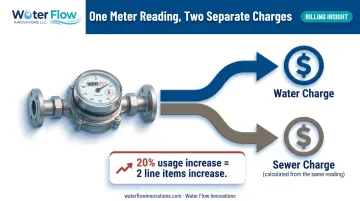
Here's where facility managers often get caught off guard. Water and sewer charges are typically calculated from the same meter reading. If your bill shows 10 CCF of water use, your sewer charge is often based on that identical 10 CCF figure, not a separate wastewater measurement.
That means:
- Every gallon you use is billed once for water
- The same gallon is billed again for sewer
- A 20% jump in usage doesn't just raise one line item, it raises two
High-volume users feel this more acutely. Restaurants, hotels, manufacturers, and multifamily buildings often sit in higher-usage tiers where the per-unit price is already elevated. The doubling effect from sewer charges compounds faster for these facilities than it does for a typical home.
How Your Water Bill Is Calculated
Most water bills contain two distinct components, and confusing the two is a common reason facility managers misread their statements.
- Fixed/base charges: A flat fee covering infrastructure, meter maintenance, and debt service, regardless of usage
- Variable/volumetric charges: Based on how much water actually passed through the meter, priced per CCF (100 cubic feet)
Rate Structures That Affect Your Final Number
| Rate Structure | How It Works |
|---|---|
| Uniform | Same price per CCF no matter how much you use |
| Increasing block (tiered) | Price per CCF rises as usage climbs into higher tiers |
| Seasonal | Higher unit prices during peak-demand months, often summer |
| Drought-based | Surcharges added above certain thresholds during water restrictions |
The EPA notes that many utilities combine a fixed base charge with one of these volumetric structures. In an increasing-block system, the more you use, the higher the price climbs per additional unit, which is why a facility that doubles its usage can see its bill more than double.
Sewer charges reinforce this pattern. Because they're commonly derived from the water meter reading rather than a separate wastewater meter, any spike in metered water use flows directly into a matching spike in sewer costs.
For commercial and industrial accounts, the volumetric portion often represents most of the total bill. As consumption grows, fixed fees shrink as a share of what you pay.
Average Water Usage Benchmarks: Homes vs. Businesses
Benchmarks help you spot when something's wrong before the bill arrives. Without a baseline, an unusual spike just looks like "a high bill" instead of a red flag.
Residential Baseline
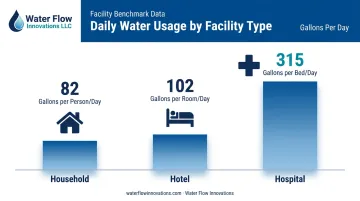
The EPA estimates average residential use at around 82 gallons per person per day. For a two-person household over a 30-day billing cycle, that works out to roughly 4,920 gallons, or about 6.6 CCF per month.
Quick Reference Conversions
| Usage Figure | Gallon Equivalent |
|---|---|
| 4 CCF | 2,992 gallons |
| 10 CCF | 7,480 gallons |
| 30-minute shower (standard 2.5 GPM head) | 75 gallons |
| 30-minute shower (low-flow, 2.0 GPM head) | 60 gallons or less |
Commercial and Industrial Contrast
Businesses operate on a completely different scale. EPA ENERGY STAR benchmarking data shows median use of:
- 102 gallons per room per day in hotels
- 315 gallons per bed per day in hospitals
A single hotel or hospital can use what a household consumes in a month within one day of operation. Manufacturing plants with continuous process water demands push that gap even wider.
Common Reasons Your Water Bill Keeps Rising
If your usage habits haven't changed but your bill has, three culprits explain most cases.
Undetected Leaks
Small leaks compound fast. The EPA's Fix a Leak Week data puts average leak loss above 9,300 gallons per year at the household scale—and commercial sites lose even more.
In commercial facilities, leaks average more than 6% of total water use. A single fixture or valve leaking at just 0.5 gallons per minute can waste 21,600 gallons in a month.
Rate Increases You Didn't Cause
Sometimes the meter reading barely moved but the bill still climbed. Bluefield Research reports that combined water and sewer bills rose 5.1% between 2024 and 2025 across large U.S. cities.
Treatment costs, labor, and infrastructure financing drive most of that jump. Tiered rate creep can also push the same usage habits into a costlier bracket year over year.
The Overlooked Cause: Meter Over-Reading
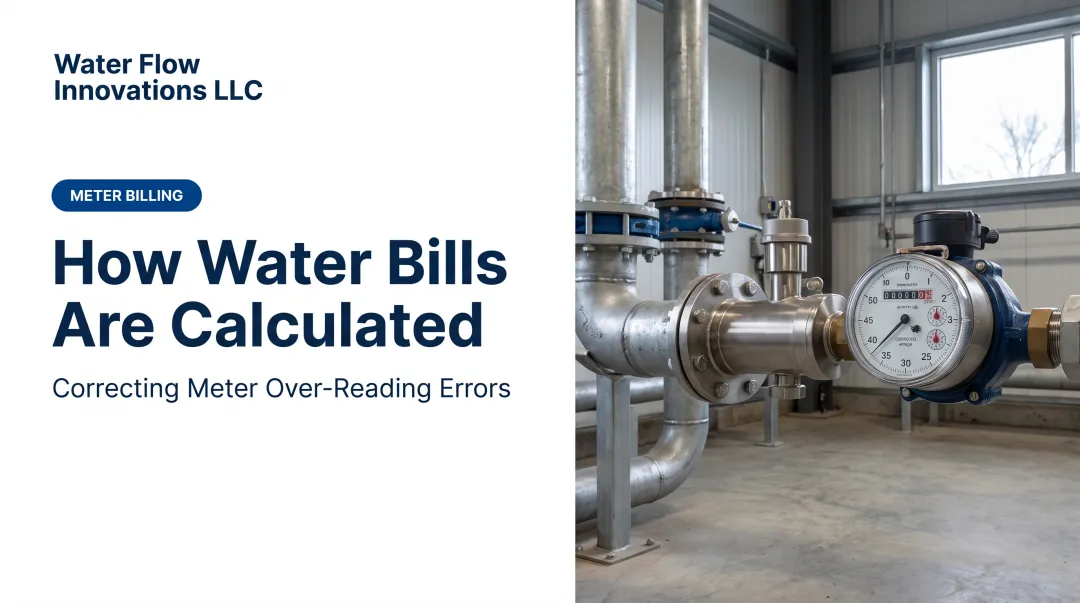
Commercial and industrial water meters don't just measure water. They measure whatever passes through them, including entrained air, micro-bubbles, and turbulent vortex flow.
Normal operations create that turbulence: CIP cycles, cooling tower makeup, and on/off pressure cycling. Displacement and turbine meters can't tell water from these non-water elements, so they register it all as billable volume. Your facility can pay for water it never received—on both the water and sewer line items.
Proven Ways to Reduce Water Usage and Lower Your Bill
Not every fix requires cutting consumption. Some strategies reduce actual use; others correct how accurately that use gets billed.
Operational Quick Wins
- Fixture upgrades: WaterSense-certified fixtures use at least 20% less water than standard models
- Routine leak audits: Catch the 6%+ of facility water typically lost to undetected leaks
- Staff and tenant training: Reinforces reporting habits and catches issues faster
Real-Time Monitoring
Smart meters and submeters flag irregular usage patterns, such as off-hours consumption, before they show up as a spike on the next bill. That early signal gives facilities time to investigate, shut off a problem line, or correct a process issue instead of absorbing another high cycle.
Correcting Meter Over-Reading
For commercial and industrial facilities, one option targets the measurement problem directly instead of asking you to use less water.
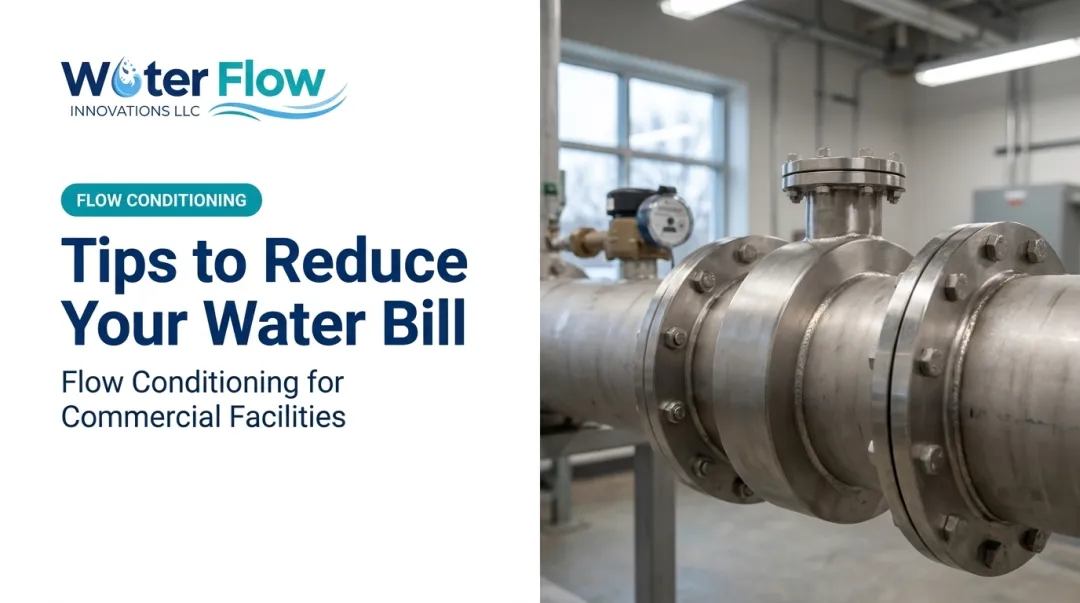
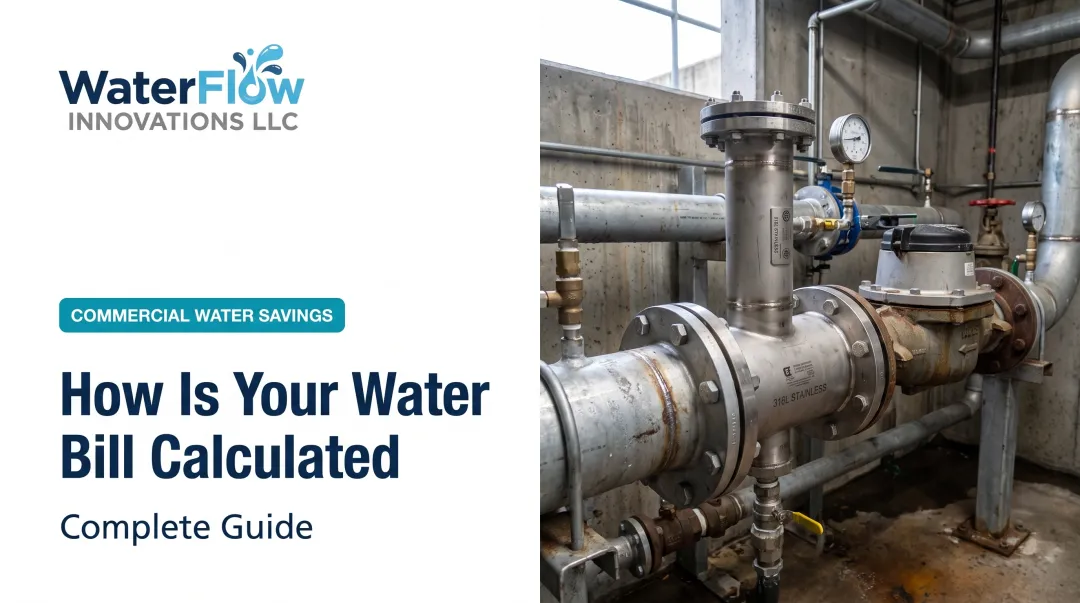
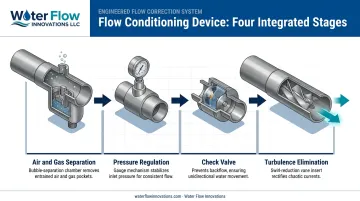
Water Flow Innovation's Flow Conditioning Device (FCD) installs immediately after the water meter. It removes the air entrainment, micro-bubbles, and turbulence that drive meter over-registration.
The device works through four integrated components:
- Air and gas separation: creates static back pressure that forms a homogeneous water column back through the meter
- Pressure regulation: smooths surges during on-off cycling
- Check valve (select configurations): prevents reverse flow that reintroduces air
- Turbulence elimination: slows velocity just enough to prevent vortex flow
Across more than 20 facility types—including food and beverage plants, hotels, healthcare campuses, and manufacturing sites—average savings land at a 5–30% reduction in combined water and sewer bills. The highest single documented result is 46%.
Most customers reach full ROI in under 12 months, and savings typically appear on the very next billing cycle.
The FCD is certified under IAPMO, NSF, ANSI, CAN 61, KIWA, GMP, and SQF standards, making documented savings usable for ESG reporting and sustainability programs. It fits any pipe size from ½" to 12" (or DN20 to DN500) and any meter type.
Getting started stays simple:
- Installation takes about one hour, with no production downtime
- Buy or lease options, with every unit custom made to the facility's pipe size
- 6-month money-back guarantee, no questions asked
- Lifetime transferable warranty that stays with the property through ownership changes
Frequently Asked Questions
What is the average CCF water usage for a 2-person household?
A two-person household typically uses around 6.6 CCF per month, based on EPA's benchmark of roughly 82 gallons per person per day. Actual usage varies with outdoor watering, appliance efficiency, and household habits.
How much water is 4 CCF?
Four CCF equals 2,992 gallons (4 × 748). That's roughly enough for 40 loads of laundry or about a month of showers for one person using a low-flow showerhead.
How much water is used for a 30-minute shower?
A standard showerhead at 2.5 gallons per minute uses about 75 gallons over 30 minutes. A WaterSense-certified low-flow head at 2.0 GPM or less brings that down to 60 gallons or less.
What causes a sudden spike in my water bill?
The most common causes are undetected leaks, seasonal outdoor watering, and utility rate increases. In commercial and industrial settings, meter over-reading from turbulent flow or air entrainment is another common cause.
Can I lower my water bill without changing how much water I use?
Yes. Your bill is based on what the meter reads, not necessarily what you actually consumed. Certified flow conditioning technology can correct meter over-reading and cut billed volume without changing operations or actual usage.
Is CCF the same as HCF?
Yes. Both terms refer to hundred cubic feet and are used interchangeably by water utilities across the United States. The conversion to gallons is identical either way: 1 CCF (or HCF) equals 748 gallons.
Does each inflated CCF also raise the sewer charge?
Usually yes. Most utilities calculate sewer as a percentage of metered intake, typically 80–120% of the water charge, rather than metering discharge. Every over-registered CCF is therefore billed twice, even though that volume never entered a drain.
Where does CCF-based over-reading cost the most?
High-volume commercial accounts, where a small percentage error multiplies across thousands of CCF — multifamily and apartment properties, hotels, hospitals, supermarkets, laundromats, car washes, data centers, and food and beverage plants.