That increase hits everyone differently. For a household, it's a tighter monthly budget. For a hotel, apartment complex, or manufacturing plant running dozens of fixtures, cooling towers, and irrigation zones, the same percentage increase means thousands of extra dollars every year.
Here's the good news: water bills aren't expensive by nature. They escalate because of leaks, outdated fixtures, poor monitoring habits, and technical issues like meter inaccuracy that almost nobody checks for. This guide breaks down where those costs quietly build up and what you can do about them — from quick fixes at home to system-level corrections at commercial facilities.
Key Takeaways
- Leaks, aging fixtures, and irrigation habits quietly inflate bills until costs spike
- Fixture age, watering practices, and meter accuracy drive most excess water spend
- Leak fixes and habit changes cut costs fastest; upgrades and meter corrections save the most
- Ongoing monitoring sustains savings longer than one-time fixes alone
How Water Bill Costs Typically Build Up
A high water bill rarely happens overnight. It builds gradually, one unnoticed drip or one extra irrigation cycle at a time, until the total finally shows up on a statement.
That's the tricky part: water waste compounds. A slow leak left alone for six months costs six times more than one caught in month one. Inefficient fixtures running daily across a property add up to thousands of wasted gallons nobody sees directly.
The EPA estimates that the average family wastes 9,400 gallons of water annually through household leaks alone — equivalent to more than 300 showers. A single faucet dripping once per second can waste over 3,000 gallons a year.
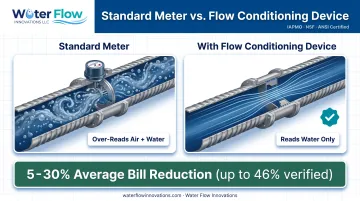
Leaks aren’t the only driver. Turbulent flow and entrained air can cause commercial meters to over-read, so a facility pays for water it never actually used.
Most facility managers only investigate after:
- A bill arrives noticeably higher than usual
- A leak test or walkthrough turns up a problem
- A formal facility audit flags unaccounted-for water use
By then, the waste has often been accumulating for weeks or months.
Key Cost Drivers Behind a High Water Bill
Every water bill is shaped by fixture efficiency, operating habits, outdoor watering, and how closely a property tracks its own usage. The most common drivers include:
- Leaks, both visible (dripping fixtures) and hidden (underground pipe seepage, silent toilet leaks)
- Aging equipment such as older washing machines, dishwashers, and pre-1994 toilets that use far more water per cycle than current standards allow
- Irrigation scheduling that runs during peak daytime heat, when much of the water evaporates before it reaches the soil
- Monitoring gaps — properties with no sub-metering or usage tracking often don't notice a problem until the bill spikes
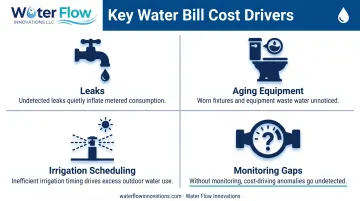
These drivers also split by when they originate. Some costs lock in at the decision stage: fixture specs chosen at install, landscape design, and the plumbing layout used at construction. Others build from ongoing conditions: occupancy habits, deferred maintenance, and irrigation timing.
A third category is easy to miss entirely: aging infrastructure and meter over-reading, where turbulent flow or worn measuring equipment inflates reported usage.
For facility managers and commercial property owners, the mix usually skews toward sub-metering gaps, aging plumbing, process or irrigation load, and deferred infrastructure work across dozens or hundreds of fixtures at once. Knowing which category drives your bill determines where to focus first.
Simple Ways to Reduce Your Water Bill
Not every fix works the same way. Some strategies change what you install before water use even begins. Others improve how you manage water while it's being used. And some fix problems in the system itself: the plumbing, the meter, or the infrastructure surrounding your water use.
Strategies That Reduce Costs by Changing Decisions Before You Buy or Build
These are the choices you make before the water ever starts flowing.
- Install EPA WaterSense-certified toilets, showerheads, and faucet aerators. Certified toilets use a maximum of 1.28 gallons per flush, at least 20% below the federal standard, and can save a facility thousands of gallons a year when replacing older units.
- Specify ENERGY STAR-certified washing machines and dishwashers. A full-size certified washer uses about 14 gallons per load versus 20 gallons for a standard model—useful in laundry rooms, kitchens, and multifamily common areas.
- Choose drought-tolerant, native landscaping and mulch at the design or renovation stage. Water-smart landscape design can cut outdoor use by 20-50% on commercial grounds, campuses, and larger properties.
- Plan for individual sub-metering in new construction or major retrofits, so usage and cost get tracked and allocated accurately from day one.
Strategies That Reduce Costs by Changing How Water Use Is Managed
This is about tightening visibility and consistency while water is actively flowing, without ripping anything out.
- Run a simple meter test. Check your meter, avoid all water use for two hours, then recheck it. Any movement usually means a leak.
- Review monthly statements for spikes. A sudden jump compared to prior periods often signals a leak or billing error worth investigating immediately.
- Use smart water monitors or utility dashboards to flag unusual consumption early. A peer-reviewed review of 21 studies on consumption feedback found usage decreases ranging from 2.5% to 28.6%, averaging around 12%, though results varied widely by format and property.
- Adjust irrigation timing to early morning and check sprinkler alignment monthly. Daytime watering loses significant volume to evaporation before it ever reaches the soil.
Strategies That Reduce Costs by Fixing the System Around Water Use
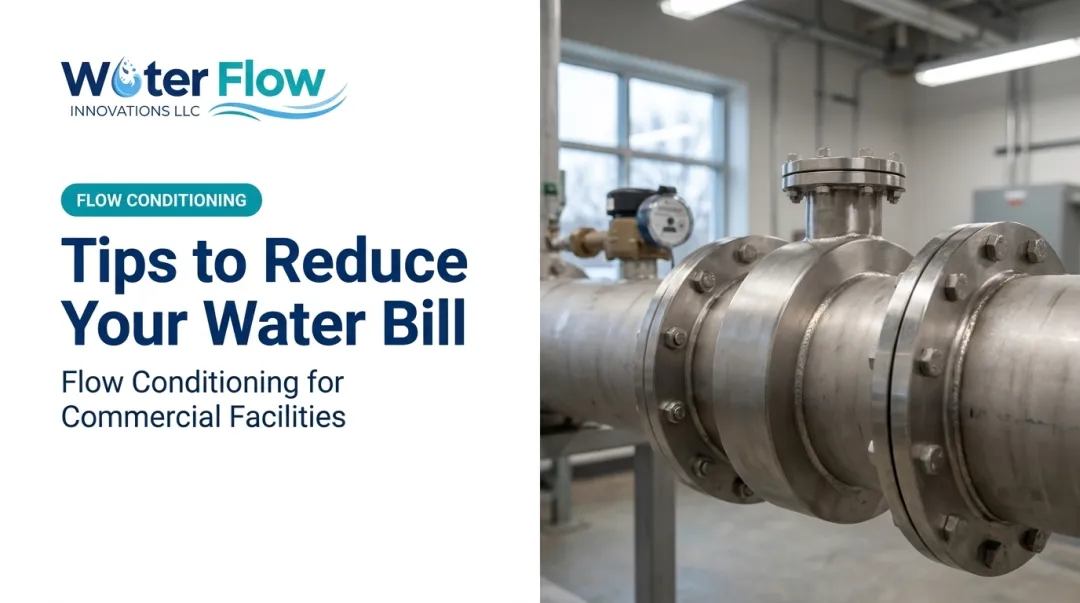
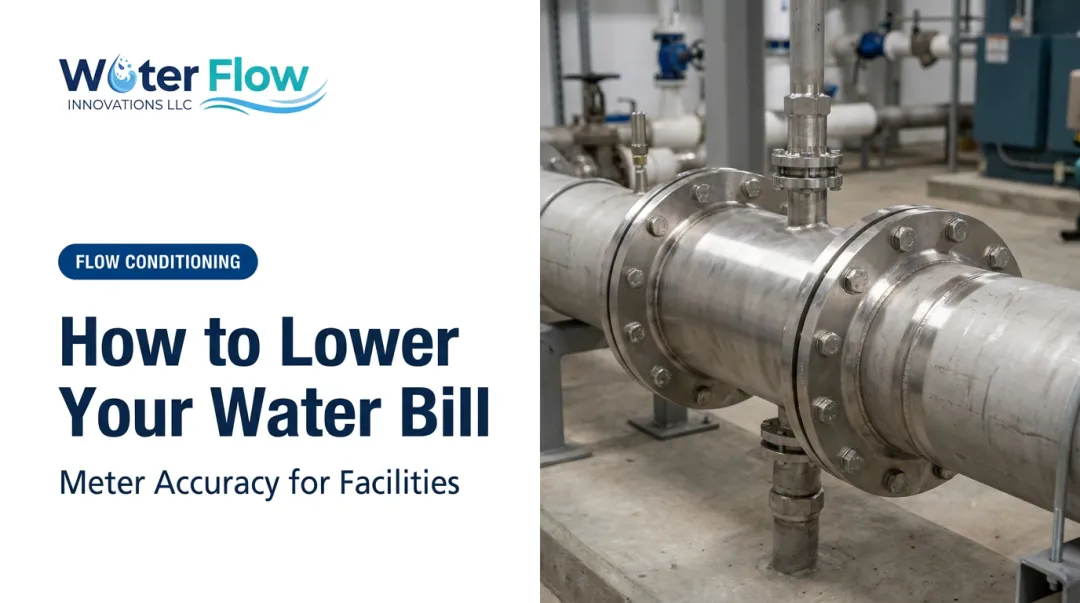
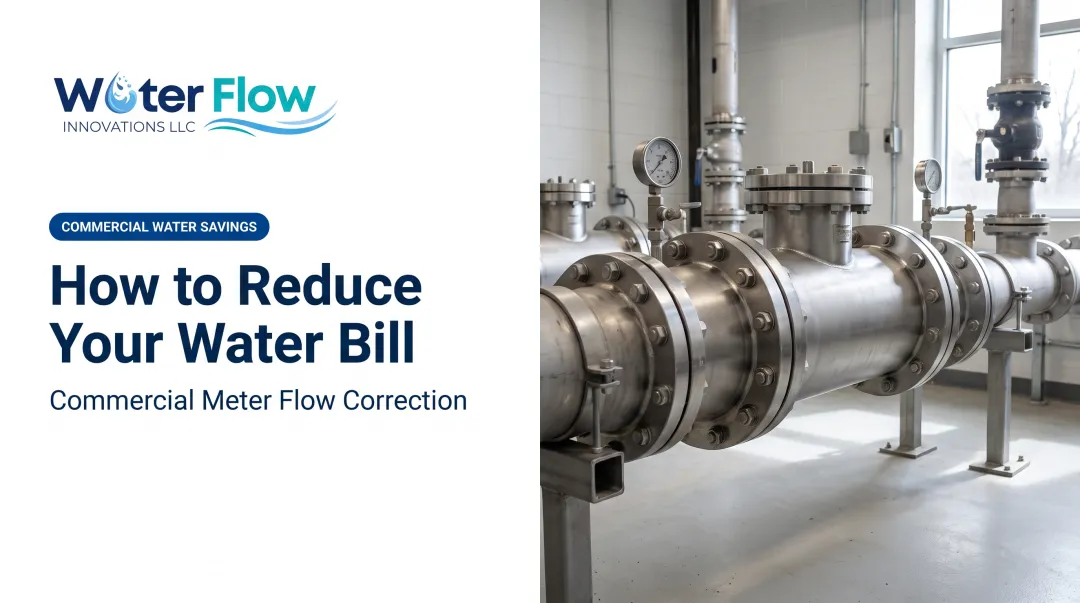
Sometimes the real problem isn't how much water you're using at all. It's an issue in the plumbing or metering infrastructure surrounding that use. This is where commercial and industrial facilities in particular run into a cost driver almost nobody checks: water meters can register more volume than actually passed through them. Here's why. Any time water travels through a pipe for more than about 30 feet, the flow becomes turbulent. Turbulence mixes air into the water through pump cycling, valve closures, pressure surges, or on-off demand from cooling towers, CIP systems, and irrigation zones. Standard meters can't tell the difference between water and air, so they count both. That means a facility can pay for volume it never actually received. This is exactly the problem Water Flow Innovation built its Flow Conditioning Device (FCD) to solve. The FCD installs directly after the municipal meter and creates laminar, bubble-free flow in the measurement zone, so the meter reads actual water only. Facilities using the FCD have documented 5-30% average reductions in combined water and sewer bills, with one verified result as high as 46%. Because sewer charges are typically calculated from metered water use, correcting the meter reading lowers both bills at once, with savings appearing on the very next billing cycle. Beyond meter correction, a few other system-level fixes are worth exploring:
- Local utility rebates for WaterSense fixtures, smart irrigation controllers, or sub-metering upgrades—some utilities offer up to $100 per fixture or a percentage of material costs
- Rainwater harvesting or greywater reuse on larger properties to cut dependence on metered municipal supply
Conclusion
Cutting a water bill meaningfully starts with finding out exactly where the cost originates — a leak, a habit, an old fixture, or a meter that's reading more than it should. Guessing at cuts rarely works.
The most durable savings come from stacking quick behavioral fixes with ongoing monitoring, and correcting systemic issues like meter over-reading at the source. Combine enough of these and the bill becomes a cost you control, not a fixed charge you simply absorb.
Frequently Asked Questions
How can a chief engineer reduce the water bill?
Chief engineers can audit fixtures and irrigation systems, sub-meter major equipment, and track usage trends monthly. Correcting meter over-reading with certified flow conditioning is often the largest untapped savings lever.
What factors most increase a building's water bill that a chief engineer can control?
Controllable factors include aging fixtures, unmonitored leaks, irrigation overuse, deferred maintenance on water heaters and boilers, and uncorrected meter accuracy issues caused by turbulent flow.
How do I decrease my water bill quickly?
Fix visible and silent leaks, install low-flow fixtures where needed, tighten irrigation schedules, and check for meter over-reading. These steps usually cut costs fastest with little or no disruption.
What causes sudden water bill increases?
Sudden spikes usually come from hidden leaks, heavier irrigation during hot weather, malfunctioning appliances, or in commercial systems, meter over-reading caused by air entrainment.
Can a water meter overcharge for water that was never actually used?
Yes. Turbulent flow and air entrainment inside pipes can cause standard meters to register more volume than actually passed through them. Certified flow conditioning devices (FCDs) correct that over-reading so you pay for water actually used.
Are there rebates or assistance programs available to help lower water bills?
Most utilities offer rebates for WaterSense fixtures, smart irrigation controllers, and efficient equipment, plus payment plans and assistance programs for qualifying customers and facilities.
What data does an engineer need to gather for an assessment?
Recent water and sewer bills, meter size, pipe size, line pressure, and PRV configuration. Those five inputs confirm whether the connection is over-reading and determine device sizing, and the review itself is free and carries no commitment.
Is asking the utility for a new meter the better first move?
Rarely. A replacement meter still counts everything reaching it, air included, so where the cause is entrained air or turbulence from the building's own pumps and demand cycling, the same over-reading returns after the swap.