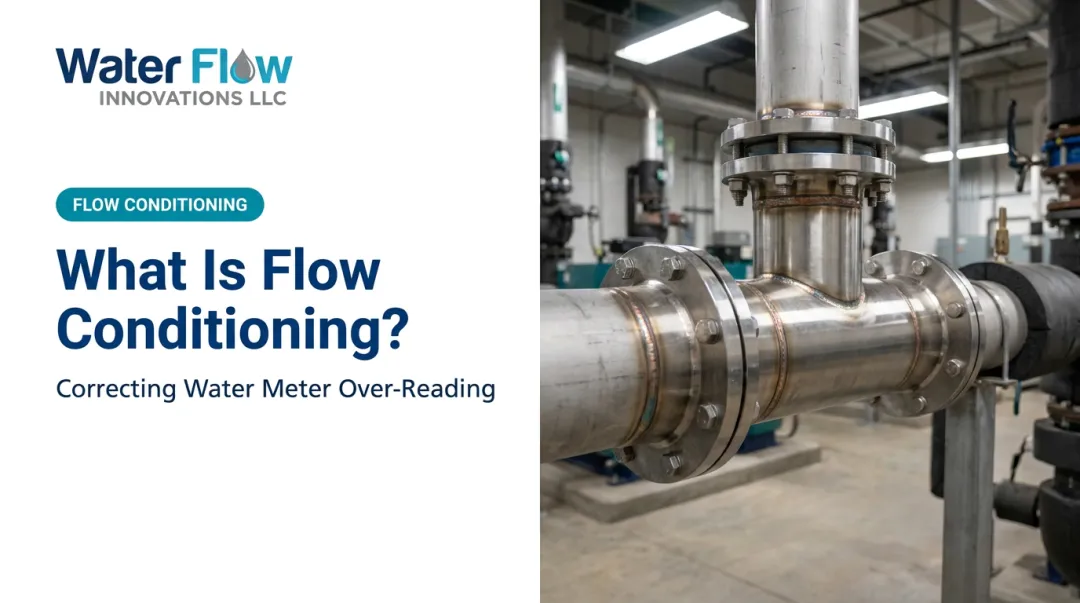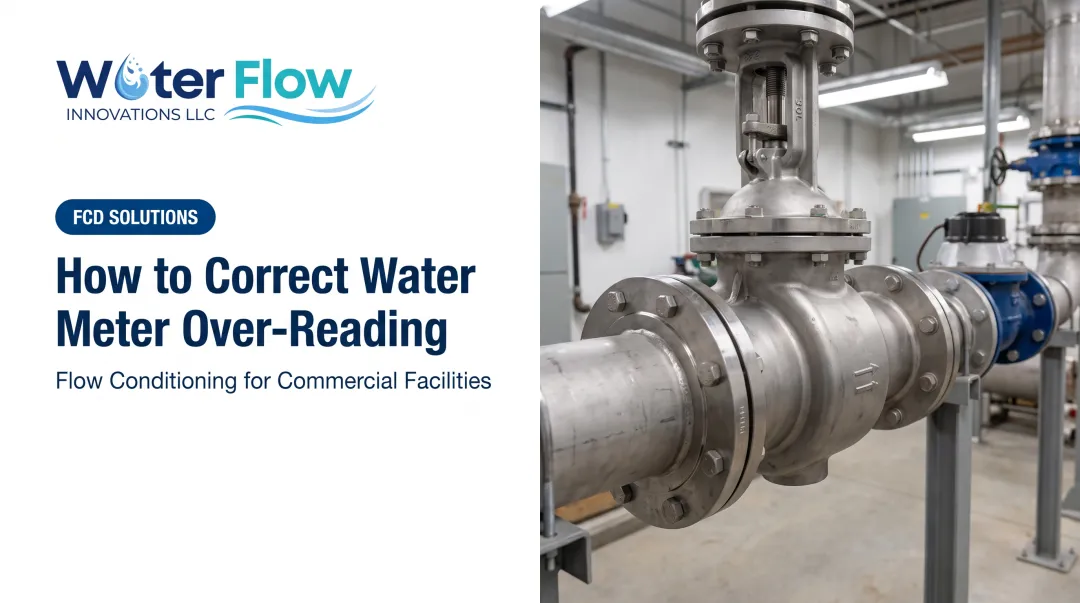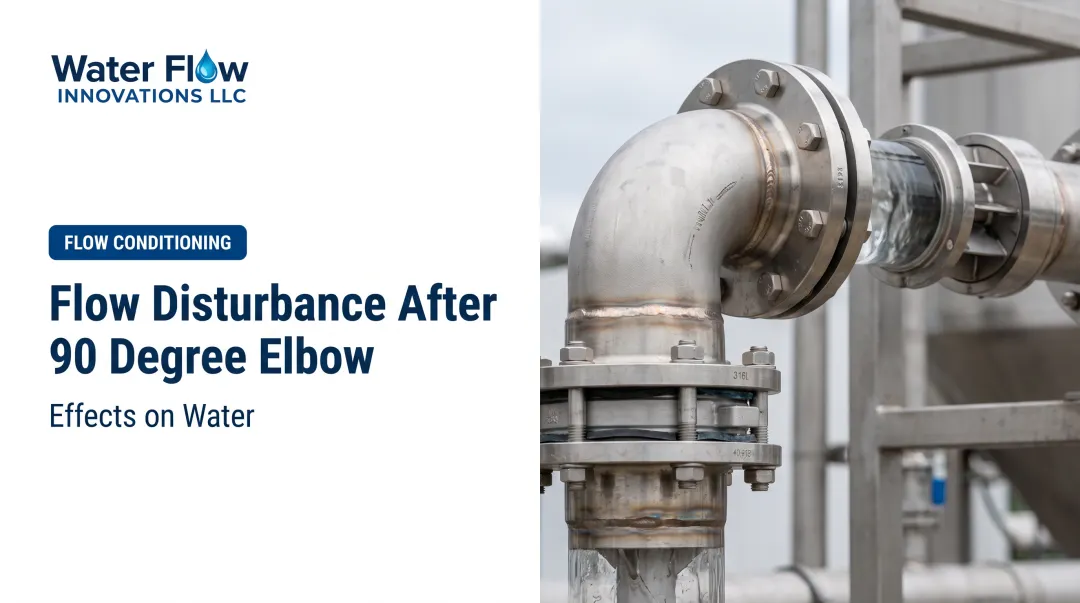

Flow asymmetry shows up in tidal estuaries, rivers, and pressurized pipe systems, but each has its own cause and its own consequences. In oceans, it reshapes sediment and coastlines. In buildings and factories, it can quietly inflate a water bill.
This article breaks down what causes asymmetry, how researchers study it, and why it matters — including for something as practical as accurate water metering.
Key Takeaways
- Flow asymmetry means water moves faster or longer in one direction than the other in a cycle.
- Friction, channel geometry, depth changes, and turbulence all drive this imbalance.
- Impacts range from natural sediment transport to meter error in commercial water systems.
- Correcting pipe-flow irregularities improves meter accuracy and cuts facility water and sewer costs.
What Is Water Flow Asymmetry?
Flow asymmetry describes the unequal duration or velocity of flow moving in opposite directions within a cyclical system. Researchers distinguish between two main types:
- Current skewness — unequal flood and ebb velocity maxima. A system is flood-dominant when peak incoming (flood) velocity exceeds peak outgoing (ebb) velocity, and ebb-dominant when the reverse holds.
- Saw-tooth asymmetry — unequal duration of rising versus falling phases, not peak speed. Researchers at TU Delft note this pattern often dominates in short basins, where basin length is much smaller than the tidal wavelength (Bosboom and Stive, 2021).

For contrast, unidirectional flow moves consistently in one direction without reversal. It's a simplifying baseline assumption in fluid mechanics: useful for calculations, but rarely how water behaves in the real world.
Asymmetry isn't confined to oceans and rivers, either. Turbulent, non-uniform flow shows up inside pipes and pressurized channels too, where fittings, bends, and air entrainment create uneven velocity profiles.
What Causes Flow Asymmetry in Tides and Channels?
Several physical factors interact to create asymmetric flow, and no single cause explains every estuary.
Geometry, Depth, and Friction
Basin shape has an outsized effect. Shoaling and narrowing channels change how fast a tidal wave propagates, so high water often moves faster than low water. A synthesis of 54 gauges across 26 estuaries confirmed that tidal amplitude, bottom friction, and channel geometry together determine how strongly a tide distorts (Friedrichs and Aubrey, 1988).
Friction plays a disproportionate role during low tide. Shallower water columns experience more drag relative to their volume, slowing the ebb phase more than the flood phase.
Intertidal Storage
Mudflats and marshes act as temporary water reservoirs. Research on the Ogeechee Estuary found that intertidal storage delays peak flood flow and advances peak ebb flow, but the effect isn't uniform.
Wetland elevation mattered more than total storage volume, and wetland friction actually weakened the storage effect in places (Bruder et al., 2014).
Flood-Dominance vs. Ebb-Dominance
Two patterns show up most often:
- Flood-dominant systems (large tidal amplitude, shallow channels) tend to import sediment landward.
- Ebb-dominant systems (large intertidal storage relative to channel volume) tend to export sediment seaward.

This is a tendency, not a rule. River discharge and storm surge can modify or override these patterns entirely.
A Different Kind of Asymmetry
Turbulence and air entrainment inside engineered channels and pipes create their own localized irregularities. Swirls, eddies, and trapped air make flow uneven across the pipe cross-section. That has nothing to do with tidal mechanics, but it still produces asymmetric flow that can cause water meters to over-read.
Tidal Asymmetry vs. Flow Asymmetry in Engineered Systems
It's tempting to lump tidal asymmetry and flow asymmetry in pipes together since both involve "uneven" flow. They're not the same phenomenon.
| Dimension | Tidal Systems | Engineered/Pipe Systems |
|---|---|---|
| Cause | Basin geometry, gravity, friction, storage | Valves, bends, rapid filling, hydraulic jumps |
| Time scale | Repeating tidal cycles | Steady or transient operating conditions |
| Consequence | Sediment transport, morphology | Meter reading errors, billing inaccuracy |
Both skew how the system is interpreted. For oceanographers, that means flawed sediment transport models. For facility engineers, it means water meters that don't reflect what's actually flowing through the pipe.
Tidal bores are the most extreme, visible version of tidal asymmetry: a steep, wall-like wave that travels upriver as the incoming tide steepens in a converging channel. NOAA documents Turnagain Arm in Alaska as a classic example, where a large tidal range and a shallow, narrowing inlet combine to produce the effect (NOAA, revised 2007).
In engineered systems, the extreme is less dramatic but persistent: swirl, jetting, and air entrainment at the meter that push readings above true volume.
Why Flow Asymmetry Matters for Water Management and Billing
Here's where this stops being an academic topic. Turbulent, asymmetric flow inside a pipe can cause a water meter to register more volume than the facility actually receives.
Air pockets and micro-bubbles pass through certain meter types and get counted as water. Distorted velocity profiles from bends, valves, or rapid demand cycling can also throw off a meter's reading.
A 2019 CFD and laboratory study found that a gate valve 75% closed immediately upstream of a Woltman meter produced errors of +42% to +46% (MDPI, 2019). That's an extreme, configuration-specific scenario, not a universal benchmark, but it shows how real the mechanism is.
This isn't limited to one industry. It shows up across pipe sizes, meter types, and flow conditions, translating directly into inflated water and sewer bills.
How Flow Conditioning Fixes This
Water Flow Innovation offers a Flow Conditioning Device (FCD) that corrects this problem. It installs immediately after the water meter and combines four components:
- Air and gas separation: creates back pressure that pushes air and gas bubbles out of the measurement zone, producing a homogeneous water column.
- Pressure regulation: smooths surges from on-off cycling and variable demand that can generate micro-bubbles.
- Check valve: reduces water hammer and prevents reverse flow that could reintroduce air (not always needed, depending on the site).
- Turbulence elimination: slows velocity enough at the meter to prevent vortex flow, particularly during CIP cycles, tank filling, or irrigation.
The FCD is custom-fabricated in 316L stainless steel for pipe sizes from NPS ½" to 12" (DN20–DN500), and it's IAPMO, NSF, ANSI, CAN 61, KIWA, GMP, and SQF certified.

Facilities across manufacturing, hospitality, healthcare, and municipal buildings have documented average reductions of 5–30%, with a highest recorded result of 46%. About 90% of customers reach full ROI within 12 months, with savings appearing on the very next billing cycle.
How Flow Asymmetry Is Measured and Modeled
Researchers rely on a few core techniques to visualize and quantify tidal asymmetry.
- Tidal curves plot water level, velocity, and discharge over a cycle to reveal skewness.
- Harmonic analysis compares amplitude ratios between tidal constituents; a stronger overtide relative to the principal tide signals more distortion (Song et al., 2011).
- Derivative skewness uses the rate of change in water level, not raw values. Its sign shows flood or ebb dominance, which ordinary skewness cannot.
- Shallow water equations, sometimes coupled with sediment-balance models, help predict vorticity and flow skewness in complex estuaries.

Those same distortion patterns show up inside facility piping, where engineers need a faster read than a full hydrodynamic study. Water Flow Innovation's free water bill review examines billing history, meter type, pipe size, and operational patterns (such as CIP cycles or irrigation zoning) that tend to create unstable flow.
The output is a facility-specific savings estimate rather than a lab-grade CFD model, but it identifies the same underlying problem: flow that isn't behaving the way a meter assumes it will.
Frequently Asked Questions
What is the definition of unidirectional flow?
Unidirectional flow moves consistently in one direction without reversal, unlike oscillating tidal flow or pulsating pipe flow. It is a simplifying assumption in basic flow calculations, not a description of most real-world systems.
What causes flood-dominance versus ebb-dominance in tidal systems?
Large tidal amplitude and shallow channels tend to favor flood-dominance, while large intertidal storage volume relative to channel size favors ebb-dominance. Local geometry and friction can shift or reverse these tendencies.
What is a tidal bore and how does it relate to flow asymmetry?
A tidal bore is an extreme case of tidal asymmetry where the incoming tide steepens into a wall-like wave that travels upriver. It occurs in shallow, narrowing estuaries with large tidal ranges, like Turnagain Arm in Alaska.
Can turbulence in pipes cause similar asymmetry issues as tides?
The mechanisms differ entirely, but both create non-uniform flow. In pipes, turbulence and entrained air can distort velocity profiles enough to affect meter readings, much like tidal distortion affects sediment models.
How can facilities correct flow-related water meter inaccuracies?
Certified flow conditioning devices, such as the FCD from Water Flow Innovation, stabilize turbulent flow and remove entrained air at the meter. That improves reading accuracy without changing system performance.
Does correcting flow asymmetry change how much water a facility actually uses?
No. Flow conditioning corrects meter over-reading rather than changing actual consumption or operations. The facility still uses the same amount of water. The bill just reflects it accurately.
What size of correction does removing asymmetry produce?
Documented installations average a 5–30% reduction in combined water and sewer charges, with a highest documented single result of 46%, delivered purely through more accurate measurement.
How long is the supply interrupted during installation?
One hour, and only that hour. A licensed plumber or mechanical contractor fits the custom-built device at the municipal supply connection, and normal operation resumes as soon as water is restored.