Introduction
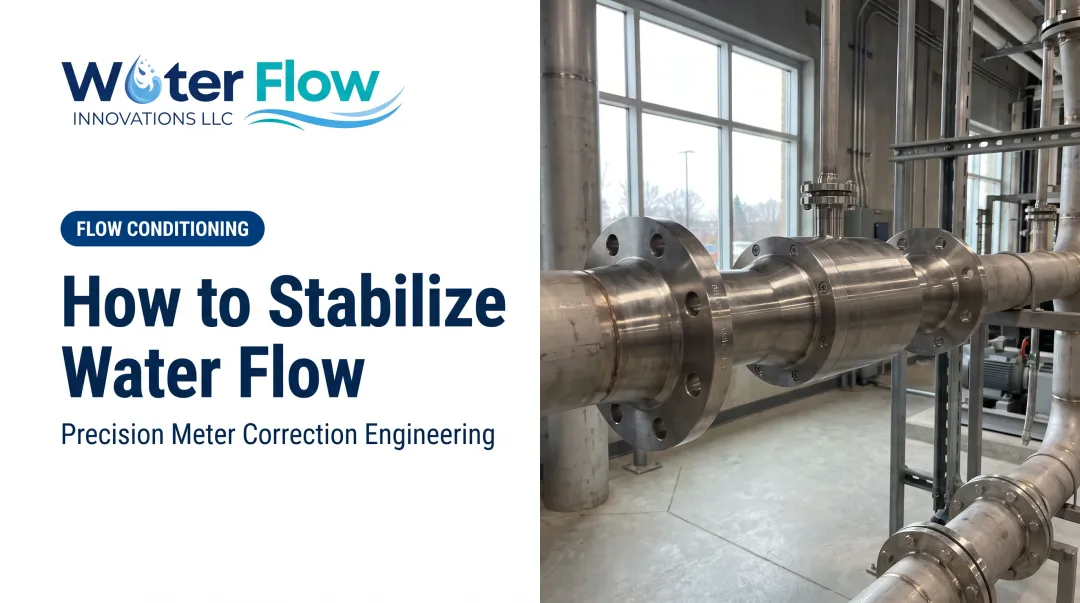
Sewerage systems rarely carry smooth, predictable flow. Pump discharge, elbows, partly closed valves, and diameter changes churn water into a turbulent, aerated stream before it reaches a meter or treatment plant inlet.
How well that flow is conditioned before measurement shapes plant decisions and the accuracy of the bill a facility pays each month. When air entrainment and swirl reach the meter, over-reading is common—and commercial sites often see water and sewer charges drop 5–30% once flow is corrected, without changing actual usage.
The right fix depends on pipe layout, meter type, where turbulence starts, and whether you need measurement accuracy, equipment protection, or relief from an inflated water and sewer bill.
This article walks through steps to improve flow conditioning, when it matters most, the variables that drive results, common installation mistakes, and alternatives worth knowing.
Key Takeaways
- Flow conditioning cuts turbulence and air entrainment so meters read true volume.
- Poor conditioning makes meters over-register, inflating sewer charges on that volume.
- Match the method to pipe size, turbulence sources, and accuracy or billing goals.
- Low-turbulence paths with straight-pipe clearance drive the biggest cost gains.
How to Improve Water Flow Conditioning in Sewerage Systems
Improving flow conditioning is a four-step process: measure the real profile in the line, match a method to your goal, install it correctly, then validate results against a baseline.
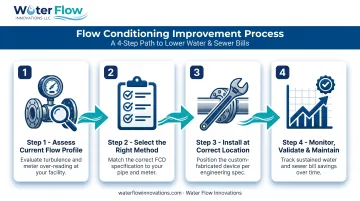
Step 1: Assess the Current Flow Profile
Start by measuring what's actually happening in the pipe. That means checking turbulence, air entrainment, and velocity variability at key points — pump station discharge, treatment plant inlets, or metering locations.
- Map upstream disturbances. Elbows, valves, pumps, and diameter changes within the recommended straight-run distance all distort the velocity profile.
- Document a baseline. Record flow readings or billing data before making any changes, so you have something concrete to compare against later.
A butterfly valve positioned too close to a meter, for example, can push measurement error above 50% for certain meter types, according to McCrometer's technical guidance. Direction and magnitude vary by meter type, so treat that figure as a warning, not a universal constant.
Step 2: Select the Right Flow Conditioning Method
Match the method to three things: pipe size, flow type, and your primary goal.
- Measurement accuracy: needed at treatment plant inlets and pump stations where operational decisions depend on the reading.
- Equipment protection: relevant where turbulence stresses downstream valves, pumps, or instrumentation.
- Billing accuracy: relevant for any facility billed on metered water use, where measurement error directly inflates both water and sewer charges.
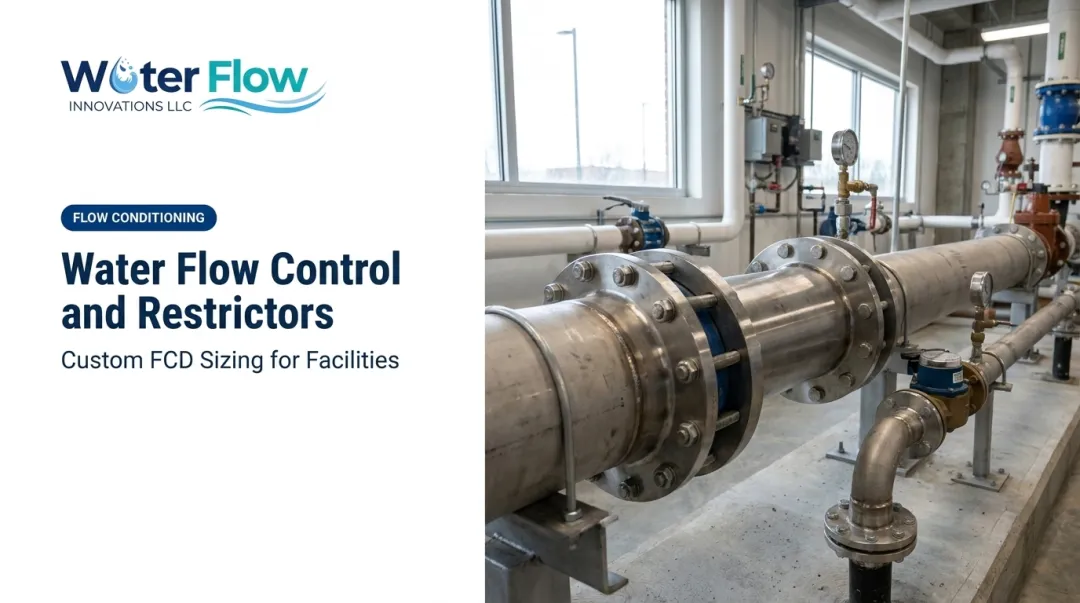
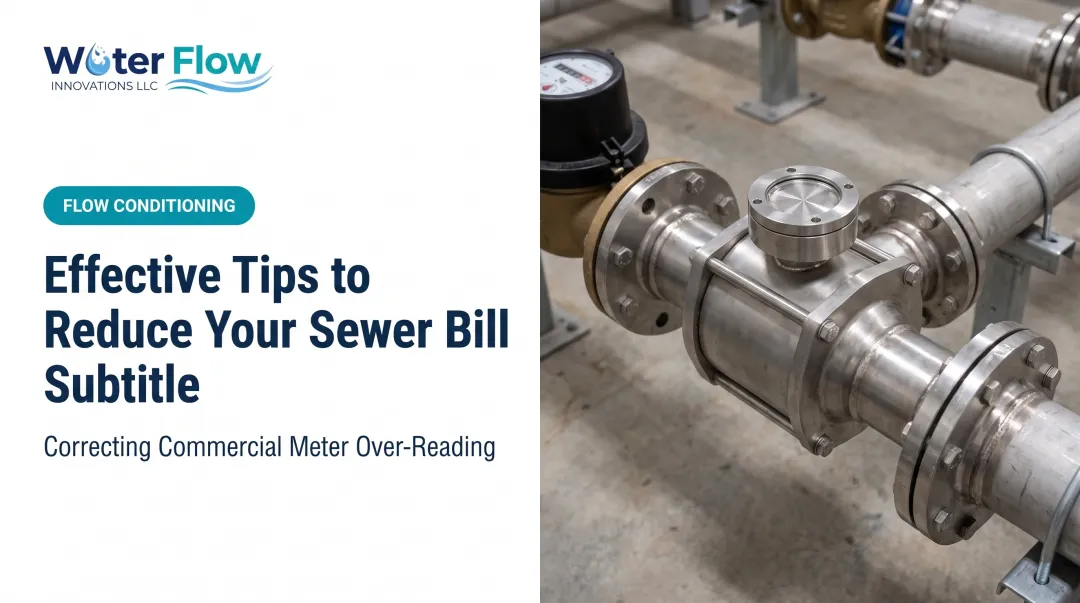
For billing accuracy, a certified flow conditioning device such as Water Flow Innovation's FCD corrects turbulence and air entrainment that cause meters to over-read. It targets the root cause of over-billing rather than treating the bill as a usage problem.
Whatever device you choose, confirm certifications fit the application. IAPMO, NSF, ANSI, CAN 61, and KIWA are the references most often cited for potable-water-contact components.
These marks confirm health-effects and material safety, not hydraulic performance on their own. Pair certification review with installation data for your specific device.
Step 3: Install at the Correct Location and Orientation
Placement matters as much as the device itself.
- Verify straight-pipe clearance. Manufacturer specs vary widely. Some magnetic meters call for 5D upstream and 2D downstream, while clamp-on ultrasonic meters can require 15D or more depending on nearby disturbances.
- Confirm orientation, pressure rating, and pipe material. Steel, copper, ductile iron, PVC, and CPVC all behave differently under installation stress.
- Use a licensed plumber or qualified technician. Code compliance and correct orientation are easy to get wrong without hands-on experience.
Step 4: Monitor, Validate, and Maintain Results
Installation only counts once the data backs it up.
- Compare post-installation flow readings or billing cycles against your documented baseline.
- Set a periodic review schedule. New upstream equipment or pipe repairs can reintroduce turbulence months later.
- Passive mechanical conditioners typically need no ongoing maintenance, unlike options with moving parts, seals, or calibration cycles.
When Flow Conditioning Matters Most & What You Need First
When Flow Conditioning Makes the Most Sense
Not every facility needs to prioritize flow conditioning immediately. It matters most when:
- Municipal treatment plant inlets and pump stations rely on flow verification for operational decisions.
- Commercial and industrial facilities pay sewer charges on metered water use, so over-registration inflates the bill directly.
- Older pipe networks or retrofit sites cannot accommodate major infrastructure changes or pipe cutting.
What You Need Before Starting
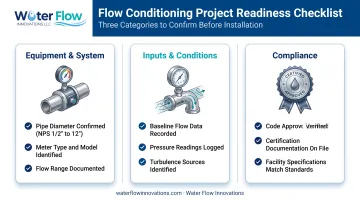
If your site fits one of those situations, gather three categories of information before choosing an approach:
| Category | What to Confirm |
|---|---|
| Equipment/System | Pipe diameter, meter type, and flow range compatibility |
| Inputs & Conditions | Baseline flow data, pressure readings, known turbulence sources |
| Compliance | Local plumbing code approval, certifications for potable or wastewater use |
Key Parameters That Affect Flow Conditioning Results
Five variables decide whether a conditioning method fixes the problem or only adds cost.
- Pipe diameter and material shape turbulence patterns and limit which methods fit without a major retrofit.
- Flow velocity and turbulence intensity: Faster flow reacts more violently to bends or obstructions, so higher-velocity lines need stronger conditioning closer to the meter.
- Air and gas entrainment must be removed at the source, not downstream. A 2025 lab study on pipe-refill conditions found mechanical meters registered 33% to 63% of displaced air volume as billable flow.
Air can be totalized like water. Treat continuous sewer entrainment at the source even though that test used rapid refill, not steady sewer flow.
- Straight-run clearance upstream and downstream: even a well-chosen device fails if runs are too short.
- Pressure conditions: the method must hold performance with negligible pressure loss so it does not hurt overall system operation.
Common Mistakes and Troubleshooting Tips
Common Mistakes to Avoid
- Skipping a baseline flow and turbulence assessment before selecting a device.
- Ignoring manufacturer-specified straight-pipe clearance requirements during installation.
- Sizing a device only to pipe diameter, ignoring actual flow rate and turbulence conditions.
- Declaring success without comparing before-and-after billing or flow data.
Troubleshooting Common Issues
Problem: Flow readings remain inconsistent after installation. Likely cause: insufficient straight-pipe clearance or incorrect orientation. Check the manufacturer spec sheet against the actual installation placement. This is the single most common gap.
Problem: Bills haven't dropped despite installing a conditioning solution. Likely cause: the high bill was consumption-driven, not measurement-driven, or a leak is involved. A free water and sewer bill review from Water Flow Innovation isolates consumption issues from measurement-driven overcharges before you assume the device underperformed.
Alternatives to Flow Conditioning Devices
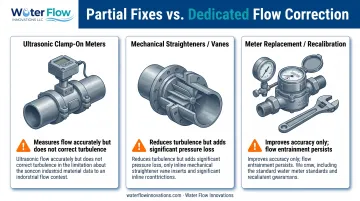
Not every situation calls for a dedicated conditioning device. Three alternatives are worth weighing:
- Ultrasonic clamp-on flow meters — non-invasive checks at treatment plant inlets; they measure flow but do not correct it, so over-reading can remain.
- Mechanical flow straighteners or vanes — cut turbulence with fixed internal geometry, but usually need more space and can add pressure loss.
- Meter replacement or recalibration — improves meter accuracy only; upstream turbulence and air entrainment stay in place, so over-reading can return when conditions shift.
Each option helps in a limited way. None of them removes turbulence and entrained air from the measurement zone.
Frequently Asked Questions
Which flowmeter is suitable for sewage flow measurement?
Ultrasonic clamp-on flowmeters are commonly used for non-invasive sewage monitoring since they handle solids-laden flow without cutting into pipes. Electromagnetic meters are another option, particularly for conductive slurries with entrained solids.
What is the name for a device that regulates water flow?
They are called flow conditioning devices or flow regulators. Conditioning devices smooth turbulence and air entrainment, while flow control valves restrict volume. They solve different problems.
What causes turbulence and air entrainment in sewerage systems?
Common causes include pipe bends, partly closed valves, pump discharge points, and insufficient straight-pipe runs near measurement points. Diameter changes and check valves contribute as well.
How does flow conditioning at the water meter affect sewer bills?
Many utilities calculate sewer charges as a percentage of metered water use — New York City's FY2027 sewer rate is set at 159% of the water charge. Correcting meter over-registration reduces both charges at once.
How much straight pipe run is required for accurate flow conditioning?
Requirements vary by device and pipe diameter. Some call for 5D, others 15D or more. Always follow manufacturer specifications for your specific device and installation.
Can flow conditioning devices be retrofitted at existing water meters?
Yes. Most units retrofit into the water line at the meter with minimal disruption. Water Flow Innovation's FCD typically installs in about an hour, with a brief water shutoff at the meter connection, and does not require extended downtime.
How much does correcting the intake reading recover?
Documented installations average a 5–30% reduction across combined water and sewer charges, with a highest documented single result of 46%, since both lines derive from the same corrected reading.
Which public-sector operations carry this exposure?
Municipal water and wastewater treatment plants, municipal buildings, and waste-to-energy facilities and MSW combustors — operators that run the network yet still pay metered charges on their own service connections.