That adds up fast. When New York City ran a conservation challenge across 30 restaurants, it found potential savings ranging from $4,000 to $41,000 per restaurant per year, depending on size and equipment. Leaks, worn valves, and inefficient habits were the biggest culprits.
Here's the good news: restaurant water costs aren't inherently this high. They climb because of equipment choices, staff habits, and metering inaccuracies that often go unnoticed. This guide breaks down how those costs build, what drives them, and a three-tier strategy to bring them back down.
Key Takeaways
- Water costs add up across dishwashing, ice machines, and restrooms, not one obvious line item
- Fix small leaks early—months of silent waste often show up only as a sudden bill spike
- Equipment and procurement decisions made once create the biggest long-term savings
- Daily operational habits (full loads, maintenance schedules) sustain those savings
- Meter over-reading from turbulent flow can inflate bills even with zero leaks or waste
How Restaurant Water Costs Typically Build Up
Restaurant water bills rarely spike from one obvious source. They accumulate through continuous, low-visibility activity: dishwashing cycles, pre-rinse stations, ice machines, beverage lines, and restroom traffic, all running in the background of every shift.
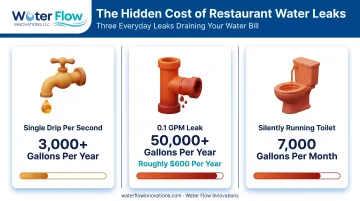
Some of this waste compounds quietly. A single drip per second can waste more than 3,000 gallons a year. A 0.1 gallon-per-minute leak can exceed 50,000 gallons annually, costing close to $600 in water charges alone. A silently running toilet can waste up to 7,000 gallons a month—no alarms, no puddles, just a slowly climbing bill.
Other cost jumps are episodic rather than gradual:
- Equipment failures (a stuck valve, a cracked hose)
- Seasonal volume surges during peak dining seasons
- Staff turnover leading to inconsistent habits
The problem with both types of waste is visibility. Most operators don't discover these issues until a monthly bill anomaly, a leak-detection audit, or a utility notice forces a closer look. By then, months of waste may already be baked into past invoices.
Shari's Cafe and Pies learned this firsthand. After auditing water use across 95 locations, the chain found continuous-flow dipper wells, broken faucets, and missing aerators were driving excess consumption.
Fixing them cut average water use by 30% and saved roughly $615,000 annually in combined water and sewer costs, according to an EPA WaterSense case study. Dipper-well fixes alone accounted for a 35% average reduction at those locations.
Key Cost Drivers for Restaurant Water Bills
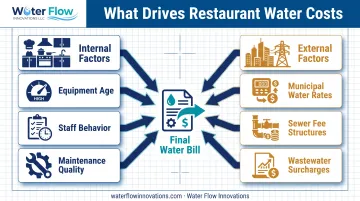
Every restaurant's water bill is shaped by a different combination of factors. Understanding which ones apply to your operation matters more than chasing generic advice.
Equipment, Staff, and Maintenance
Three internal factors typically dominate:
- Equipment type and age — older dishwashers, pre-rinse valves, and ice machines use significantly more water per cycle than current models
- Staff behavior — how servers, dishwashers, and cooks use water during service, day in and day out
- Facility maintenance quality — worn washers, aging pipes, and meters that drift out of calibration
Some are one-time decisions (what equipment you specify at build-out). Others are daily habits. A third group builds up over years as fixtures wear down.
External Factors Outside the Kitchen
Not every cost driver is internal. Municipal rate structures and sewer fees can swing your bill regardless of how efficiently your kitchen runs. For example:
| City | Water Rate | Sewer Rate | Notes |
|---|---|---|---|
| New York City | $5.35/100 cu ft | 159% of water charge | Combined rate: $13.86/100 cu ft |
| Chicago | $4.98/1,000 gal | 100% of water charge | Before other applicable charges |
| Portland | Standard rate | Standard + BOD/TSS surcharge | Extra charges for food-service wastewater strength |
Portland's extra-strength wastewater charges are a good example: restaurants pay more based on the biological load in what they discharge, not just the volume. A grease trap on a poor cleaning schedule can drive up a sewer bill independent of anything happening at the tap.
A fine-dining restaurant running heavy dishwashing loads will have a different dominant cost driver than a quick-service outlet built around high seat turnover and beverage service. No single fix applies to every restaurant type. The strategies below are organized by what you're actually changing.
Cost-Reduction Strategies for Restaurant Water Bills
Effective water-cost reduction works through three levers: what you buy, how you manage daily use, and what's happening in the plumbing and metering system behind the scenes. Each requires a different approach.
Strategies That Reduce Costs by Changing Decisions
These are choices made once, at purchase, renovation, or policy-setting, that pay off for years without daily management effort.
Specify efficient equipment before you need to retrofit it. Look for:
- Low-flow pre-rinse spray valves rated at 1.00–1.28 gallons per minute under current federal standards
- ENERGY STAR-certified dishwashers, which save an average of over 5,647 gallons per year compared to standard models
- Sensor-activated faucets in prep and restroom areas
Set policy-level defaults. Serving drinking water only upon request eliminates unnecessary glass washing and reduces water that gets poured out untouched. Build water-conservation habits into new-hire training from day one:
- Use thaw racks instead of running water under thawing product
- Load dishwashers correctly and consistently
- Report dripping faucets or slow-draining fixtures immediately
Require water-efficiency certifications as a standard line item in your procurement checklist, the same way you'd check for energy ratings on a new oven.
Strategies That Reduce Costs by Changing How Water Is Managed
Once systems and staff are in place, the next lever is consistency—making sure what's already efficient stays efficient.
- Enforce full-load-only policies for dishwashers. Running fewer, fuller cycles can save hundreds of dollars a year in combined water, energy, and chemical costs
- Build a recurring maintenance schedule for faucets, toilets, and grease traps to catch wear before it becomes a leak
- Run periodic manual leak checks by shutting off all fixtures and watching the meter's leak-indicator dial for movement between billing cycles
- Share actual bill data with staff so teams can see the tangible dollar impact of their daily habits
None of this requires new capital. It requires discipline and a calendar.
Strategies That Reduce Costs by Changing the Context Around Water Use
Sometimes the restaurant's actual usage isn't the problem—the plumbing, metering, or billing system feeding into the bill is.
Submetering and smart-meter technology give granular, real-time visibility into usage patterns, helping you catch anomalies faster than a manual leak check ever could.
Commercial water meters can over-register usage due to turbulent flow and air entrainment inside restaurant plumbing. A dish machine filling and draining 40 to 60 times an hour at peak service, combined with CIP cycles, ice machines, and bar equipment, introduces air and pressure surges into the line.
Meters read that air as billable water, meaning you can be charged for water you never actually consumed, with zero leaks anywhere on the property.
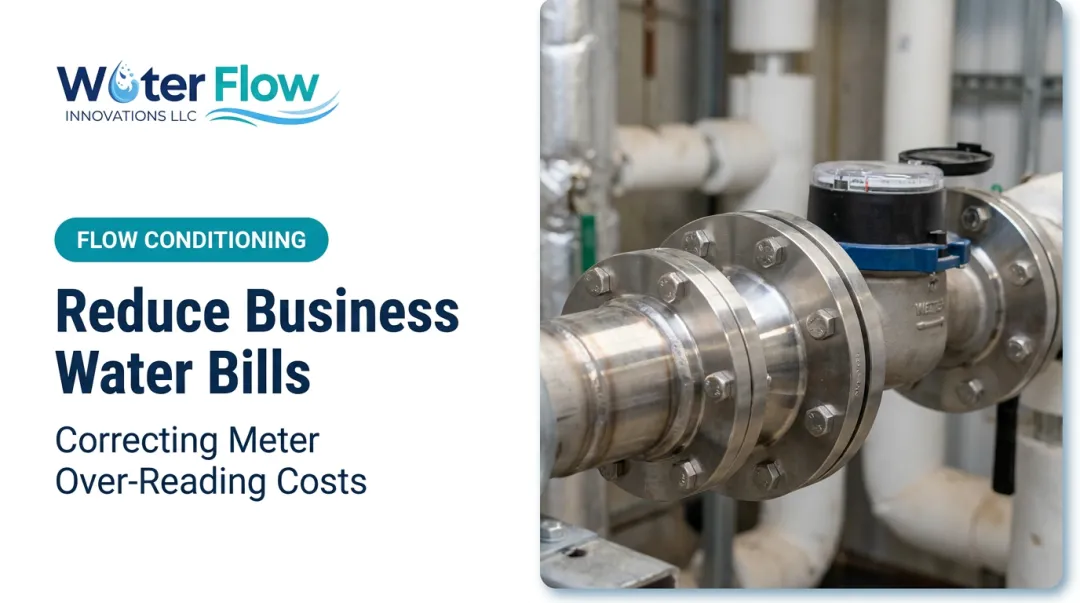
A certified flow conditioning device (FCD) from Water Flow Innovation corrects the reading at the meter itself. The device combines four functions (air and gas separation, pressure regulation, a check valve, and turbulence elimination) to create a smooth, bubble-free water column through the measurement zone.
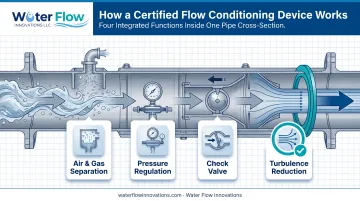
Restaurant customers typically see 5–30% reductions in combined water and sewer bills, with the highest documented single-installation result at 46%. Because the correction happens at the meter, savings show up on the very next billing cycle, with no change to kitchen pressure, dish machine performance, or food safety compliance.
Beyond metering, review:
- Utility rate structures and sewer fee calculations with your local provider. Rate tiers can be as impactful as usage itself
- Site-level infrastructure such as aging supply lines, irrigation systems, and backflow assemblies, which can quietly inflate bills outside the kitchen entirely
Conclusion
Reducing restaurant water costs starts with correctly identifying the source: behavior, equipment, maintenance, or metering accuracy. Cutting usage blindly without knowing which lever you're pulling wastes time and often misses the real problem.
Lasting savings come from working all four levers: smarter equipment choices, tighter daily habits, steady maintenance, and accurate metering. Skip one and you keep paying for waste you never see on the line.
If usage fixes still don’t match the bill, Water Flow Innovation offers a free water bill review to check whether meter over-reading is inflating your costs.
Frequently Asked Questions
How can a restaurant save water?
Combine behavioral fixes like serving water on request and full dishwasher loads with equipment upgrades such as low-flow valves and sensor faucets. Add regular maintenance and leak checks to catch problems early. Together, these typically deliver the largest reduction.
How much water does a small restaurant use?
A monitored quick-service/cafe example used about 936 gallons a day, split across sanitation, drinks and ice, and restrooms. Full-service restaurants use considerably more, often averaging around 5,800 gallons daily.
What is the average water bill for a restaurant?
There's no single national average. Bills vary widely by size, equipment, and local rate structure. One NYC study found restaurants had $4,000 to $41,000 in annual savings potential once inefficiencies were addressed.
Can a restaurant's water meter overcharge it even without a leak?
Yes. Turbulent flow and air entrainment from equipment like dish machines and other high-flow kitchen equipment can cause meters to over-register usage independent of any leak. Certified flow conditioning devices correct this discrepancy at the meter itself.
How quickly can a restaurant see savings from water conservation efforts?
Behavioral changes like full-load policies typically show measurable results within a billing cycle or two. Flow conditioning corrections can reflect savings on the very next bill after installation, with no operational ramp-up required.
Do water-saving upgrades require closing the restaurant or disrupting service?
Most fixture upgrades and flow conditioning installations take about an hour, usually scheduled outside business hours. There's no lasting operational disruption, and kitchen equipment pressure remains unaffected.
How does meter over-reading affect the sewer line of a restaurant bill?
Most utilities calculate sewer as a percentage of metered water intake, typically 80–120% of the water charge. Every phantom gallon is therefore billed twice, once as water and once as sewer, even though it never entered a drain. Food service sites are already billed heavily on the sewer side, so an inflated intake reading compounds quickly across a year.
Which food-service operations see the largest correction?
Sites with constant on-off demand across one meter: restaurants and fast food, supermarkets, bakeries, hotel and resort kitchens, and truck stops. Documented reductions average 5–30% of combined water and sewer charges, with a highest documented result of 46%.