For a household, that stings. For a hotel, manufacturing plant, or apartment complex running thousands of gallons a day, it's a serious operating expense.
Residential bills vary widely by region. Commercial and industrial accounts can run into the thousands per month depending on meter size and volume. What most people don't realize: a chunk of that bill often has nothing to do with actual water use.
A water bill isn't inherently expensive. It becomes expensive through a mix of usage habits, aging infrastructure, rate hikes, and billing or metering inaccuracies that go unnoticed for years. This guide breaks down where those costs come from and what you can actually do about them.
Key Takeaways
- Water bills build gradually from usage and fees, but spike suddenly from leaks, rate hikes, or meter errors
- Cost drivers include consumption, local rate structures, aging meters, and infrastructure condition
- The biggest savings combine behavior changes, better monitoring, and fixing structural billing issues
- Some fixes need zero behavior change, like correcting meter over-reads or claiming assistance programs
- Layering strategies beats relying on a single tactic, like fixture upgrades alone
How Costs Around Your Water Bill Typically Build Up
Every water bill combines three components: metered usage charges, sewer/wastewater fees (usually tied to your water usage), and fixed base charges you pay regardless of consumption.
Some cost increases creep up slowly:
- Annual rate hikes from your local utility
- Seasonal usage creep (irrigation, cooling towers, seasonal production)
- Aging fixtures and equipment losing efficiency over time
Others hit all at once. A burst pipe, an irrigation valve stuck open, a cooling tower malfunction, or a meter swap can send a facility's bill soaring overnight. Meter-related spikes deserve special attention, since they often trace back to how accurately (or inaccurately) your meter reads flow in the first place.
The Hidden Catch-Up Bill Problem
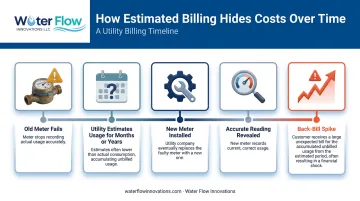
One of the more frustrating meter-related scenarios involves replacements. Philadelphia's water department explains that when an old meter stops functioning correctly, the utility estimates your usage. Once a new meter goes in and starts reading accurately, you can suddenly owe for months of underbilled water.
Columbus, Ohio saw this play out in 2025. Local reporting found the city can back-bill customers up to two years after new meters reveal higher actual usage than what was estimated.
This isn't proof that new meters over-read. It's proof that estimated billing accumulates cost that surfaces all at once — often with no warning until it lands on your statement. For facilities running older meters, the opposite problem is just as costly: turbulent flow can cause a meter to over-read for years before anyone notices.
Key Cost Drivers Behind a High Water Bill
Consumption is the obvious driver: fixture use, irrigation, leaks, occupancy levels. But it's rarely the whole story.
Rate Hikes and Infrastructure Spending
Utilities across the country are raising rates to fund aging infrastructure. Recent examples:
- San Diego raised water rates 5.2% and wastewater rates 6% in 2024 for core system upgrades (source)
- Bloomington, Illinois scheduled back-to-back 33% water rate increases in 2024 and 2025 to fund a $400 million infrastructure program (source)
These increases hit every customer on the system, regardless of how careful they are with usage.
Metering and Infrastructure Issues
Here's the piece most people never learn about: aging meters, air entrainment, and turbulent flow inside pipes can cause a meter to over-register, showing more volume than what's actually delivered.
This isn't a fringe theory. The American Water Works Association's own meter-testing research confirms that disturbed flow conditions upstream of a meter can create measurable testing errors. In real-world terms, that means facilities can pay for water they never actually received — a correctable error, not an unavoidable cost of doing business.
Sewer Charges Compound the Problem
Most utilities calculate sewer/wastewater fees based on metered water usage. Charleston Water, for example, bills sewer volume at 95% of metered water consumption. That means an inflated water reading doesn't just cost you once — it inflates your sewer bill too.
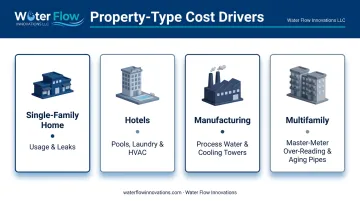
Rate increases, meter accuracy, and sewer calculations all stack on top of baseline usage, but their impact varies by property type. The dominant driver often depends on the facility:
| Property Type | Primary Cost Driver |
|---|---|
| Single-family home | Usage habits, leaks |
| Hotels | Multi-department demand (pools, laundry, HVAC) |
| Manufacturing | Process water cycling, cooling towers |
| Multifamily | Master-meter over-reading, aging pipes |
Cost-Reduction Strategies for Lowering Your Water Bill
The right fix depends on whether your problem is a usage issue, a management issue, or a structural/billing accuracy issue. Most facilities have some of all three.
Strategies That Change Usage Decisions
Start with the fixtures and habits you control directly:
- Audit fixtures and appliances — replace older toilets, faucets, and washing machines with WaterSense-certified models. EPA-labeled commercial toilets use about 20% less water than the federal standard requires
- Rethink landscaping — switch to drought-tolerant plants and drip/microirrigation, which uses 20-50% less water than conventional sprinklers
- Review your rate plan — commercial accounts with variable usage sometimes qualify for better tiers
- Time high-volume activities — consolidate laundry and dishwashing loads, avoid peak periods where tiered pricing applies
Strategies That Improve Water Management
Habit changes only get you so far if nobody's watching for waste. Build routine oversight into your operations:
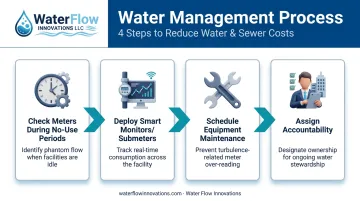
- Check meters during no-use periods — if the dial moves when nothing's running, you likely have a leak
- Deploy smart monitors or submeters — the EPA's commercial guidance notes submeters help isolate end uses and catch malfunctioning equipment before waste adds up
- Schedule equipment maintenance — cooling towers, dishwashers, and irrigation controllers all lose efficiency without upkeep
- Assign accountability — for multi-unit or commercial properties, someone needs ownership of usage tracking so spikes get caught in weeks, not months
Strategies That Fix the Context Around Water Use
This layer gets skipped most often, yet it's frequently where the largest savings are hiding.
Often, the real issue isn't usage volume at all — it's measurement accuracy.
Why meters over-read. Air entrainment, micro-bubbles, and turbulent flow inside pressurized pipes cause meters to register volume that was never actually delivered as usable water. This is a documented issue in commercial and industrial systems with variable demand cycling — think cooling towers, CIP cycles, irrigation start-ups, or high-frequency on/off cycling at a car wash.
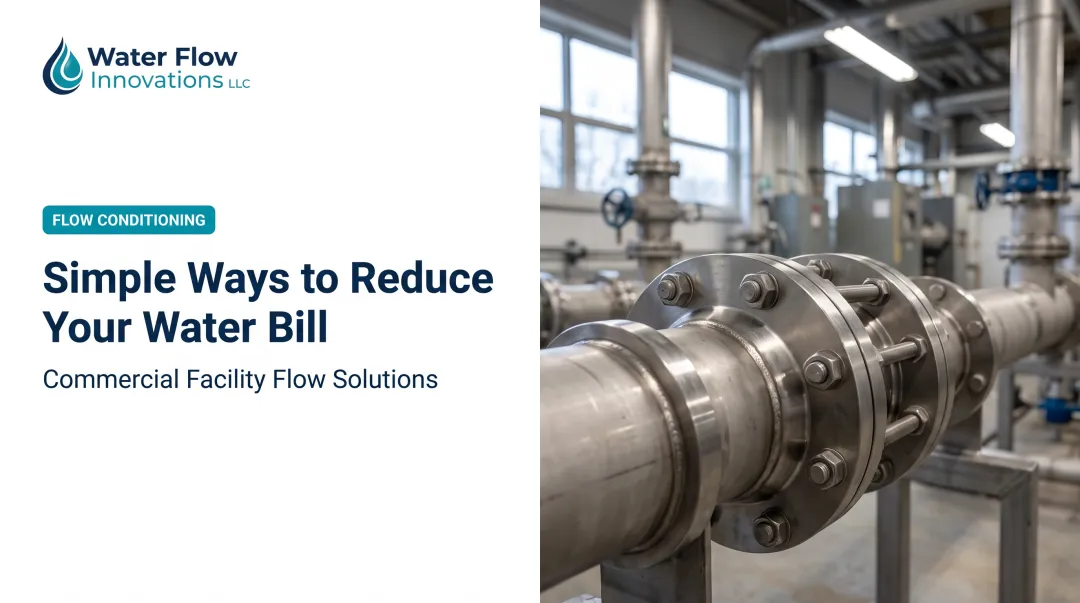
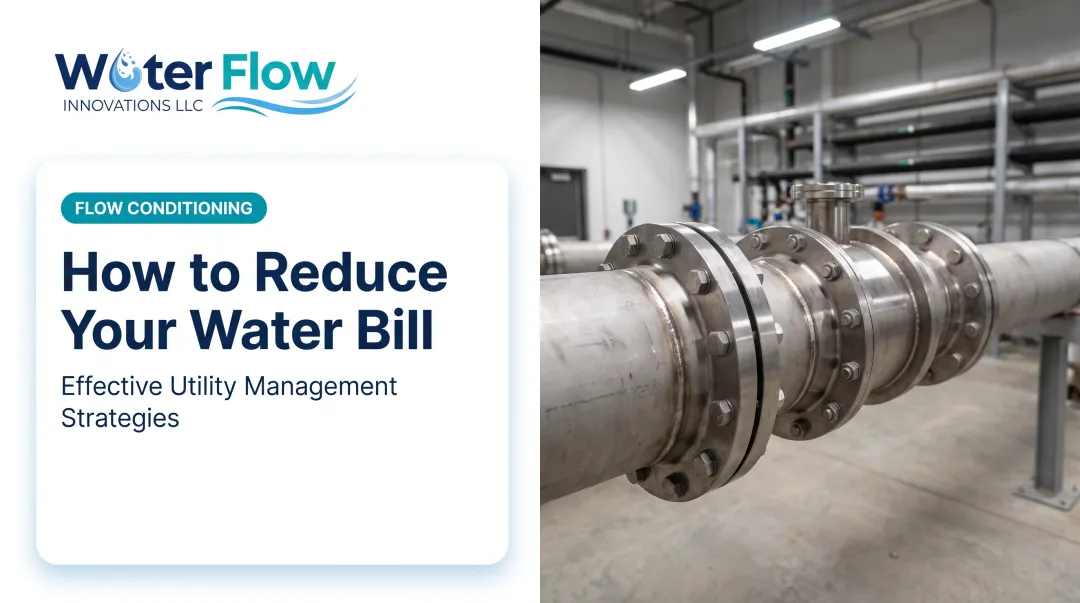
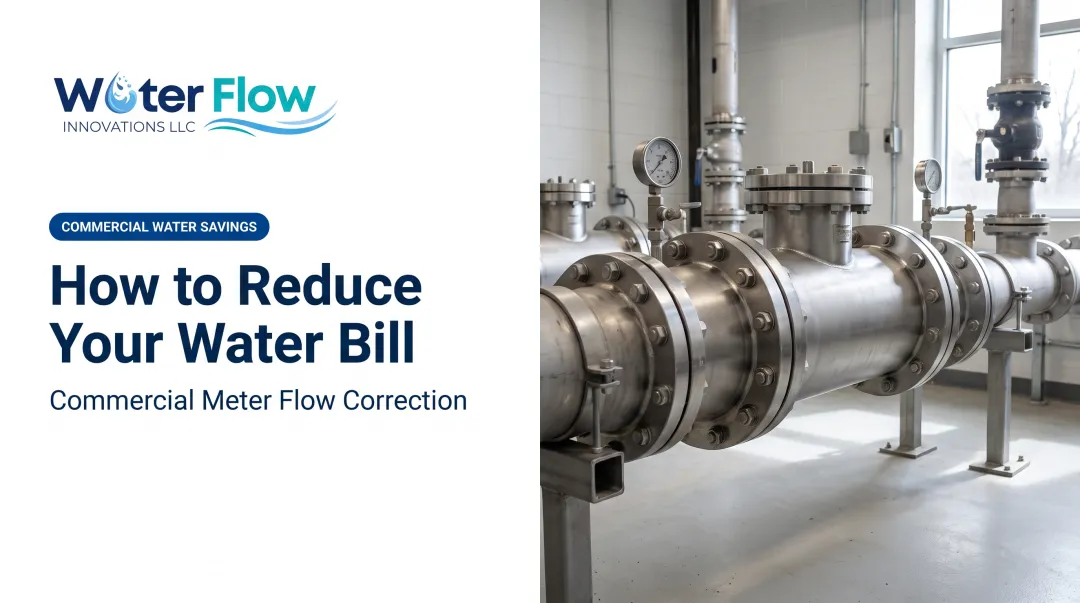
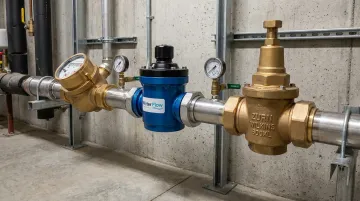
Flow conditioning devices address this at the source. Water Flow Innovation offers a certified Flow Conditioning Device (FCD) that installs immediately after the water meter and corrects over-reading through four components:
- Air/gas separation, which creates laminar flow so the meter sees a homogeneous water column, not a mixture of water and air
- Pressure regulation, which smooths water hammer and pressure surges that introduce air into the line
- A check valve that prevents reverse flow from reintroducing air after initial correction
- Turbulence elimination, which stops vortex flow that causes meters to register rotational energy as extra volume
Because it installs at the meter, it requires no change to how a facility operates. No fixture swaps, no process changes, no downtime beyond a brief water shutoff of about an hour.
What results typically look like:
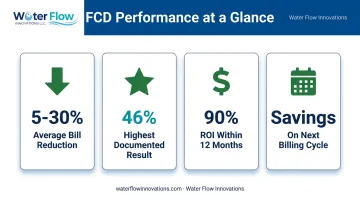
- 5-30% average reduction in combined water and sewer bills
- 46% highest documented result for a single facility
- 90% ROI rate within 12 months for most customers
- Savings appear on the very next billing cycle — not months later
Because sewer charges are usually calculated from metered water volume, correcting the water reading reduces both charges simultaneously. No extra step required.
The FCD is IAPMO, NSF, ANSI, CAN 61, KIWA, GMP, and SQF certified, and it's custom-fabricated for pipe sizes from 1/2 inch through 12 inches (larger sizes available on request), built in 316L stainless steel. It works with any meter type. The one hard exclusion: it can't be installed on fire line systems.
For facilities that suspect over-reading but aren't sure, a bill review can reveal patterns like consumption climbing without any corresponding operational growth, or sewer charges rising faster than water charges — both red flags worth investigating before assuming usage is the problem.
Assistance programs matter too. Eligible households can access water utility assistance programs, conservation rebates, or the Low Income Household Water Assistance Program, offsetting costs with zero usage changes required.
Conclusion
Lowering a water bill isn't about picking one tactic and hoping it works. It's about identifying whether the real cost driver is usage, poor management, or a structural/metering issue — because the fix that works for one won't move the needle on another.
The most durable savings come from combining behavioral changes with a hard look at billing accuracy and infrastructure. When meter over-reading is confirmed, installing a certified Flow Conditioning Device (FCD) alongside those usage fixes delivers results that are faster and longer-lasting than usage cuts alone.
Frequently Asked Questions
How can I reduce my water bill?
Start by reviewing your billing history and meter accuracy, since correcting meter over-reading often delivers faster, more reliable savings than usage changes alone. From there, fixture upgrades, leak checks, and irrigation adjustments can help reduce actual consumption.
What causes a high water bill?
Common causes include usage spikes, undetected leaks, utility rate increases, and meter inaccuracies. Often it's a combination rather than a single cause.
Can a faulty water meter cause my bill to be too high?
Yes. Aging meters, turbulent flow, and entrained air in pipes can cause meters to over-register consumption that was never delivered, sometimes inflating bills by 5-46%.
Are there programs to help with water bill costs?
Many states offer utility assistance programs, conservation rebates, and income-based rate reductions. Programs like the Low Income Household Water Assistance Program are worth checking for eligibility.
How quickly can I see savings after making changes to reduce my water bill?
Behavioral fixes typically take a billing cycle or two to show measurable impact. Correcting metering issues with a flow conditioning device works faster, with savings often appearing on the very next bill.
Do water-saving devices actually reduce sewer charges too?
Yes, in most cases. Since sewer fees are usually calculated from metered water usage, any reduction or correction in water readings typically lowers sewer charges at the same time.
How can I tell the meter is at fault and not my consumption?
If consumption stops tracking with occupancy or production, the gap is usually at the meter. A sewer line out of proportion to actual discharge, and totals that stayed high after the utility fitted a replacement, both point the same way.
What is reviewed to confirm the cause before spending anything?
Your water and sewer bills, meter size, pipe size, line pressure, and PRV configuration. That review is free, completed remotely from uploaded bills, and carries no commitment or obligation to buy.