
Introduction
Clean-in-place systems let food, beverage, dairy, and pharmaceutical plants scrub tanks, pipes, and vessels without taking anything apart. That convenience comes at a cost: CIP cycles run large volumes of water through the plant every day.
In many food and beverage facilities, CIP accounts for the single largest share of total water use—and a matching share of the water and sewer bill.
Here's what often gets missed: the water meter sitting upstream of your CIP skid doesn't just measure water. Air pockets, pressure spikes, and turbulent flow can all register as billed volume on displacement and turbine meters. You pay for that “volume” even when no extra water entered the building.
This article breaks down what CIP is, where flow conditioning fits into the picture, and how to evaluate a conditioning device without touching your validated cleaning procedures.
Key Takeaways
- CIP success depends on flow, temperature, chemistry, time, and drainage — not water volume alone.
- A flow conditioning device targets metering conditions, not CIP pumps, sensors, or chemical controls.
- Build a billing and operating baseline before installation, then verify results afterward.
- Treat every savings claim as something to confirm with your own billing records and engineering review.
What Is a CIP Cleaning System and How Does It Work?
Clean-in-place is an automated or semi-automated method for circulating water, detergents, acids, sanitizers, and rinses through fixed process equipment, all without dismantling the system.
3-A Sanitary Standards defines CIP specifically as soil removal from product-contact surfaces in their process position. Parts not designed for CIP must be cleaned out of place or by hand instead.
CIP shows up constantly in U.S. food and beverage, dairy, pharmaceutical, biotech, and chemical operations. The appeal is simple: repeatable cleaning, lower contamination risk, and far less manual labor than disassembling equipment for every wash.
A typical CIP loop includes:
- Supply tank or CIP skid
- Pump and heat exchanger
- Valves and process piping
- Spray devices or direct equipment contact
- Return line with sensors
- Drain or recovery path
Two things need to go right here, and they're not the same thing. The CIP system has to hit its validated cleaning conditions: correct flow, temperature, and chemical concentration. Separately, the facility's utility meter has to accurately register how much water actually entered the site. Confusing these two is where a lot of billing headaches start.

Typical CIP Stages
CIP recipes vary by soil type, equipment, and validation requirements, so don't treat any single sequence as universal. A commonly referenced example (used in brewery CIP stations) looks like this:
| Stage | Purpose |
|---|---|
| Initial rinse / heel removal | Clears loose soil and residual product |
| Detergent or caustic wash | Breaks down fats, proteins, and mineral deposits |
| Intermediate rinse | Displaces cleaning chemical before the next stage |
| Acid wash (optional) | Removes mineral scale, used where required |
| Sanitization | Reduces microbial load to validated levels |
| Final rinse | Clears chemical residue before production resumes |
Flow rate and turbulence drive mechanical soil removal during the wash stages, while temperature and chemical concentration handle the chemistry.
Recovery tanks, water reuse loops, and conductivity monitoring can cut waste without compromising consistency. None of that changes what happens at the utility meter, which is where flow conditioning comes in.
Why Flow Conditions Matter in CIP Systems
Pipe geometry, valves, pumps, and upstream restrictions can all create unstable flow: air pockets, rapid pressure swings, and partially filled lines.
Not every meter handles these conditions the same way. Displacement and turbine meters, common in commercial and industrial installations, cannot distinguish water from entrained air or turbulent vortex flow. They count both toward billed volume.
A 1990 NIST study on orifice meters found that upstream elbows and tees distorted meter readings, and a tube-bundle flow conditioner's benefit depended heavily on the specific configuration tested. For plant teams, the takeaway is simple: the fix has to match the meter and piping on site, not a generic assumption.
This disconnect between actual consumption and apparent meter volume creates real operational friction:
- Billed usage that doesn't reconcile with production data
- Unexpected spikes in water and sewer charges
- Unreliable conservation figures for ESG or sustainability reporting
- Difficulty explaining variance during utility audits
Flow conditioning does not reduce the flow your validated CIP procedure requires. Pressure, temperature, chemistry, and contact time stay exactly where your sanitation team set them. Only the measurement point changes—how the meter sees that flow.
Warning signs worth an engineering review:
- Billed usage running high relative to production activity
- Unstable or inconsistent meter readings
- Recurring billing anomalies the utility can't explain
- Visible air or spitting at fixtures
- Pressure fluctuations at the supply connection
- Changes in billed volume after pump or piping modifications
How Water Flow Conditioning Devices Work in CIP Applications
A water flow conditioning device is an in-line assembly that manages the physical conditions of water passing through a meter or process section. It is not a filter, softener, or chemical treatment system, and it does not replace your CIP skid or pumps.
In a CIP-adjacent installation, the relevant functions typically include:
- Air and gas separation — removing entrained air before it reaches the measurement zone
- Pressure regulation — smoothing surges from on-off cycling and variable demand
- Check-valve protection — preventing reverse flow through the meter
- Turbulence reduction — breaking up vortex flow patterns before measurement
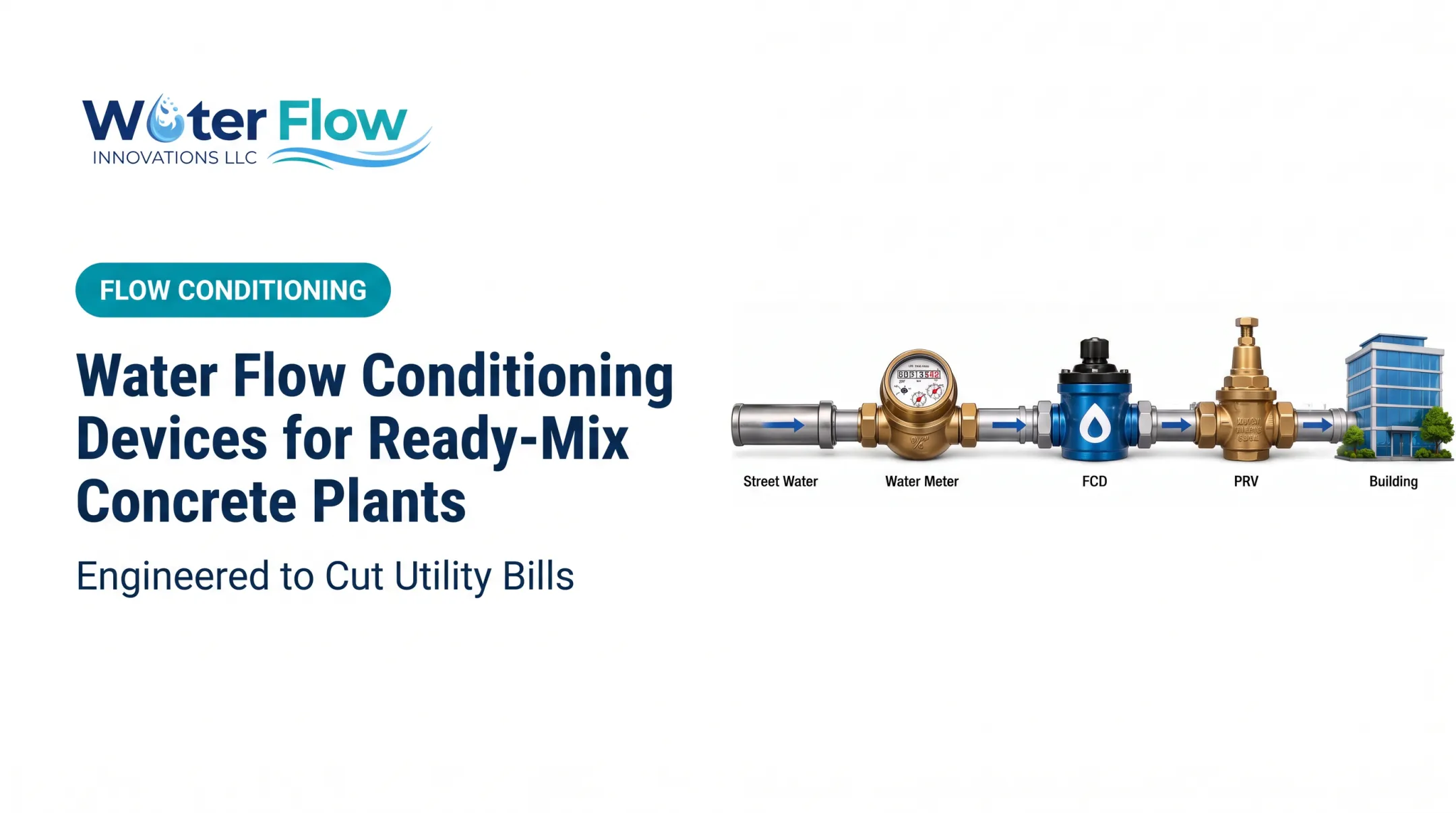
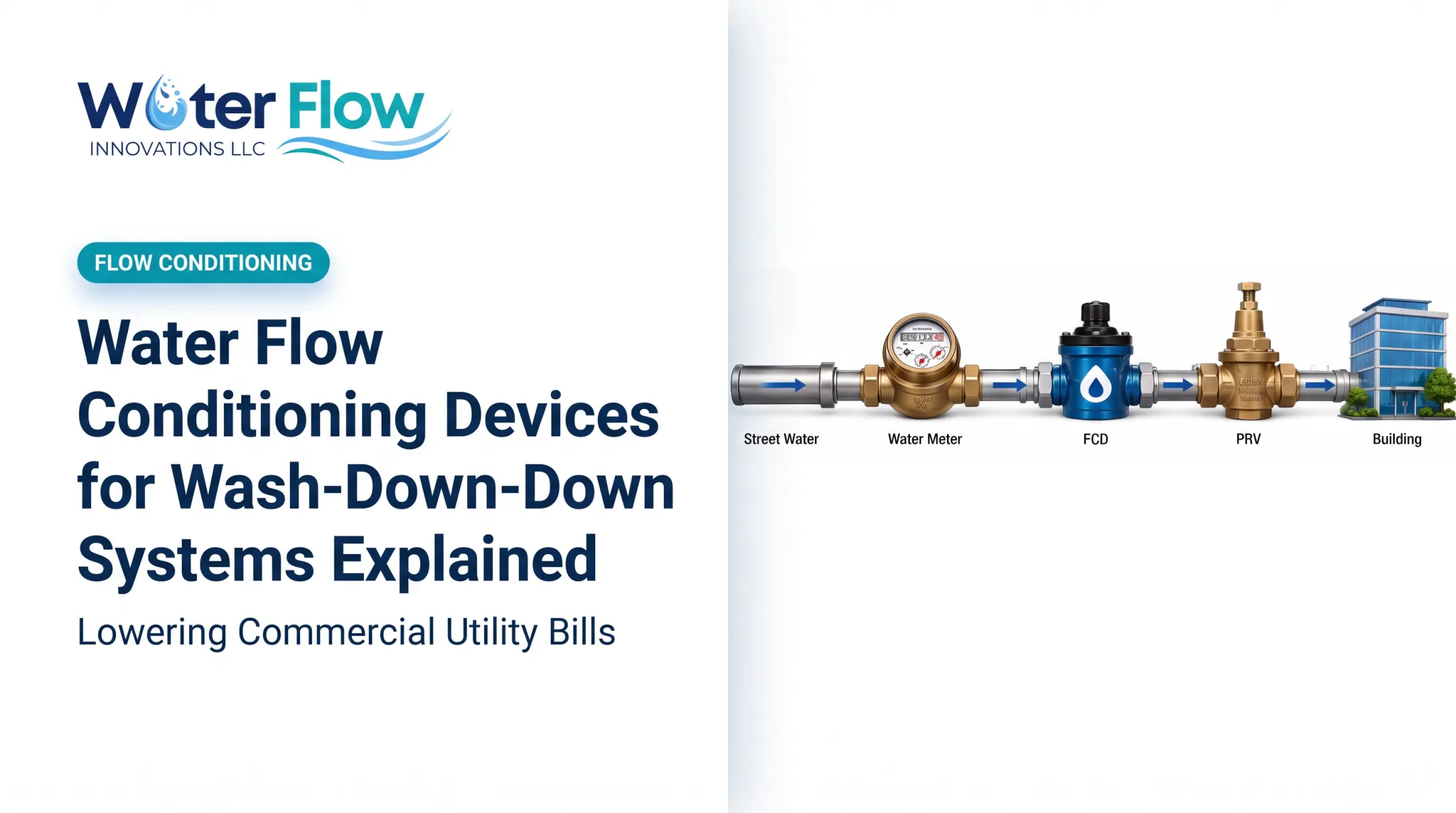
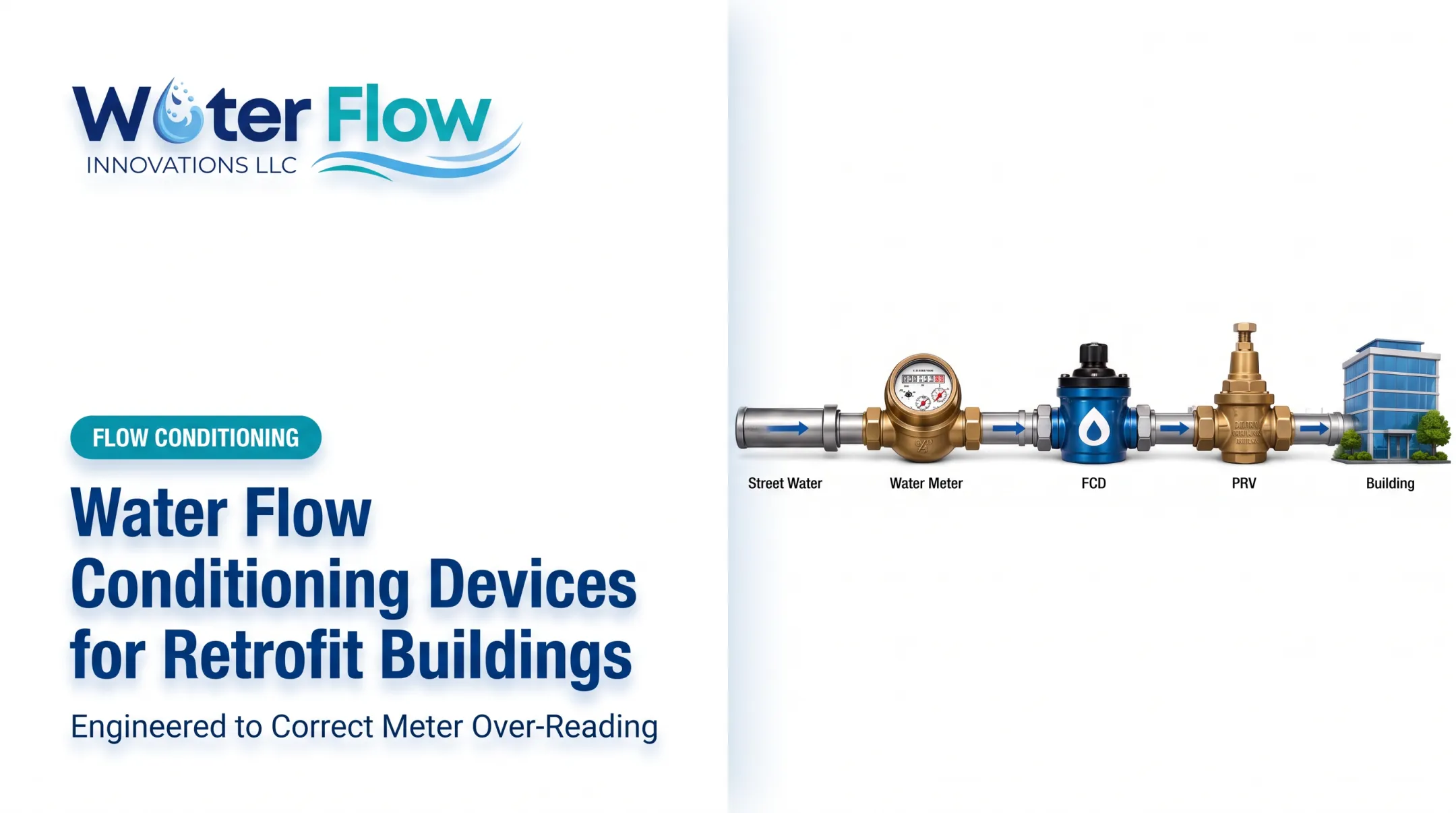
A simple flow path runs from the supply line, through isolation valves and backflow protection, into the water meter, then to the CIP skid, pumps, and process equipment. Exact placement still needs site-specific engineering review because piping layout and meter type both matter.

Water Flow Innovation's Flow Conditioning Device (FCD) is built around this four-component architecture: air/gas removal, pressure regulation, check-valve protection, and turbulence reduction, combined into a single in-line unit. The design targets negligible pressure loss so downstream pressure and flow remain effectively unchanged.
Verify that on site. Compare upstream and downstream pressure readings before and after installation, and confirm pump curves and process requirements still hold. Each FCD is built to order for a given pipe size and meter model for commercial and industrial facilities. For CIP use, confirm specifications, certifications, and suitability against your site conditions.
Potential Benefits for CIP-Intensive Facilities
Improving conditions around a water meter can help a facility separate true process consumption from measurement artifacts. That distinction matters when CIP cycles run hot caustic, acid rinses, and final flushes at high flow rates with rapid valve transitions, a pattern common in dairy processing.
The financial angle often runs in two directions at once. Many utilities calculate sewer charges from metered water volume rather than a separate sewer meter.
Portland's water utility, for example, bases nonresidential sewer charges on actual metered water use unless the customer participates in a submeter program. Where that's true, a correction to the water-meter reading affects both bills. Confirm your own tariff before assuming the same structure applies.
Reliable usage data supports more than accounting:
- ESG and sustainability reporting
- LEED documentation and performance-data sharing
- Internal conservation targets
- Capital-planning decisions
None of that works if the underlying numbers are inflated by air or turbulence. A corrected meter reading is a measurement fix, not automatically proof of reduced water use, and should be documented accordingly.
On the operational side, facilities evaluating Water Flow Innovation's FCD report no change to CIP recipes and no reduction in cleaning flow.
Practical install and commercial terms include:
- About one hour of install time during an approved maintenance window
- No planned production shutdown required
- Documented average bill reductions of 5–30%, with a highest recorded result of 46%
- 6-month money-back guarantee and lifetime transferable warranty
Confirm those figures against your own billing history rather than treating them as guaranteed outcomes.
How to Choose and Specify a Device
Before selecting any device, pull together the site details that actually determine fit:
- Pipe diameter, material, and schedule (Schedule 40/80, Type K/L/M)
- Meter manufacturer, model, and type
- Flow and pressure range
- Water temperature and chemistry
- Connection and flange details
- Available installation space
- Whether the line serves potable, process, reclaimed, or mixed-use water
A device also needs to perform across every CIP operating mode your plant actually runs:
- Startup and pump ramping
- High-flow wash and low-flow rinse
- Intermittent demand and drainage
- Simultaneous users sharing the same branch line
Verify code and certification fit, not just a general certification claim:
- Applicable U.S. plumbing and backflow-prevention codes
- Potable-water and hygienic-design standards relevant to your facility
- Whether certifications (NSF, IAPMO, ANSI, CAN 61, KIWA, GMP, SQF) apply to the exact model being quoted, not just the product line
Loop in the plant engineer, sanitation or validation team, maintenance staff, and sustainability manager before approving any change — each one will catch something the others miss.
Quick comparison checklist:
- Pressure loss and flow capacity under real operating conditions
- Meter compatibility (size, type, manufacturer)
- Materials and corrosion resistance
- Maintenance access and drainability
- Installation orientation and warranty terms
- Post-installation verification method
Installation, Baseline Measurement, and Verification
Before anything gets installed, build a baseline. Pull recent water and sewer bills, meter readings, CIP cycle frequency, production volume, and any known billing anomalies. Without this, you can't tell whether a change after installation is real or coincidental.
Steps that keep the process defensible:
- Map the system — confirm the installation point, isolation requirements, valve access, and clearance for inspection.
- Coordinate with change control — align installation with lockout/tagout, sanitation, and validation procedures. The device must not introduce a deadleg, contamination risk, or inaccessible maintenance point.
- Record before-and-after readings under comparable conditions (same CIP cycles and non-CIP demand), and control for leaks, seasonal shifts, and tariff changes.
- Confirm pressure and flow stay within approved process limits and that CIP cleaning outcomes remain validated.
- Track bills over multiple cycles to confirm any change is sustained, not a one-month anomaly.

Water Flow Innovation's FCD installs immediately after the municipal meter on the consumer side of the connection. Downstream pressure and CIP delivery remain unchanged.
If you want to evaluate fit, request a review with your pipe size, meter type, flow profile, and billing history. Confirm current certifications and installation requirements apply to your setup before you move forward.
Frequently Asked Questions
What is a CIP cleaning system?
A clean-in-place (CIP) system circulates cleaning and rinsing solutions through fixed equipment without dismantling it. It's standard in food, beverage, dairy, pharmaceutical, and chemical processing plants.
What are the steps of the clean-in-place (CIP) process?
A typical sequence includes draining, pre-rinse, detergent wash, intermediate rinse, optional acid wash, sanitization, and final rinse. The validated sequence varies by facility, soil type, and equipment.
How does flow conditioning affect a CIP system?
It addresses air, pressure, reverse-flow, and turbulence conditions around the water meter or supply line. It doesn't replace validated CIP controls like temperature, chemistry, or flow rate.
Can a flow conditioning device reduce CIP water costs?
It can reduce billed volume by correcting meter over-reading, which is different from reducing actual water use. Validate any savings against comparable billing and operating data before reporting it.
Where should a flow conditioning device be installed in a CIP system?
Placement depends on the meter type, piping arrangement, flow profile, and local code requirements. A site-specific engineering review is more reliable than any universal installation rule.
Will a flow conditioning device affect CIP pressure or cleaning performance?
Evaluate pressure loss, flow capacity, and compatibility with your validated CIP conditions before install. Run pre- and post-installation checks to confirm cleaning performance has not changed.