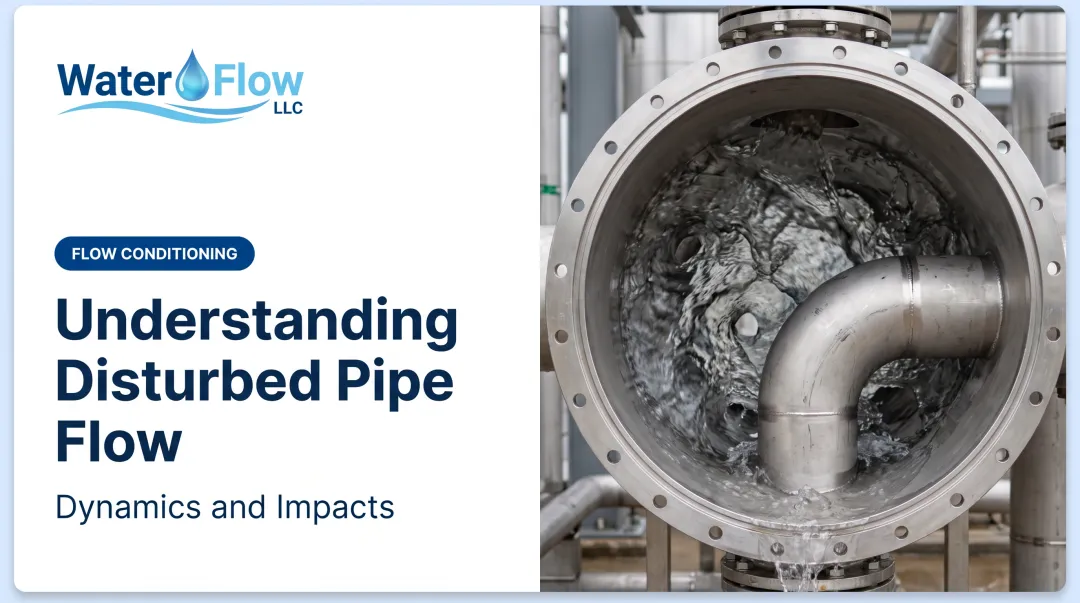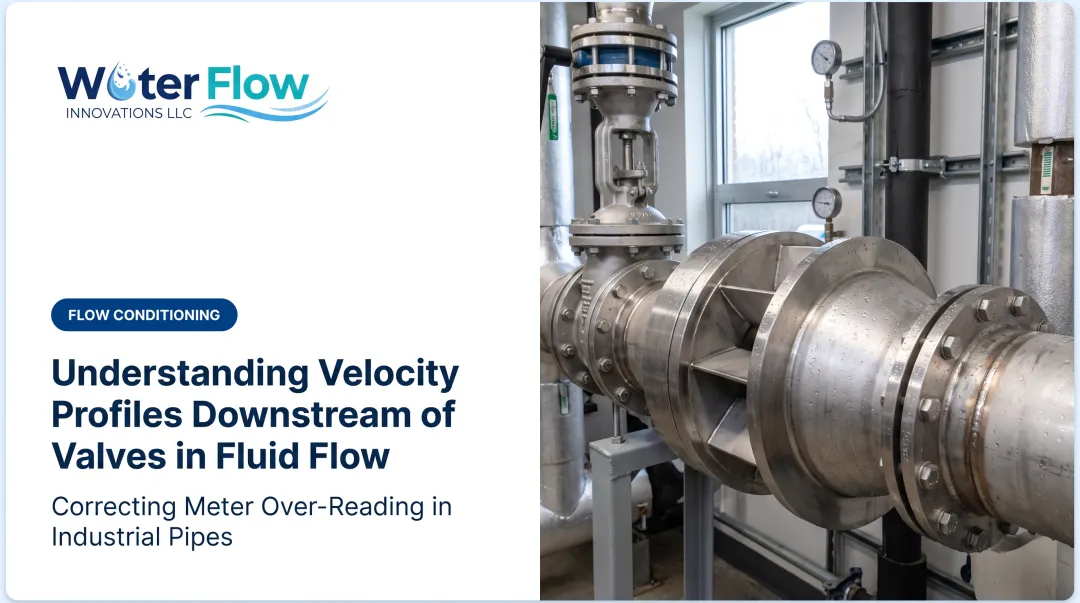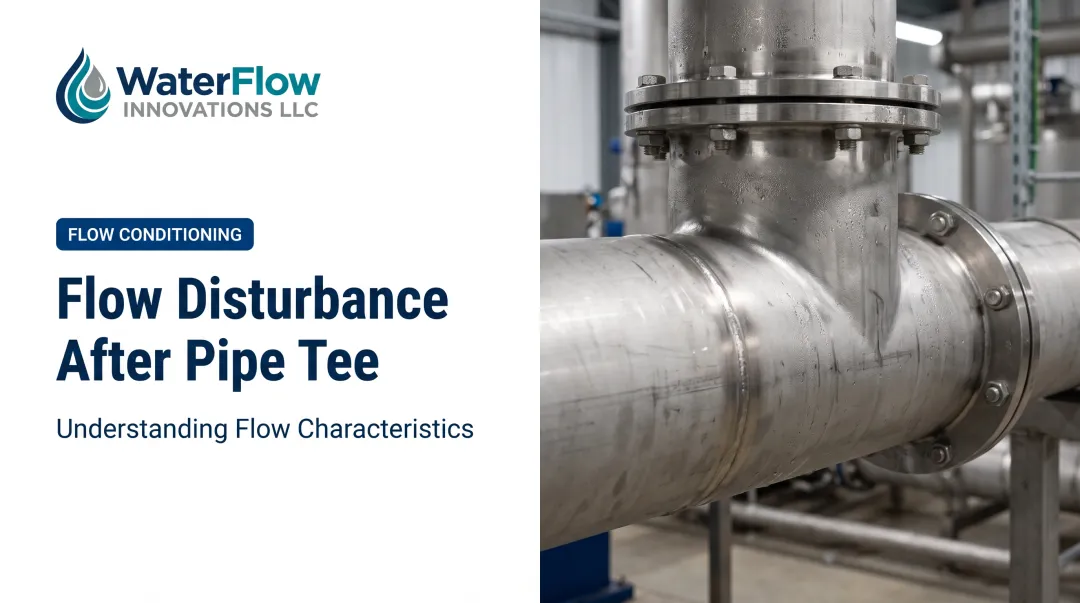

Straight pipe flow development is the process by which a fluid's velocity profile transitions from disturbed, irregular entry conditions into a stable, predictable profile as it travels through unobstructed pipe. This matters to engineers, facility managers, and operators across industrial, commercial, and municipal water systems who depend on accurate flow measurement for process control, billing, and compliance.
"Straight run" and "fully developed flow" show up constantly in flow meter manuals and plumbing codes, but they're rarely explained at an operational level. This article covers what the process is, why it matters, how it works, where it applies, and when it becomes a real, costly problem.
Key Takeaways
- Straight pipe flow development is how a fluid's velocity profile stabilizes after a disturbance (elbow, valve, or pump).
- Too little straight run leaves turbulent, asymmetric profiles that skew water meter readings.
- Requirements vary widely by meter technology — anywhere from zero to 20-50x pipe diameter.
- Undeveloped flow is a documented contributor to water meter over-registration, which inflates utility bills.
- Fixes include adding straight pipe or installing a flow conditioning device when space is tight.
What Is Straight Pipe Flow Development?
Straight pipe flow development is the transition of a fluid's velocity profile from a disturbed, uneven shape to fully developed (symmetrical and predictable) as it moves through an unobstructed straight section of pipe.
The goal is a stable, axisymmetric velocity profile. Measurement instruments and system components are engineered to read that specific profile shape accurately. Feed them something else, and errors creep in.
It helps to separate three related but distinct terms:
- Laminar vs. turbulent flow — a classification of flow regime, based on Reynolds number
- Flow development — the process of the profile stabilizing over distance
- Fully developed flow — the result once that process is complete
Straight pipe flow development is the process. Fully developed flow is the result once that process finishes.
Why Straight Pipe Flow Development Matters in Real-World Systems
Elbows, valves, pumps, and reducers all do the same thing to a flow stream: they introduce swirl, asymmetry, or velocity spikes. Every flow meter and control instrument downstream assumes it's reading a developed profile. When it isn't, the numbers drift.
NIST testing found flow meter deviations from gravimetric standards generally ranging from 0% to 3%, with a worst-case error of -14% in one configuration.
A separate NIST simulation of centerline-based meters that incorrectly assumed a uniform velocity profile produced positive errors of 5% to 6.5%, according to NIST Technical Note 1429.

That kind of error doesn't stay theoretical. In real systems, undeveloped flow shows up as:
- Inaccurate flow control and inconsistent process quality
- Skewed data feeding into automation or SCADA systems
- Water meters recording more (or less) water than actually passed through
There's no single universal code governing this. Requirements are scattered across ISO standards, AWWA guidance, and individual meter OEM manuals — making straight-run compliance an engineering best practice rather than a one-size-fits-all rule.
Certified flow conditioning devices address that shortfall. Water Flow Innovation's Flow Conditioning Device (FCD) restores an accurate flow profile at the meter, correcting turbulence-driven over-registration without changing actual water usage.
How Straight Pipe Flow Development Works
Picture fluid entering a straight pipe section carrying a disturbance from an upstream fitting. As it travels, viscous drag along the pipe wall progressively reshapes that chaotic entry profile into something stable.
Factors that shape development:
- Fluid velocity and Reynolds number (laminar vs. turbulent)
- Type and severity of the upstream disturbance
- Pipe diameter and wall roughness
- Fluid properties (viscosity, density)
Near the wall, friction slows fluid layers while the core keeps moving fast. That shear creates a boundary layer that thickens downstream until it fills the full pipe radius.
The result is a stable, repeatable profile: parabolic in laminar flow, flatter in turbulent flow. It holds until the next fitting or valve disturbs it again.
Step 1: Disturbance Introduction
A fitting, valve, pump, or reducer imparts swirl, asymmetry, or a velocity spike into the flow stream right at the point of disturbance. This is where the distorted profile begins.
Step 2: Boundary Layer Growth
The boundary layer forms at the pipe wall and grows inward. As distance from the disturbance increases, velocity across the cross-section gradually normalizes.
Step 3: Profile Stabilization
Once the boundary layer meets at the pipe centerline, the profile stops changing shape with further distance. That marks full development, and it is where meters and instruments should sit.

Where Straight Pipe Flow Development Is Applied and Key Factors Affecting It
Flow development matters most in flow and water meter installations, control valve stations, pump discharge lines, and other inline instrumentation. It becomes a design consideration at several points in a system's life:
- New construction — lock in straight-run lengths before pipe is set
- Retrofits — reassess runs when fittings or layout change
- Meter calibration or replacement — confirm upstream/downstream requirements
- Troubleshooting — chase inaccurate or disputed readings back to profile distortion
Three factors determine how much straight run you actually need:
- Disturbance severity: a single elbow behaves very differently than two elbows out of plane, or a partially throttled valve
- Meter technology: requirements swing from zero for Coriolis and positive displacement meters to 20–50× pipe diameter for insertion probes
- Available space: many retrofit mechanical rooms simply can't fit the ideal straight-run length
When space is the constraint, flow conditioning devices stabilize the profile in a fraction of the distance straight pipe alone would need.
Common Issues, Misconceptions, and When Straight Pipe Alone May Not Be Enough
Misconception #1: "More straight pipe always fixes accuracy issues." In a perfect world, sure. In a real mechanical room with existing infrastructure and limited square footage, adding 30 diameters of pipe often isn't practical or affordable.
Misconception #2: "Straight pipe automatically means fully developed flow." Length alone doesn't guarantee it. If the upstream disturbance is severe, or the pipe diameter changes partway through, the profile may still be off at the meter even with a seemingly generous straight run.
Misconception #3: "Erratic meter readings mean equipment failure or a leak." Often the real culprit is undeveloped flow at the meter, compounded by air entrainment, not a broken meter or a hidden leak.
Where mechanical room constraints make adding straight run impossible, certified flow conditioning solutions like Water Flow Innovation's FCD correct turbulence and air entrainment at the meter directly. This frequently results in a measurable reduction in water and sewer billing, with no change to actual system performance. The FCD's four-part design targets each of those problems:
- Air and gas separation: Creates back-pressure that pushes entrained bubbles back into the line so the meter sees a full water column
- Pressure regulation: Reduces surges and water hammer from cycling demand
- Check valve: Limits reverse flow and pressure spikes that could reintroduce air
- Turbulence elimination: Slows velocity enough to prevent vortex formation at the meter

Not every technology needs this fix, though. Coriolis and positive displacement meters are largely insensitive to profile disturbances, so extensive straight run — or conditioning — isn't necessary for those.
Frequently Asked Questions
Does increasing pipe size increase flow?
Not by itself. A larger diameter reduces velocity for a given flow rate and lowers friction losses, but actual flow rate depends on available pressure and system resistance, not diameter alone.
What does fully developed straight pipe flow mean?
It's the stable, unchanging velocity profile a fluid reaches after enough straight, unobstructed pipe length following a disturbance. Once reached, the profile shape stops changing with further distance.
What is the Bernoulli equation for pipe flow?
Bernoulli's equation relates pressure, velocity, and elevation along a streamline, forming the basis for energy conservation in pipe flow. It excludes friction losses. Those need separate equations.
How much straight pipe run is needed before a flow meter?
It varies by meter type: from none for Coriolis or positive displacement meters to 20-50x pipe diameter for insertion probes. Always check the manufacturer's specific installation manual.
Can undeveloped flow cause inaccurate water bills?
Yes. Turbulent, undeveloped flow at a water meter is a documented cause of over-registration. Flow conditioning devices can correct this at the meter without changing actual consumption.
What's the difference between laminar and turbulent flow in pipe development?
Laminar flow develops a parabolic profile over a shorter, more predictable distance. Turbulent flow develops a flatter profile but reacts more strongly to disturbances, often requiring much longer straight runs.
What if the mechanical room has nowhere near that straight run?
That is the common case. A conditioning device is custom-built and fitted at the municipal supply connection instead, so the required straight length never has to be found and no pipework is rerouted.
What does correcting undeveloped flow deliver on the bill?
Documented installations average a 5–30% reduction in combined water and sewer charges, with a highest documented single result of 46%, visible on the very next billing cycle.