Part of the problem is invisible. Standard meters register everything moving through the pipe, including trapped air, turbulence, and micro-bubbles that were never actually water. Add rising utility rates across most US markets, and facilities end up paying more for less.
Water flow management and monitoring systems solve this by pairing hardware, such as meters and sensors, with software that tracks consumption in real time and flags problems before they become expensive. This article breaks down how these systems work, the technologies behind them, the benefits they deliver, and how to implement one without disrupting daily operations.
Key Takeaways
- Sensors, meters, analytics, and controls turn monthly water reads into continuous, real-time visibility.
- Meter accuracy matters as much as monitoring; turbulence and air entrainment silently inflate bills for years.
- Correcting meter over-reading cuts water and sewer charges together, often with ROI in under 12 months.
- Phased rollouts and automated alerts cut implementation risk around cost, integration, and data overload.
What Is a Water Flow Management and Monitoring System?
A water flow management and monitoring system is an integrated set of hardware and software built to measure, track, and control water movement through pipelines, buildings, or distribution networks. It replaces one-off meter readings with a continuous feedback loop between real flow conditions and what facility teams see day to day.
Traditional metering tells you almost nothing until the bill arrives 30 days later. There's no way to catch a leak on day two or a pressure spike during a production run. Many commercial properties still operate this way, relying on a single monthly number with no context behind it.
Modern systems replace that blind spot with continuous data: flow rates, pressure trends, and anomaly alerts delivered as they happen, not weeks later.
Core Components of a Water Flow Monitoring System
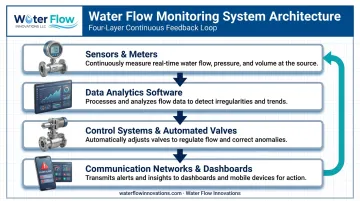
Every functional system relies on four connected layers:
- Sensors and meters — capture flow rate, pressure, and volume at critical points, from the main supply line to individual equipment loops
- Data analytics software — converts raw readings into usable insights, flagging leaks, unusual consumption spikes, and long-term trends
- Control systems — automated valves and pumps that adjust flow or shut off supply the moment a sensor detects a problem
- Communication networks and dashboards — IoT connectivity that pushes instant alerts to a facility manager's phone or app
Each layer depends on the one before it. Sensors alone produce numbers; analytics alone produce warnings. The payoff comes when measurement, analysis, control, and alerts run as one system.
Types of Water Flow Meters and Monitoring Technologies
Not every meter fits every pipe, fluid, or budget. Choosing the wrong technology is one of the most common (and expensive) mistakes facilities make.
| Meter Type | How It Works | Best Fit |
|---|---|---|
| Mechanical (turbine/paddlewheel) | A rotor or paddle physically contacts the flow stream | Clean liquids, light commercial settings |
| Electromagnetic | Uses a magnetic field and Faraday's law to measure conductive fluids with no moving parts | Industrial water, wastewater, hydronic loops |
| Ultrasonic | Sound waves measure transit time (clean liquids) or Doppler shift (dirty liquids) | Large-scale distribution networks |
| Smart/IoT-enabled | Adds continuous remote data collection to any base meter type | Facilities needing real-time visibility |
Each option carries clear tradeoffs:
- Mechanical: Affordable and simple, but parts in the flow path wear down over time
- Electromagnetic: No moving parts, yet needs a conductive fluid and a full pipe for accuracy
- Ultrasonic: Non-invasive and scales well on large systems; results hinge on installation quality and fluid clarity
- Smart/IoT: Adds remote visibility to any base meter—value depends on integration and how the data is used
The Overlooked Accuracy Layer: Flow Conditioning
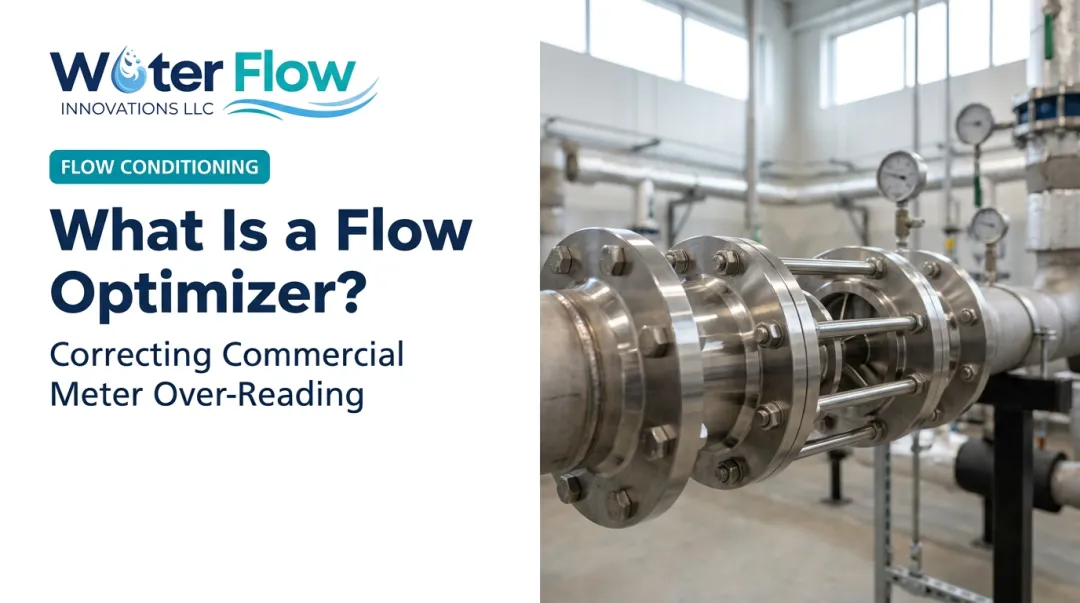
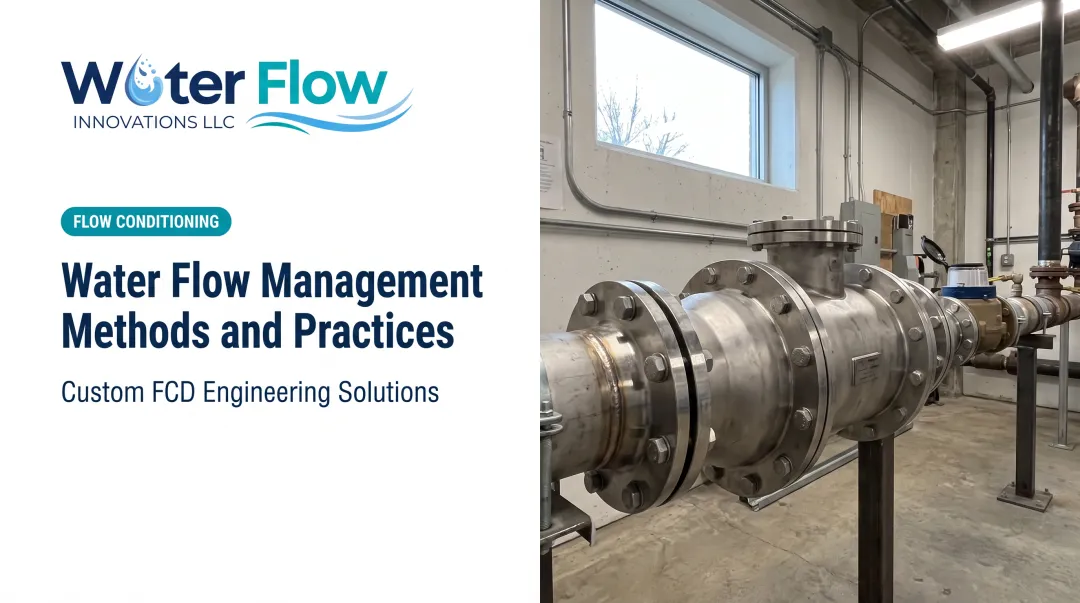
Here's what most facilities miss: even a perfectly functioning meter can over-read. Turbulence, pressure surges, and air entrainment create a flow profile that confuses the measurement zone, so the meter counts air and turbulence as billable water.
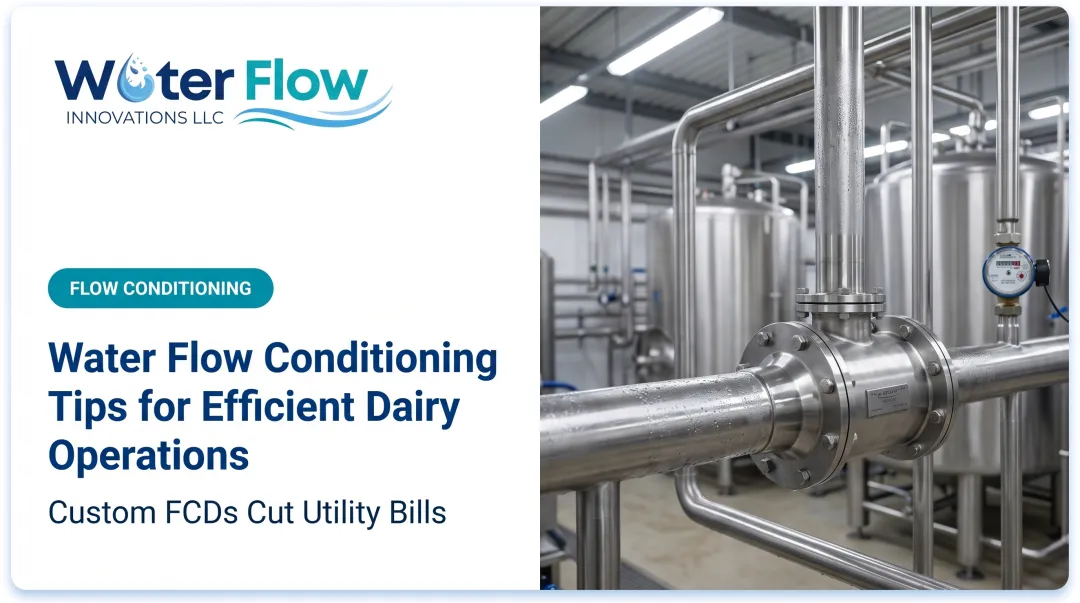
This is where flow conditioning devices (FCDs) come in. A certified FCD (like those engineered by Water Flow Innovation) installs immediately after the water meter and stabilizes the flow in the measurement zone. It doesn't change how much water a facility actually uses. It just makes sure the meter reads what's real.
Once meter type and accuracy limits are clear, narrow the choice with these factors:
- Pipe size and material
- Flow velocity and pressure conditions
- Fluid type (clean water, wastewater, chemically treated)
- Budget and installation constraints
Key Benefits of a Robust Water Flow Management System
Key Benefits of a Water Flow Management System
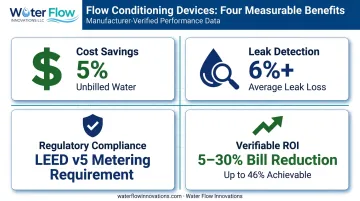
The case for investing in flow monitoring comes down to four measurable outcomes.
Cost savings
Meter inaccuracy cuts both ways. Xylem's industry benchmark data shows that about 5% of retail water goes unregistered or unbilled, roughly 2% of total utility revenue.
Commercial facilities often face the opposite problem: turbulent flow and air entrainment push meters to over-read, which shows up as inflated water and sewer bills.
Leak detection and prevention
Undetected leaks are a quiet budget killer. The EPA's WaterSense program reports that leaks can average more than 6% of a commercial facility's total water use when left unmonitored. Real-time alerts catch a broken line or failed valve in hours, not months.
Regulatory compliance and sustainability reporting
LEED v5 now requires permanent whole-project metering with annual data sharing. ESG disclosures and GRI reporting likewise depend on accurate, auditable consumption records—not estimates.
Immediate, verifiable ROI
Water Flow Innovation's certified FCD typically delivers a 5–30% reduction in water and sewer bills on the very next billing cycle, with documented cases as high as 46%. Installation takes about an hour, causes no downtime, and 90% of customers reach full ROI within 12 months.
Sewer charges are usually calculated from metered water intake, so correcting meter over-reading lowers the water bill and the sewer bill together. Leak repairs and fixture upgrades rarely hit both sides of the invoice at once.
Applications of Water Flow Monitoring Across Industries
Water flow monitoring needs differ by sector. Pressure swings, occupancy patterns, and compliance rules each change what “good” measurement looks like.
Industrial and manufacturing
CIP cycles, cooling towers, and production lines create constant pressure changes that pull air into supply lines. That turbulence skews meter readings and makes process water costs harder to predict.
Facilities that feel this most include:
- Food and beverage processors
- Semiconductor fabs
- Chemical and other heavy manufacturers
These plants still have to hit compliance targets. Stable, accurate flow data keeps both regulators and finance teams aligned.
Commercial, hospitality, and multifamily
Hotels, apartments, and mixed-use properties see uneven demand across guest rooms, laundry, pools, and amenities. Usage spikes are normal; billing surprises should not be.
Master-metered buildings gain the most. One correction at the meter improves billing accuracy for every unit downstream, with no tenant disruption.
Municipal, healthcare, and education
School districts, hospitals, and government buildings run large, mixed portfolios. Compliance tracking, waste reduction, and multi-year budget forecasts all depend on trustworthy meter data.
A hospital system with a dozen sites, for example, can document savings building by building, then roll them into portfolio-wide sustainability and ESG reporting.
Best Practices for Implementation and Common Challenges
Rolling out a water flow monitoring system works best when it's approached in stages, not all at once.
Best Practices for Successful Implementation
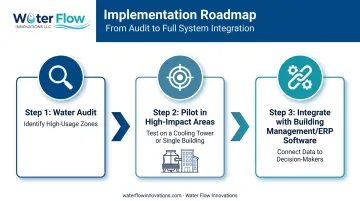
- Start with a water audit to identify high-usage zones and check for existing meter accuracy issues before investing in new technology.
- Pilot in high-impact areas first, such as a cooling tower loop or a single high-consumption building, then scale once results are proven.
- Integrate monitoring data with existing building management or ERP software so the information reaches decision-makers instead of sitting in a separate dashboard nobody checks.
Common Challenges to Anticipate
Even a staged rollout hits friction. Plan for these issues early:
- High initial investment: Offset costs with phased rollouts or flexible buy-or-lease options that avoid large upfront capital outlays.
- Undetected meter over-reading: Turbulence and air entrainment can inflate bills for years. The meter isn't broken; it's measuring more than water, which takes a specialized diagnostic to catch.
- Data overload and limited technical staff: Automated alerting and simplified dashboards cut the analysis burden so teams aren't buried in raw numbers.
Frequently Asked Questions
What is the most accurate flow meter for water?
Ultrasonic and electromagnetic meters are typically the most accurate for larger commercial applications. Even a precise meter can over-read, though, if turbulence or air entrainment isn't corrected with flow conditioning.
How can water flow be controlled?
Control mechanisms include automated valves, variable-speed pumps, and pressure regulators that respond to real-time sensor data. These systems adjust or shut off flow automatically the moment a reading falls outside a set range.
What is an example of a water management system?
A typical commercial setup pairs a smart meter with a real-time analytics dashboard and a certified flow conditioning device. Together they track usage continuously and keep the meter from over-reading due to turbulence or air in the line.
How many gallons per minute should a commercial building have?
Commercial and multifamily flow rates vary widely by fixtures, pipe size, and demand—often far above the 6–12 GPM range common in single-family plumbing. Industrial facilities can require substantially higher GPM based on process equipment.
How much can businesses realistically save with a water flow monitoring system?
Corrected metering and monitoring typically deliver a 5–30% reduction in combined water and sewer bills, with some documented cases reaching as high as 46%.
Is installing a water flow monitoring or conditioning system disruptive to daily operations?
No. Certified flow conditioning devices are designed for minimal disruption. Installation is usually completed in about an hour, with a brief water shutoff at the meter connection and negligible impact on pressure or system performance.
What inputs does the upfront assessment need?
Your water and sewer bills plus meter size, pipe size, line pressure, and PRV configuration. Those five confirm whether the connection over-registers and size the device, at no cost and with no obligation.
What protection applies if the system underperforms?
A 6-month money-back guarantee on the device purchase price, with installation cost non-refundable, so it can be returned if metered consumption does not measurably fall. A lifetime transferable warranty against manufacturing defects also applies.