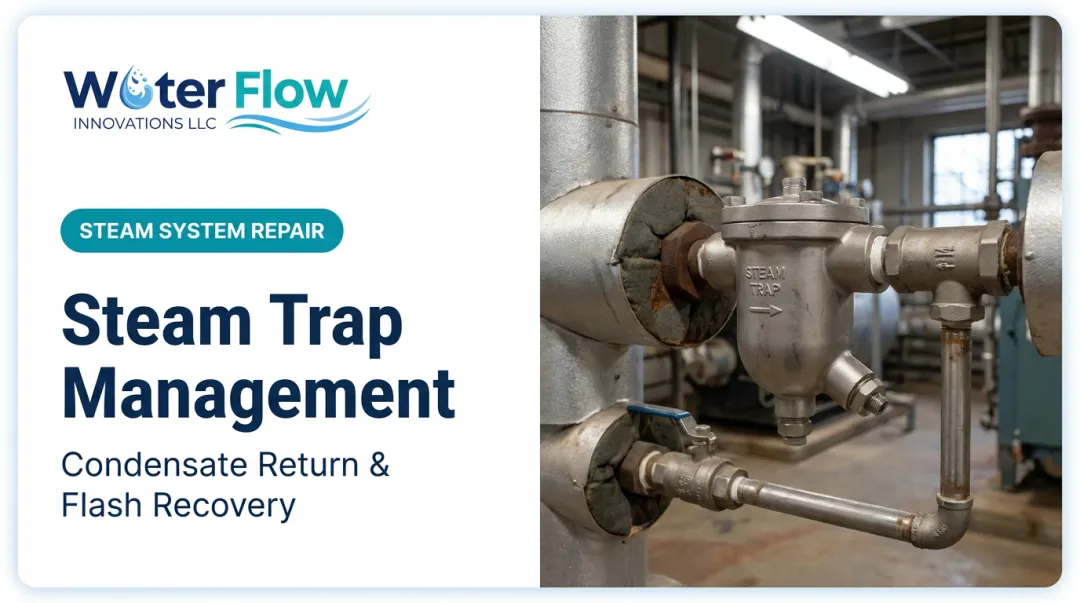
Introduction
Walk any steam plant and you'll hear it: hissing, cycling, the occasional clank. Most of it's normal. Some of it isn't.
The U.S. Department of Energy notes that in systems left unmaintained for 3-5 years, 15%-30% of installed steam traps may have failed, often without anyone noticing until the utility bill arrives. A regular testing program should keep that failure rate under 5%.
Here's the catch: "leaking" doesn't always mean what people think. A trap venting visible vapor might be releasing normal flash steam, not losing live steam at all. Confusing the two leads to two costly mistakes: replacing healthy traps or ignoring failed ones.
This guide walks through how to test a steam trap, what the results actually mean, and the errors that trip up even experienced maintenance teams.
Key Takeaways
- Traps fail open (losing live steam) or closed (trapping condensate)—each creates different risks
- Combine temperature, ultrasonic, and visual testing for the most reliable diagnosis
- Visible vapor at a trap outlet is often normal flash steam, not proof of failure
- DOE recommends testing frequency based on system pressure, from weekly to annual checks
What You Need to Check If a Steam Trap Is Leaking
Diagnostic accuracy depends on using multiple tools together. Relying on sight or sound alone almost guarantees a wrong call somewhere along the line.
Tools and Indicators Required
Before testing, gather:
- Infrared thermometer or thermal imaging camera: gives inlet/outlet temperature readings
- Ultrasonic stethoscope or leak detector: many steam professionals consider it the single most reliable tool, especially when paired with temperature checks
- Test valve (two-valve or three-way design) for direct visual inspection of discharge
Always check manufacturer documentation for the specific trap type. An inverted-bucket trap and a thermostatic trap sound completely different when healthy, and expecting one to match the other's baseline is a common source of false alarms.
Preconditions and Setup
A few conditions matter more than people expect:
- Confirm normal operating load before testing. Low-load or startup conditions can mimic failure symptoms that disappear once the system reaches full demand
- Wear proper PPE: heat-resistant gloves and eye protection are non-negotiable near high-temperature, high-pressure lines
- Direct test valve discharge safely away from personnel before opening anything
Skipping any of these steps doesn't just risk a bad reading. It risks an injury.
Methods to Check If Your Steam Trap Is Leaking
No single test method gives you the complete picture. Combining methods increases confidence, and which ones you use often depends on what's on hand and how accessible the trap is.
Method 1: Temperature Differential Test
Condensate runs cooler than live steam, so a healthy trap generally shows a measurable temperature drop from inlet to outlet. That said, there's no universal "healthy" number here.
Outlet temperature shifts with downstream pressure and piping. TLV's steam trap testing guidance points to inlet temperature, checked against expected saturation temperature, as the more useful reference point.
Tools needed: Infrared thermometer or thermal camera
Steps:
- Measure temperature at the trap inlet
- Measure temperature at the outlet/discharge line
- Compare the inlet reading against expected saturation temperature for that system pressure
Pros: Fast, non-invasive, no system shutdown required.
Cons: Can't reliably distinguish a failed-open trap from one that's simply working hard under heavy load. The DOE's Federal Energy Management Program actually calls temperature the least reliable standalone method for this reason.
Method 2: Sound/Ultrasonic Test
Every trap type has a predictable acoustic signature when healthy. Deviations from that pattern (hissing, rattling, unexpected silence) point to specific failure modes.
Tools needed: Ultrasonic stethoscope or leak detector
Steps:
- Position the sensor on the trap body per manufacturer guidance
- Listen for and record the cycling pattern
- Cross-reference against the known-good baseline for that trap type
A healthy disc trap, for example, typically cycles 1-10 times per minute. Cycling above 20 times per minute, or continuous discharge, signals trouble.
Pros: Works on live systems and offers high accuracy. AIChE's Chemical Engineering Progress research identifies ultrasonic testing combined with contact temperature as the most accurate approach available.
Cons: Requires training. Adjacent valves, other traps, and background noise can distort readings, and sound alone doesn't confirm whether a trap is fully blocked.
Method 3: Visual Discharge Test (Test Valve)
This is the most direct method, provided you have a test valve installed downstream of the trap.
Tools needed: Two-valve or three-way test valve
Steps:
- Close the discharge line and open the test valve safely
- Observe discharge velocity and clarity
- Compare against flash steam versus live steam indicators (covered next)
Pros: Nothing beats seeing the actual discharge.
Cons: Requires pre-installed test valves. Trap surfaces run hot, so isolate and bleed off pressure before servicing anything. Armstrong's installation guidance is explicit on this point.
If your facility lacks pre-installed test valves or in-house expertise for these checks, Water Flow Innovation's steam system repair team can run a full diagnostic combining all three methods.

How to Interpret the Results
Misreading results cuts both ways. Call a healthy trap "failed" and you've wasted budget on an unnecessary replacement. Miss a real failure and you're burning steam (and money) every hour it stays in service.
| Condition | What You'll See | Action |
|---|---|---|
| Normal | Measurable temperature drop, regular cycling sound, discharge that's low-velocity and forms visibly (flash steam) | Log as pass, re-test on schedule |
| Minor issue | Slightly reduced differential, irregular but not silent cycling | Flag for monitoring, re-test under full load |
| Failed open | No temperature drop, high-velocity clear discharge (live steam) | Schedule immediate repair |
| Failed closed | Cold trap on both sides, no discharge or sound | Check for waterlogging risk upstream, prioritize repair |
The Flash Steam Trap
Here's where most misdiagnoses happen. A big vapor cloud at a trap outlet looks alarming, but it's usually mostly flash steam, not live steam escaping through a failed trap.
When hot condensate drops to atmospheric pressure, part of it flashes back into steam and expands dramatically in volume.
Spirax Sarco's condensate recovery data shows condensate at 7 bar gauge flashing at roughly 13.4% by mass, with the resulting steam occupying about 200 times the volume of the condensate it came from. Other conditions push that ratio even higher.
The takeaway: don't diagnose failure by cloud size. Confirm it with sound or a test valve first.
Common Errors and Safety Best Practices
Common Errors in Checking Steam Traps
- Testing under low-load conditions and mistaking minimal live steam loss for a full failure
- Reading vapor clouds as leaks without confirming with a second method
- Ignoring manufacturer-specific baselines, since a bimetallic trap and an inverted-bucket trap sound nothing alike even when both are healthy
Safety Best Practices
- Confirm lockout/tagout (LOTO) procedures and safe discharge direction before opening any test valve
- Require heat-resistant gloves and eye protection per OSHA's PPE standards
- Maintain a documented trap map and tagging system so nothing gets missed between inspections
Pair these safety habits with a consistent testing schedule. DOE recommends testing frequency scaled to system pressure:
| System Pressure | Recommended Testing |
|---|---|
| 150 psig and above | Weekly to monthly |
| 30-150 psig | Monthly to quarterly |
| Below 30 psig | Annually |
Conclusion
Accurate steam trap diagnosis isn't about picking one test and trusting it. It's about combining temperature readings, ultrasonic sound patterns, and visual discharge checks to build a confident picture. Correctly telling flash steam apart from live steam alone prevents most of the wasted repair budget and overlooked failures we see in the field.
Steam traps aren't the only place utility waste hides. If your facility is already tightening up steam losses, the water side deserves the same scrutiny.
Water Flow Innovation offers the Flow Conditioning Device (FCD), a certified solution that corrects water meter over-reading caused by turbulent flow and air entrainment. It pairs naturally with steam system repairs for facilities tackling utility waste on every front.
The FCD delivers:
- 5-30% average savings on water and sewer bills, with a documented high of 46%
- 90% of customers reach full ROI in under 12 months
- Installation in roughly 1-2 hours with a brief water shutoff, no production impact, and negligible downstream pressure loss
- Certification to IAPMO, NSF, ANSI, CAN 61, KIWA, GMP, and SQF standards
Frequently Asked Questions
How can you tell if a steam trap is bad?
Compare inlet temperature to the expected saturation temperature, then use an ultrasonic detector to catch abnormal cycling. A quick visual check of discharge through a test valve confirms the diagnosis: a bad trap shows no temperature drop plus continuous, high-velocity discharge.
Why is my steam trap leaking?
Dirt or debris often prevents proper valve closure. Pressure surges causing water hammer can damage internal components, and oversized traps tend to cycle excessively, wearing out early.
How often do steam traps need to be replaced?
There's no universal age—it depends on trap quality, pressure, and load. DOE recommends inspection every week to month for high-pressure systems (150+ psig), and annually for systems below 30 psig.
Is it normal for a steam trap to make noise?
Yes, regular cycling sounds are normal and expected. Continuous hissing or rapid rattling above 20 cycles per minute usually signals a failure mode, and so does complete silence during testing.
What does it mean if my steam trap is cold?
A cold trap on both sides typically indicates a failed-closed trap or a blocked line. This risks condensate backup and waterlogging in upstream equipment, so it needs prompt attention.
Can a leaking steam trap be repaired, or does it need replacement?
Minor issues, like debris buildup, are sometimes fixable through cleaning or part replacement. Full failure, whether stuck open or closed, usually calls for complete replacement, which is where steam system specialists like Water Flow Innovation can help.
How much extra makeup water does a failed trap draw?
A trap stuck open passes live steam straight to the condensate return or atmosphere, and every pound lost is replaced with metered makeup water. Industry data indicates roughly 30% of traps in an average facility are failed at any time, so the volume adds up quickly.
Can trap replacement be combined with correcting the water meter?
Yes, and the two address different halves of the bill. Trap repair cuts the makeup water you genuinely consume; a flow conditioning device corrects billing for water you never consumed, with documented reductions averaging 5–30% and a highest documented result of 46%.