
Facility teams often focus on catchment area and tank capacity, then wonder why meters read inconsistently or pumps cycle noisily. The real culprits are frequently hydraulic: entrained air, turbulence, and pressure variation moving through the plumbing after storage.
Water flow conditioning devices address these hydraulic conditions. They are not filters, and they do not disinfect water. This guide covers what conditioning does, where it belongs in a US rainwater harvesting system, how it compares to filtration and treatment, and how to evaluate whether it fits your setup.
Key Takeaways
- Flow conditioning manages water movement; it does not remove debris, pathogens, or dissolved contaminants.
- Screens, first-flush diverters, filtration, pumps, treatment, and backflow each handle a separate job from conditioning.
- Choose devices by pipe size, meter type, flow rate, pressure, air entrainment, and local codes.
- Verify manufacturer documentation and certifications before installing on your system.
What Water Flow Conditioning Devices Do in Rainwater Harvesting Systems
A water flow conditioning device is a hydraulic component installed inline that influences how water moves through a pipe, without changing how much water a facility actually needs or uses. It doesn't touch water chemistry, demand, or intended end use. It changes flow behavior at a specific point in the system.
Why Air and Turbulence Matter
Air can enter a rainwater system through collection lines, pump suction, partially filled pipes, shifting tank levels, or turbulent transitions at elbows and valves. Once air mixes into the water column, meters can over-read, pressure can spike, and flow can turn unstable at valves and measurement points.
According to Utah's ultrasonic meter guidance, ultrasonic meters, including transit-time designs, require a full pipe for an accurate volumetric reading. Air bubbles attenuate the acoustic signal the meter depends on. A pipe that looks "full enough" to the eye may still carry enough entrained gas to distort a reading.
Four Functions, Not Always Four Requirements
Water Flow Innovation's Flow Conditioning Device (FCD) addresses four separate hydraulic issues:
- Air/gas removal – creates static back-pressure so the meter sees a homogeneous water column instead of air pockets
- Pressure regulation – smooths surges from pump cycling and on-off demand events
- Check-valve protection – (on applicable units) prevents reverse flow and reduces water-hammer events
- Turbulence reduction – slows velocity enough at the measurement point to prevent vortex formation
Not every rainwater system needs all four. A gravity-fed irrigation line with a stable pump might only need turbulence reduction; a system with frequent pump cycling may need pressure regulation more than anything else.
Smoother, more stable flow matters anywhere a system depends on accurate measurement or consistent pressure: water meters, control valves, irrigation zones, cooling makeup lines, and facility-wide monitoring dashboards.
That said, correcting a measurement or flow-behavior issue is not the same as reducing actual water consumption. Any savings or billing claim needs site-specific records, not a general product description.
Simple flow path example: Roof catchment → gutters → storage tank → pump → conditioning device → meter → distribution to irrigation or process use. Conditioning sits between the mechanical disturbance (pump, fittings) and the measurement or delivery point it's meant to stabilize.

How a Flow Conditioning Device Fits Into a Rainwater Harvesting System
A complete system typically runs through this sequence:
- Roof or catchment surface
- Gutters and downspouts with leaf screens
- First-flush diversion
- Inlet filtration
- Storage tank
- Pump
- Flow conditioning device (where the hydraulic layout needs it)
- Meter or monitoring point
- Treatment
- Backflow protection
- Non-potable (or, where approved, potable) end use
Where the conditioning step sits in that chain depends on the disturbance you need to correct.
Placement Depends on the Problem, Not a Fixed Rule
No single placement is correct for every system. Put the device where it solves the hydraulic issue:
- Near the pump discharge, if pump cycling is driving pressure surges
- Just before the meter, if measurement accuracy is the concern
- Upstream of a control valve, if turbulence is affecting irrigation zone behavior
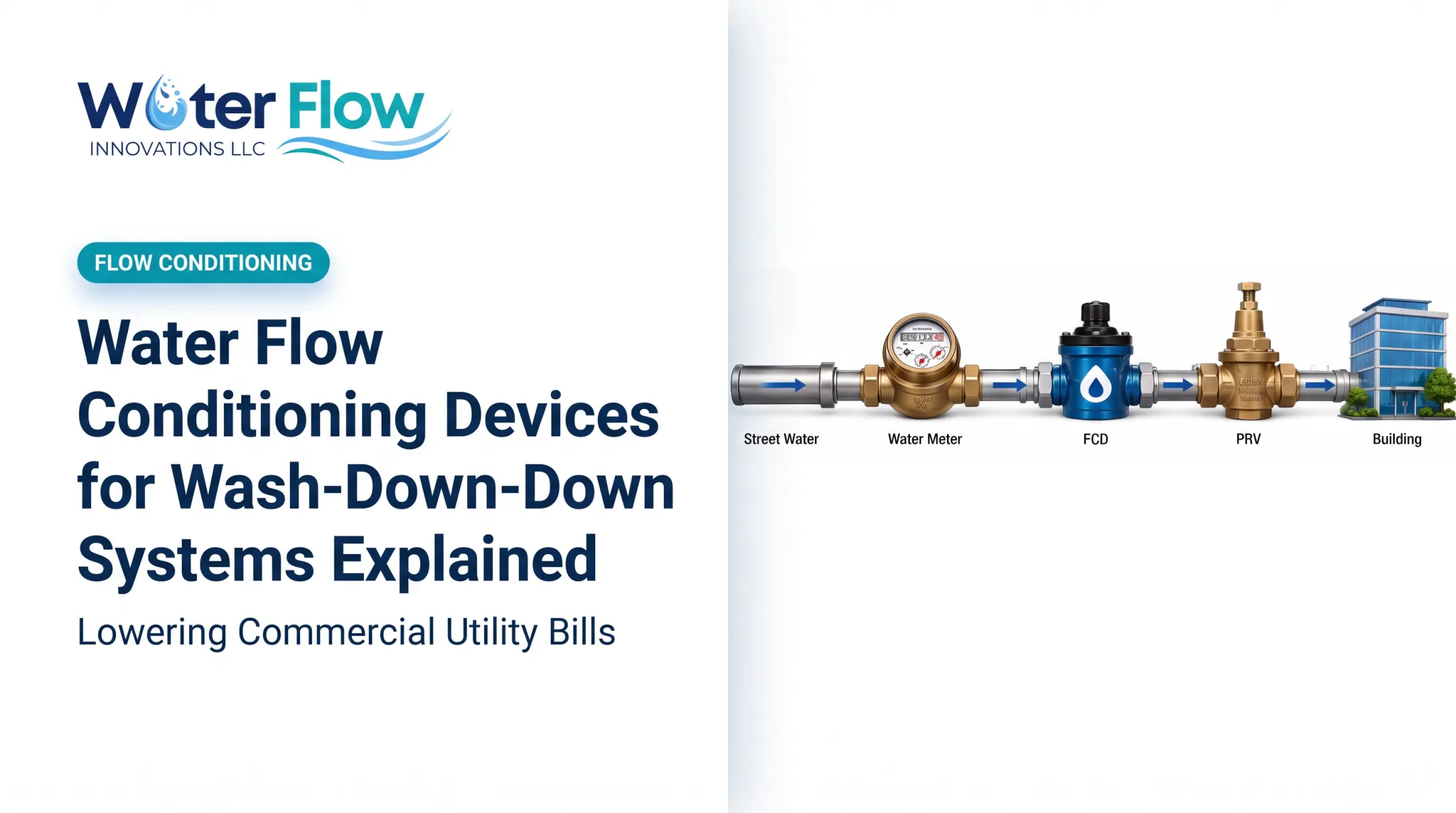
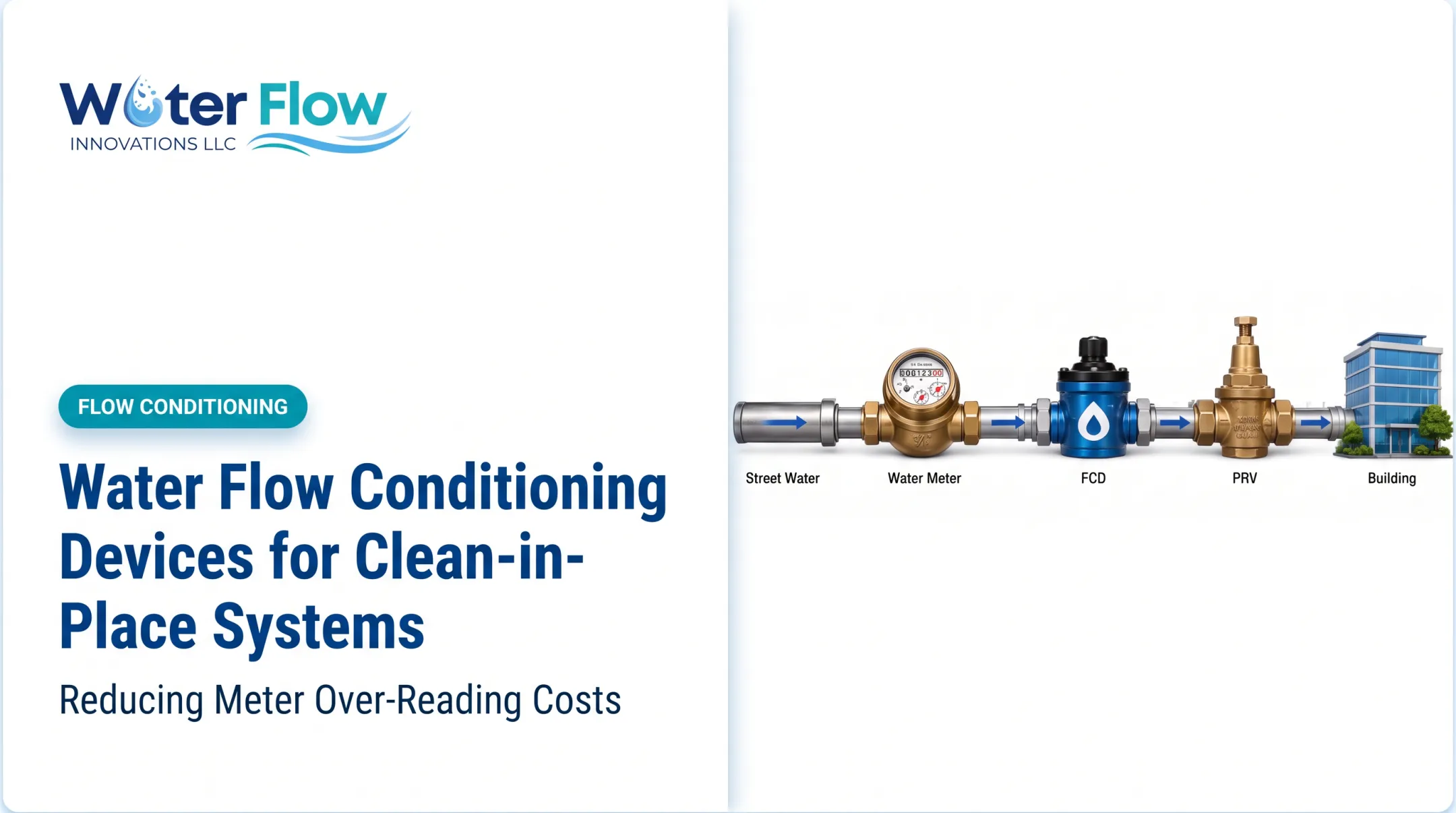
In the documented municipal configuration Water Flow Innovation uses as a baseline, the FCD installs after the meter and before any pressure-reducing valve. The same rule applies on rainwater systems: correct the disturbance closest to where it causes problems in the pump and meter layout.
A conditioning device complements the rest of the sequence; it does not replace it. These components keep their original jobs:
- Coarse screens for debris
- First-flush diverters for early contaminated runoff
- Sediment filtration and disinfection
- Pressure tanks, float controls, and check valves
- Backflow prevention
Conditions That Affect Selection
Rainwater systems bring hydraulic quirks that municipal-only systems don't deal with as often:
- Intermittent rainfall causing variable tank levels
- Pump cycling tied to irregular demand
- Long conveyance runs between tank and point of use
- Systems that alternate between rainwater and municipal backup supply
Where This Shows Up Across Facility Types
Flow stability and metering accuracy matter most in commercial and institutional settings such as:
- Food and beverage production
- Healthcare facilities
- Hospitality properties
- Schools and multifamily buildings
- Agricultural and irrigation operations
- Car washes and cooling-related processes
Golf courses and country clubs are a clear example: irrigation-meter zone cycling can cause measurable over-reading, which is a documented case for conditioning at the meter.
Water-quality and cross-connection requirements still vary by application. Intended use always decides what else must sit alongside conditioning in the system.
Flow Conditioning Compared With Filtration and Other Rainwater System Components
It's easy to assume one device can do everything. It can't. Here's how conditioning stacks up against the components it's often confused with:
| Component | What it actually does | What it doesn't do |
|---|---|---|
| Roof screens / leaf guards | Capture leaves, insects, larger debris | Address pressure, turbulence, or air |
| First-flush diverter | Diverts early, contaminated runoff away from storage | Clean water already in the tank |
| Sediment / cartridge / bag filters | Remove particulate matter via porous media | Remove dissolved gas or smooth flow |
| Carbon, membrane, UV treatment | Target organics, taste/odor, or pathogens depending on method | Replace a calming inlet or meter conditioner |
| Flow conditioning device | Manages air, pressure, turbulence at a specific point | Clean, disinfect, or filter water |
Pressure regulators, air separators, check valves, and flow sensors can overlap in function with a conditioning device (some conditioning products integrate a check valve, for example). None of this means one product eliminates the need for the others. Treat these as a coordinated system, not interchangeable parts.
When to Investigate Flow Conditioning
Investigate flow conditioning if you notice:
- Unexplained meter discrepancies compared to known usage
- Unstable or jumping flow readings
- Visible air discharge at fixtures or outlets
- Noisy, surging, or vibrating flow near pumps or valves
- Pressure fluctuations tied to demand cycling
A fully developed, undisturbed velocity profile behaves differently than flow right after an elbow or pump. That difference is well documented in NIST's technical work on liquid flow measurement, which is why placement and problem diagnosis matter more than buying a device off a spec sheet.

Once you know which component belongs where, confirm materials and cross-connection rules for the installation itself. For non-potable and potable rainwater reuse, backflow prevention, and drinking-water-contact materials, check the plumbing code adopted in your jurisdiction plus standards such as ARCSA/ASPE/ANSI 63-2020 for rainwater catchment and NSF/ANSI 61 for contact materials.
A general certification label is not the same as confirmed compliance for your specific installation. Verify scope directly with the manufacturer.
How to Select, Install, and Maintain a Flow Conditioning Device
Start With a Site Assessment
Before evaluating any product, document:
- Catchment type and rainwater end use (potable vs. non-potable)
- Pipe material and diameter
- Meter type and location
- Pump configuration and expected flow range
- Operating pressure and elevation changes
- Air-entrainment sources (drops, sprays, partially filled lines)
Confirm Compatibility
Check connection dimensions, installation orientation, isolation valve placement, bypass requirements, and available clearance for servicing. A device that fits on paper but leaves no service access becomes a maintenance problem later.
Ask for Real Documentation
Request manufacturer test data, not marketing copy, covering:
- Pressure loss across the device
- Flow range and air-removal performance
- Materials and certification scope
- Operating limits and installation requirements
Installation and Maintenance
Have qualified plumbing or water-system professionals review the design, confirm shutoffs, and protect potable supplies from cross-connection. Follow applicable US codes and local authority requirements throughout. Build one maintenance calendar for the full harvesting train. Per the EPA rainwater harvesting literature review:
- Clean gutters and downspouts twice a year
- Inspect prescreening, inlet filters, and first-flush devices about four times a year
- Service the flow conditioning device on the manufacturer’s stated interval
Evaluating Water Flow Innovation's FCD
If you are comparing engineered options, Water Flow Innovation custom-fabricates each FCD to the facility meter and piping layout. Typical configuration details include:
- Sizes from 1/2" through 12" NPS (DN20–DN500)
- 316L stainless steel construction, with titanium on special order
- Certifications: IAPMO, NSF, ANSI, CAN 61, KIWA, GMP, and SQF
- Compatibility with common pipe sizes and meter types
- Not for fire line systems Confirm certification scope, configuration, warranty, and suitability for your rainwater system before purchase. A free water bill review and savings analysis can support that evaluation. Establish a baseline before installing anything:
- Record meter readings, pressure, and pump cycling behavior
- Keep recent utility bills for comparison
- Judge results against those figures, not a promised savings percentage

Frequently Asked Questions
What is the best filtration for rainwater?
It depends on the catchment surface, intended use, and local requirements. Most systems combine roof screens, first-flush diversion, sediment filtration, and disinfection. Filtration and flow conditioning serve different purposes and aren't interchangeable.
How long does rainwater stay fresh in a barrel?
Storage life depends on tank cleanliness, light exposure, temperature, sealing, and turnover. Use covered, screened storage, maintain it regularly, and test the water before any use requiring defined quality standards.
What is the best rain catchment system?
The best system is sized for local rainfall, catchment area, storage demand, and intended use, following applicable US rules. It integrates collection, prefiltration, storage, pumping, treatment, and distribution as one coordinated design.
What does a water flow conditioning device do?
It manages hydraulic conditions like entrained air, pressure variation, check-valve protection, and turbulence at a specific point in the system. It does not filter debris or disinfect water.
Does a flow conditioning device replace a rainwater filter?
No. Filtration protects water quality and downstream equipment from contaminants, while conditioning addresses flow behavior and measurement-related issues. They solve different problems within the same system.