
This guide covers the physics behind laminar flow, the two distinct categories of laminar flow devices (faucet-level and system-level), where each type is used, and how to choose the right one for a specific application.
Key Takeaways
- Laminar flow is smooth, layered, air-free water movement; turbulent flow is chaotic, air-mixed, and introduces contamination and measurement errors
- Laminar flow devices range from faucet inserts for hygiene to system-level flow conditioning devices that stop meter over-reading
- Standard faucet aerators harbor pathogens including Legionella, Stenotrophomonas, and Acinetobacter, per peer-reviewed studies
- Air entrained in supply lines causes meters to bill for air as water volume, so facilities pay for water never delivered
- Certifications such as IAPMO, NSF, and ANSI confirm code compliance and materials safety for any laminar flow device
What Is a Laminar Flow Device?
The Physics: Laminar vs. Turbulent Flow
Fluid dynamics describes water movement in terms of the Reynolds number (Re) — a dimensionless ratio of inertial to viscous forces calculated as Re = U × D / ν (velocity × pipe diameter ÷ kinematic viscosity). Engineering references classify pipe flow into three regimes:
| Flow Regime | Reynolds Number | Appearance |
|---|---|---|
| Laminar | Re < 2,300 | Clear, glass-like, silent |
| Transitional | 2,300–4,000 | Unstable, variable |
| Turbulent | Re > 4,000 | White/foamy, hissing |

At low Reynolds numbers, water moves in parallel, undisturbed layers with no cross-currents or mixing between them. The result is a crystal-clear, silent stream. Push the velocity high enough — or introduce sharp fittings, pressure changes, or air — and those layers collapse into chaotic turbulence. Laminar flow devices exist specifically to prevent that collapse.
What a Laminar Flow Device Does
A laminar flow device is any component that creates or sustains this smooth, non-turbulent, air-free water movement within a plumbing system. That definition covers two very different product categories:
- Faucet-level devices — inserts or built-in spout designs that control the water stream at the point of discharge, primarily for hygiene or aesthetic purposes
- System-level devices — pipe-mounted conditioning units installed on the main supply line to remove air and turbulence at the meter
Laminar flow devices are not "low-flow" aerators or water-saving fixtures. Aerators deliberately introduce air into the stream to simulate higher volume while using less water. Laminar flow devices eliminate air entirely — the two products serve opposite purposes.
Laminar Flow vs. Turbulent Flow: Key Differences
Appearance, Sound, and Air Entrainment
The visual difference is immediate. Laminar flow produces a transparent, rod-like stream that looks almost solid. Turbulent flow appears white or opaque because thousands of air bubbles are suspended throughout the water column, and the air-water mixing creates a hissing or rushing sound.
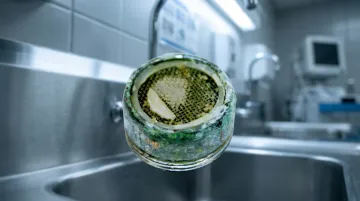
The air suspended in that turbulent stream does more than change how water looks. Conventional aerators pull ambient air into the water stream as it exits the spout — and any airborne particles in that air, including bacteria, travel with it.
Research comparing hospital faucets with aerators versus laminar water-flow devices found measurable differences in Legionella concentrations, with aerator-equipped faucets showing higher contamination levels. Multiple PubMed-indexed studies have identified faucet aerators as reservoirs or contributors for pathogens including Stenotrophomonas maltophilia, carbapenem-resistant Acinetobacter baumannii, and gram-negative opportunists in high-risk hospital units.
Impact on Water Meter Accuracy
Air entrainment creates a separate, less visible problem upstream. When air enters a supply line — through pressure cycling, pump starts/stops, or turbulent conditions near the meter — the meter registers the combined volume of water and air as if it were entirely water.
Two authoritative sources document this effect:
- NIST Handbook 44 requires batching systems to include air/vapor eliminators to prevent air passage through the meter
- PNNL's water metering guidance confirms air bubbles degrade electronic meter accuracy, and fittings or valves close to a meter introduce turbulence that compounds the problem
Facilities end up billed for water volume they never consumed.
Splash Zones and Surface Hygiene
Beyond metering, turbulent flow creates a point-of-use hygiene problem. The forceful, aerated stream at a faucet generates splash zones — rings of droplets that land on countertops, sink edges, and surrounding surfaces. In healthcare environments, those droplets can carry pathogens from the drain to adjacent surfaces.
Laminar flow eliminates the splash radius entirely, keeping the sink area drier and reducing cross-contamination risk.
Types of Laminar Flow Devices
Faucet-Level Laminar Flow Devices
Three configurations exist at the faucet level, each suited to different installation scenarios:
- Laminar aerator inserts screw into a standard faucet spout in place of a conventional aerator. Internal chambers or screens align water into parallel flow without introducing air — the standard choice in healthcare faucet upgrades where infection control teams have flagged aerator risk.
- Built-in laminar flow faucets integrate the laminar design directly into the spout during manufacturing. Many commercial-grade models include antimicrobial coatings and hands-free activation.
- Flow control spouts combine laminar stream characteristics with internal GPM regulation — useful where both stream quality and flow rate need to be managed at once.
System-Level Flow Conditioning Devices
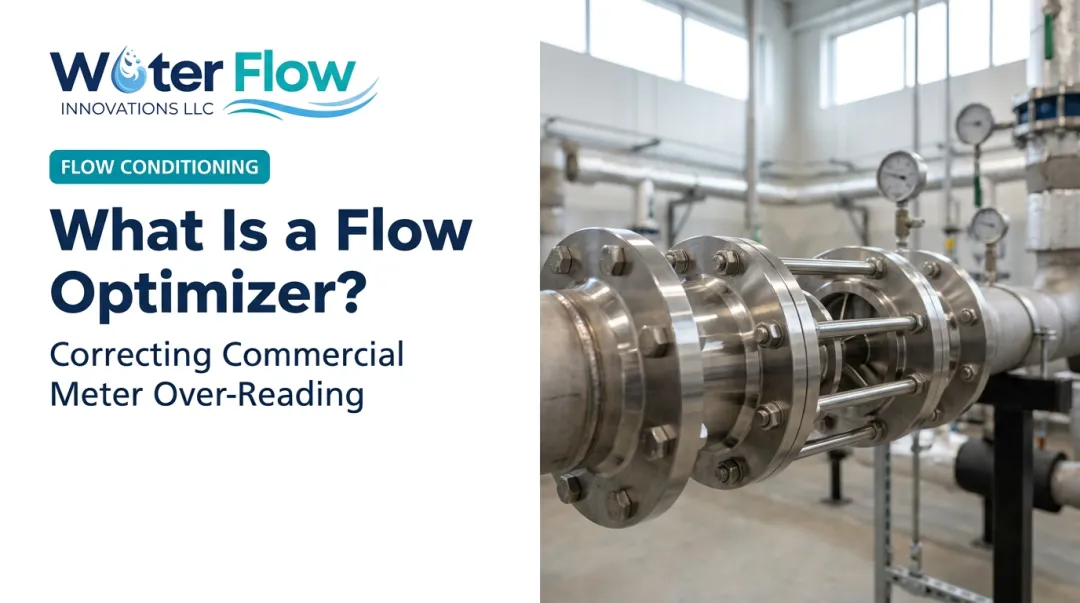
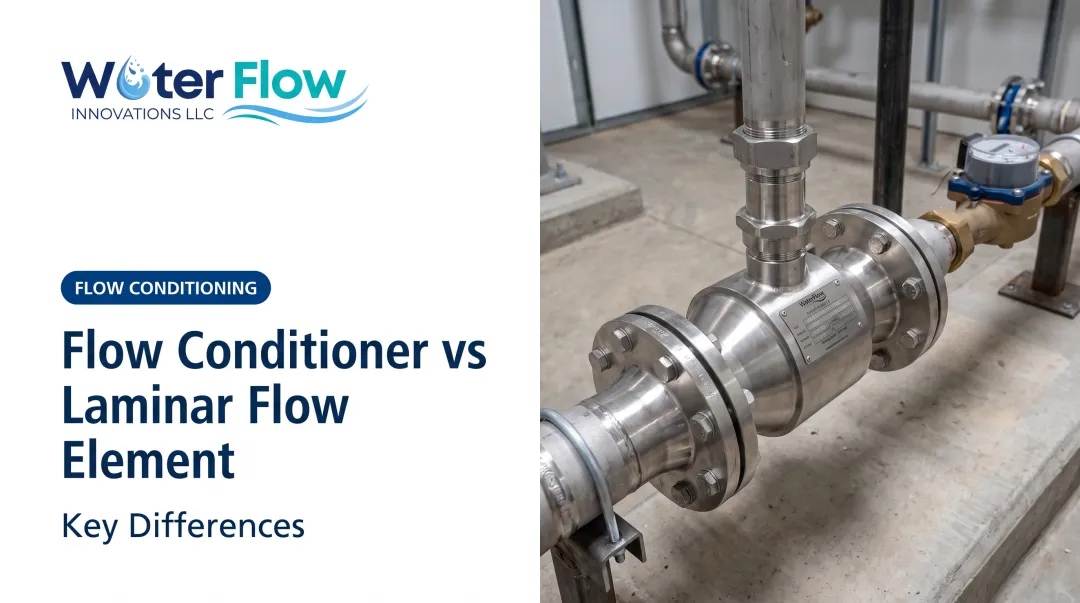
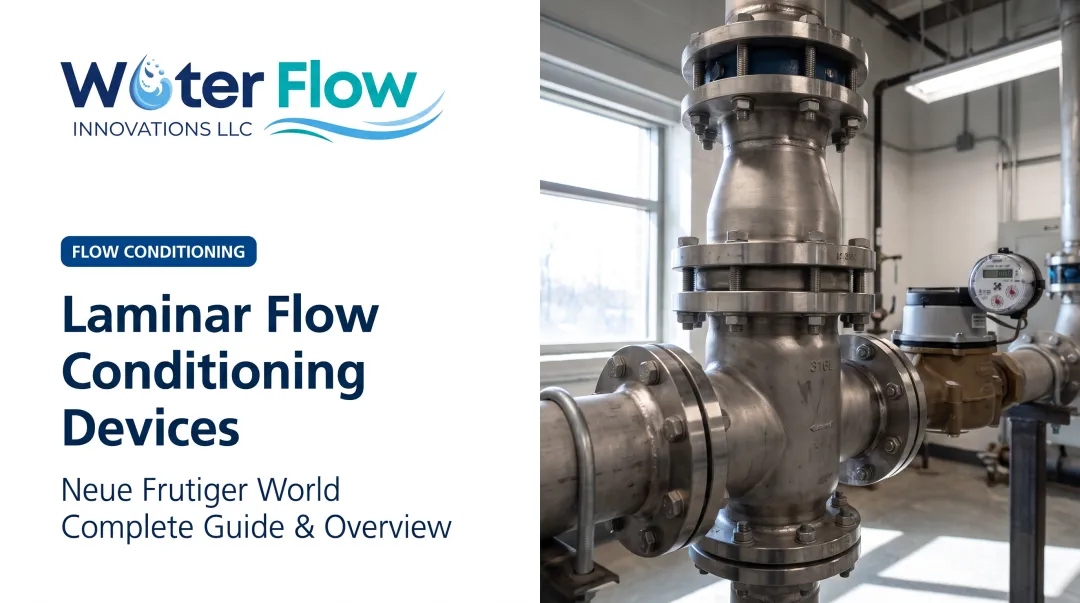
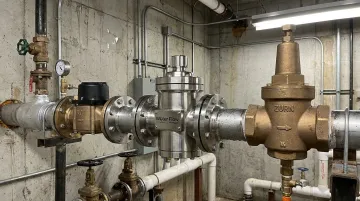
A system-level laminar flow device operates at the pipe level rather than the faucet. Installed on the main supply line — positioned at the water meter connection point — it addresses turbulence and air entrainment within the pipe itself, conditioning the flow in the meter's measurement zone.
Water Flow Innovation's Flow Conditioning Device (FCD) is the primary commercial product in this category. The FCD uses a proprietary 4-component system — air and gas removal, pressure regulation, check valve, and turbulence elimination — to deliver laminar, bubble-free flow at the meter. It is custom-fabricated in 316L stainless steel to match each facility's pipe size and meter configuration, compatible with any meter type, and carries IAPMO, NSF, ANSI, CAN 61, KIWA, GMP, and SQF certifications.
When the FCD eliminates air entrainment at the meter, the meter records only actual water consumed — not inflated volume from trapped air. Because sewer fees are typically calculated as a percentage of incoming metered water, the billing correction hits both charges at once.
Documented savings on combined water and sewer bills range from 5–30%, with the highest single result at 46%. Savings appear on the first billing cycle after installation, and 90% of customers reach full ROI in under 12 months.
Key Benefits of Laminar Flow Devices
Infection control in high-risk environments. Aerators have been linked to clinical outbreaks in peer-reviewed literature. APIC reported over 617,000 hospitalizations from 1991 to 2006 tied to waterborne opportunistic pathogens including Legionella pneumophila, Mycobacterium avium, and Pseudomonas aeruginosa, with approximately $9 billion in Medicare payments.
These figures reflect the broader waterborne pathogen burden, but aerators are well-documented as pathogen reservoirs. For facilities treating immunocompromised patients, switching to non-aerating laminar outlets is a direct, practical risk-reduction step.
Water and sewer bill accuracy. System-level flow conditioning devices correct the metering error caused by air entrainment. Because sewer discharge fees are derived directly from the metered water intake figure, correcting over-registration reduces both line items proportionally. For high-consumption facilities — hotels, hospitals, food and beverage plants, multifamily buildings — the compounded impact on annual utility spend is significant enough to recover device costs within months.
Operational cleanliness and surface hygiene. A splash-free, laminar stream keeps sink areas drier, reduces standing water on countertops and floors, lowers slip hazard risk, and makes disinfection protocol maintenance easier. In food prep areas, pharmaceutical labs, and semiconductor facilities, process purity and contamination control are production requirements. In those environments, eliminating aeration and splash isn't a preference — it's operationally necessary.
Where Are Laminar Flow Devices Used?
Healthcare and clinical environments use faucet-level laminar flow devices as part of risk-based water management plans. The CDC and Joint Commission both require formal water management programs addressing waterborne pathogen risk — and device selection at the faucet feeds directly into that framework, especially in units treating immunocompromised patients. Common settings include:
- Hospitals and surgical suites
- ICUs and outpatient clinics
- Long-term care and assisted living facilities
Commercial and industrial facilities are strong candidates for system-level flow conditioning. Any facility with high water consumption, pressure cycling, or variable demand is likely experiencing meter over-reading — and the higher the volume, the larger the dollar impact. This includes:
- Hotels, multifamily housing, and universities
- Food and beverage manufacturers and pharmaceutical plants
- Semiconductor fabrication facilities and data centers
- Large commercial office buildings
Food service, laboratories, and controlled environments benefit from laminar flow on two fronts: hygiene and precision. In restaurants and food prep areas, eliminating aeration removes bacterial entrainment risk and reduces splash contamination. In laboratory and pharmaceutical settings, laminar delivery supports production purity and compliance documentation. Applications include:
- Commercial kitchens and food prep facilities
- Pharmaceutical and life sciences labs
- Biotech and cleanroom environments
How to Choose the Right Laminar Flow Device
Identify Your Primary Problem First
The right device depends entirely on the underlying issue:
- Contamination risk at the point of use → laminar aerator insert or built-in laminar faucet
- Inflated water and sewer bills from meter over-reading → system-level flow conditioning device installed at the main supply line
These are different problems with different solutions. A faucet insert won't correct a billing error upstream, and a pipe-level conditioning device won't address splash risk at the sink.
Evaluate Certifications and Compliance Requirements
Third-party certifications matter for any commercial application — they protect against liability and support compliance documentation:
- NSF/ANSI 61 — covers health-effects requirements for drinking water system components including faucets, water meters, and valves
- NSF/ANSI 372 — validates lead-content compliance for plumbing products
- IAPMO — confirms the device meets applicable plumbing and mechanical codes
Certified devices also provide defensible documentation for ESG reporting, LEED water metering credits (LEED BD+C v4 awards 1 point for permanent metering of two or more subsystems), and sustainability program submissions.
Assess Installation Requirements and ROI Potential
Before committing to a system-level device, facility managers should work through four practical questions:
- Is the device compatible with your pipe size and meter type?
- Does it produce negligible pressure loss — meaning no downstream operational impact?
- What is the projected payback period based on your current water and sewer spend?
- Does the supplier offer a money-back guarantee period to validate results before full commitment?
Water Flow Innovation's FCD checks each of those boxes: negligible pressure loss, compatibility with any meter type and any standard pipe size (½-inch to 12-inch), a 6-month money-back guarantee, and a lifetime transferable warranty. Savings appear on the first billing cycle, so the evidence is visible before a full commitment is required.
Frequently Asked Questions
What is a laminar flow device and why are they used instead of aerators in hospitals?
A laminar flow device creates a smooth, air-free water stream by preventing turbulent mixing. Hospitals prefer them because standard aerators introduce ambient air — and any airborne bacteria present — directly into the water stream. In units treating immunocompromised patients, that contamination risk is unacceptable.
What is the difference between laminar flow and turbulent flow in water systems?
Laminar flow moves in stable, parallel layers with no air mixing, producing a clear, quiet stream. Turbulent flow is chaotic and mixes air into the water column, producing a white, hissing stream. At the faucet level this raises hygiene concerns; at the meter level it causes over-reading of actual water consumed.
How does a laminar flow device reduce water bills for commercial facilities?
Air entrainment in supply lines causes water meters to register both air and water as billable volume. A system-level flow conditioning device removes the air at the meter, so the meter records only actual water consumed — directly reducing both water consumption charges and sewer discharge fees.
What types of commercial facilities benefit most from system-level laminar flow devices?
Any high-consumption facility is likely to see meaningful savings, including hotels, multifamily buildings, hospitals, manufacturers, universities, food and beverage plants, and data centers. The higher the water usage, the greater the dollar impact of air-inflated meter readings.
Can a flow conditioning device be installed without disrupting daily operations?
Yes. System-level flow conditioning devices are designed to deliver negligible pressure loss, meaning all downstream operations remain unaffected. Installation is completed without impacting facility performance, and savings appear on the very next billing cycle after installation.
How long is water off during a system-level installation?
About one hour, and only that hour. A licensed plumber or mechanical contractor fits the custom-built unit at the supply connection, so wards, sterile processing, kitchens, and laundry resume normally once water is restored.
What approvals should a device on a potable line carry?
Certification to IAPMO, NSF, ANSI, CAN 61, KIWA, GMP, and SQF, plus compliance with the EPA WaterSense program. The device is built from 316L stainless steel in the USA.