Most facility teams shrug it off. "That's just what the system does when it warms up." That assumption is dangerous, and it's costing plants and buildings money, equipment, and sometimes lives.
Steam turbines generate about 42% of all US electricity, according to the US Energy Information Administration, and steam systems power heating, sterilization, and processing in facilities across the country. Any one of them can develop steam hammer if condensate isn't managed properly.
This guide breaks down what steam hammer actually is, the three mechanisms that cause it, why it's a genuine safety hazard, and how to stop it for good.
Key Takeaways
- Steam hammer occurs when steam condenses instantly, creating a vacuum liquid rushes to fill.
- Thermal shock and slug flow are the top causes; hydraulic shock is far less common.
- Pressure spikes can exceed 1,450 psi (10 MPa), enough to rupture pipe and injure workers.
- Controlled startups, trap maintenance, and correct pipe slope prevent nearly all incidents.
What Is Steam Hammer?
Steam hammer is the violent banging, shaking, or booming that occurs when steam rapidly condenses, or when a slug of trapped condensate slams into a fitting inside a pipe. The force involved is a genuine pressure event, capable of stressing pipes, fittings, and supports.
Here's the physics behind it: steam is compressible, almost springy, while condensate is not. When steam suddenly collapses into liquid, its volume shrinks dramatically and nearly instantly.
According to TLV's engineering analysis of water hammer, condensate's specific volume can be more than 1,000 times smaller than the steam it came from. That collapse creates a momentary vacuum.
The surrounding water rushes in to fill that gap, and when opposing walls of condensate meet inside the void, they collide with tremendous force.
That violent collision explains why terminology gets muddled. Many engineers use "steam hammer" and "water hammer in steam systems" interchangeably, since the destructive mass doing the damage is technically liquid condensate, not steam itself. Either term describes the same underlying event.
Common Warning Signs
Steam hammer rarely happens without warning. Watch for:
- Repetitive metallic banging, especially during startup
- Sudden loud booms with no obvious mechanical trigger
- Pipe supports or hangers visibly vibrating or shifting
- Rattling or chattering valves and traps
Why Steam Systems Are Especially Vulnerable
Steam runs through heating loops, industrial process lines, sterilizers, and power generation equipment. Every system with condensate return piping, boilers, or long horizontal runs carries some risk if drainage isn't designed and maintained correctly.
The longer the pipe run and the more direction changes it has, the more places condensate has to pool undetected.
What Causes Steam Hammer? The 3 Main Types
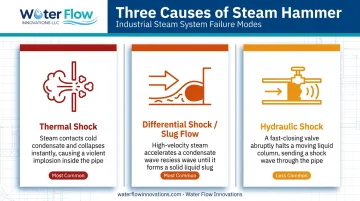
Steam hammer falls into two dominant categories, with a third less common mechanism. Identifying which one you're dealing with matters, because the fix for each is different.
Thermal Shock (Condensation-Induced Hammer)
This happens when live steam contacts cooler condensate or a cold pipe wall. Steam bubbles collapse almost instantly, producing a rapid, popcorn-like sequence of pops and bangs.
Common triggers include:
- Failed or leaking steam traps letting live steam bleed into cooler condensate return lines
- High-pressure and low-pressure condensate returns mixed in the same line
- Cold startup where steam hits piping that hasn't been warmed gradually
Differential Shock (Slug Flow / Water Slug Hammer)
This one involves biphase flow. Condensate pools in a horizontal pipe while high-velocity steam races over the top of it. That steam creates waves on the condensate surface. Eventually, a wave grows tall enough to seal the pipe's entire cross-section, forming a solid slug of liquid.
Steam in distribution mains can move at over 100 ft/s (30 m/s), and Spirax Sarco notes steam can travel up to 145 km/h (90 mph) while dragging condensate along with it. That carrier speed is what launches the slug downstream, where it slams into elbows, valves, or tees with enough force to crack cast iron.
Common causes include:
- Undersized or clogged steam traps that can't keep pace with condensate volume
- Headers that stay full of condensate due to poor drainage
- Improperly sloped piping that lets liquid accumulate instead of draining
- Boiler carryover pushing excess moisture into the distribution system
Hydraulic Shock (Less Common in Steam Systems)
Hydraulic shock occurs when a column of liquid condensate decelerates suddenly, usually from a fast-closing valve. It's the mechanism most people associate with "classic" water hammer in plumbing, and it's more typical in flooded condensate lines than in dry steam mains.
The Real Dangers: Why Steam Hammer Is So Destructive
Steam hammer isn't cosmetic wear and tear. It's a structural event that happens over and over until something gives.
During a hammer event, momentary pressure can spike over 10 MPa (roughly 1,450 psi) above normal operating pressure, according to TLV's engineering data. That's enough force to jar flanges loose, crack gaskets, snap valve internals, and eventually rupture piping outright.
A Real Fatality on Record
This isn't theoretical. In 2002, a high-pressure steam line ruptured at SUNY Buffalo while an engineer was bringing the heating system online.
OSHA's investigation concluded that condensation-induced water hammer was the probable cause. The worker suffered scalding steam burns over his entire body and died at the scene.
Contributing factors OSHA identified included condensate sitting in the high-pressure line, reverse-sloped piping, inoperative steam traps, and a startup procedure that had been changed without adequate training. Every one of those is preventable.
A separate 2021 incident in Boston injured three people when water hammer ruptured a cast-iron tee on a 6-inch steam line, again traced to trapped condensate and rapid steam collapse.
The Financial Cost Adds Up Too
Beyond safety, steam hammer is expensive:
- Emergency repairs on ruptured piping cost far more than scheduled maintenance
- Destroyed steam traps and instrumentation need replacing repeatedly if the root cause isn't fixed
- Unplanned downtime halts production lines and heating systems
- Repeated shock waves accelerate wear on nearby joints, hangers, and connected equipment
How to Prevent and Eliminate Steam Hammer
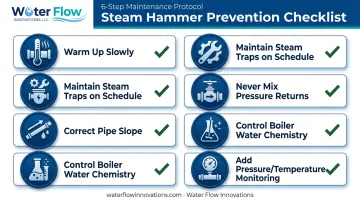
Prevention comes down to one principle: keep condensate moving and never surprise the system with sudden pressure.
- Warm up slowly. Open bleed and drain valves and bring the system to pressure gradually. Rushing full steam into a cold system is the single most common trigger for thermal shock.
- Maintain steam traps on a schedule. High-pressure traps (150+ psig) should be tested weekly to monthly; medium pressure monthly to quarterly; low pressure at least annually. A facility-wide trap survey every 6 to 12 months catches failures before they cause damage.
- Get the pipe slope right. Steam mains should fall at least 1:100 in the direction of flow, with drip legs at every low point and every 30-50 meters along the run.
- Never mix high- and low-pressure condensate returns. Combining them is a direct path to thermal shock.
- Keep boiler water chemistry in check. Poor chemistry causes carryover, pushing excess moisture into distribution piping.
- Add monitoring where it counts. Pressure and temperature sensors on critical lines give early warning before a hammer event becomes a rupture.
Why Steam Trap Failures Deserve Extra Attention
Steam trap failure is more common than most operators assume. Roughly a quarter to a third of traps in a typical industrial facility have failed at any given time, either stuck open and wasting live steam or stuck shut and backing up condensate.
Water Flow Innovation's steam system repair services address this directly. Using ultrasonic and thermal imaging surveys, the team locates failed traps, then pairs trap replacement with condensate return optimization and flash steam recovery.
Fixing a failed trap doesn't just stop the banging. It also cuts wasted fuel, water, and sewer costs tied to lost steam and condensate.
Steam Hammer vs. Water Hammer: Understanding the Bigger Picture of Flow-Related Utility Issues
Water hammer, in the strict technical sense, refers to a sudden change in liquid velocity, typically from a valve slamming shut.
Steam hammer is a specific, more complicated cousin of that phenomenon. It adds phase change and condensation dynamics into the mix, which is why it demands its own diagnosis and its own fixes.
Here's where it gets interesting for facility managers. Many buildings running steam boilers also operate a completely separate water intake and metering system. That system faces its own flow-related problem, and it has nothing to do with pipes rupturing.
Turbulent, air-entrained flow at the water meter causes inaccurate readings that inflate utility bills, even though nothing is mechanically wrong with the pipe. This billing problem drains budget every single month, even though it poses no safety risk.
Water Flow Innovation's Flow Conditioning Device (FCD) is built specifically for that meter-side problem. It's certified to IAPMO, NSF, ANSI, CAN 61, KIWA, GMP, and SQF. It installs immediately downstream of the water meter, not anywhere near the steam or condensate piping. Consider these figures:
- Facilities typically see 5-30% reductions in water and sewer bills, with the highest documented result at 46%
- 90% of customers reach full ROI in under 12 months
- Savings show up on the very next billing cycle, since the meter starts reading accurately the moment the FCD is installed
For facilities juggling both steam-side hammer risks and meter-side over-billing, these are two distinct problems requiring two distinct fixes. Tackling both delivers compounding savings across water, sewer, and fuel bills.
Frequently Asked Questions
What is steam hammering?
Steam hammering is the violent banging that occurs when steam condenses too rapidly or when condensate slugs collide inside piping. It's distinct from simple water hammer in liquid-only systems because it involves a phase change.
What causes hammering in steam pipes?
Thermal shock (live steam meeting cool condensate) and differential shock (condensate slugs launched by fast-moving steam) cause most cases. Hydraulic shock from a rapidly closing valve occurs less often.
Is steam hammer dangerous?
Yes. It can rupture pipes, destroy valves and traps, and has caused documented injuries and at least one fatality in industrial settings. Never dismiss it as normal operating noise.
What is the difference between water hammer and steam hammer?
Water hammer generally describes sudden liquid deceleration, like a valve slamming shut. Steam hammer is a specific type involving condensation and phase-change dynamics unique to steam and condensate systems.
How do you stop water hammer in steam pipes?
Warm up systems slowly, maintain and test steam traps on schedule, ensure correct pipe slope toward drip legs, and avoid mixing high- and low-pressure condensate returns. Professional trap testing and replacement, like the repair services Water Flow Innovation provides, prevents most hammer events.
Can steam hammer damage a boiler?
Steam hammer typically originates in distribution and condensate piping rather than inside the boiler itself. However, repeated shock waves travel back through connected equipment and can stress boiler-side components, traps, and instrumentation over time.
Does hammer on the cold-water side affect meter accuracy?
Yes. Water hammer and the pressure surges around it drive air out of solution and create turbulence at the meter. Most meters cannot distinguish water from air, so that entrained volume is registered as billable consumption. Correcting it has produced documented reductions averaging 5–30%, with a highest documented result of 46%.
Which facilities most commonly report steam hammer?
Sites with long distribution runs and frequent start-stop cycling: centralized district energy plants, hospitals, universities and dormitories, paper mills, textile mills, food and beverage plants, breweries and distilleries, and commercial laundries.