Introduction
U.S. commercial and institutional facilities account for 17% of withdrawals from public water supplies, making them the second-largest public-supply customer category in the country. Large commercial buildings over 200,000 square feet consume an average of 7.9 million gallons per year — yet most property managers review water spend only as a single monthly total, rarely examining what drives the number.
The problem isn't just volume. Commercial water bills accumulate from multiple directions: consumption charges, sewer fees tied to metered intake, demand surcharges, and billing inaccuracies that go undetected across billing cycles.
With 73% of U.S. water utilities planning rate increases in 2024, even a property holding flat consumption will see its water bill climb year over year.
This guide breaks down where commercial water costs originate, what causes them to escalate, and which reduction strategies address the problem at its source — not just around the edges.
Key Takeaways
- Water bills include consumption charges, sewer fees, and demand surcharges — most properties only track the total
- Hidden cost drivers — leaks, aging fixtures, cooling tower inefficiency, and meter over-reading — often go unaddressed
- Sewer fees amplify every billing error: inflated water meter reads produce matching sewer charges
- Flow conditioning can cut bills without changing usage habits or disrupting operations
- The right interventions can show savings as early as the next billing cycle
How Water Costs Build Up in Commercial Real Estate
Commercial water costs rarely present as a single visible line item. A typical bill includes:
- Volumetric water charges — billed per CCF (100 cubic feet, or 748 gallons) or per 1,000 gallons
- Sewer/wastewater fees — in NYC, sewer charges run 159% of the water rate; in Chicago, they match water charges dollar-for-dollar
- Meter-size service availability charges — fixed fees based on connection size regardless of usage
- Pollutant loading or demand surcharges — common in industrial and food service applications
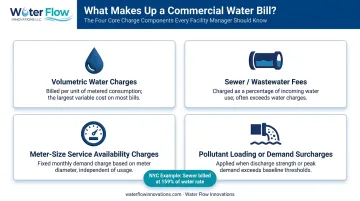
Most property managers see only the combined monthly total. That's where the problem starts.
Cost build-up is gradual and compounding. A 5% billing inaccuracy on a $15,000/month water bill adds up to $9,000 in overpayment annually — invisible unless someone runs the numbers. A slow fixture leak or minor meter misread never triggers an alert. By the time the source is identified, months or years of excess charges have already hit the books — with no automatic mechanism to recover them.
Key Cost Drivers Behind High Water Bills in CRE
Rising Municipal Rates
Rates are climbing regardless of consumption behavior. In 2025, roughly 50% of U.S. water utilities planned rate increases over a two-year window, with 30% struggling to cover service costs through user rates alone. For context on what commercial properties pay:
- New York City: Water at $5.35/CCF, combined water/sewer at $13.86/CCF
- Chicago: Metered water at approximately $4.98/1,000 gallons, with sewer matching water charges 1:1
- San Antonio: Base water at $1.958/1,000 gallons, sewer at $4.37/1,000 gallons
Flat consumption won't protect against rising rates. A property using the same volume it did three years ago is still paying more today.
Undetected Leaks and Fixture Inefficiency
According to EPA, leaks typically account for around 6% of a commercial facility's total water use — and most go unnoticed for extended periods. The dollar impact scales quickly:
- A 15 gpm broken distribution line: up to $86,000/year in wasted water
- A stuck cooling tower float valve at 5 gpm: $29,000/year
- A single stuck toilet fill valve at 3 gpm: up to $1,400/month
On the fixture side, older flushometer-valve toilets in U.S. commercial buildings use 3.0–7.0 gallons per flush. WaterSense-certified replacements use no more than 1.28 gpf — a reduction of 60–80% per flush. EPA estimates that a 10-story office building with 1,000 occupants can save nearly 1.2 million gallons per year just from toilet replacements.
Cooling Tower and HVAC Water Consumption
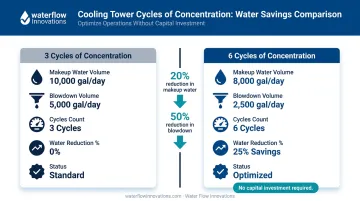
Cooling towers represent 20–50% or more of total facility water use in many commercial buildings. A 500-ton chiller operating at 50% load for 18 hours per day at 3 cycles of concentration draws over 10,000 gallons per day — just in makeup water.
Poor management of blowdown cycles and concentration ratios turns cooling systems into systematic water wasters. Increasing cycles of concentration from 3 to 6 reduces makeup water consumption by 20% and blowdown by 50%, according to EPA guidance — without capital investment.
Sewer Fees Amplifying Every Over-Charge
Because most utilities bill sewer discharge based on metered water intake, every inflated gallon on the water meter generates a corresponding sewer charge. This creates a compounding billing penalty that's easy to miss.
In NYC, where sewer fees are 159% of water charges, a $1,000 metering error on the water side becomes a $2,590 total billing error when sewer is included. No leak repair, fixture upgrade, or conservation program addresses this if the underlying meter reading is the problem.
Water Meter Over-Reading: The Hidden Structural Cost
Most CRE operators never factor this in. Standard water meters register more volume than actually flows through them when air bubbles or turbulent flow conditions are present in the supply line. Peer-reviewed research confirms that mechanical meters can record 0–150% of air volume as billed water, meaning the property pays for volume it never received.
Turbulence from nearby fittings, valves, or pressure cycling compounds the problem. A Clemson Industrial Assessment Center case study found that correcting air-induced meter errors delivered:
- 3.87 million gallons per year in verified savings
- $15,929 annually in reduced utility charges
- 2-month payback on the correction cost
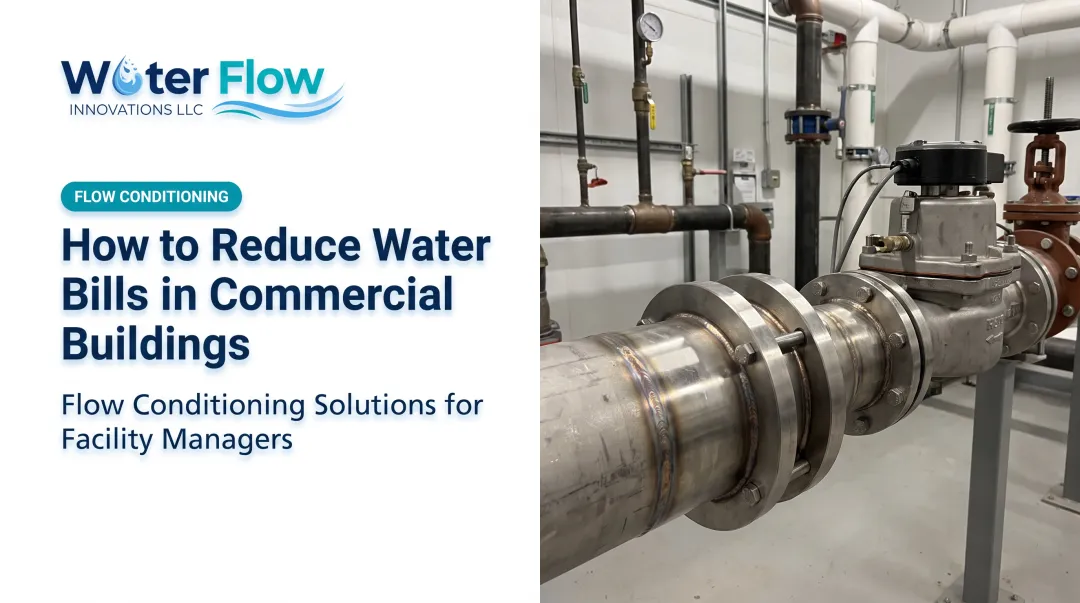
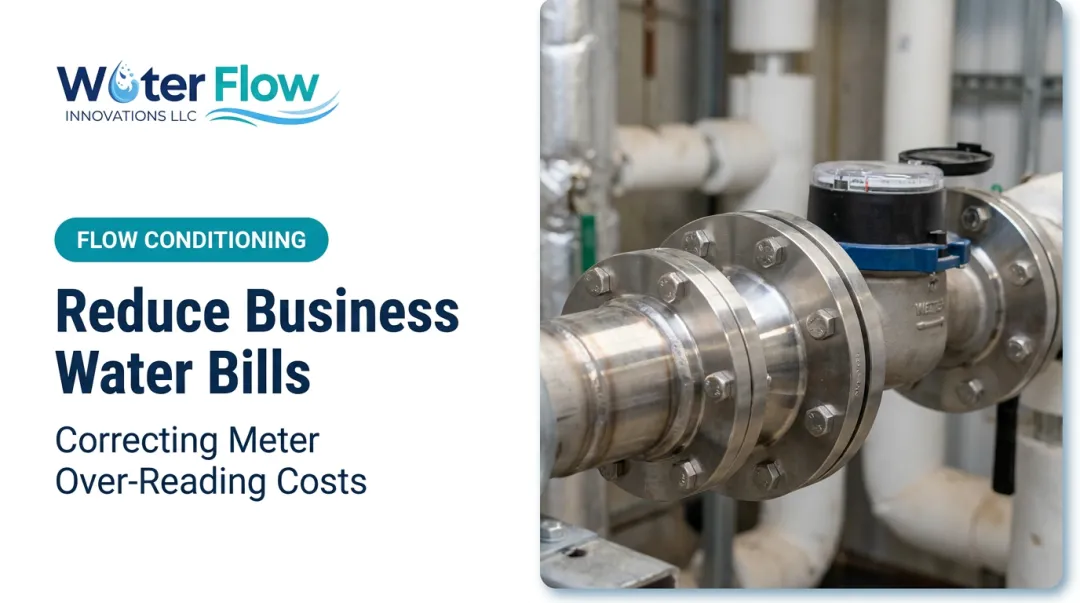
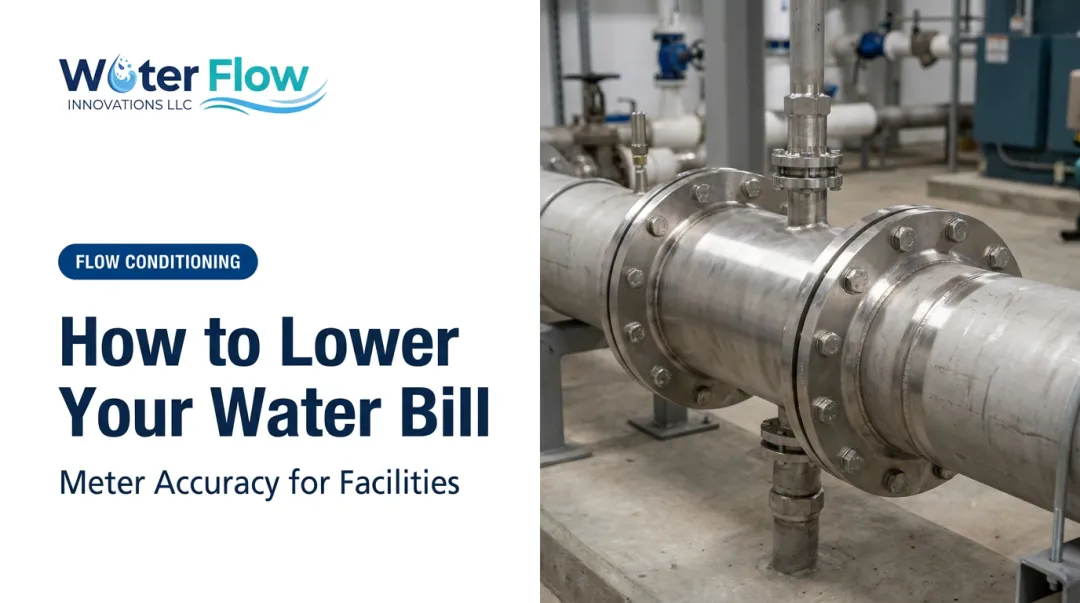
Water Flow Innovation's Flow Conditioning Device (FCD) is built to correct exactly this problem. The FCD installs directly after the water meter, creates laminar (smooth, uniform) flow conditions, and eliminates the air entrainment and turbulence that cause meters to over-register.
The device produces negligible pressure loss, so every downstream system operates identically after installation. Savings typically range 5–30%, with the highest documented result at 46%, and appear on the very next billing cycle.
Cost-Reduction Strategies for Commercial Real Estate
Water cost reduction strategies fall into three distinct categories depending on where the cost originates: decisions made around facility setup and procurement, how the building is operated day-to-day, and structural factors in the surrounding environment that inflate costs regardless of user behavior.
Strategies That Reduce Costs by Changing Decisions
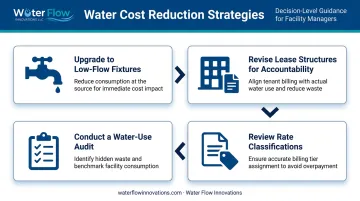
These are decisions made before water is ever used — around equipment specification, lease structure, and billing setup.
Upgrade to low-flow fixtures WaterSense-certified commercial toilets use no more than 1.28 gpf versus the 3.0–7.0 gpf found in older buildings. Aerators and low-flow faucet valves typically carry payback periods under 12 months. A Holiday Inn in San Antonio replaced 397 fixtures and achieved $35,000/year in water and sewer savings with a simple payback under 2 years.
Revise lease structures to assign water accountability In master-metered buildings where the landlord absorbs all water costs, tenants have no incentive to conserve. Shifting to submeter-based billing or a RUBS (Ratio Utility Billing System) structure transfers accountability to end users. Studies suggest submetered multifamily properties use 15–40% less water than master-metered equivalents.
Conduct a water-use audit before budgeting Formal audits surface rate misclassifications, billing tier errors, and fixture inventories that would otherwise persist indefinitely. Errors identified through audits can often be corrected retroactively.
Review rate classifications and tariff structures Commercial properties are sometimes billed under incorrect rate codes — particularly after renovations or changes in use. A rate audit can identify whether the property qualifies for lower-tier pricing without changing anything operationally.
Strategies That Reduce Costs by Changing How Water Is Managed
Operational management decisions determine whether inefficiencies persist or get caught early.
Implement real-time water monitoring and submetering Properties with consumption monitoring can identify anomalous usage spikes within hours. Without submetering, most leaks surface only through unexpected bill increases — often months after they begin.
Establish a proactive leak detection and repair schedule A regular inspection schedule with defined response protocols prevents gradual losses from becoming permanent costs. Cooling towers, irrigation systems, and restrooms should be checked on a fixed cadence, not only when problems become visible.
Optimize cooling tower cycles of concentration Increasing from 3 to 6 cycles reduces makeup water by 20% and blowdown by 50%. Many systems run at 2–4 cycles when 6 or more is achievable with proper water chemistry management — a purely operational change with no capital cost.
Train facility staff on water accountability Operational efficiency improves when on-site teams understand which systems consume the most water, how to spot abnormal usage, and who is responsible for acting on anomalies. Internal benchmarks and tracking sustain savings achieved through equipment upgrades.
Strategies That Reduce Costs by Changing the Context Around Water Use
In many properties, how water is measured and priced is the actual cost driver.
Correct meter over-reading with a Flow Conditioning Device Installing a certified flow conditioning device immediately after the water meter eliminates the air entrainment and turbulent flow that causes meters to register inflated readings. The reduction applies to both water and sewer charges simultaneously, since sewer fees are billed from metered intake.
Water Flow Innovation's FCD is IAPMO, NSF, ANSI, CAN 61, KIWA, GMP, and SQF-certified, and installation is usually about an hour (+/-). Key commercial advantages include:
- 6-month money-back guarantee with no questions asked
- Lifetime transferable warranty that stays with the property through ownership changes, refinancings, and lease transitions
- Documented NOI improvement verifiable on utility bills — useful for transactions and due diligence
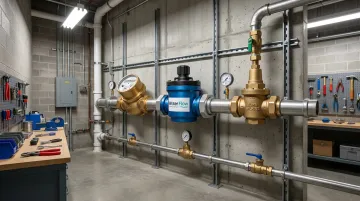
Property managers can estimate potential savings using Water Flow Innovation's free Water & Sewer Bill Savings Calculator.
Pursue utility rebates and demand response programs Many municipal water utilities and state programs offer rebates for fixture upgrades, submetering installation, or water audits. EPA's WaterSense Rebate Finder is searchable by ZIP code and product category. The Southern Nevada Water Authority, for example, runs a Water Efficient Technologies program specifically for commercial, industrial, and institutional customers.
Use water savings for ESG reporting and LEED certification LEED BD+C v4.1 requires a 20% aggregate indoor water-use reduction from baseline to achieve certification. LEED Commercial Interiors v4 awards up to 12 points for indoor water reductions between 25–50%. CBRE research found LEED-certified U.S. office buildings commanded a 3.7% rent premium versus comparable non-certified assets after controlling for age, size, and location.
Documented water reductions — particularly those verified on utility bills — satisfy the evidentiary requirements for ESG disclosures and LEED audits. Water Flow Innovation's before-and-after utility bill documentation is structured to meet this standard.
Conclusion
Reducing water costs in commercial real estate depends on correctly diagnosing where the cost originates. A property overpaying because of meter over-reading won't see meaningful results from fixture upgrades alone. A property with a systemic cooling tower inefficiency won't benefit from a tariff reclassification. The strategies have to match the source.
Effective water cost reduction is layered and ongoing. Decision-level changes — fixture upgrades, lease restructuring, rate audits — set the foundation. Operational management sustains savings over time. Structural corrections, particularly addressing how water is measured and billed, often unlock the most immediate and verifiable results. For many commercial properties, correcting meter over-reading alone has reduced bills by 5–46% — starting with the very next billing cycle. A free bill review from Water Flow Innovation can show you whether that's happening at your property.
Frequently Asked Questions
What runs your water bill up the most?
For commercial properties, the biggest drivers are typically high-consumption fixtures, undetected leaks, cooling system inefficiency, and water meter over-reading. Sewer fees compound all of these — utilities bill them directly from metered intake, so every inflated reading produces two charges, not one.
How do you reduce water consumption in commercial buildings?
The key levers are upgrading to WaterSense-certified fixtures, installing submetering systems, optimizing cooling tower cycles of concentration, auditing billing classifications for rate errors, and correcting meter over-reading where applicable.
Is 10,000 gallons of water a month a lot?
For a household, 10,000 gallons per month is moderate. For a commercial building, it's quite low — mid-size commercial properties typically consume hundreds of thousands to millions of gallons monthly. Even a 1–2% billing reduction at that scale can represent thousands of dollars per year.
How much does water typically cost as a percentage of commercial operating expenses?
A BOMA Kansas City benchmark for Class B office space in 2021 reported water and sewer at $0.26/sf against total operating expenses of $11.42/sf — roughly 2.3% of total OPEX and 11.7% of total utility costs. This share grows as municipal rates increase annually, even without changes in consumption.
What is water meter over-reading and how does it affect commercial water bills?
Water meters register more volume than actually flows through them when air bubbles or turbulent flow conditions are present in the supply line — billing properties for water they never received. Because sewer fees are calculated from metered intake, one inflated reading produces two inflated charges simultaneously.
How quickly can commercial properties expect to see results from water cost reduction measures?
Fixture upgrades and leak repairs typically show savings within one to two billing cycles. Flow conditioning devices take effect on the very next billing cycle after installation — the meter reads accurately from the moment the device is active, so savings are immediate rather than gradual.
How much building disruption does the correction involve?
About an hour, with a brief water shutoff at the meter connection, fitted by a licensed plumber or mechanical contractor at the supply connection. Tenants, lifts, cooling plant, and restrooms are unaffected outside that window.
Is this a flow restrictor that tenants would notice?
No. Negligible pressure loss is a fundamental design characteristic, so tenant fixtures, kitchens, and cooling plant receive exactly what they received before. It restricts nothing and alters no water chemistry — it corrects only what the meter registers.