For most homeowners, trapped air is a temporary nuisance fixed with a simple flush. For commercial and industrial facilities, the stakes are higher. Air entrained in supply lines causes water meters to register volume that is partly air, not water — meaning you may be paying for water you never actually received.
This article covers the signs of trapped air, the most common root causes, a step-by-step process to clear it, and when a permanent solution becomes necessary.
Key Takeaways
- Sputtering faucets, pressure swings, banging pipes, and milky water are the four reliable signs of air in supply lines
- Air enters through plumbing repairs, pipe leaks, well system issues, and municipal supply disruptions
- DIY fix: shut off the main supply, open fixtures top to bottom, restore water slowly, and flush until flow is steady
- Recurring air in commercial facilities is a structural issue — flushing only treats the symptom
- Entrained air causes water meters to over-read, inflating bills for water never actually consumed
Signs of Air in Your Water Pipes
Most air-related symptoms appear at the point of use and follow predictable patterns. Knowing them helps confirm the problem before you start pulling wrenches.
Sputtering or Spitting Faucets
Water shoots out in bursts with intermittent blasts of air rather than a steady stream. This happens when air pockets trapped in supply lines get displaced as water pushes through, releasing at the fixture outlet. Utility guidance from Seattle Public Utilities directly identifies air release and sputtering as expected symptoms after supply disruptions.
Pressure Fluctuations and Inconsistent Flow
Water pressure unexpectedly surges or drops without any change in usage patterns. Air pockets compress and expand under pressure, creating unpredictable variations in flow rate throughout the building — particularly noticeable when multiple fixtures run simultaneously.
Knocking, Banging, or Hammering Noises
Pipes produce loud banging or rattling sounds, especially when a valve or fixture is shut off suddenly. This is water hammer. According to the American Society of Plumbing Engineers, abrupt valve closure is the most frequent initiating event. Air already present in the line worsens the effect, amplifying the resulting pressure shockwaves throughout the system.
Cloudy Water That Clears Quickly
Water appears milky or opaque when the tap first opens, then clears within seconds. This is the most reliable indicator: micro air bubbles suspended in the water column rise and escape once water is poured into a glass. The key identifier is that it clears from the bottom upward — sediment settles; bubbles rise.
What Causes Air in Water Pipes?
Air enters plumbing through several predictable pathways. Identifying the specific cause matters before applying a fix — some causes are temporary, others are structural.
| Cause | When It Appears | What to Look For |
|---|---|---|
| Recent plumbing work | Immediately after repairs or fixture replacement | Symptoms started same day as maintenance |
| Pipe leaks or cracked fittings | Persistent, no recent maintenance | Air returns shortly after flushing |
| Well system issues | Properties on private wells | Pump or pressure tank recently serviced |
| Municipal supply disruption | After utility maintenance or main break | Neighbors report similar issues |
| Turbulent flow conditions | High-demand commercial facilities | Symptoms correlate with operational cycles |
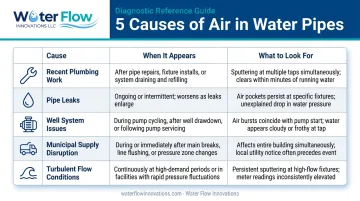
Pipe leaks deserve specific attention. Small cracks, loose joints, or deteriorated seals allow air to be drawn into the line when local pressure drops. Even a minor breach can introduce a continuous trickle of air without causing visible water damage — which is why air symptoms that persist despite repeated flushing often trace back to an undetected leak.
On private well systems, the pressure tank is the first place to check. A waterlogged tank with a failing bladder is one of the most common and overlooked sources of recurring air in supply lines. Most bladder tanks last 5–7 years; if yours is older and symptoms keep returning, the bladder has likely failed.
In commercial and industrial settings, turbulent flow is the dominant cause. High-demand scenarios create pressure differentials that pull air into the line or hold it in suspension. Common triggers include:
- Simultaneous fixture use across multiple zones
- CIP cycles and process washdowns
- Cooling tower makeup water cycling
- Sudden shutoff of large valves
- Irrigation zone sequencing
This turbulence-driven air entrainment is also the primary mechanism behind water meter over-reading — a separate but directly related problem for facilities paying inflated utility bills.
How to Get Air Out of Water Pipes: Step-by-Step
Clearing air pockets effectively means working through the entire system — not just the fixture nearest to the problem. The steps below cover the full sequence.
Step 1: Identify the scope of the problem
Run each faucet briefly and note where sputtering, noise, or pressure irregularities occur. Note whether symptoms started after a specific event — plumbing work, utility maintenance, a power outage affecting a pump. Isolated symptoms suggest a branch line issue; building-wide symptoms indicate the main supply.
Step 2: Shut off the main water supply valve
Locate and close the main shutoff. Valve operation varies by type:
| Valve Type | How to Close | Caution |
|---|---|---|
| Ball valve | 90-degree turn (lever perpendicular to pipe) | Moves quickly — don't overshoot |
| Gate valve | Turn clockwise until fully stopped | Do not force if stuck under pressure |
If a valve feels stuck, do not force it — forcing a seized valve can cause damage.
Step 3: Open all faucets and fixtures throughout the building
Start from the highest floor and work downward, opening both hot and cold taps at every fixture. Include:
- Outdoor spigots
- Toilet fill valves (flush each toilet)
- Water-connected appliances (dishwashers, washing machines)
Opening all outlets simultaneously gives trapped air the maximum number of escape routes.
Step 4: Restore water flow slowly and flush
Gradually reopen the main shutoff valve — turning it on too fast pushes air unevenly and prolongs clearing. Allow water to run from all open fixtures until flow is steady and sputtering stops, typically 10–15 minutes depending on system size.
Philadelphia Water Department guidance recommends running cold taps for several minutes after any main break to release air and flush debris before closing fixtures.
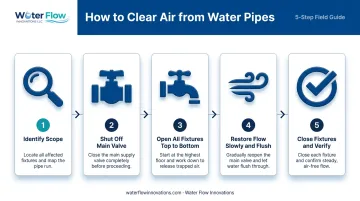
Step 5: Close fixtures and verify flow
Close faucets in reverse order — starting from the lowest fixture and working upward. Check that water runs smoothly from each outlet with no residual sputtering. If specific fixtures still show symptoms, re-open and flush that branch for an additional period. Observe flow for at least 30 seconds after apparent clearing before closing.
When Flushing Isn't Enough: Chronic Air Entrainment in Commercial Facilities
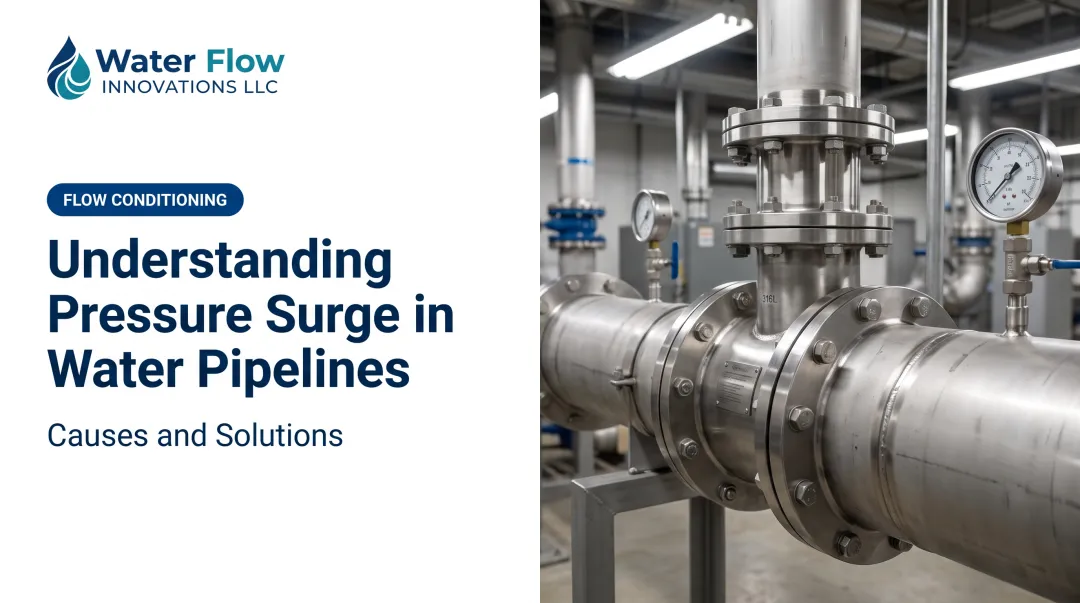
For residential properties after a one-time event, the flush method typically resolves the issue in a single session. For commercial and industrial facilities where air symptoms return week after week, pipe flushing is a temporary measure — it does not fix the underlying structural condition.
The Meter Over-Reading Problem
Water meters measure volume passing through. They cannot distinguish between air and water. A 2022 study published in AQUA — Water Infrastructure, Ecosystems and Society found that during intermittent-supply pipe-filling conditions, DN15 single-jet and multi-jet meters registered expelled air, with the recorded air volume representing 32.3%–61.9% of incoming water volume per filling event.
For commercial facilities with frequent demand cycling — CIP systems, cooling towers, irrigation zones, high-frequency valve operations — this isn't an isolated test condition. It's operational reality on every shift.
The compounding factor: most commercial sewer charges are calculated from metered water consumption. Every air-inflated water reading produces an equally inflated sewer charge. Two bills affected by one problem.
A Permanent Solution
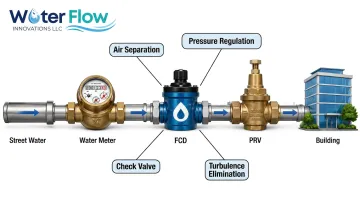
Water Flow Innovation's Flow Conditioning Device (FCD) corrects meter over-reading by installing immediately after the water meter. It operates through four integrated components:
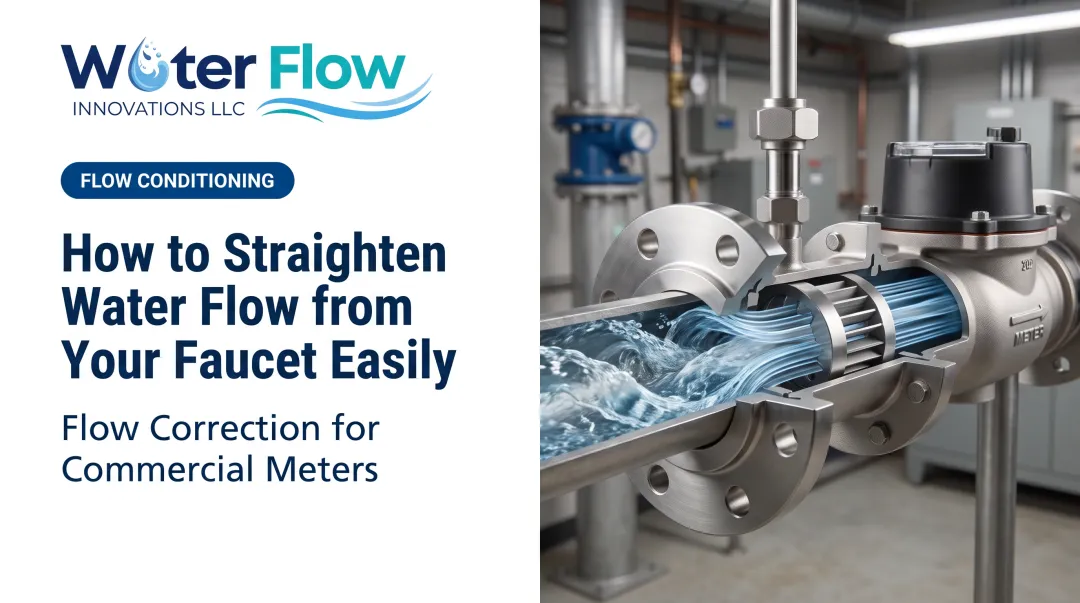
- Air & Gas Separation — creates static back-pressure that produces laminar flow, ensuring a 100% homogeneous water column passes through the measurement zone
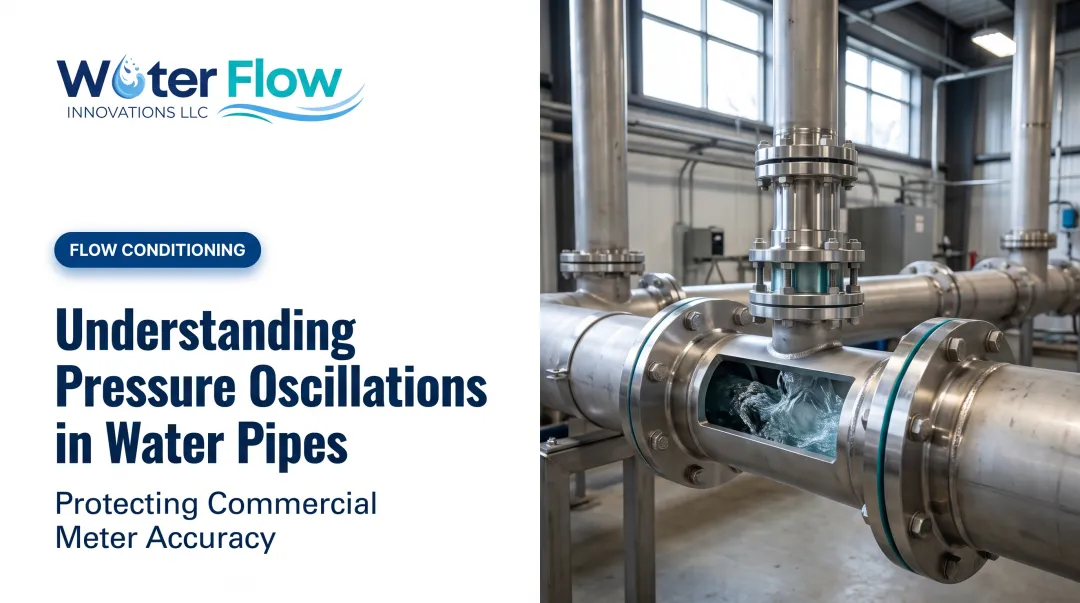
- Pressure Regulation — smooths incoming pressure spikes and reduces water hammer, both of which introduce entrained air
- Check Valve — prevents reverse flow and pressure spikes that reintroduce air after purging
- Turbulence Elimination — reduces water velocity to prevent vortex flow while maintaining full downstream pressure
The result is that the meter reads only actual water delivered — not air, micro-bubbles, or turbulent flow artifacts. Documented savings range from 5–30% on combined water and sewer bills, with the highest single documented result at 46%. Ninety percent of commercial customers reach full ROI within 12 months, and savings appear on the first billing cycle after installation.
The FCD carries IAPMO, NSF, ANSI, CAN 61, KIWA, GMP, and SQF. Downstream pressure loss is negligible by design, which makes it suitable for pressure-sensitive environments including hospitals, food processing plants, and semiconductor facilities.
How to Prevent Air From Building Up in Your Water Pipes
How to Prevent Air From Building Up in Your Water Pipes
Prevention is simpler than repeated flushing. A few consistent practices eliminate most recurring air problems:
- Inspect for leaks regularly — even minor breaches that don't cause visible water damage can introduce continuous air infiltration; address identified leaks promptly
- For well systems: schedule annual service checks on the pump, pressure tank bladder, and check valves — a waterlogged pressure tank is among the most common overlooked sources of recurring air
- For commercial facilities with chronic symptoms: install a permanent air and gas removal solution immediately after the water meter rather than relying on repeated flushing
That last step matters beyond operational comfort. Air entrained in your supply line doesn't just cause sputtering fixtures — it causes your water meter to register flow that never delivered usable water. Flushing clears the symptom temporarily; a permanent air removal device fitted immediately after the meter stops the over-reading condition that inflates your bill every billing cycle.
Frequently Asked Questions
How long does it take air to get out of water pipes?
For minor cases after plumbing work or a supply disruption, running all faucets for 10–15 minutes typically clears the system. More extensive systems or deeper air pockets may take longer. If symptoms return within days of flushing, a persistent root cause — a leak, a failing pressure tank — needs to be addressed directly.
How can I tell if air is in my water pipes?
The most reliable indicators are sputtering or spitting at the faucet when first turned on, brief milky water that clears from the bottom upward, inconsistent water pressure, and banging sounds in the walls — particularly after a shutoff event or recent plumbing work.
Can air in water pipes cause higher water bills?
Yes, particularly for commercial facilities. Water meters measure volume and cannot distinguish air from water. Air entrainment causes meters to register inflated readings, meaning facilities pay for volume that was partially air. This affects both the water charge and the sewer charge simultaneously.
Is air in water pipes dangerous?
Air itself isn't a health hazard. The pressure fluctuations it causes, however, can accelerate wear on pipe joints, fixtures, and appliances over time. In commercial settings, the financial cost from meter over-reading and increased maintenance makes it worth resolving — not just ignoring.
What causes recurring air in water pipes after flushing?
If air symptoms return shortly after flushing, the source of air ingress is still active. Common persistent causes include a slow pipe leak drawing in air under pressure, a failing well pump or pressure tank bladder, or turbulent flow conditions that keep air suspended in the supply line.
Can I fix air in water pipes myself, or do I need a plumber?
The DIY flush method works well for most one-time occurrences after plumbing work or a supply disruption. Call a plumber when symptoms persist after multiple flushes, when a leak or equipment failure is suspected, or when the facility needs a permanent air removal solution rather than repeated manual maintenance.
How much does removing entrained air recover on a commercial bill?
Documented installations average a 5–30% reduction in combined water and sewer charges, with a highest documented single result of 46%, appearing on the very next billing cycle after installation.
What does a permanent air removal solution involve?
A custom-built device fitted at the municipal supply connection by a licensed plumber or mechanical contractor, in about an hour with a brief water shutoff at the meter connection. It removes air continuously rather than needing repeated manual flushing.