Introduction
You open the bill, expecting the usual number, and instead find a figure that's 30%, 50%, sometimes double what you paid last month. Nothing obviously changed. No new tenants, no burst pipe you noticed, no renovation.
Many facility managers and property owners face this exact moment every billing cycle. A high water bill almost always traces back to one of four things: a leak, a genuine usage increase, a rate hike, or a meter that's registering more flow than actually passed through it.
The trick is figuring out which one you're dealing with before you assume you simply "used more water." This guide walks through each cause, the warning signs that show up before the bill does, and prevention strategies — including a cause most people never consider: meter over-reading.
Key Takeaways
- High bills usually stem from leaks, seasonal spikes, rate hikes, or meter inaccuracy
- A dripping faucet wastes 250+ gallons a month; a running toilet, 6,000 gallons
- Water meters can register air and turbulence as billable volume, even with no leak
- Combined water-sewer bills rose 24% over five years nationally, separate from any usage change
- Routine checks plus flow conditioning technology catch and correct issues before they compound
Common Causes of High Water Bills
Before diagnosing anything, it helps to know what "normal" looks like. The EPA reports the average American uses 82 gallons per person per day at home, roughly 2,460 gallons per person over a 30-day billing cycle.
Commercial facilities don't have one universal number. A warehouse might use 3.43 gallons per square foot per year, while a hospital averages 55.71 gallons per square foot per year. Compare your facility only to similar properties, not a generic average.
Once you know your baseline, an unusually high bill traces back to one of four root issues.
Cause 1: Leaking Fixtures and Plumbing
Running toilets, dripping faucets, and hidden pipe leaks add up fast, often with zero visible sign until the bill lands.
| Leak Type | Estimated Monthly Waste |
|---|---|
| Faucet dripping once per second | 250+ gallons |
| Average leaking (running) toilet | ~6,000 gallons |
| 1/8-inch pipe opening at 60 psi | ~98,670 gallons |
The EPA's Fix a Leak Week resources note that a toilet flapper problem alone can waste hundreds of gallons daily. Typical warning scenario: a toilet that keeps "whooshing" long after flushing, or a soggy patch in the yard that never seems to dry out.
Cause 2: Increased or Seasonal Water Usage
Guests, a new pool, a garden bed, or an irrigation system left running after a hot spell all quietly raise consumption. Outdoor watering alone accounts for more than 30% of household use nationally, climbing to 60% in arid regions.
Common triggers include:
- Irrigation timers left unadjusted after summer heat waves
- Extra household or tenant occupancy during holidays
- Uncovered pools losing 12,000–31,000 gallons a year to evaporation
- New landscaping or garden expansion
Cause 3: Faulty or Over-Reading Water Meters
This is the cause most people never check. Displacement and turbine meters, the type most utilities use, can't always tell the difference between actual water and the air, micro-bubbles, and turbulent flow that travel alongside it through commercial piping.
This behavior is built into how these meter designs handle real-world flow conditions:
- Entrained air gets pulled into supply lines during valve closures or demand spikes and gets billed as water
- Micro-bubbles form when pressure changes cause dissolved gases to release, particularly during on-off equipment cycling
- Turbulent vortex flow (a spinning pattern rather than smooth flow) causes the meter to over-count actual volume
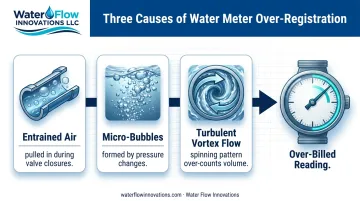
This shows up most in facilities with high-volume, on-off cycling: car washes, food and beverage plants running CIP (clean-in-place) systems, hospitals, data center cooling towers, and irrigation-heavy properties.
Typical scenario: the bill spikes, no leak turns up, and usage hasn't changed. A manual meter test even confirms the meter is mechanically "accurate," since the test checks the hardware, not the flow conditions passing through it. Flow conditioning devices address this exact gap by correcting the turbulence at the meter.
Cause 4: Rate Increases and Added Fees
Sometimes nothing about your usage changed at all. Bluefield Research reports the typical combined U.S. household water-sewer bill rose 4.6% from 2023 to 2024, and 24% over five years, driven by aging infrastructure investment and tiered pricing.
Watch for:
- Crossing into a higher tiered-pricing bracket
- New sewer or stormwater surcharge line items
- Fixed service charge increases separate from consumption
Warning Signs and What Happens If You Ignore Them
Early indicators often show up before the bill spikes. Watch for:
- The meter's low-flow indicator moving when every fixture is off
- Damp spots, mold, or unusually soft ground near pipes or the yard
- A gradual upward usage trend across several billing cycles with no matching activity increase
Ignoring these signs compounds the problem. Undetected leaks cause real property damage: the Insurance Information Institute reports an average water-damage claim severity of $13,954.
Unresolved meter over-reading or rate creep erodes budgets month after month. For businesses tracking sustainability targets, unexplained water waste also undermines ESG and conservation reporting.
How to Prevent and Reduce a High Water Bill
Prevention combines routine checks, habit changes, and the right technology.
Conduct Regular Leak Checks
Dye-test toilets monthly: add food coloring to the tank, wait 10 minutes without flushing, and check the bowl for color. Inspect faucets, appliances, and exposed pipes on the same schedule, with a professional plumbing inspection annually. This catches leaks before they waste thousands of gallons in a single billing cycle.
Monitor and Adjust Usage Habits
Track consumption through your utility's online portal or a smart meter app. Adjust irrigation schedules seasonally and review laundry or appliance habits. Do a seasonal review each spring and fall; this lowers your baseline and flags spikes fast.
Correct Meter Over-Reading With Flow Conditioning
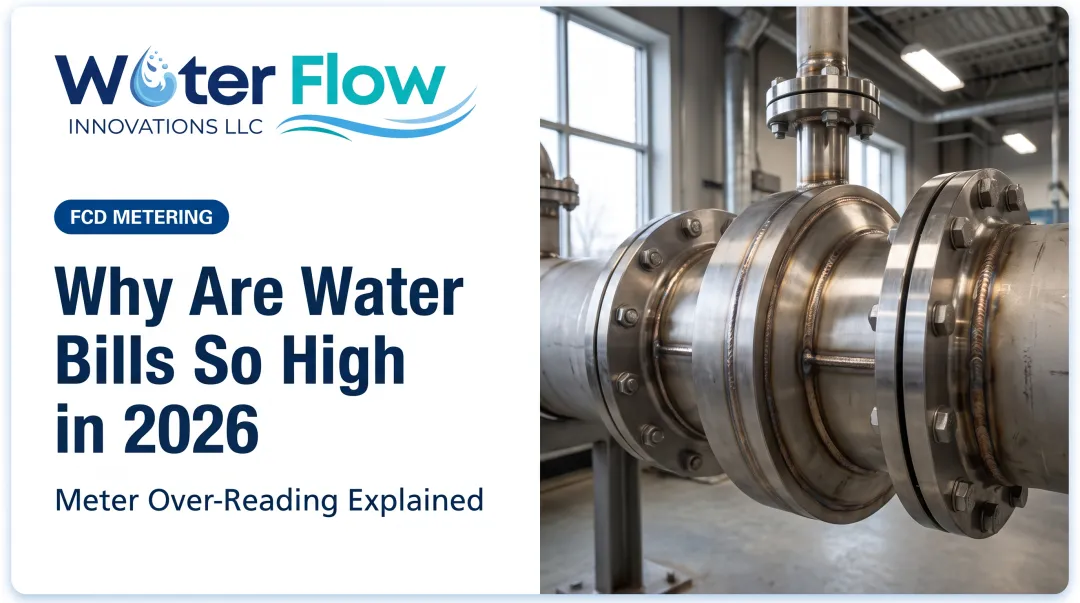
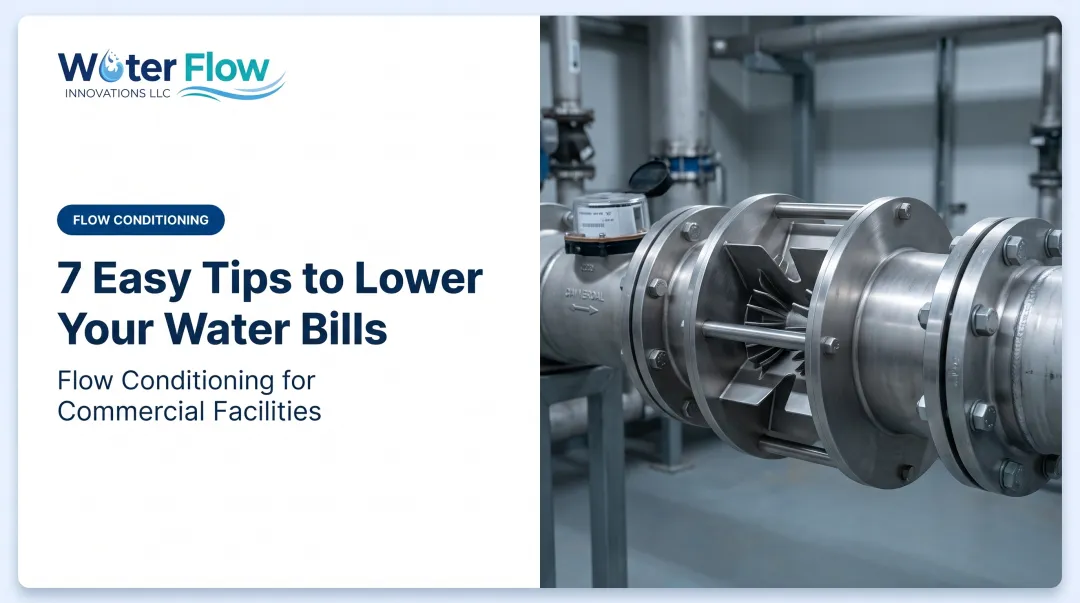
For facilities where leak checks come back clean and usage hasn't changed, meter over-reading is worth investigating directly. Water Flow Innovation offers a certified Flow Conditioning Device (FCD) that installs immediately after the water meter to remove trapped air and reduce turbulence in the measurement zone.
The device works through four components:
- Air and gas separation: creates a homogeneous water column so the meter reads only actual water
- Pressure regulation: reduces water hammer and protects downstream plumbing
- Check valve: prevents reverse flow that lets air re-enter the line
- Turbulence elimination: stops the vortex flow pattern that causes meters to over-count
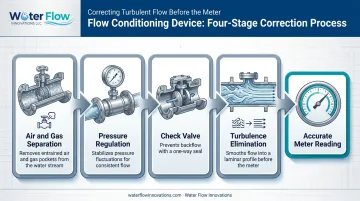
Because sewer charges are typically calculated from metered water consumption, correcting the meter reading corrects both charges simultaneously: a facility over-billed 15% on water is also over-billed 15% on sewer.
Documented results: 5–30% average bill reduction, with a 46% highest single result recorded. Installation takes about an hour with no operational disruption, and savings typically show up on the very next billing cycle. Water Flow Innovation backs every unit with a 6-month money-back guarantee and a lifetime transferable warranty.
Stay Informed on Rate Changes and Billing Structure
Review your utility's rate schedule, tiered pricing thresholds, and any sewer or stormwater line items at every billing cycle. This helps separate real usage problems from rate-driven increases and keeps budgeting accurate.
Long-term control checklist:
- Schedule plumbing and meter checks each season, not just after a high bill arrives
- Train staff or household members to report leaks or unusual sounds immediately
- Keep documented billing history to spot trends and support conservation reporting
- Use smart monitoring or certified flow conditioning technology to catch issues automatically
Conclusion
A high water bill has an identifiable, fixable cause: a leak, a seasonal usage bump, a rate hike, or a meter registering more than actually flowed through it. Routine monitoring and maintenance keep most of these issues from ever reaching the bill in the first place.
For facilities that have ruled out leaks and usage changes, meter over-reading deserves a closer look. Water Flow Innovation offers a free water bill review and savings analysis with no obligation, helping you see exactly where the phantom charges are coming from before you commit to anything.
Frequently Asked Questions
Why is my water bill so much more expensive?
The main culprits are a leak, a genuine usage increase, a rate hike, or a meter registering inflated flow. Start by checking your meter during a no-water period and reviewing any recent activity changes.
Why has my water bill doubled each month?
A sustained doubling usually points to a continuous leak or a malfunctioning meter or water softener rather than a one-time usage spike. Run a two-hour no-water meter test to confirm.
How can I tell if my water bill is unusually high for my facility?
Compare your bill to average usage benchmarks for similar facility types and square footage, then check it against your own billing history for unexplained spikes. A bill that no longer tracks with production or occupancy is the clearest warning sign.
Can a faulty or over-reading water meter really cause a high bill?
Yes. Mechanical wear, air entrainment, and turbulent flow can all cause meters to register more than actual consumption. Certified flow conditioning devices correct this at the source.
What's the fastest way to check for a hidden leak?
Record your meter reading, avoid all water use for two hours, then recheck it; any change signals a leak. A toilet dye test or listening for running water helps pinpoint the source.
How can commercial or industrial facilities lower persistently high water bills long term?
Combine routine leak audits, staff training on reporting issues, and certified flow conditioning technology. This cuts consumption charges and sewer charges simultaneously, since sewer billing is typically based on metered water volume.
How large is the correction when the meter is the cause?
Documented installations average a 5–30% reduction in combined water and sewer charges, with a highest documented single result of 46%, and the change lands on the very next billing cycle rather than building gradually.
What if the correction doesn't lower the bill?
A 6-month money-back guarantee covers the device purchase price, with installation cost non-refundable, so it can be returned if metered consumption does not measurably fall. A lifetime transferable warranty against manufacturing defects also applies.