Introduction
Somewhere in your plant right now, a valve is hissing softly near a pipe joint nobody's touched in months. A thin plume drifts up from a trap station, and staff walk past without a second glance. It's been there so long it just blends into the noise.
That's the real problem with steam leaks. They're loud enough to hear but easy enough to ignore, and that neglect is what makes them expensive.
A single failed trap or worn gasket can waste thousands of dollars a year in fuel, treated water, and chemicals. Those losses show up quietly on your utility bills month after month.
Steam leaks rank among the most common yet most overlooked sources of energy and water waste in industrial and commercial facilities.
This guide covers what causes them, what they actually cost, how to find them before they drain your budget, and the maintenance strategies that keep them from coming back.
Key Takeaways
- Failed traps, worn gaskets, corrosion, and thermal stress cause most steam leaks
- A single leak can waste thousands of dollars yearly in fuel and treated water
- Annual loss = leakage rate × operating hours × steam unit cost, divided by 1,000
- Trap surveys, real-time monitoring, and correctly sized equipment prevent recurring losses
- Every leaked pound of steam is also lost makeup water, doubling the bill impact
What Is a Steam Leak?
A steam leak is any unintended escape of steam from pipes, valves, fittings, or traps before it delivers useful heat to your process. That steam already cost money to generate. Once it escapes, that investment is gone for good.
Steam leaks come in two forms:
- External leaks: Visible steam escaping to atmosphere at gland packing, pipe joints, or damaged gaskets. You can hear it, see it, sometimes feel it from ten feet away.
- Internal leaks: Steam passing through a valve seat or trap orifice while the component sits in its "closed" position. Nothing escapes to the room, but live steam bleeds into a line that should carry only condensate.
Internal leaks are the harder problem. A trap that's failed open looks identical to one working correctly unless someone actually tests it, which is why systematic surveys matter more than a quick walk-through.
Steam Leaks vs. Flash Steam
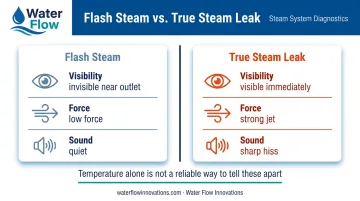
Not every cloud of vapor near a trap station is a leak. When hot, high-pressure condensate drops to a lower pressure, part of it instantly re-evaporates into flash steam. That's a normal byproduct of pressure reduction, not a malfunction.
The trouble is that flash steam and a genuine leak can look similar at a glance. Technicians rely on a few distinctions:
- Visibility at the outlet: Live steam escaping a failed trap is often invisible right at the discharge point before forming a plume further downstream. Flash steam is visible almost immediately.
- Force and velocity: A true leak tends to jet out with noticeable force. Flash steam drifts.
- Sound signature: A genuine leak often produces a sharp hiss or whistle audible from several feet away. Flash steam is comparatively quiet.
Temperature isn't reliable on its own, either. Flash steam and a leaking live steam trap can register the same outlet temperature, so a thermometer alone can lead you astray. Pair thermal readings with ultrasound and a visual check before calling something a leak.
Why Steam Systems Leak: Common Root Causes
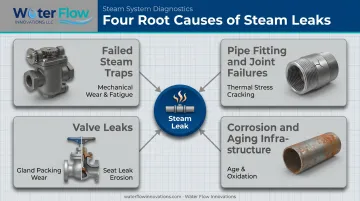
Most steam leaks trace back to one of four mechanisms, and they rarely act alone. Knowing which one you're dealing with determines whether tightening a bolt actually fixes the problem or just delays the next failure.
Failed Steam Traps
Failed steam traps are the biggest contributor by far. Dirt and debris lodge in the trap seat and prevent full closure. Oversized traps cycle harder than they need to, losing their water seal or wearing out early. Pressure surges from water hammer, or a valve opened too quickly, can physically damage the trap's internal mechanism.
Pipe Fitting and Joint Failures
Steam pipes expand when hot and contract when cold, cycle after cycle, day after day. That constant movement stresses bolted and threaded connections at flanges and screwed joints. Over months and years, repeated flexing works nuts and bolts loose, opening small gaps where steam escapes.
Gasket deterioration compounds the problem. Heat cycling dries out and hardens gasket material, and age alone reduces its sealing ability. A joint that held tight for a decade can start weeping steam once the gasket finally gives out.
Valve Leaks
Valve leaks split into two categories that need different fixes:
- Gland packing leaks: External and visible. Steam escapes around the valve stem where packing has worn or dried out.
- Seat leaks: Internal and often invisible. Steam passes through the valve body even when it's fully closed, because the seat surface has eroded or been damaged.
Valves that get opened and closed regularly, rather than left in one position, are more prone to seat leakage. Every cycle wears the seating surface a little more.
Corrosion and Aging Infrastructure
Condensate return piping takes the worst of it. Dissolved oxygen and carbon dioxide create a mildly corrosive environment, and wet steel piping supplies exactly the conditions rust needs to spread. Over years, that corrosion thins pipe walls until a crack opens and steam escapes into a ceiling void, a trench, or open air.
This is why trap replacement alone rarely solves a chronic leak problem. If the root cause is corroded piping or a joint under constant thermal stress, a new trap just buys time before the next failure shows up somewhere else.
The Real Cost of Steam Leaks
Steam leaks don't announce themselves on a utility bill. They just make the number bigger, month after month, without ever showing up as a line item.
The scale of the problem is bigger than most facilities assume. The U.S. Department of Energy found that in systems left unmaintained for 3 to 5 years, 15% to 30% of installed steam traps may have already failed. A facility running a documented maintenance program should keep that failure rate under 5% (U.S. Department of Energy).
Calculating what a single leak costs isn't complicated. The standard formula is:
Annual loss ($/yr) = Steam Leakage (kg/h) × Operating Hours (h/yr) × Steam Unit Cost ($/1,000 kg) ÷ 1,000
Here's what each variable means:
- Steam leakage: The rate of steam escaping, measured or estimated in kilograms per hour
- Operating hours: How many hours per year the system runs at that leak rate
- Steam unit cost: Your facility's actual cost to generate 1,000 kg of steam, based on fuel, boiler efficiency, and feedwater conditions
Run the numbers on a modest leak, say 35 kg/h, running 8,000 hours a year, at a steam cost of $18 per 1,000 kg. That works out to roughly $5,040 a year from one leak. Multiply that across a plant with a dozen failed traps, and the number stops looking small.
Steam Leaks and Your Water Bill: The Overlooked Connection
Here's the part most facilities miss: steam is made from treated makeup water. Every pound lost to a leak is also a pound of water that has to be repurchased, treated, and reheated from scratch.
That means a leak hits two utility bills at once, not one. Facilities tracking energy KPIs closely often don't connect a failed trap to the water and sewer line, but it's the same water disappearing either way.
The DOE has documented this connection directly. Returned condensate typically arrives back at the boiler between 130°F and 225°F, compared to 50°F to 60°F for fresh makeup water.
One specialty paper plant that improved condensate return cut its makeup water need from about 35% of steam production down to 14–20% (U.S. Department of Energy). That single change saved fuel, chemicals, and treatment costs along with the water itself.
If your facility is already auditing steam losses, check whether your water meter is adding a second, separate layer of waste. Meters can over-read due to turbulent flow at the measurement point, inflating a bill that has nothing to do with steam.
Water Flow Innovation's Flow Conditioning Device corrects that over-reading with a certified, no-disruption installation that typically takes an hour or two. That means a facility can validate meter accuracy alongside a steam audit instead of treating them as separate projects.

How to Detect a Steam Leak
Finding a leak starts with the senses you already have, then moves to tools that catch what senses can't.
Start with the basics:
- Listen for a hiss near joints, valves, and trap stations.
- Look for a visible plume or a wet, discolored patch on insulation.
- Feel for heat radiating from a fitting that should be at ambient temperature.
These checks cost nothing and catch a surprising share of external leaks during a routine walk-through.
External checks only go so far. Internal leaks, the ones hiding inside a closed valve or a failed trap, need instrumentation:
- Ultrasonic detectors and stethoscopes pick up the high-frequency sound of steam passing through a seat or orifice that should be sealed, catching leaks invisible from outside the pipe.
- Infrared thermography maps temperature differences across a pipe run without touching anything, useful for buried lines or piping hidden behind walls and ceilings.
- Acoustic imaging cameras localize leak sound sources across a wide area, helpful for scanning a large trap station or valve manifold quickly.
None of these tools work well in isolation. A trap can read the correct temperature and still be failed open, since flash steam and a live leak often share the same outlet temperature. Ultrasound and thermal readings together give a far more reliable picture than either one alone.
How to Prevent and Fix Steam Leaks
Detecting leaks is only half the job. Preventing them from recurring takes a maintenance structure, not a one-time repair.
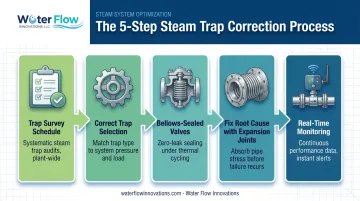
Build a trap survey schedule. Tag and map every trap in the system so each one has a documented location, type, and inspection history. Test frequency depends on operating pressure:
Pressure Range Testing Frequency Above 150 psig Weekly to monthly 30-150 psig Monthly to quarterly Under 30 psig Annually Choose the right trap for the job. Steam loss varies by trap design under normal operation: a Free Float trap seals continuously at the orifice, while a disc trap cycles and vents steam under light load, according to TLV. Matching trap type to application cuts losses unrelated to outright failure.
Install bellows-sealed valves in high-cycle locations. Valves opened and closed frequently wear out gland packing fast. A bellows seal removes that dependency entirely, cutting recurring packing leaks where they matter most.
Fix the root cause, not just the symptom. Adding expansion joints or adjusting pipe supports addresses the thermal stress that loosens fittings in the first place, rather than re-tightening the same bolts every few months.
Add real-time monitoring where it counts. Wireless sensors on critical traps flag a failure the moment it happens. This doesn't replace scheduled surveys, it just shortens how long a leak runs before repair.
Water Flow Innovation's steam system repair program combines these steps into a single engagement:
- Ultrasonic and thermal trap survey across the facility
- Documented energy loss for each failed trap
- Correctly specified replacement traps
- Post-repair verification survey confirming the fix held
For facilities juggling condensate return, flash steam recovery, and trap replacement as separate projects, running them as one assessment often surfaces savings that otherwise get missed.
Frequently Asked Questions
What is steam leakage?
Steam leakage is the unintended escape of steam from pipes, valves, fittings, or steam traps before it can do useful work. It represents both an energy loss and a water loss, since steam is generated from treated water.
How much does a steam leak cost?
Cost depends on the leak's size, how many hours the system runs, and your facility's steam unit cost. Use the calculation method above with your own numbers for a facility-specific figure.
How do you calculate steam leakage?
Multiply the leakage rate in kilograms per hour by annual operating hours, then multiply by your steam unit cost per 1,000 kg, and divide by 1,000. You'll need a measured leak rate, operating hours, and your facility's actual steam cost.
Why is my steam leaking?
The most common culprits are a failed steam trap, a worn gasket, a fitting loosened by repeated thermal cycling, or a valve with worn gland packing or a damaged seat. Corrosion in older condensate piping is another frequent cause.
What's the difference between a steam leak and flash steam?
Flash steam is a normal result of hot condensate dropping to a lower pressure and partially re-evaporating. A true leak is an uncontrolled escape of live steam from a failed component that needs repair.
How often should steam traps be inspected?
Test weekly to monthly above 150 psig, monthly to quarterly between 30-150 psig, and annually below 30 psig. Continuous monitoring on critical traps can shorten the time between failure and detection.
How does lost condensate raise the water and sewer bill?
Lost condensate must be replaced with metered makeup water, and most utilities calculate sewer as a percentage of metered intake — typically 80–120% of the water charge. The replacement volume is therefore billed on both lines at once.
What does a steam system assessment cover?
A trap survey to identify failed, blocked, undersized, or misapplied traps, plus a review of condensate return condition, flash steam recovery, and quantified system losses. Findings are prioritized by cost impact so repairs go where the measurable loss actually is.