
This isn't a fringe issue. Federal researchers at Pacific Northwest National Laboratory note that nearby valves, elbows, and fittings disturb the flow profile meters were calibrated to read, reducing accuracy in ways that can run in either direction (PNNL Water Metering Best Practices). A 2023 peer-reviewed study of large commercial meters found variations as extreme as -15% to +15% depending on the accessory and meter technology involved (Springer, Influence of Various Accessories Upstream Large Water Meters).
This guide covers what water flow stabilization devices actually do, the mechanisms behind them, installation and maintenance best practices, and how to choose a solution that fits your facility. Done right, the payoff includes lower utility bills, protected piping infrastructure, and documentation you can hand to your sustainability team.
Key Takeaways
- Turbulent, aerated flow at the meter distorts readings; correcting it stops overpayment for air and swirl
- Sizing, install location, and pressure regulation decide whether a stabilization device works as intended
- NSF, ANSI, and IAPMO certify potable-water safety, not accuracy gains; verify performance separately
- Facilities that follow best practices often see savings on the next billing cycle
What Is a Water Flow Stabilization Device and Why It Matters
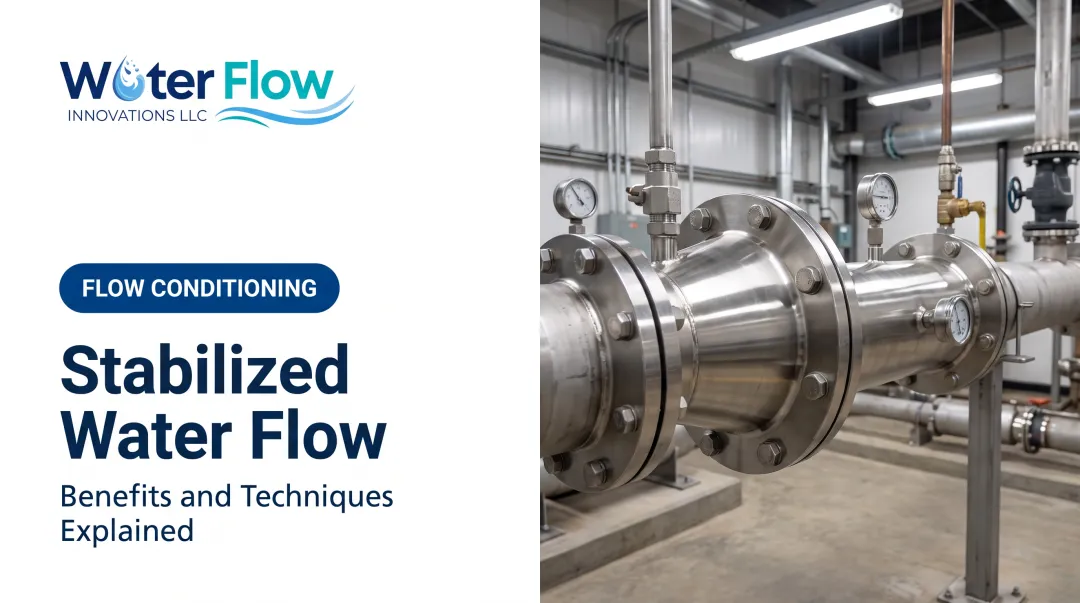
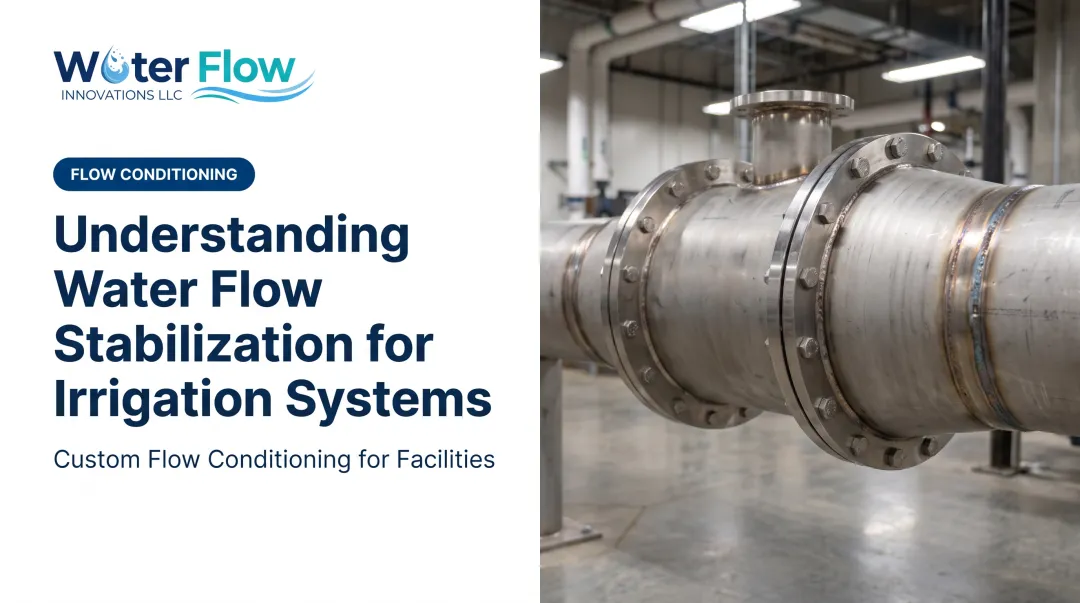
Flow stabilization is the process of correcting turbulence, air entrainment, and pressure irregularities at the meter. The goal is simple: present the meter with the clean, full-pipe flow profile it was designed and calibrated to measure.
Both mechanical and ultrasonic meters rely on predictable flow behavior. A 2022 laboratory study published in AQUA found that air expelled through mechanical jet meters during pipe filling directly caused inflated register movement: the meter was measuring air, not water (AQUA, Impact of intermittent supply on water meter accuracy).
Ultrasonic meters have a different vulnerability. Bubbles interfere with transit-time signal accuracy, though the direction of that error depends on the setup. When meters register air or turbulent flow as consumption, facilities pay for water they never received.
Stabilization devices are not flow control valves. A flow control valve regulates rate (how much water moves through). A conditioning device corrects measurement quality — what the meter sees when it counts that water.
Water Flow Innovation's Flow Conditioning Device (FCD) is one example of a certified, custom-fabricated system built around four components: air/gas removal, pressure regulation, check valve function, and turbulence elimination. It's installed on the consumer side, immediately after the municipal meter.

Industries most exposed share a common pattern: high flow variability, complex piping, or frequent start-stop cycles. That includes:
- Industrial manufacturing (cooling towers, steam condensate, equipment washdown)
- Food and beverage production (CIP cycles, scalding, chilling)
- Agriculture and irrigation (high-volume starts and stops)
- Pharmaceutical and life sciences (WFI stills, purified-water systems)
- Hospitals, hotels, and data centers (HVAC and sterilization cycling)
Core Components and Mechanisms of Effective Flow Stabilization
A stabilization system typically layers four mechanisms. Each targets a different source of measurement error.
Air and Gas Removal
Entrained air bubbles occupy volume the meter counts as water. Air separation components create back-pressure that releases bubbles out of the water column, producing a homogeneous water column.
NIST's Handbook 44 requires an effective air/vapor eliminator in certain covered batching systems because air passing through a meter distorts readings (NIST HB44).

Pressure Regulation
Consistent downstream pressure prevents surges and water hammer caused by on-off cycling. This matters for two reasons:
- Protects piping, fittings, and equipment from premature wear
- Keeps the system inside a safe operating envelope for the meter
Pressure regulation is primarily a system-protection function, not a guaranteed accuracy fix on its own. It works best combined with the other three mechanisms.
Turbulence Reduction
Straightening vanes and conditioning chambers reduce swirl and vortex flow, particularly during high-demand events like tank filling or irrigation starts. This doesn't create true laminar flow in a commercial pipe (turbulent flow is normal at these velocities), but it does produce a more repeatable, conditioned profile the meter can read consistently.
Check Valve Integration
A directional check valve prevents reverse flow through the meter, which can reintroduce air and cause erratic readings. Not every installation needs one, but where pressure spikes or reverse flow are a risk, it belongs in the design.
Design priority across all four: negligible pressure loss. A conditioning system that restricts flow just trades one problem for another.
Best Practices for Installing a Water Flow Stabilization Device
Getting installation right determines whether the device performs as designed.
- Assess the layout first. Map upstream elbows, valves, pumps, and reducers. A qualified engineer should identify turbulence sources before specifying equipment.
- Follow manufacturer spacing requirements. PNNL recommends at least 5 pipe diameters upstream and downstream for compound and turbine meters; some turbine meters need up to 10D upstream (PNNL). Don't override this without engineering justification.
- Confirm compatibility. Match pipe size, meter type, and material before ordering. Look for NSF/ANSI/CAN 61 certification for potable-water contact — but remember, that standard evaluates material safety, not hydraulic performance.
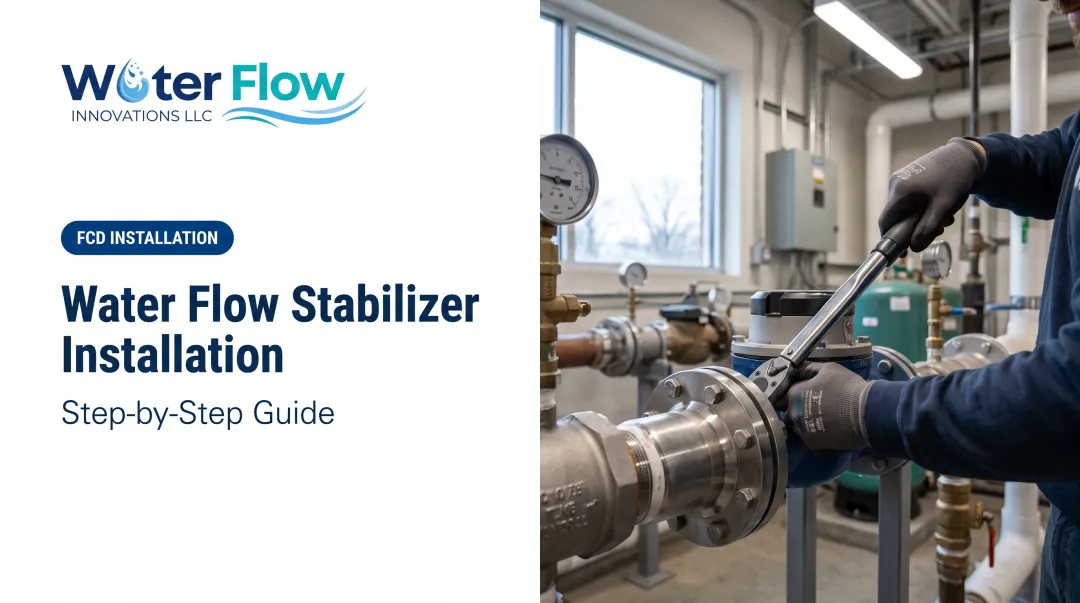
- Schedule around low-flow periods. Installing a Water Flow Innovation FCD typically takes about an hour; complex industrial setups can run longer. Plan the work window so operations stay online.
- Document your baseline. Pull 12 months of water and sewer bills before installation. That record makes before/after comparison credible instead of anecdotal.

Placement is part of the same decision. Install the FCD on the consumer side, immediately after the meter, and generally before any pressure-reducing valve when that layout is feasible.
Maintenance and Monitoring Methods for Long-Term Performance
Passive conditioning systems (no moving parts beyond an optional check valve) don't require the same servicing cadence as active mechanical equipment. Still, a monitoring routine protects your investment.
- Inspect periodically for sediment buildup or wear, especially on any active components like check valves
- Track your monthly bills post-installation — this is your early warning system for anomalies
- Follow meter recalibration norms, not device servicing schedules. AWWA-derived guidance (via PNNL and Georgia EPD) suggests testing meters under 1 inch every 10 years, 1–4 inch meters every five years, and meters above 4 inches annually (PNNL)
Water Flow Innovation's FCD is built as a passive unit with no filters and no scheduled servicing requirement, backed by a lifetime transferable warranty. Those terms matter more than most operators realize:
A warranty tied to the device and the property — not just the original buyer — means savings and protection carry over if the facility changes hands.
Choosing the Right Water Flow Stabilization Solution for Your Facility
The right water flow stabilization solution depends on certifications, how well the unit fits your site, and the commercial terms behind it. Not every certification answers the same question. Sort them by purpose:
| Certification | What it actually confirms |
|---|---|
| NSF/ANSI/CAN 61 | Wetted materials are safe for potable water contact |
| IAPMO | Product performance validated under US/international plumbing codes |
| KIWA | Health, safety, and durability per European/international frameworks |
| GMP / SQF | Suitable for food and pharmaceutical production environments |
Beyond certification, weigh:
- Pipe diameter and meter type — a good provider fabricates to your exact specs rather than forcing a standard size
- Facility category — municipal, healthcare, hospitality, and industrial sites all have different flow variability profiles
- Financing structure — buy outright for the strongest total value, or lease to avoid capex and treat it as an operating expense
- Risk protection — a money-back guarantee period reduces downside if results underperform
Those commercial terms only matter if payback is real. There is no universal industry ROI figure, so be skeptical of anyone who quotes one without your billing data.
Water Flow Innovation reports that 90% of customers reach full ROI in under 12 months, with documented bill reductions averaging 5–30% and a highest recorded result of 46%. Those figures come from verified before-and-after billing comparisons, not modeling. Hold every provider to that standard.

Frequently Asked Questions
How does a water flow stabilization device reduce utility bills?
It corrects meter over-reading caused by turbulence and air entrainment, so your bill reflects actual water delivered instead of an inflated reading. The correction is immediate, not gradual.
Is a flow stabilization device the same as a flow control valve?
No. A flow control valve regulates the rate of flow. A stabilization or conditioning device corrects flow quality so the meter measures it accurately.
Will installing a flow stabilization device affect water pressure or operations?
Certified devices are engineered for negligible pressure loss. Downstream pressure at your equipment and fixtures typically remains unchanged.
How long does it take to see savings after installation?
Savings often show up on the very next billing cycle, since the meter begins reading accurately immediately with no ramp-up period.
What certifications should I look for in a flow stabilization device?
Look for NSF, ANSI, CAN 61, and IAPMO for potable-water safety and code compliance. For food, beverage, or pharmaceutical production, also check KIWA, GMP, or SQF.
Can these devices work with any pipe size or meter type?
Most flow conditioning devices are custom-fabricated for specific pipe diameters—from small commercial lines to large industrial mains—and work across most standard meter technologies.
How much of the bill does the device typically recover?
Documented installations average a 5–30% cut in combined water and sewer charges, with a highest documented single result of 46%, achieved without altering consumption or operations.
Is asking the utility for a replacement meter a better first step?
Usually not. The replacement still counts everything reaching it, air included, so where entrained air or turbulence is the cause, the same over-registration returns after the swap.