
Introduction
Distilleries run on water. Mash-in, fermentation, condenser cooling, proofing, bottling, cleaning-in-place, even the tasting room sink: it all draws from the same incoming line.
Industry reporting puts distillery water use at 3 to 10 gallons for every gallon of finished product, so utility bills carry real weight in a distillery's operating budget.
Here's the catch. Not every spike in a water or sewer bill means your distillery used more water. Air entrainment, pipe turbulence, pressure swings, and the quirks of commercial metering can all inflate a reading without a single extra gallon reaching your tanks.
This article looks at what water flow conditioning devices actually do for distilleries, where the evidence supports them, and where their limits are. No blanket savings promises, just a grounded look at utility, operational, and sustainability outcomes.
Key Takeaways
- A flow conditioning device stabilizes incoming water flow; it is not a water or wastewater treatment system.
- Correcting meter over-reading supports lower water-sewer charges, fewer simultaneous overcharges, and clearer cost visibility.
- Pressure, turbulence, and entrained air can cause commercial meters to over-read, inflating bills in ways that vary by meter type.
- These devices support leak detection and conservation programs; they don't replace them.
- Build a usage baseline first, then verify results against distillery production data and billing history.
What Is a Water Flow Conditioning Device?
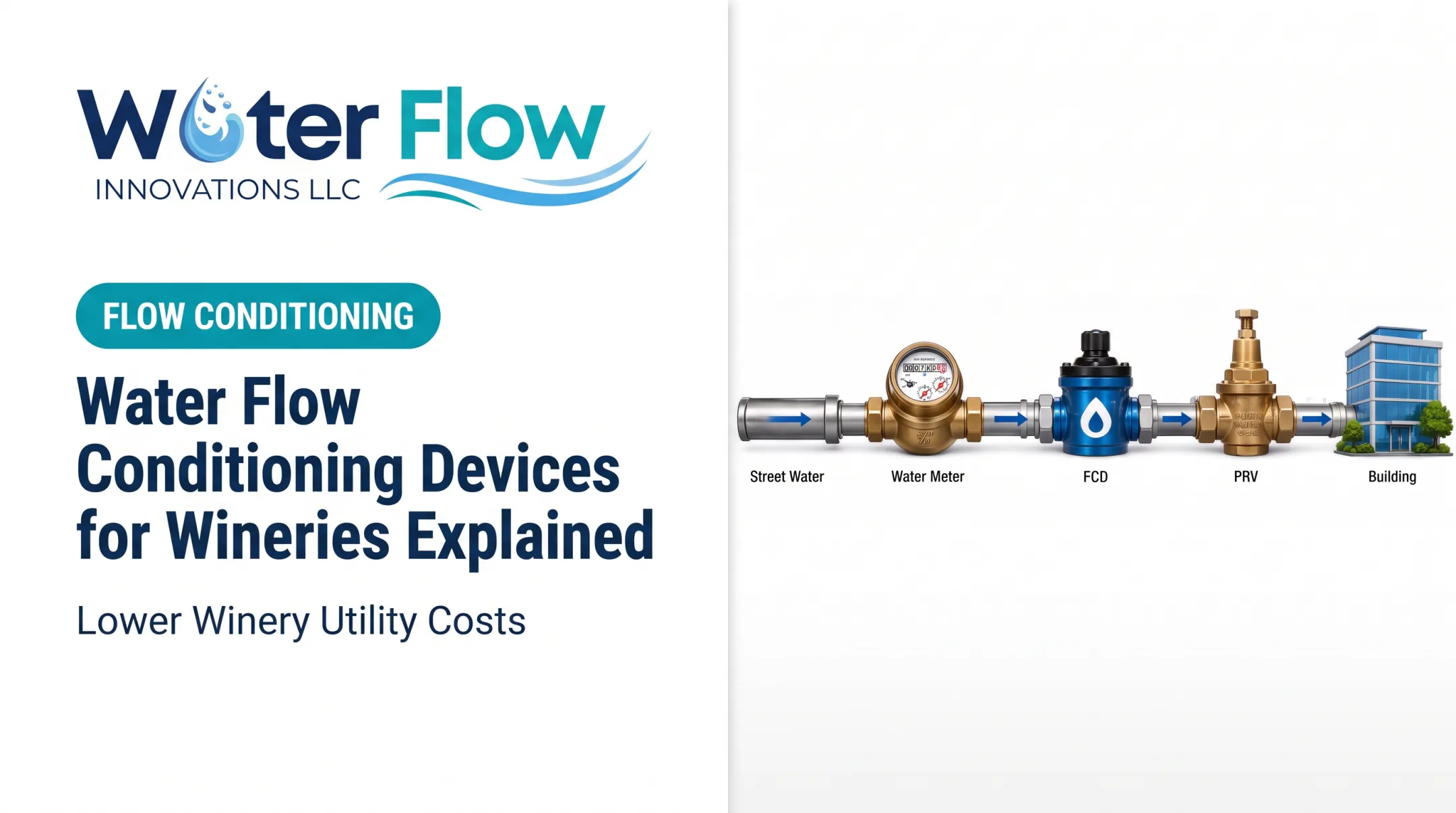
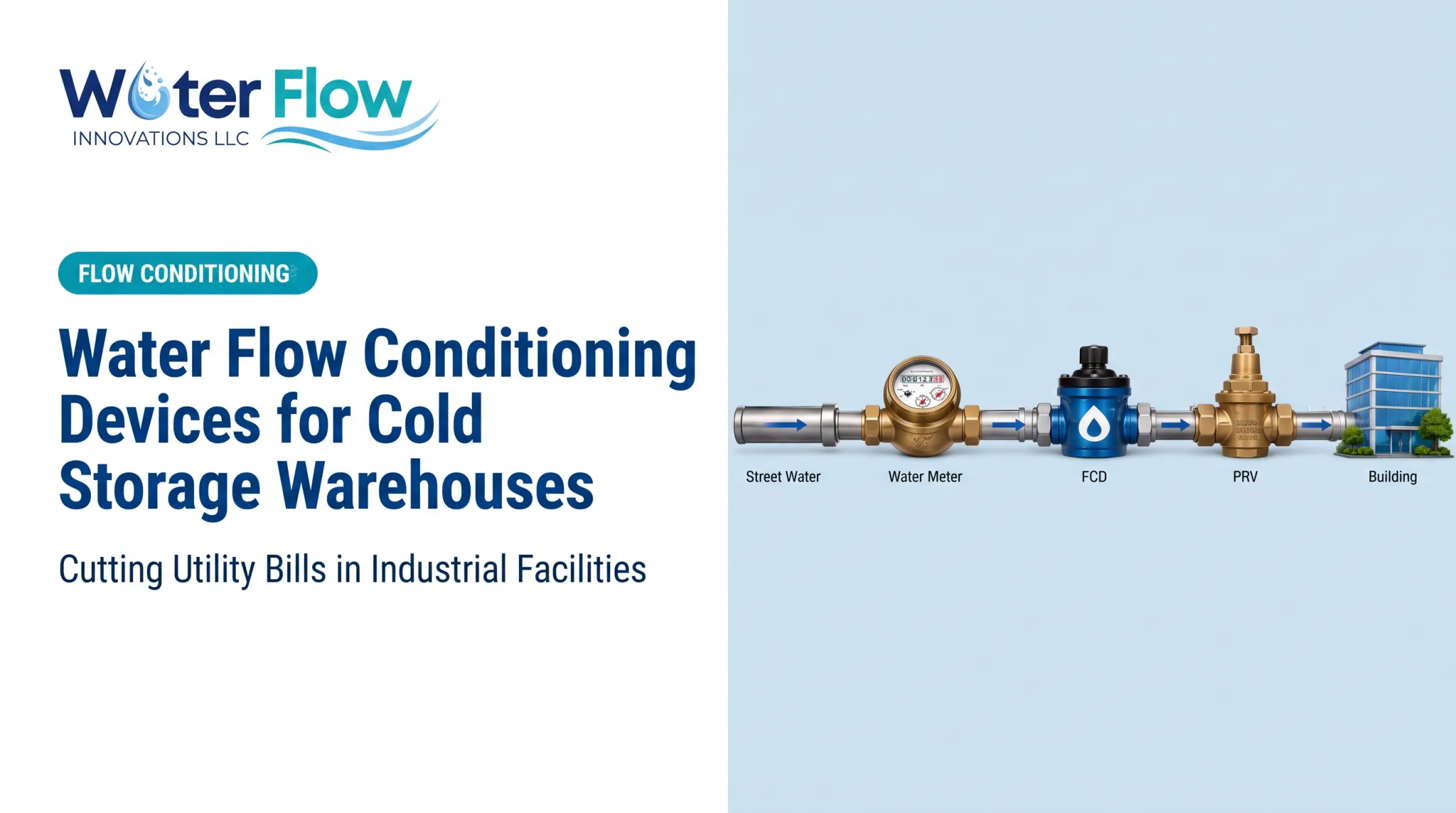
A water flow conditioning device is an inline component installed in a facility's incoming water line, typically right after the main meter. It smooths out flow conditions that can interfere with accurate metering.
What it doesn't do matters just as much. A flow conditioning device doesn't purify water, treat distillery wastewater, or reduce how much water your production process actually needs. If your mash tun needs 500 gallons, it still needs 500 gallons after installation.
The flow conditions these devices typically target include:
- Entrained air and micro-bubbles from pumps, valves, or pressure drops
- Turbulent flow, which often develops after water travels more than about 30 feet of pipe
- Pressure fluctuations, including surges from on-off cycling during cleaning or tank fills
- Sudden velocity changes at elbows, valves, or pipe constrictions
How the Four-Component Approach Works
Water Flow Innovation's Flow Conditioning Device combines four elements in one custom-fabricated unit: air and gas removal, pressure regulation, a check valve, and turbulence reduction. The check valve may be omitted depending on the installation. Confirm product details against manufacturer documentation and your local plumbing code before install.

What a Flow Conditioning Device Is Not
It's easy to confuse this equipment with other utility components. A quick distinction:
| Device | Primary Function |
|---|---|
| Flow conditioning device | Stabilizes flow for consistent metering |
| Flow meter | Measures volume of water passing through |
| Pressure regulator | Controls downstream pressure only |
| Water treatment system | Removes contaminants or adjusts water chemistry |
| Backflow preventer | Stops reverse flow into the public supply |
| Wastewater flow meter | Measures discharge volume, not intake |
Use a flow conditioner when the goal is stable intake metering—not treatment, backflow protection, or discharge measurement.
Key Advantages of Water Flow Conditioning Devices
For a distillery, the measure of a flow conditioning device is simple: does installation show up as a verified change in your utility bill, operations, or reporting data? Results depend on meter type, pipe layout, pressure, air presence, billing structure, and installation quality. Treat every claim below as something to test on your own site—not a guarantee.
Utility Bill Control and Billing Predictability
Unstable flow can cause certain meter types to register more volume than what's actually delivered. McCrometer, a flow-meter manufacturer, notes that disturbed velocity profiles and swirl can cause meters to over-read or under-read, depending on the technology. That's not a universal claim that every high bill traces back to a bad meter reading, but it's a documented mechanism worth investigating.
For a distillery, that mechanism hits cost centers such as condenser cooling, CIP cycles, bottling lines, and any attached hospitality space.
Many utilities, including Portland, Oregon, calculate nonresidential sewer charges from incoming metered water volume unless the customer qualifies for an approved submeter program. If a meter over-registers, the error can hit twice: once on the water bill and once on the sewer bill. Local billing rules vary, so confirm your utility's method before estimating savings.

KPIs to watch:
- Utility cost per batch
- Water cost per gallon of finished spirits
- Billed volume versus internal submeter data
- Sewer charges and payback period
Facilities with unexplained high bills, volatile monthly readings, large incoming service lines, or a gap between billed volume and production records gain the most from this check.
Operational Continuity Without Changing Production
Distilleries are understandably cautious about anything touching the incoming water line. A pressure drop during a CIP cycle or condenser run can delay a batch or compromise a cooling step. A properly specified flow conditioning device is designed to stabilize flow while preserving usable pressure and throughput, though pressure-loss and capacity figures should always be verified for the specific model and your pipe size.
Compared with redesigning production lines or replacing every meter in the building, a correctly installed conditioning device is usually the lower-disruption path. A site review by a qualified engineer or plumber is still required before work begins.
KPIs to watch:
- Pressure stability
- Production interruptions and water-related downtime
- Cleaning-cycle duration
- Cooling performance
Continuous or multi-shift plants, tight production calendars, heavy CIP loads, and seasonal demand peaks feel this advantage first.
Sustainability, Reporting, and Resource-Management Visibility
You can't manage water-intensity goals with billing data you don't trust. Reliable, reconciled utility numbers feed water-intensity tracking, budgeting, and disclosures for programs such as ESG reporting or LEED—verify each program's rules before you file.
One distinction matters: fixing a metering or billing issue is not the same as cutting actual water use. Document billing corrections separately from real conservation work such as leak repairs or process changes. Mixing the two muddies sustainability data instead of clarifying it.
KPIs to watch:
- Water intensity per case of spirits
- Billed water and sewer cost
- Wastewater volume
- Conservation actions versus metering corrections
Distilleries building sustainability reports, scaling production, or running multi-site portfolios need this data split to keep reporting clean.
What Happens When a Water Flow Conditioning Device Is Missing or Ignored
Not every distillery needs a flow conditioning device. But skipping an investigation into flow and metering conditions altogether can leave real problems undiagnosed.
Without a baseline, an unexplained bill increase is just a mystery. You can't tell whether it's genuine production growth, a leak, or a metering artifact. Disputes with the utility become harder to resolve because there's no data trail to point to.
Related risks often compound:
- Leaks going undetected for months
- Pressure instability that stresses pumps and valves
- Air entering the line through loose fittings or cavitating pumps
- Turbulent piping conditions from tight elbows or undersized runs
- Inaccurate internal cost allocation across departments or product lines
- Delayed recognition of abnormal consumption patterns
A flow conditioning device will not fix every water-cost problem. The U.S. EPA's WaterSense program notes that leaks alone can account for more than 6% of a commercial facility's total water use—actual water loss, not a metering artifact.
Your facility still needs to inspect leaks, valves, hoses, cooling systems, and wastewater discharge on a regular schedule.
Document everything: utility communications, meter testing results, installation dates, production volume, and billing history. That record is what lets you separate a real measurement issue from legitimate operational growth later on.
How to Get the Most Value from a Water Flow Conditioning Device
A flow conditioning device only creates measurable value when you can prove improvement against a reliable baseline. Skipping this step is the most common reason results are hard to verify.
Establish a Baseline Before Installation
Pull together several billing cycles of water and sewer invoices, meter readings, production volumes, operating hours, and any known leaks or facility changes. The exact study period depends on what records you have available, so don't force it into a fixed number of months if your data doesn't support that.
Reconcile utility bills against internal submeters, tank fills, or batch records where they exist. Note the meter type, pipe size, pressure conditions, and installation layout while you're at it.
Confirm Compatibility and Installation Requirements
Before touching the service line, loop in your water utility, a licensed plumber, or a qualified engineer. Confirm backflow requirements, code compliance, meter ownership, and shutdown procedures.
Key factors to assess:
- Pipe size and current meter type
- Flow range and pressure conditions at peak demand
- Air-management needs specific to your system
- Available space and maintenance access
- Whether the installation could affect required utility inspections
Water Flow Innovation custom-fabricates devices for pipe sizes from NPS 1/2" to 12" and various meter types. The company holds IAPMO, NSF International, ANSI, CAN 61, KIWA, GMP, and SQF certifications.
These credentials don't automatically satisfy every local code requirement, so confirm applicability with your plumber or engineer before proceeding.
Verify Results and Connect Them to Business Decisions
After installation, compare bills to your baseline while controlling for production volume, rate changes, weather, and any new leaks. Track both physical usage and billed usage separately, so you can tell actual conservation apart from a corrected meter reading.
To build a business case, gather:
- Installed cost
- Verified monthly savings
- Maintenance needs
- Expected service life
Water Flow Innovation reports average bill reductions of 5% to 30%, with a documented high of 46% and roughly 90% of customers reaching ROI within 12 months. Treat those as reported figures to confirm independently on your own site, not outcomes to assume in advance.

If your distillery is seeing unexplained bill variance or wants a clearer picture of water costs, Water Flow Innovation offers a site-specific flow and utility review, with buy or lease options once suitability is confirmed.
The company states its installations avoid operational disruption, though you should verify that against your site conditions.
Conclusion
The real value of flow conditioning for a distillery comes down to better control over incoming water measurement, utility costs, and the data behind your sustainability reporting. It doesn't replace conservation programs or wastewater treatment, and it won't be the right fit for every facility.
The strongest candidates are distilleries dealing with:
- Unexplained billing variance
- Unstable flow conditions
- Complex piping systems
- A need for more reliable utility data
The process that works:
- Establish a baseline
- Confirm technical and utility compatibility
- Install with qualified help
- Verify results against both billed volume and actual production water use
Skip any of those steps, and you're guessing instead of measuring.
Frequently Asked Questions
What is a water flow conditioning device?
A water flow conditioning device is an inline unit installed near a water meter to stabilize conditions such as turbulence and entrained air. It is not a filtration system, distillation equipment, or wastewater treatment unit.
How can a flow conditioning device benefit a distillery?
When meter over-reading from turbulence or entrained air is confirmed, it can lower water and sewer charges and make billing data more reliable. Installation disruption is typically minimal compared with larger infrastructure changes.
Does a flow conditioning device reduce actual water usage?
No. It addresses flow and metering conditions, not production demand. Actual conservation requires separate steps like leak repairs, process changes, or water-reuse measures.
Can a flow conditioning device reduce sewer charges?
Sometimes. Some utilities calculate sewer charges directly from incoming water volume, while others use separate meters or formulas. Confirm your local billing structure before estimating any savings.
Will a flow conditioning device affect water pressure or production?
A properly selected device should have minimal pressure loss and fit your facility's peak demand. Always have a qualified plumber or engineer review the installation against your specific system.
How should a distillery determine whether a flow conditioning device is worthwhile?
Review your billing history, production-adjusted usage, meter and piping conditions, and installation cost. A verified payback estimate, based on your own baseline data, is the clearest way to decide.