
Cooling-system upgrades aren't the only lever available. Water distribution, flow quality, and metering accuracy all affect what shows up on the bill. This article breaks down data center cooling-water systems, explains where flow conditioning devices fit, distinguishes them from cooling technology itself, and gives you a practical framework for evaluating one.
Key Takeaways
- Flow conditioning devices complement evaporative, liquid, dry, and hybrid cooling systems; they do not replace them.
- Billed water often exceeds delivered volume when air entrainment and turbulence skew meter readings.
- Credible retrofits need baseline data, engineering review, and post-installation verification.
- Judge flow gains alongside WUE, PUE, cooling performance, and operational continuity.
Why Water Efficiency Matters in Data Center Cooling
Data centers reject heat continuously, and the path that heat takes matters. A technology cooling system circulates fluid directly at the rack or chip level. A facility cooling system moves that heat to the outside world through a chilled-water loop, a condenser-water loop, and ultimately a cooling tower (or an air-cooled alternative).
Evaporative Loss Versus Closed Loops
Evaporative cooling towers consume water through evaporation and blowdown — that's the mechanism by design. Closed-loop direct liquid cooling moves heat away from chips, but if the facility still rejects that heat through a cooling tower, rack-level liquid cooling alone does not cut water draw.
WUE and PUE Aren't the Same Metric
The Green Grid defines Water Usage Effectiveness (WUE) as annual site water usage divided by annual IT-equipment energy, measured in liters per kilowatt-hour (The Green Grid, 2011). PUE measures total facility energy divided by IT-equipment energy — it's an energy ratio, not a water metric. Industry average PUE sat at 1.56 in Uptime Institute's 2024 survey, but that figure says nothing about water use.
Keep the two metrics separate:
- PUE tracks facility energy overhead, not water
- WUE tracks liters of site water per kWh of IT load
- A strong PUE can still hide high evaporative loss or meter error
Internal benchmarking from Water Flow Innovation suggests WUE above 1.8 L/kWh for older facilities, or 1.2 L/kWh for newer builds, can signal meter over-reading rather than genuine consumption increases.

Where the Inefficiency Actually Comes From
Water waste in data center cooling rarely comes from one source. Common contributors include:
- Leaks in distribution piping or cooling-tower basins
- Excessive blowdown beyond what water chemistry requires
- Poor temperature or pressure set points
- Fouling and scaling that reduce heat-transfer efficiency
- Inaccurate or unstable flow measurement at the meter
That last item is distinct from the rest. Reducing physical water use takes different fixes than correcting a meter that registers more volume than passed through it. Validate both on site; fixing one does not automatically fix the other.
Data Center Cooling Options and Where Flow Conditioning Fits
Facilities use several cooling architectures, and none of them is universally best. Each comes with its own water profile, energy tradeoff, and retrofit complexity.
| Approach | Water Profile | Retrofit Complexity |
|---|---|---|
| Air-side economization | Low water use; depends on outdoor air quality | Difficult in existing buildings — requires significant ductwork |
| Evaporative cooling towers | Ongoing evaporation and blowdown | Moderate; capacity must match IT load |
| Air-cooled chillers | No tower evaporation; higher electrical load for fans/compressors | Requires adequate space and power sizing |
| Hybrid dry-adiabatic | Water use scales with outdoor conditions | Requires coordination with existing plant |
| Direct-to-chip liquid cooling | Depends entirely on the final heat-rejection system | Requires liquid distribution infrastructure |
| Immersion cooling | Same dependency as direct-to-chip | Requires tank integration with IT equipment |
Uptime Institute's analysis on liquid cooling notes that some direct-liquid installations use dry coolers, while others still rely on evaporation or mechanical cooling. The water outcome depends on what sits downstream, not on the liquid-cooling technology alone.
A Different Part of the System
Most cooling-water efficiency measures target cycles of concentration, blowdown control, filtration, or reclaimed water use. Flow conditioning addresses something else entirely: flow characteristics and measurement conditions at a metered connection point.
A quick way to separate these interventions:
- Cooling redesign — changes how heat is removed from the facility
- Water treatment — manages chemistry to control scaling and corrosion
- Filtration — removes particulates from the water stream
- Flow conditioning — manages turbulence and air entrainment at the meter
Conditioning may apply at a main water service, cooling-tower makeup line, or other metered point. A qualified engineer should confirm the correct installation location for that system before any work proceeds.
How Water Flow Conditioning Devices Work
A water flow conditioning device addresses a specific operating problem: air or gas entrainment and turbulent, unstable flow that can cause a water meter to over-register.
The Four-Component Approach
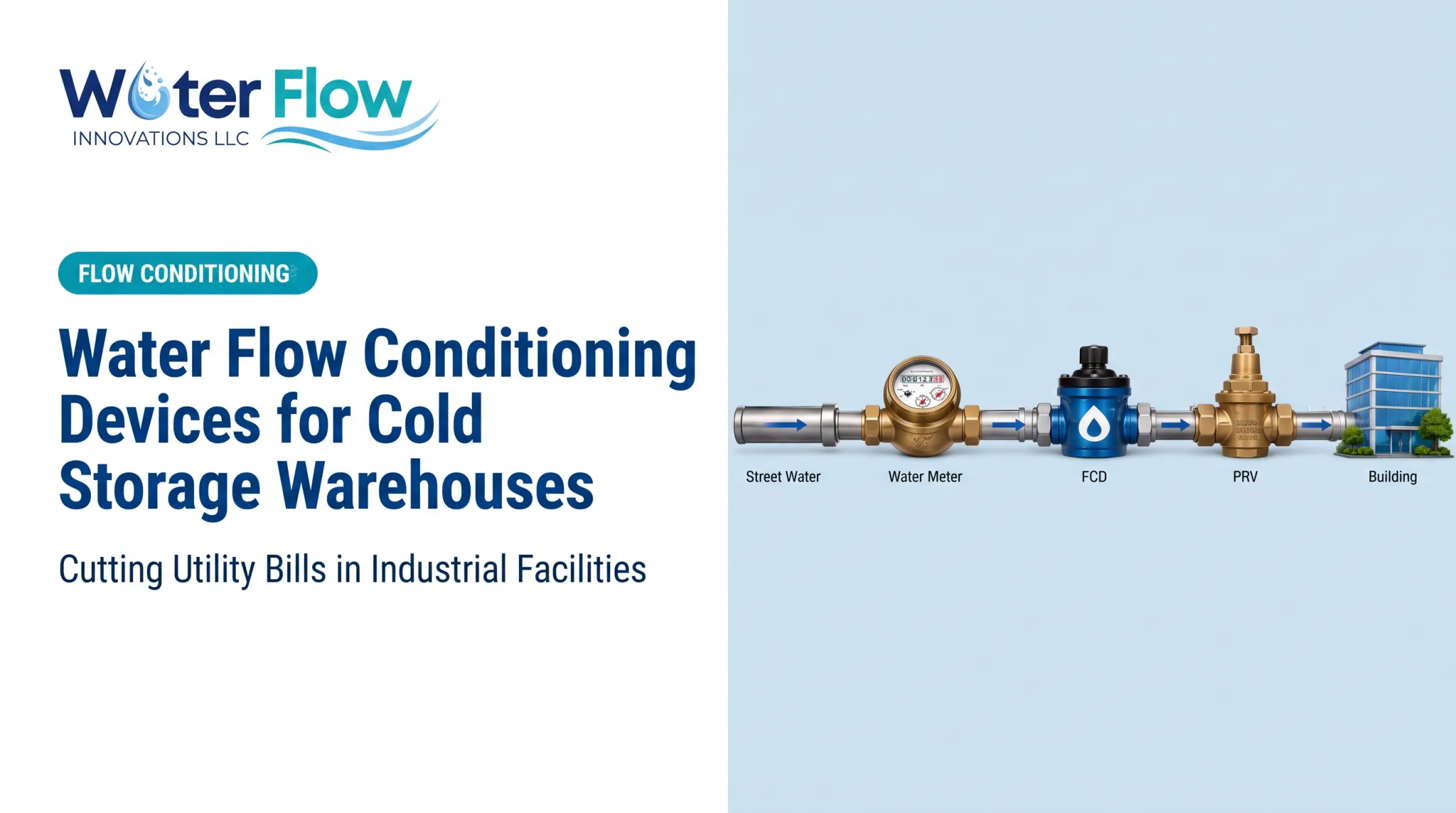
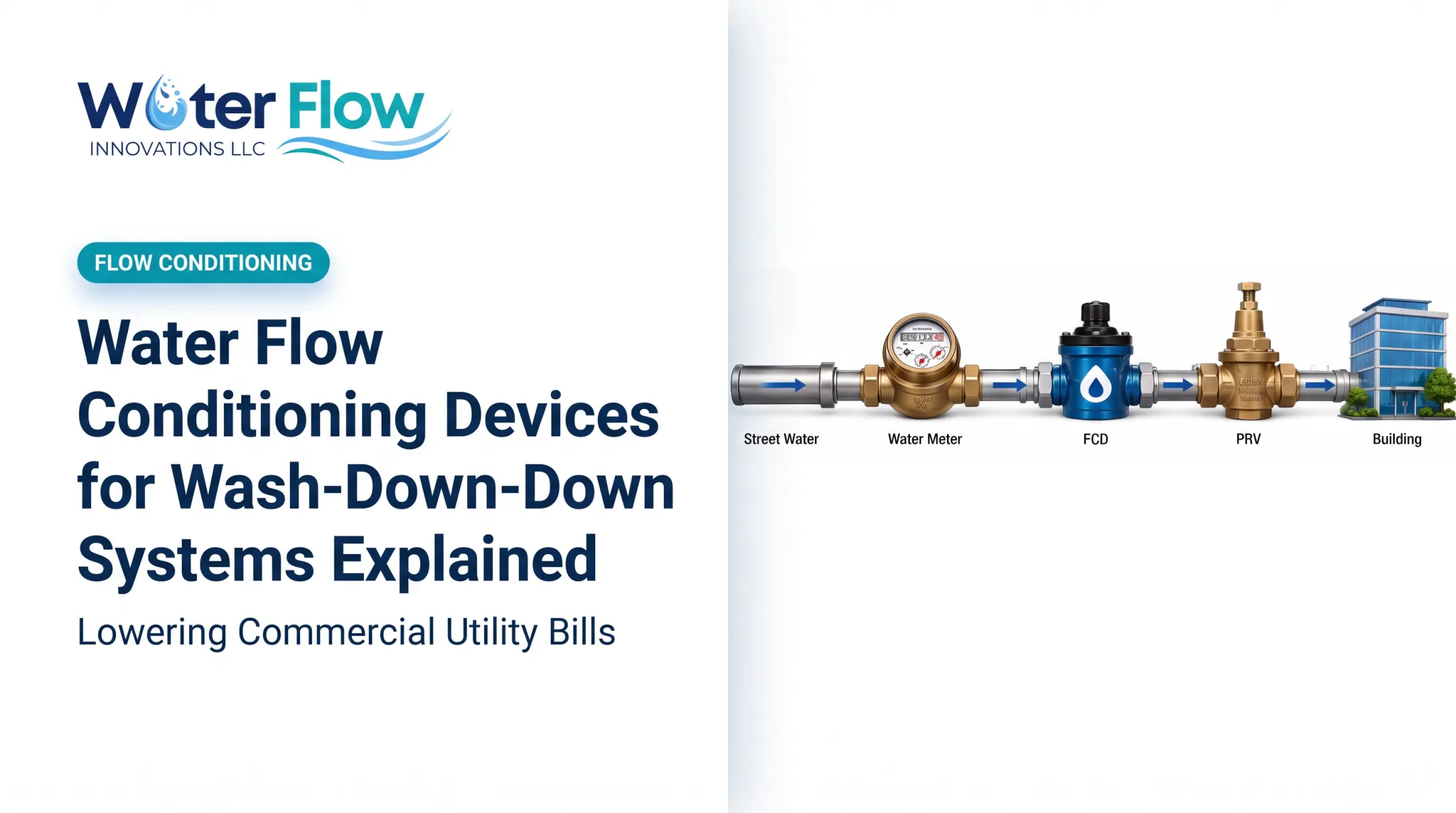
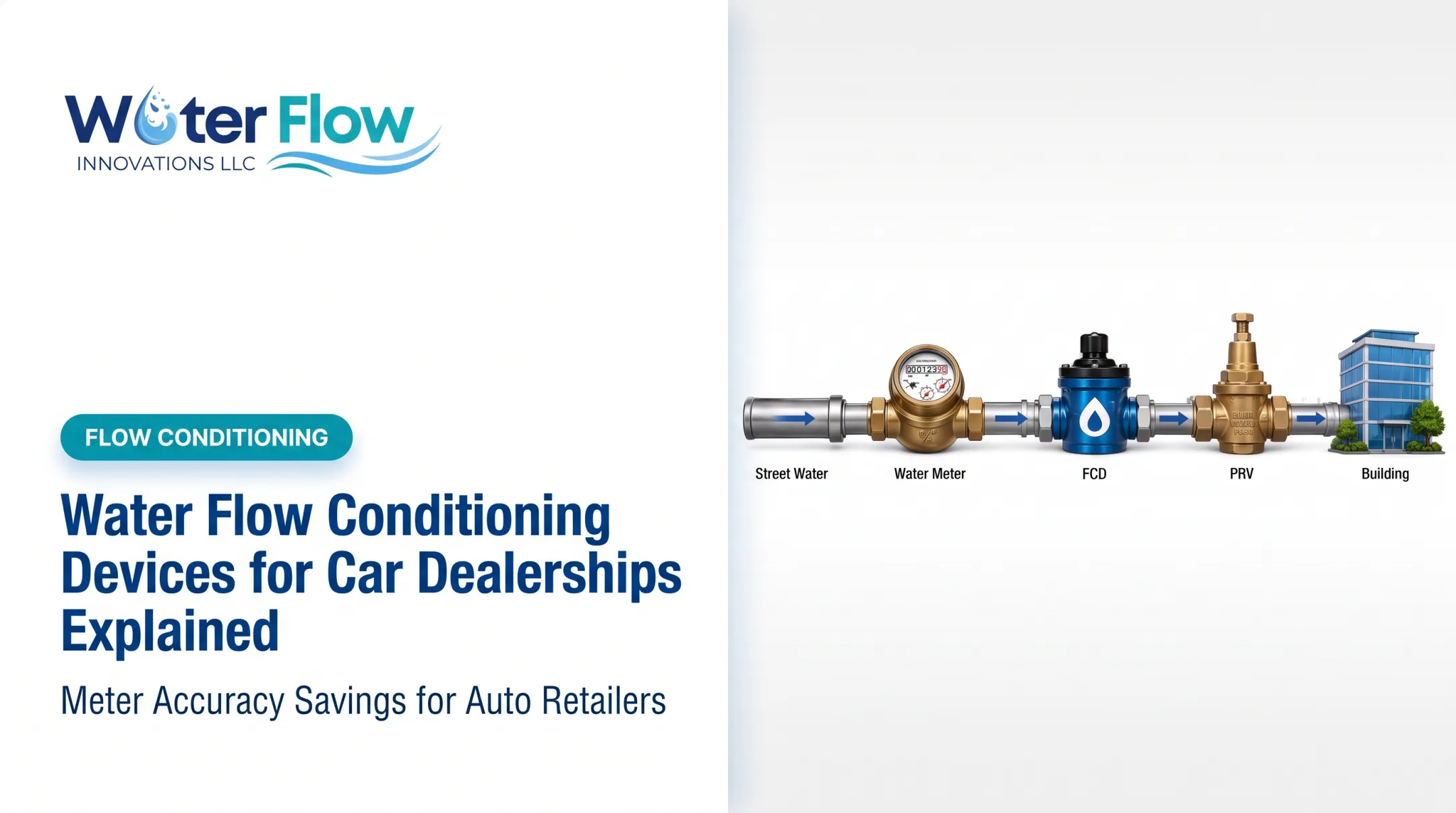
Water Flow Innovation's Flow Conditioning Device (FCD) is built around four functions:
- Air/gas removal — separates entrained air and micro-bubbles from the water stream before the meter
- Pressure regulation — stabilizes pressure surges created by on-off pump cycling and variable demand
- Check-valve protection — prevents reverse flow and reduces water-hammer events
- Turbulence reduction — slows velocity to prevent vortex flow patterns that meters can misread
None of these functions replace required cooling-system controls. They operate on the water line itself, not the chiller, cooling tower, or server-room infrastructure.

What Influences Flow Behavior
Several factors drive the turbulence and air entrainment that throw off meter accuracy:
- Pressure cycling from pump starts and stops
- Undersized piping
- Valves and elbows close to the meter
- Improperly configured meter runs
PNNL's water metering guidance notes that fittings and valves near a meter introduce turbulence and can reduce accuracy for most meter types. Compound and turbine meters typically need at least five pipe diameters of straight run upstream and downstream for optimal performance.
System Considerations and Limitations
Before specifying any device, engineering review should cover:
- Pipe diameter and meter type
- Flow range and pressure-loss tolerance
- Water temperature and quality
- Isolation valve placement and inspection access
A flow conditioning device cannot eliminate evaporation, repair leaks, reduce heat load, or replace water treatment. It will not produce savings where meter over-reading or flow instability is not present.
Water Flow Innovation's FCD carries IAPMO, NSF International, ANSI, CAN 61, KIWA, GMP, and SQF certifications. Confirm which certification applies to your device size and installation context before relying on it.
Potential Benefits for Data Center Operators
More reliable flow measurement strengthens utility-bill analysis, water balance calculations, and sustainability reporting. Those gains hold up only when you have validated before-and-after data.
Financial Impact
Sewer charges are often calculated directly from metered water consumption. That means correcting over-reading can reduce both water and sewer line items on the same bill. Calculate expected savings using your facility's actual tariff structure, not a generic estimate. Flat-rate sewer charges won't move the same way as metered ones.
Operational Criteria That Matter
Data center operators evaluating any water-system change typically require:
- Negligible pressure loss across the device
- No measurable impact on cooling performance or PUE
- No interruption to critical loads during installation
- Compatibility with existing pipework and meter types
- Straightforward maintenance access
Documented Commercial Claims
Water Flow Innovation documents a 5–30% average water and sewer bill reduction, with a highest documented result of 46%. The company also reports that 90% of customers reach ROI in under 12 months. These figures come from the company's installed base. Treat them as a reference range that needs site-specific modeling and supporting documentation, not a guaranteed outcome for every facility.

A six-month money-back guarantee, lifetime transferable warranty, and buy-or-lease options can make the buying decision easier. Installation is typically about an hour. Still, confirm the specific terms, exclusions, and any outage requirements with your facilities team before committing.
How to Evaluate and Implement a Flow Conditioning Device
Evaluate the opportunity before you buy or schedule install work.
Build Your Baseline
Collect several billing cycles of facility data before comparing options:
- Water and sewer charges with matching meter readings
- Cooling load, make-up water volume, and blowdown rates
- Operating schedules and system pressure readings
- Weather or production conditions that shift cooling demand
Inspect Before You Buy
Document the meter manufacturer and type, pipe size, meter orientation, upstream and downstream fittings, pump and valve locations, and any known air-entry points or pressure fluctuations.
Set Acceptance Criteria First
Before purchasing anything, define what success looks like:
- Measurement repeatability across billing cycles
- Maximum permitted pressure loss for your cooling loop
- Install window that protects cooling-system availability
- Bill comparison method against your documented baseline
Installation and Verification
A practical install path usually follows this sequence:
- Engineering review of meter, piping, and flow range
- Isolation or bypass planning with change-control approval
- Device placement, then pressure and leak checks
- Meter verification after the system returns to normal operation
Don't stop at the first lower bill. Confirm results with calibrated meters, temporary ultrasonic measurement, or structured bill reconciliation.
One reduced bill is not proof on its own. Weather, occupancy, and seasonal cooling load can move independently of the device.
Final Decision Checklist
Before signing off, confirm:
- Technical fit with your pipe size, meter type, and flow range
- Which certifications apply to your specific installation
- Warranty and money-back guarantee terms, including exclusions
- Maintenance responsibilities post-installation
- Expected payback period based on your actual tariff
- ESG documentation requirements for reporting
Data center owners and facility teams in the United States can reach Water Flow Innovation at 1-844-934-8258 or Info@WaterFlowInnovations.com for a site-specific assessment. A proper review starts with meter conditions and billing history. Savings claims should follow that review, not lead it.
Frequently Asked Questions
Is there an alternative to water cooling for data centers?
Yes. Air cooling, air-cooled chillers, dry cooling, and hybrid dry-adiabatic systems all reduce or eliminate evaporative water use. Immersion and direct liquid cooling still rely on the facility's final heat-rejection system.
What kind of water cooling systems do data centers use?
Common systems include evaporative cooling towers, chilled-water and condenser-water loops, direct-to-chip liquid cooling, and closed-loop technology cooling systems. Many facilities combine several of these across different zones.
What does a water flow conditioning device do?
It manages air entrainment, pressure surges, and turbulent flow around a water meter to improve measurement accuracy. It does not replace or modify the cooling system itself.
Can a flow conditioning device reduce data center water bills?
Results depend on verified meter conditions, your specific tariff structure, and actual flow characteristics; baseline data matters. A device can correct billing inaccuracy, but that's distinct from reducing actual physical water use.
How do you measure whether a data center water-efficiency retrofit worked?
Compare pre-installation baselines against post-installation data using calibrated measurement under comparable operating conditions. Track water and sewer bills, cooling performance, and water usage effectiveness (WUE) over multiple billing cycles, not just one.