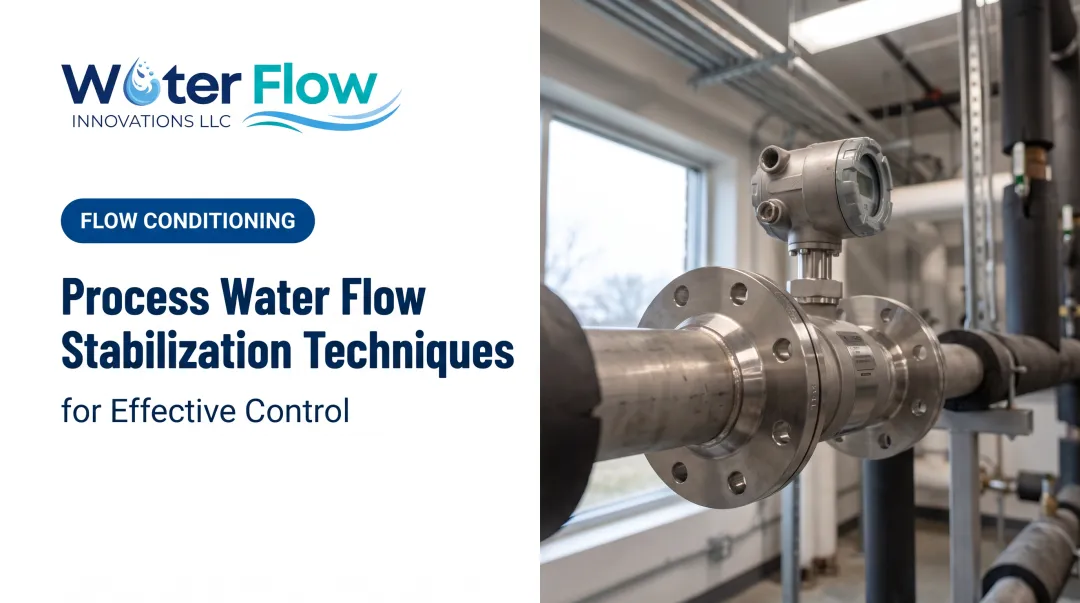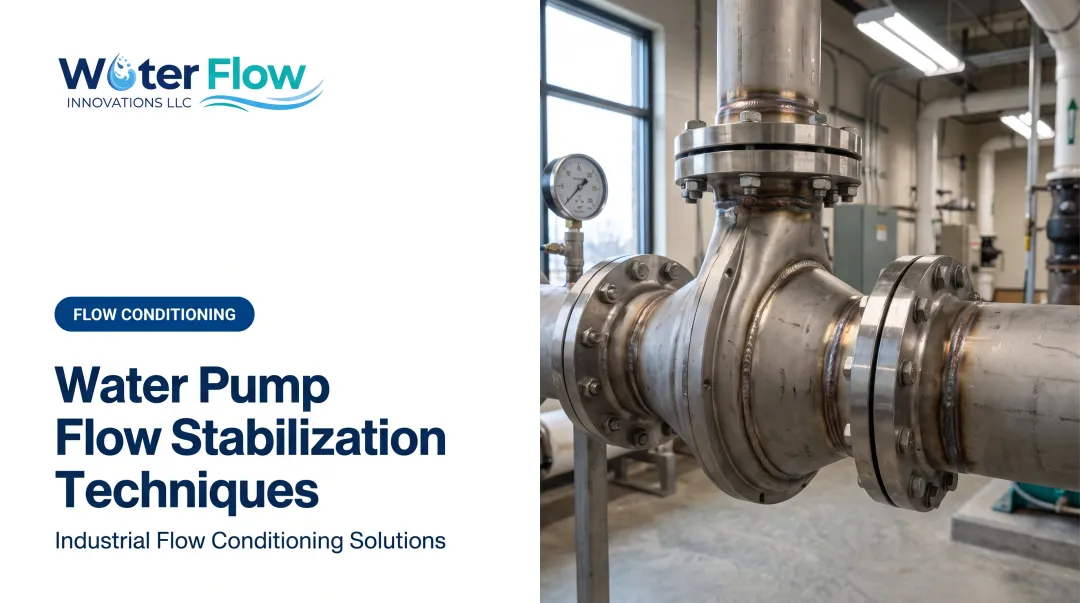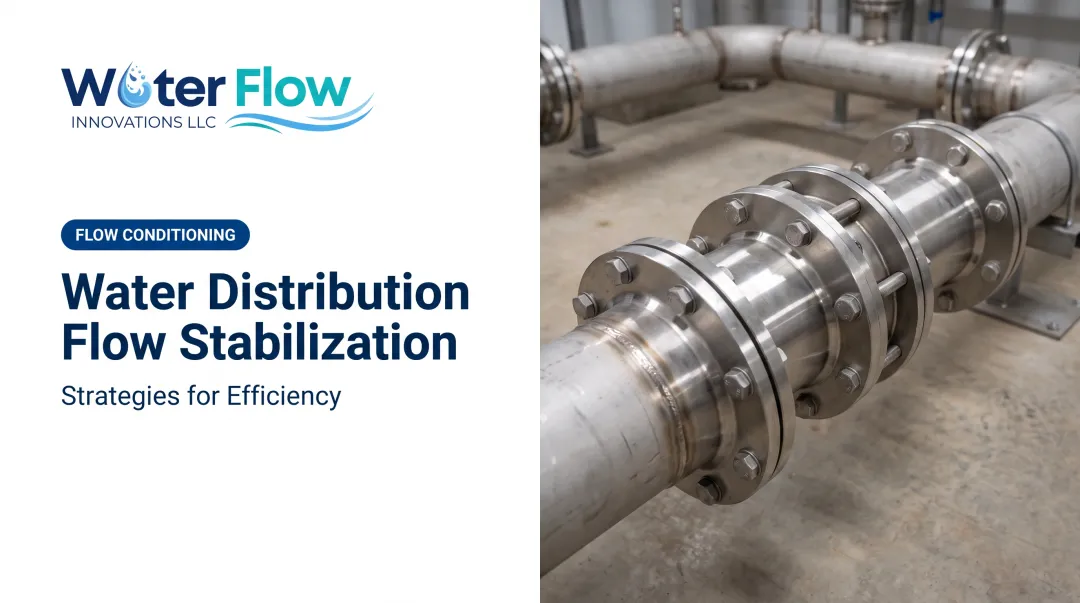

Most facility managers respond by chasing conservation. Fix the leaky faucet. Shorten the shower timers. But there's a bigger lever many overlook entirely: flow stabilization.
This isn't about using less water. It's about making sure the water you do use gets measured accurately. Turbulence, air entrainment, and pressure swings inside municipal piping can cause meters to register more volume than actually passes through. Below, we'll cover what causes flow instability, the engineering techniques that fix it, and what facilities can expect to gain.
Key Takeaways
- Turbulence and air entrainment inside pipes cause meters to over-register actual consumption
- Pressure regulation, air removal, and turbulence elimination stabilize flow with no operational disruption
- Stabilized flow cuts water and sewer bills together—sewer fees track metered intake
- Certified solutions install in about an hour, add negligible pressure loss, and often pay back within 12 months
What Is Water Flow Stabilization and Why It Matters
Flow stabilization is the process of controlling turbulence, pressure fluctuation, and entrained air so water moves smoothly and consistently through pipes and meters. Think of a garden hose with a kink in it: water surges, sputters, and swirls instead of flowing in a straight, even column. Municipal pipelines face that same problem, just at a much larger scale.
Water pressure (measured in psi) drives flow rate (measured in GPM). When those two variables fall out of sync, instability follows.
According to PNNL's water metering guidance, meter accuracy depends heavily on a uniform, swirl-free flow profile. Nearby fittings, valves, and elbows introduce turbulence that most meters simply weren't designed to handle cleanly.
Municipal systems are especially prone to this because:
- They rely on shared piping networks serving hundreds of properties
- Demand shifts constantly as neighboring buildings cycle fixtures on and off
- Water often travels long distances before reaching your meter
Here's the part that catches facilities off guard: unstable flow doesn't just create noisy pipes or pressure headaches. It can cause the meter itself to misread actual consumption.
McCrometer's 2023 technical analysis found that disturbances like partially closed valves produced metering errors above 50% in some configurations. That's not a rounding error. That's a bill that doesn't match reality.

Common Causes of Flow Instability in Water Utility Systems
Flow instability rarely comes from one source. It's usually a combination of factors specific to a building's plumbing and its municipal connection.
- Elevation changes — Hilly service areas create gravity-driven pressure drops that fluctuate throughout the day
- Aging or undersized pipes — Older infrastructure increases friction, which increases turbulence
- Demand fluctuations — Peak-hour usage, fire suppression testing, or nearby construction can send shockwaves through shared lines
- Malfunctioning valves and regulators — A failing pressure regulator anywhere in the network can destabilize flow downstream
- Air entrainment — Trapped air or gas mixes with water and disrupts the smooth water column meters are designed to read
The Air Entrainment Problem
Air is easy to miss and hard on meter accuracy. A 2022 peer-reviewed study in IWA Publishing's Aqua journal measured 0.45 to 0.86 cubic meters of over-registration during pipe refill events. Air moved through the mechanical meter at roughly 14 times the velocity of water.
Commercial buildings see the same pattern. Cooling tower makeup, CIP cycles, and dish machines cycling 40 to 60 times per hour during peak service pull air into the line and throw readings off.
Core Techniques Used to Stabilize Water Flow
Several proven engineering approaches address the root causes of flow instability. Most utilities and facilities combine two or more.
Pressure regulation devices maintain consistent psi despite fluctuating municipal supply conditions. The EPA notes that reducing excess pressure lowers stress on pipes and joints, reducing both leak volume and long-term wear.
Air and gas removal systems eliminate entrained air from the flow that meters and fixtures see. Meters can't distinguish between a bubble and a gallon of water; both register as flow.
Turbulence reduction components, often called flow straighteners or conditioners, smooth erratic water movement as it passes through metering equipment. A controlled 2019 study published in MDPI's Water journal found that adding just 3 pipe diameters of straight run reduced a Woltman meter's error from roughly +40% down to +2%.

Check valves prevent backflow-related pressure surges and stop air from re-entering a line after it's been purged.
How the FCD Combines These Techniques
Water Flow Innovation's Flow Conditioning Device (FCD) is a certified four-component system that addresses all of these mechanisms in a single device installed immediately after the municipal meter:
- Air and gas separation: creates static back-pressure that promotes laminar flow, producing a homogeneous water column through the measurement zone
- Pressure regulation: reduces surges and water hammer from on-off cycling
- Check valve: prevents reverse flow through the meter and blocks air re-entry
- Turbulence elimination: slows velocity enough to prevent vortex formation during CIP cycles, tank fills, and sprinkler use
The FCD is IAPMO, NSF, ANSI, CAN 61, KIWA, GMP, and SQF certified. It corrects meter over-reading without changing actual water usage or system performance.

Once flow is conditioned at the meter, monitoring tools catch issues that used to slip through. AI-enabled data loggers flag pressure imbalances and flow irregularities before they show up as a spiked bill.
Benefits of Flow Stabilization for Facilities and Utilities
Stabilized flow pays off in ways that go beyond a smaller invoice.
Facilities and utilities typically see:
- Lower water and sewer bills at once: sewer discharge fees usually track metered intake, so every over-read gallon is billed twice (water and sewer); correcting the reading fixes both
- Longer pipe and fitting life from fewer pressure swings and less turbulence, which cuts stress, bursts, and joint wear
- No operational disruption, because conditioning at the meter leaves downstream pressure and performance unchanged for hotels, hospitals, and production lines
- Before-and-after billing records that support ESG and LEED sustainability disclosures
A Halifax Water pressure-management pilot, cited by Mueller Water Products, reduced demand by 2.8% in a single low-leakage zone. Even without new pipes, flow management produced a measurable drop in demand.

Industries That Benefit Most from Flow Stabilization
Facilities that cycle high-demand equipment see the largest billing corrections from flow stabilization. Variable loads push meters into turbulent conditions; the sectors below hit that pattern most often.
Hospitality and Multifamily Housing
Guests and residents expect strong water pressure. Pools, laundry rooms, restaurants, and HVAC systems create variable demand that destabilizes flow.
Because flow conditioning does not reduce actual pressure, properties cut billing costs without touching the guest experience.
Food & Beverage and Industrial Manufacturing
Production reliability depends on stable water delivery for processing and sanitation. Dish machines and CIP systems cycle dozens of times per hour, creating pressure events that trigger meter over-reading.
Stabilizing flow protects metering accuracy and downstream equipment.
Municipal, Healthcare, and Education Facilities
Large campuses and public-sector buildings run continuous demand from sterilization, cooling towers, kitchens, and emergency systems. Predictable billing matters as much as infrastructure protection, especially for facilities on fixed public budgets.
How to Get Started with Flow Stabilization
Most commercial and industrial facilities can move from bill review to verified savings in a few weeks. Use these five steps to evaluate fit, install, and confirm results.
- Review recent water and sewer bills. Look for irregular spikes, unexplained increases, or patterns tied to high-demand equipment cycling.
- Request a free savings analysis. This examines billing history, meter type, pipe size, and facility water-use profile to project likely savings.
- Schedule installation. Installation typically takes about an hour, with negligible pressure loss and no changes to internal plumbing.
- Choose to buy or lease. Purchase includes a lifetime transferable warranty and a 6-month money-back guarantee; leasing offers predictable monthly payments with no capital outlay.
- Track results on your next bill. Most facilities see savings reflected on the very next billing cycle, and 90% of customers reach full ROI within 12 months.

Frequently Asked Questions
What is a normal GPM for a commercial building?
Commercial flow varies widely by facility type, fixture count, and pipe size—often tens to hundreds of GPM under peak demand. There is no single fixed number; capacity must match real operating load.
What causes turbulence in municipal water pipes?
Shared piping networks, shifting neighborhood demand, valve position changes, and nearby construction activity all disrupt the smooth flow profile meters need for accurate readings.
Does flow stabilization reduce water pressure or affect performance?
No. Properly designed flow conditioning is non-restrictive, creating negligible pressure loss and no noticeable change to downstream performance or operations.
How quickly can a business see savings from flow stabilization?
Most facilities see savings reflected on their very next water and sewer billing cycle after installation, verified through direct bill comparison.
Is flow stabilization different from water pressure boosting?
Yes. Pressure boosting increases psi to improve performance, while flow stabilization corrects turbulence and air-related metering issues that cause inaccurate billing.
Can flow stabilization help with sustainability certifications like LEED?
Yes. Documented before-and-after billing data can support ESG reporting and contribute toward LEED water-efficiency points.
How much of the saving comes from the sewer side?
Often the larger share. Sewer is typically derived from metered intake rather than measured discharge, commonly at 80–120% of the water charge, so a corrected reading reduces both lines together.
What cover applies if billing doesn't improve?
A 6-month money-back guarantee on the device purchase price, with installation cost non-refundable, so it can be returned if metered consumption does not measurably fall. A lifetime transferable warranty against manufacturing defects also applies.