
Most people never look past the total due on their water bill. But that number hides several moving parts, and few homeowners or facility managers understand how utilities actually arrive at it.
This guide breaks down every charge on a typical water bill, walks through the real math utilities use, and explains what drives your bill up (or down) — including a lesser-known factor most people never consider.
Key Takeaways
- Bills stack a fixed base charge, a variable usage charge, and often a sewer fee tied to water use
- Meters bill in CCF (hundred cubic feet) or gallons: 1 CCF equals 748 gallons
- Leaks, tiered rates, irrigation, and meter over-reading are common hidden causes of inflated bills
- Bill audits and flow-conditioning technology can cut water and sewer charges—often in the 5–30% range
How Is a Water Bill Calculated? Breaking Down the Charges
Every water bill rests on two core components: a fixed base charge and a variable usage charge. Those two line items account for most of what appears on your statement.
Base/Fixed Service Charge
This charge covers the utility's cost of maintaining infrastructure, reading your meter, and billing you, regardless of how much water you use. It's typically tied to your meter size, so a larger meter (common in commercial and industrial buildings) carries a higher fixed fee than a residential 5/8-inch meter.
Volumetric Usage Charge
This portion scales with how much water you actually consume, and many utilities use a tiered (increasing-block) rate structure to encourage conservation. The more you use, the higher the per-unit price climbs.
Denver Water's 2026 rates are a clear example:
| Usage Tier | Rate per 1,000 gallons |
|---|---|
| Tier 1 (up to average winter use) | $3.02 |
| Tier 2 (above average, up to +15,000 gal) | $6.54 |
| Tier 3 (above that threshold) | $9.45 |

According to Denver Water's 2026 residential rate schedule, usage that exceeds Tier 1 during peak irrigation season can nearly triple the per-unit cost. Many commercial rate schedules use the same increasing-block logic.
Sewer/Wastewater Charge
Since utilities can't practically measure what goes down your drain, sewer charges are usually calculated from your metered water usage, often using a winter-average baseline to exclude outdoor watering. You may also see stormwater fees, local taxes, and other municipal service charges tacked onto the same bill.
How Water Usage Is Measured on Your Meter
Your bill reflects the difference between two meter readings: current reading minus previous reading equals billed usage. That meter read can be:
- Actual: physically read by a technician or transmitted electronically
- Estimated: based on historical usage when a read is missed
- Manual override: corrected after an error or access issue
Estimated reads can distort a bill significantly, especially if your usage pattern just changed.
Understanding Units and Conversions
A "unit" varies by utility, so it pays to check your bill's fine print:
- 1 CCF (hundred cubic feet) = 748 gallons
- 1 cubic meter ≈ 264.2 gallons, per the USGS conversion tables
- 1 "unit" often equals either 100 cubic feet or 1,000 gallons, depending on the utility
Many analog and digital meters also register "phantom" usage from air entrainment and turbulent flow. That inflates the reading without a single extra gallon actually reaching your facility.
What's a Normal Water Bill? Usage Benchmarks by Household Size
The EPA cites 82 gallons per person per day as a national average for in-home water use. That translates to rough monthly benchmarks:
| Household Size | Daily Use | Monthly Use | Approx. CCF |
|---|---|---|---|
| 1 person | 82 gal | 2,460 gal | 3.29 CCF |
| 2 people | 164 gal | 4,920 gal | 6.58 CCF |
| 3 people | 246 gal | 7,380 gal | 9.87 CCF |
| 4 people | 328 gal | 9,840 gal | 13.16 CCF |
| 5 people | 410 gal | 12,300 gal | 16.44 CCF |

Is metered billing cheaper for a small household?
Generally, yes. A 2015 Journal AWWA study found unmetered homes used 15–31% more water than comparable metered homes before conversion, and usage dropped 13–21% after meters went in.
Smaller households benefit most: a flat rate doesn't reward low use, while a metered rate does.
Keep in mind: "normal" varies enormously by climate, region, and irrigation habits. A national average is a rough gauge, not a target.
Why Your Water Bill May Be Higher Than It Should Be
A higher water bill does not always mean your facility is using more water. Some causes are easy to spot once you know where to look:
- Leaks — running toilets, dripping faucets, or a hidden pipe issue
- Outdoor irrigation — sprinklers pushing you into a higher tier
- Longer billing periods — more days between reads means more usage
- Tiered rate creep — small usage increases that cross into a pricier block
The Hidden Cause: Meter Over-Reading
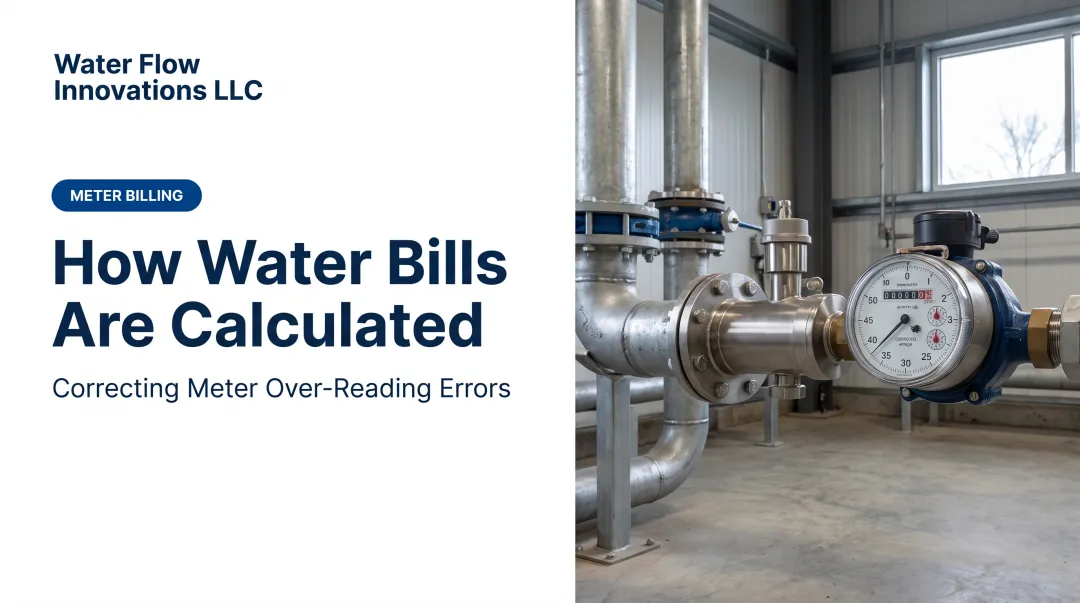
What many facility and property managers never hear: water meters can mechanically over-read when entrained air, turbulence, and pressure swings disturb flow in the pipe. You can be billed for water your building never actually received.
Over-reading is a documented mechanical issue. Research on Woltman meters has reported over-registration as high as +45% under disturbed flow, falling to roughly +2% when straight pipe stabilized the flow. Other meter studies have found intermittent-flow errors often near ±20%, depending on meter technology.

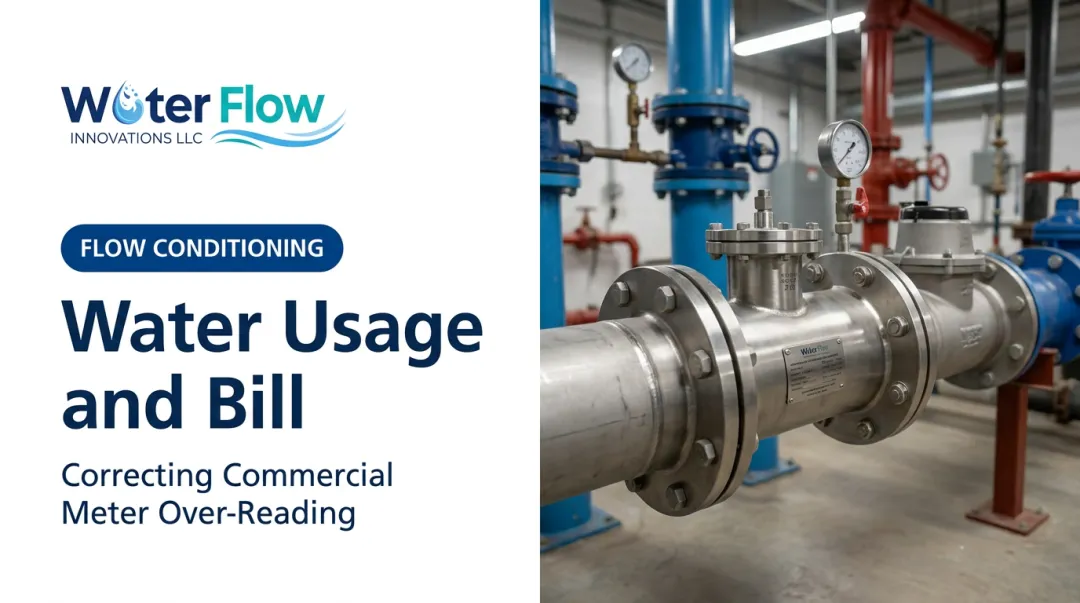
Water Flow Innovation's certified Flow Conditioning Device (FCD) is built to correct that measurement error. Installed immediately after the meter, the FCD:
- Removes air and gas at the meter, creating a homogeneous water column
- Regulates pressure, reducing water hammer and surge events
- Prevents reverse flow through an integrated check valve
- Reduces turbulence, eliminating the vortex flow patterns that cause over-counting
Facilities see a documented 5–30% average bill reduction (highest recorded case: 46%) on the next billing cycle, with no change in actual water use or operations.

Practical Steps to Lower Your Water and Sewer Bill
Before assuming your meter is at fault, rule out the basics:
- Run a leak check. Read your meter before and after a two-hour no-use period. Any movement signals a leak. The EPA notes that fixing easily corrected leaks can save roughly 10% on water bills.
- Review your billing period and read type. An estimated read during a usage spike can overstate your bill.
- Request a sewer cap recalculation if your utility offers one and your winter-average baseline seems off.
If those checks look clean and you still run a commercial, industrial, or other high-usage site, meter over-reading may be driving a larger cost impact. Water Flow Innovation offers a free water bill review and savings calculator: enter your current monthly bill and get a savings projection in about 30 seconds.
When turbulent flow or air entrainment inflates what the meter records, a certified Flow Conditioning Device (FCD) can correct the read at the source. FCD units:
- Install in about an hour with no operational disruption
- Fit pipe sizes from 1/2 inch to 12 inches, in 316L stainless steel
- Carry IAPMO, NSF, ANSI, CAN 61, KIWA, GMP, and SQF certifications
- Include a 6-month money-back guarantee and a lifetime transferable warranty
Hotels, hospitals, and food and beverage plants use this approach to cut water and sewer charges together, since sewer fees are usually based on metered water use.
Frequently Asked Questions
How is a water bill calculated?
Most bills combine a fixed base charge (covers meter and infrastructure costs) with a variable usage charge based on metered consumption. A sewer charge, often based on your water usage or a winter average, is typically added on top.
How much should my water bill be?
It depends on household size, local rates, and usage. A typical two-person household uses around 4,920 gallons monthly; multiply that by your utility’s per-gallon or per-CCF rate for a rough estimate. Check the benchmarks section above for regional comparisons.
Why are my water rates higher than my neighbors?
Differences often come down to meter size, tiered usage rates, irrigation habits, and property-specific sewer caps. Two similar homes can land in different pricing tiers based on outdoor watering alone.
How much does 1 cubic meter of water cost?
One cubic meter equals about 264.2 gallons. The dollar cost depends entirely on your local utility’s per-unit rate, so check your specific rate schedule.
How much water is 1 unit on a water meter?
It depends on the utility: commonly either 100 cubic feet (748 gallons) or 1,000 gallons. Your bill should specify which unit applies.
How many gallons of wastewater per person per day?
The EPA estimates typical wastewater flow at 40-70 gallons per person per day, depending on the home's age and fixture efficiency.