
This guide covers what causes pressure instability, the mechanical and control-based techniques used to fix it, and how to pick the right approach for your facility. We'll also touch on something many facility managers miss entirely: pressure problems and water meter over-registration are often the same root issue wearing two different hats.
Key Takeaways
- Pressure instability usually traces to demand swings, aging infrastructure, air entrainment, or poor system design
- Fixes range from a simple pressure switch to VFD boosting with real-time feedback
- Match the technique to facility size, demand variability, and process sensitivity to pressure swings
- Unstable pressure can make meters over-read—what looks like a usage issue may be a billing accuracy problem
Understanding Industrial Water Pressure Instability
Water pressure stabilization means keeping PSI consistent despite changing demand, elevation differences, or long pipe runs. It sounds simple. In practice, several things conspire against it.
Common culprits include:
- Turbulent flow near elbows, valves, or undersized piping
- Air entrainment or trapped air pockets in the system
- Worn pump components — impellers, seals, diffusers
- Pressure tanks that are the wrong size for actual demand
- Clogged filters or partially blocked impellers
The Hydraulic Institute flags water hammer — a sudden pressure transient that can exceed pipe and fitting ratings — as a frequent failure mode. Common triggers include:
- Pump startup and shutdown
- Rapid valve closure
- Fast-closing check valves
In brittle materials like cast iron, the surge can crack pipe. In ductile piping, it causes slow deformation over time (Pumps.org, Hydraulic Institute).

The financial stakes are real, even if they vary by facility. Department of Energy case studies documented a chemical-process condensate pump correction that saved $115,000 over 10 years (a 40% reduction), and a pulp-and-paper circulation redesign that saved more than $700,000 over 20 years (DOE/LBNL case study).
Those figures cover broader pump-system improvements, not pressure instability alone — but they show how much money sits inside a poorly tuned system.
Warning Signs Facility Managers Should Watch For
- Fixtures or equipment outlets with fluctuating flow output
- Pumps cycling on and off more frequently than usual
- Unusual noise or vibration near pump housing
- Pressure gauges at different points in the system giving inconsistent readings
Address these early and you avoid turning a minor annoyance into a $50,000 pump replacement.
Core Water Pressure Stabilization Techniques
There's no single fix for pressure instability. Most facilities use a combination of these approaches.
Direct Boosting Systems
Booster pumps connect in-line with the main utility feed, raising pressure independent of variable inlet conditions (Grundfos). This is the most common setup for commercial and industrial buildings with inadequate incoming pressure.
Zone-Divided Systems
Multi-story or campus facilities often need different pressure levels for different zones. You don't want a first-floor faucet blasting because the system is sized for the twentieth floor.
Grundfos documented one 20-story hospital where zone division used 72,937 kWh/year versus 106,530 kWh/year for a single booster setup, a 31.5% reduction (Grundfos case study). That's one case, not a guarantee, but it shows the potential.
Variable Frequency Drives (VFDs)
VFDs hold pressure near-constant by adjusting pump speed rather than cycling pumps on and off, using a pressure transducer to feed real-time data into the control loop. That removes one common source of the pressure swings that disturb flow at the meter.
What they do not do is correct what the meter records. Speed control smooths the supply; entrained air and turbulence at the measurement point still register as billed volume, and that correction happens at the meter itself.
Pressure Switches vs. Pressure Transducers
| Feature | Pressure Switch | Pressure Transducer |
|---|---|---|
| Control type | On/off contact | Continuous analog signal (4-20 mA or 0-10V) |
| Precision | Basic, preset threshold | Fine-grained, real-time feedback |
| Best for | Smaller, less sensitive systems | Facilities needing tight tolerances |
| Pairs with | Simple pump control | VFDs, PID loops |
Bladder/Pressure Tanks
These tanks absorb surges and prevent short-cycling, which otherwise burns out pump motors fast. Sizing matters.
Amtrol's commercial sizing model calculates acceptance volume from pump capacity and minimum run time, then converts that to total tank volume using a pressure-based acceptance factor. A worked 15-hp example yields a 378-gallon minimum tank volume (Amtrol sizing guide). Precharge pressure should always match the system's minimum required cut-in pressure.

Flow Conditioning as a Complementary Technique
Mechanical and control-based fixes address pumps and tanks. Turbulence and air entrainment upstream of your meter still need a separate solution.
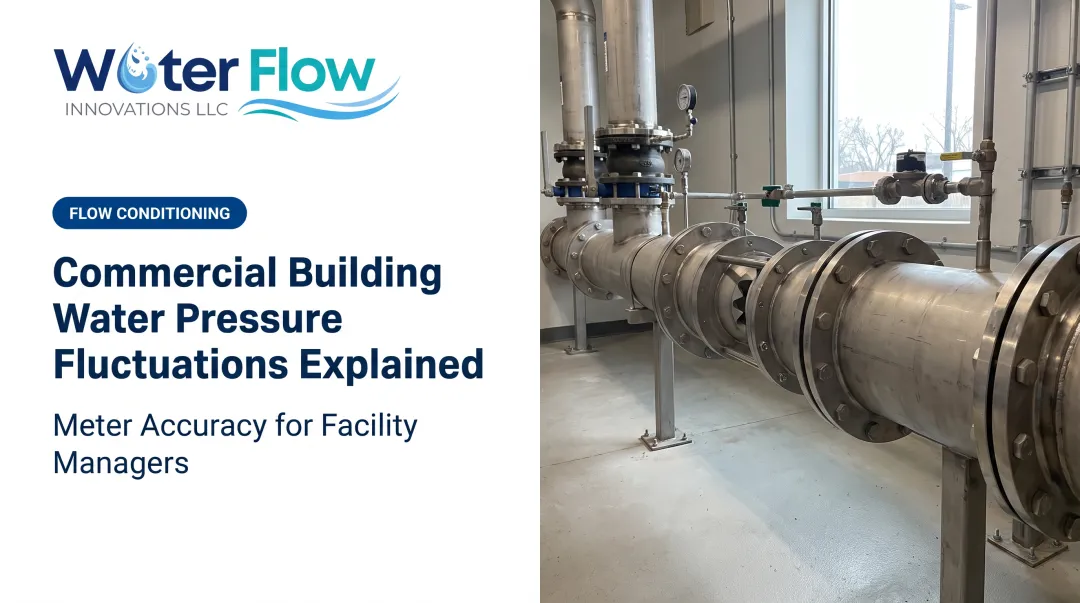
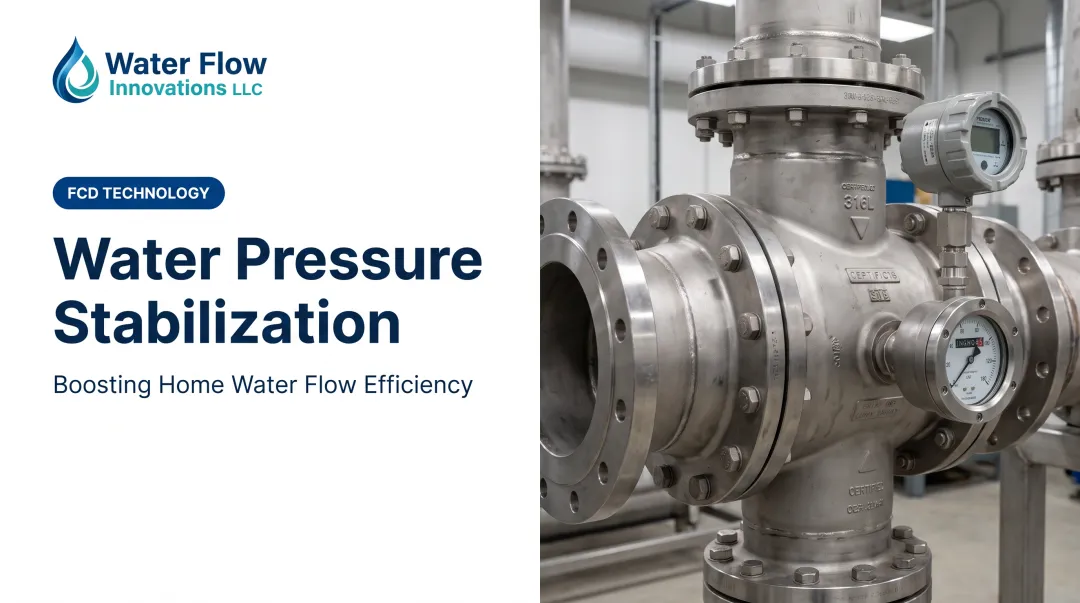
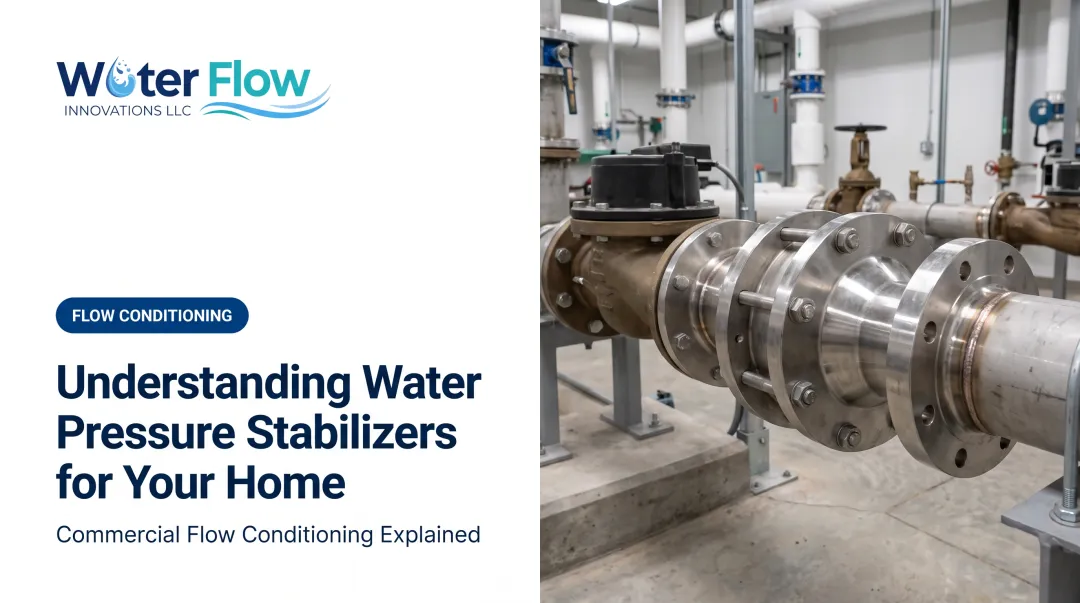
Water Flow Innovation's Flow Conditioning Device smooths flow at sensitive measurement points. It adds no moving parts and no operational complexity to your existing pressure system.
Components That Support a Stable Pressure System
Beyond the core techniques, a few supporting components keep pressure steady day to day:
- Control panels protect wiring, monitor pressure continuously, and alert staff before a fault becomes a failure
- Check valves stop backflow that can trigger valve slam and pressure spikes in high-head systems
- Properly sized pumps match Total Dynamic Head (static, elevation, and velocity head) so the system is neither over-pressurized nor starved
Troubleshooting Common Pressure Fluctuation Issues
When pressure swings show up, start with the faults that appear most often in industrial water systems.
Air in the system is a frequent culprit. A soapy water test on suction-line connections will show bubbles at ingress points. Bleeding the system at high points usually clears it.
Leaks in suction or discharge piping do more than waste water. Even small leaks pull in air and throw off readings across the system.
Worn internal components such as impellers, seals, and diffusers rarely fail overnight. By the time output drops, wear has often been building for months.
Catching these issues early is easier when inspection is routine rather than reactive.
Preventive Maintenance Best Practices
- Conduct daily or weekly visual checks of pumps, gauges, and connections
- Clean filters and valves on a set schedule (monthly is common)
- Schedule annual professional servicing with sensor recalibration
- Follow manufacturer intervals: Goulds HT 3196 pumps, for example, call for oil changes every 2,000 operating hours or three months
The Hidden Connection Between Pressure Instability and Water Bill Accuracy
Here's the part most facility managers never connect: turbulent flow and air entrainment don't just destabilize pressure. They can make your water meter over-read your actual usage.
Research from PNNL confirms that turbulence near fittings and valves degrades meter accuracy. Turbine and compound meters specifically need uniform, swirl-free flow to register correctly (PNNL Water Metering Best Practices).
In one peer-reviewed study of pipe refill after intermittent supply, air passing through meters produced registered volumes averaging roughly 0.5 cubic meters (about 132 gallons) per interruption. Rotor speeds spiked to 14 times normal, and five of six tested meters failed accuracy standards under those conditions.
That is the gap Water Flow Innovation's Flow Conditioning Device (FCD) is built to close. It is a custom-fabricated, certified device (IAPMO, NSF, ANSI, CAN 61, KIWA, GMP, SQF) organized as a four-component system:
- Air/gas separation: Creates a compression zone that pushes entrained air back into the main line, so meters measure water instead of a water-air mixture
- Pressure regulation: Smooths surges and reduces water-hammer risk at the meter entry point
- Check valve: Limits reverse flow and pressure spikes (specified where needed)
- Turbulence elimination: Conditions flow into a laminar pattern, preventing the vortex spin that causes meters to over-count

Facilities typically see lower water and sewer charges on the very next billing cycle, with negligible pressure loss and about an hour of installation time. The same turbulence drivers show up across industrial, manufacturing, food and beverage, and other high-water-use sites, including:
- CIP cycles
- Tank fills
- Irrigation and similar surge-prone demand
Choosing the Right Stabilization Approach for Your Facility
Match the solution to your actual operating profile:
- Small or less sensitive applications — a basic pressure switch and standard booster pump usually suffice
- Facilities needing tight tolerances — VFD-controlled systems with transducer feedback are worth the added cost
- Multi-story or campus facilities — zone-divided boosting reduces energy waste and prevents over-pressurizing lower floors
Retrofit compatibility matters just as much as the technology itself. Solutions that work with your existing pipe sizes and meter types, rather than requiring a rebuild, cut both disruption and capital cost.
The FCD, for instance, is custom-fabricated per facility. It fits pipe sizes from ½ inch through 12 inches standard (larger sizes available by custom order) and works with any existing meter type.
A professional system audit that covers pressure stabilization and flow conditioning together is often the most efficient next step. Water Flow Innovation offers a free Water Bill Review & Savings Analysis that examines your billing history, meter configuration, and usage patterns (CIP cycles, cooling tower makeup, irrigation zones) to flag over-registration risk alongside pressure issues.
That single review addresses performance and billing accuracy together instead of treating them as separate problems.
Frequently Asked Questions
Is there a device to increase water pressure?
Yes. Booster pumps, hydrophore sets, and VFD-controlled pumping stations are the primary devices used in industrial and commercial settings. The right choice depends on your required flow rate and head.
What causes sudden water pressure drops in industrial facilities?
Common causes include sudden demand spikes, leaks in supply lines, clogged filters, and worn pump components like impellers or seals.
How does a VFD help stabilize water pressure?
A VFD uses closed-loop PID control, adjusting pump speed based on real-time feedback from a pressure transducer. This keeps output steady instead of letting pumps cycle abruptly on and off.
Can unstable water pressure affect my water bill?
Yes. Turbulence and air entrainment caused by pressure instability can cause meters to over-register actual usage, inflating both water and sewer charges even though consumption hasn't changed.
How often should industrial pressure systems be inspected?
Most facilities benefit from annual professional servicing with sensor recalibration, combined with regular visual and component checks weekly or monthly depending on equipment criticality.
What is the difference between a pressure switch and a pressure transducer?
A pressure switch provides basic on/off control at a preset threshold. A pressure transducer delivers continuous analog feedback, enabling precise, real-time control loops like those used with VFDs.
Can the correction be fitted without pausing production?
Yes. A licensed plumber or mechanical contractor installs the custom-built unit at the municipal supply connection in about an hour, with a brief water shutoff at the meter connection. Pumps, VFDs, and process lines are otherwise untouched.
What approvals should the device carry on an industrial supply?
Certification to IAPMO, NSF, ANSI, CAN 61, KIWA, GMP, and SQF, together with EPA WaterSense compliance. The unit is fabricated from 316L stainless steel in the USA.