
Many operators confuse flow conditioning with aeration, pumping, filtration, or water-quality treatment. They're related, but not the same thing. This article explains how conditioning devices actually work, where they fit into an aquaculture system, and what to check before you install one.
Key Takeaways
- Flow conditioning manages hydraulic behavior — it doesn't replace an aerator, pump, biofilter, oxygenation system, or disinfection process.
- Air entrainment, turbulence, pressure swings, fittings, and system layout all influence flow stability and measurement accuracy.
- Suitability depends on pipe size, flow rate, pressure, water chemistry, solids loading, and materials compatibility.
- Establish baseline flow and pressure readings, then validate performance after any installation.
- Verify product claims and certifications against documentation for your specific system.
What Are Water Flow Conditioning Devices, and Why Are They Used in Aquaculture?
In practical terms, a flow conditioning device improves hydraulic consistency in a pipe run. It typically:
- Reduces undesirable turbulence
- Manages entrained air or gas
- Regulates pressure
- Prevents reverse flow
The goal is straightforward: water reaches tanks, filters, heat exchangers, sensors, and discharge points with fewer unpredictable disturbances.
These devices differ from adjacent equipment:
- Pumps create or maintain movement
- Aerators add gas exchange for dissolved oxygen
- Filters remove solids or biological contaminants
- Flow meters measure movement, but don't condition it
Aquaculture systems are particularly sensitive to hydraulic swings. Recirculating systems run continuously, depend on steady treatment performance, and need to protect fish from abrupt pressure or flow changes.
A USDA Agricultural Research Service report on a Freshwater Institute recirculating system found it used as little as 4% new water per day. The same water, and the same hydraulic conditions, cycle through the system again and again. That level of reuse raises the stakes for consistent flow behavior, since small disturbances compound over time rather than flushing out.

Flow conditioning is generally an operational design choice, not a blanket regulatory mandate. That said, materials, potable-water interfaces, backflow prevention, and electrical or mechanical safety can fall under applicable codes and standards depending on where the device sits in your system.
How Water Flow Conditioning Devices Work
Picture the path water takes: it leaves a tank or source, moves through a pump, travels through pipework, passes through conditioning components if present, and continues to treatment equipment or culture units.
Along that path, several things can go wrong:
- Air or gas pockets enter lines at pump seals, partially filled sections, or vortex points
- Turbulence develops at valves, elbows, diameter changes, and tees
NIST testing found that a single upstream tee produced fluctuating differential pressure and substantial measurement errors in a tested orifice-meter installation. A tube-bundle conditioner reduced that disturbance in many (though not all) of the tested configurations. Researchers noted the finding was specific to the meter type and pipe arrangement tested (NIST Technical Note 1344).
The Four Functions a Conditioning Assembly May Combine
Not every device does all four, but a comprehensive assembly typically addresses:
- Air or gas separation: reducing the effect of entrained air or micro-bubbles in the line
- Pressure regulation: keeping operating conditions within an intended range, which also helps dampen water hammer from on-off cycling
- Check-valve or backflow control: limiting reverse movement when pumps stop or conditions shift
- Turbulence reduction: creating a more consistent flow profile ahead of a sensitive component or measurement point

Here's what these devices don't do: remove ammonia, strip nitrite, filter suspended solids, kill pathogens, or treat dissolved contaminants. Those require a separate, purpose-built treatment component.
A Simple Placement Example
In a basic RAS or hatchery loop, conditioning might sit upstream of a flow meter, biofilter, heat exchanger, or tank return, wherever turbulence or air entrainment is creating a measurable problem. Exact placement should be confirmed with a qualified system designer, since pipe layout and equipment sensitivity vary facility to facility.
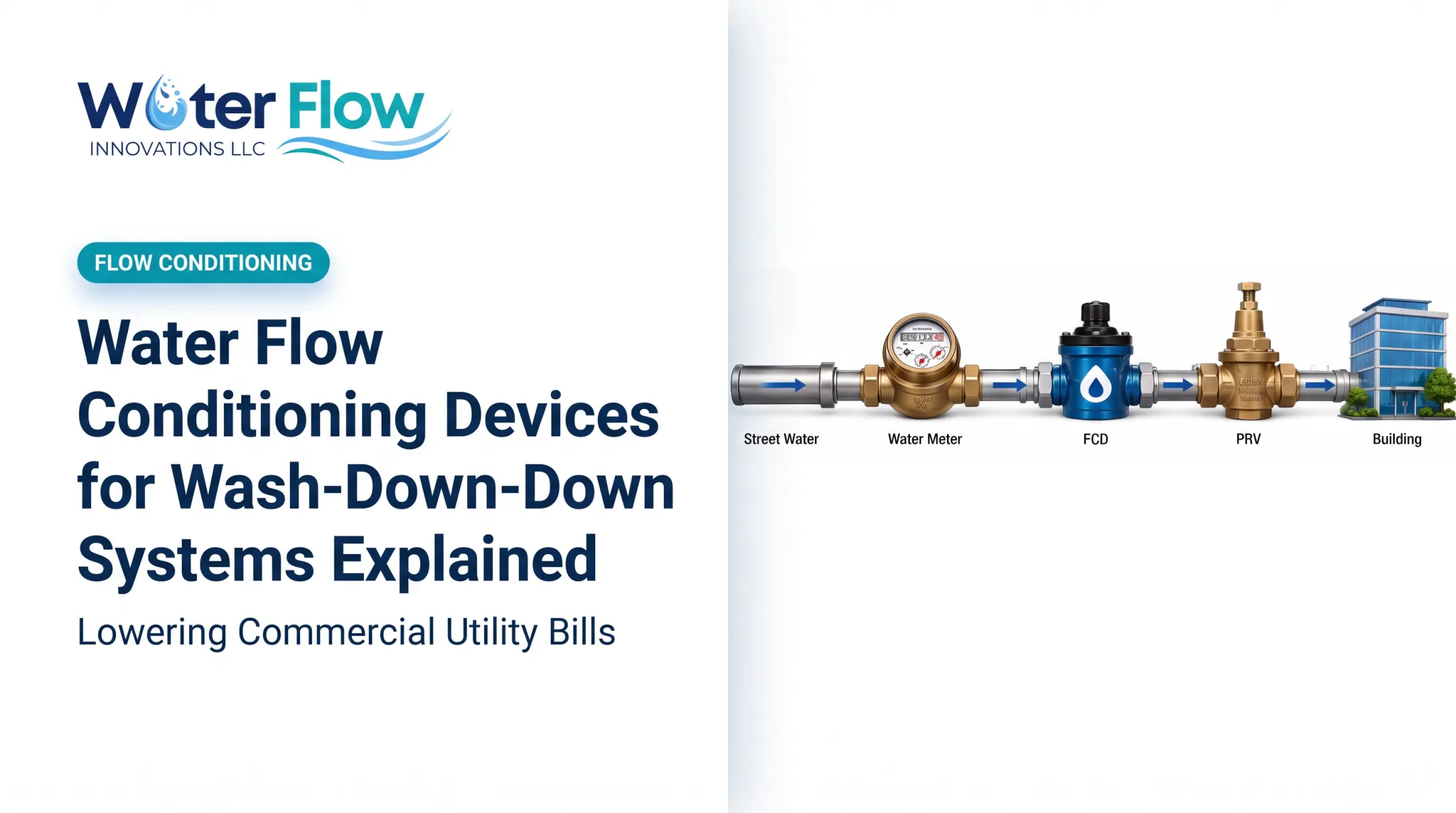
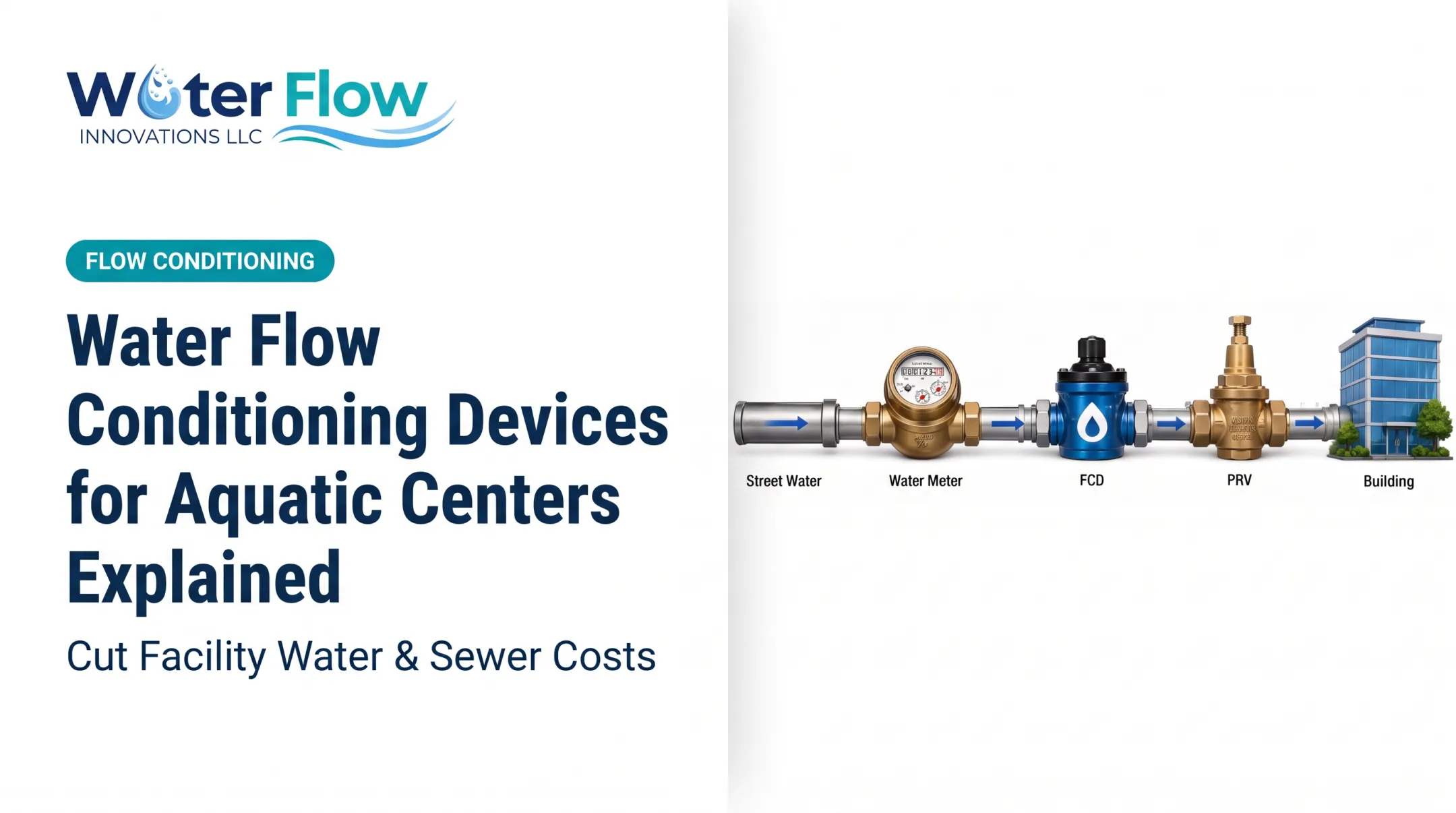
Water Flow Innovation's Flow Conditioning Device (FCD) is one example of this four-function approach. It's built around air and gas separation, pressure regulation, an optional check valve, and turbulence elimination, all combined into one in-line unit.
The FCD is designed to install immediately after a water meter on the supply side of a facility's connection, correcting meter over-reading caused by entrained air and turbulent vortex flow. That application targets billing accuracy at the meter, not every point in an aquaculture recirculation loop. Confirm it matches your hydraulic symptom and location before specifying it.
Where Flow Conditioning Devices Are Used and What Affects Performance
Operators apply flow conditioning across RAS, hatcheries, raceways, and pond circulation or water-reuse systems. In every case, the goal is hydraulic stability, not an automatic improvement in water quality or animal health.
When Conditioning Enters the Conversation
Operators typically evaluate conditioning at one of these points:
- During new system design, when pipe runs and equipment layout are still being finalized
- When adding a pump or treatment unit that changes flow characteristics downstream
- During troubleshooting, when flow meter readings or pressure behavior seem erratic
- When retrofitting an existing pipe run that's showing hydraulic symptoms
What Affects Performance
Several variables determine whether conditioning will actually help:
- Flow rate, pipe diameter, and pressure at the install point
- Elevation changes and pump curve behavior
- Water temperature, salinity, and suspended solids
- Entrained gas content in the line
- Upstream valves, fittings, and pipe geometry
Equipment dependencies matter too. Pump selection, filter loading, heat-exchanger requirements, and sensor installation all interact with any conditioning you add. Every device also has a manufacturer-specified minimum and maximum operating range that you should not exceed.
Scale changes the calculus. A small hatchery loop running intermittently has different requirements than a high-throughput commercial system running continuously with variable demand, scheduled cleaning cycles, and emergency bypass needs.
Pre-Installation Checklist
Before specifying any device:
- Document baseline flow and pressure readings
- Identify the specific hydraulic symptom (not just "something seems off")
- Confirm connection sizes and materials match your pipe run
- Check maintenance access around the proposed installation point
- Determine whether a bypass or isolation valve is needed for servicing
On the regulatory side, the 2024 International Plumbing Code covers protection of potable water supplies from nonpotable cross-connections. That includes a high-hazard backpressure provision that requires a reduced-pressure-principle assembly at certain connections (2024 IPC, Chapter 6).
That rule matters if your conditioning point sits near a potable makeup-water interface. It is not a universal certification for every process-water line in an aquaculture facility.
Common Issues, Misconceptions, and When a Device May Not Be Appropriate
The most persistent misconception: flow conditioning adds oxygen. It doesn't. Oxygenation and flow conditioning address entirely different functions, even though both can interact within the same recirculating loop.
A conditioning device also can't fix:
- An undersized pump struggling to move the required volume
- A blocked filter restricting flow
- A poorly designed pipe network with excessive bends or constrictions
- Insufficient aeration or biofiltration capacity
- Incorrect water-quality management upstream
University of Florida IFAS Extension guidance lists blocked suction lines, poor piping design, and unmet net-positive-suction-head requirements among cavitation causes in aquaculture pumping systems. A conditioning device resolves none of these.
Separately, SRAC guidance identifies pipe constriction and clogged retaining screens as causes of declining circulation. Those call for cleaning or redesign, not conditioning.
There are also real risks to weigh:
- Adding unnecessary pressure loss to an already tight system
- Restricting access for routine cleaning
- Creating a solids-accumulation point that needs its own maintenance
- Selecting materials incompatible with salinity, disinfectants, or biosecurity protocols
A well-designed system with stable hydraulic behavior and no documented measurement or pressure problem simply doesn't need this equipment.
Watch for these warning signs that point to a broader engineering issue rather than a conditioning fix:
- Recurring pump cavitation
- Unexplained flow-meter variation
- Unstable tank turnover
- Filter bypassing
- Abnormal pressure swings
- Fish stress coinciding with hydraulic changes
If any of these show up, compare pre- and post-installation flow, pressure, energy use, meter stability, and maintenance frequency before drawing conclusions. Don't assume a single device will deliver a specific biological or financial result without that comparison.

Conclusion
Water flow conditioning devices are hydraulic-support components. They make water movement more predictable, but they're not substitutes for pumps, aerators, filters, biofilters, sensors, or disinfection systems.
Start by identifying the actual flow problem, then check:
- System compatibility
- Pressure loss
- Materials of construction
- Maintenance needs
- Applicable US codes and standards
Talk to a qualified system designer before specifying anything, and ask for documented performance data rather than general claims.
Where air entrainment, turbulence, pressure control, or backflow are documented concerns at a facility's water meter connection, Water Flow Innovation's Flow Conditioning Device is available for evaluation against your specific installation.
Frequently Asked Questions
What is the best aerator for aquaculture?
The best aerator depends on species, tank or pond geometry, stocking density, oxygen demand, water temperature, and salinity. An aerator addresses gas exchange. A flow conditioning device addresses hydraulic stability. They are not interchangeable.
Which is better, Biofloc or RAS?
Biofloc and RAS use different production and water-management approaches, so neither is universally "better." The right choice depends on species, facility goals, solids and nutrient management needs, and available expertise and capital.
What does a water flow conditioning device do?
It manages entrained air, pressure variation, reverse flow, and turbulence so hydraulics stay more consistent through a pipe run. It does not treat water quality or add oxygen.
Is a flow conditioning device the same as an aerator?
No. A conditioning device manages hydraulic behavior, while an aerator handles oxygen transfer and gas exchange. Most aquaculture systems need both types of equipment for different purposes.
Where should a flow conditioning device be installed in an aquaculture system?
Placement depends on the specific hydraulic problem and system layout, with common evaluation points near pumps, meters, treatment equipment, or tank-return lines. A professional design review should confirm the exact location.
How do I choose a flow conditioning device for aquaculture?
Evaluate flow range, pipe size, pressure, water chemistry, solids content, temperature, and materials compatibility. Confirm certifications, maintenance access, and bypass needs, and request documented performance before purchasing.