Here's the scale of it: EPA estimates the average family spends more than $1,000 a year on water costs, with national residential rates running about $7.74 per 1,000 gallons for water and $9.09 for wastewater. Apartment dwellers don't control the building's infrastructure, but daily habits, hidden leaks, and fixture quality still swing that bill significantly.
This guide breaks down where apartment water costs actually come from, what drives them up, and what you can do about it — starting with habits you control today and ending with building-level issues worth flagging to your property manager.
Key Takeaways
- Water bills build up gradually through daily habits, but leaks spike costs fast
- Bathroom and laundry use account for the largest share of in-unit consumption
- Shorter showers, full laundry loads, and quick leak fixes add up to real monthly savings
- Old plumbing and building-wide leaks sit outside a renter's control, so flag them to property management
- The best results come from combining personal habits with property-level fixes
How Water Bill Costs Build Up in an Apartment
Water costs aren't a single expense. They're dozens of small actions (a shower here, a load of dishes there) that compound over a billing cycle without anyone tracking them individually.
Some buildup is gradual. You take showers, run the dishwasher, do laundry. Each action barely registers, but a month's worth adds up fast.
Other cost spikes are sudden and hidden. A running toilet or dripping faucet can waste hundreds of gallons before anyone notices. That's the frustrating part: you might not realize costs are climbing until the bill arrives, especially in units without submeters where usage isn't visible in real time.
Billing frequency makes this worse. Some cities bill monthly, others quarterly:
| City/Utility | Billing Frequency |
|---|---|
| DC Water | Monthly |
| Chicago | Monthly or bimonthly |
| New York City | Every 3 months |
| Royal Oak, MI | Four times a year |
If your building bills quarterly, a leak could run for weeks before it ever shows up as a number you can see.
Key Cost Drivers Behind a High Apartment Water Bill
A handful of factors determine most of what you pay: fixture efficiency, daily habits, leaks, and how your building actually bills for water.
Fixture Age and Flow Rate
Older fixtures use far more water per use than modern ones. Since 1994, federal standards cap showerheads at 2.5 GPM and toilets at 1.6 gallons per flush. WaterSense-labeled fixtures go further:
| Fixture | Pre-1994 Older Models | Federal Standard | WaterSense Max |
|---|---|---|---|
| Showerhead | 3.0–5.0 GPM | 2.5 GPM | 2.0 GPM |
| Bathroom Faucet | Up to 2.5 GPM | 2.2 GPM | 1.5 GPM |
| Toilet | 3.5–5.0 GPF | 1.6 GPF | 1.28 GPF |
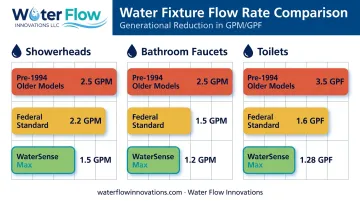
Renters usually can't swap these out themselves. Fixture replacement is landlord territory, but knowing the EPA's WaterSense benchmarks helps you make the case for an upgrade.
Daily Habits Scale Fast
EPA estimates Americans use about 82 gallons per person per day at home, based on USGS data. Showers, dishwashing, and laundry frequency all directly move that number — and your bill along with it.
Undetected Leaks Are the Costliest Preventable Driver
A running toilet can waste roughly 200 gallons per day. Multiply that across a billing cycle and you're looking at thousands of gallons nobody used but everybody paid for. EPA's Fix a Leak Week data shows the average household leak wastes nearly 10,000 gallons annually, and 10% of homes have leaks bad enough to waste 90+ gallons a day.
Billing Structure Changes Your Control
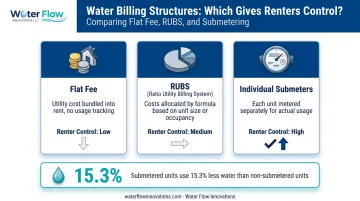
How your building charges for water changes how much power you actually have:
- Flat fee included in rent: your habits don't show up as a separate charge
- RUBS (Ratio Utility Billing System) — your bill is a formula based on occupants or square footage, not your actual use
- Individual submeters (you're billed for exactly what you use)
A 2004 multifamily study found submetered units used 15.3% less water than units where water was included in rent, about 21.8 gallons per unit per day. RUBS, by contrast, showed no meaningful reduction. If you're on RUBS, your careful habits might not move your bill much at all — which is worth knowing before you blame yourself for a high number.
Money-Saving Strategies to Reduce Your Water Bill
The most effective savings combine daily habit changes, ongoing monitoring, and awareness of what's actually outside your control. Not every cost driver responds to the same fix.
Strategies That Start With Your Daily Habits
These cost nothing and start working immediately:
- Shorten your showers. EPA says cutting shower time by just one minute saves nearly 1,000 gallons a year. A cheap shower timer builds awareness fast.
- Turn off the tap while brushing teeth, shaving, or hand-washing dishes instead of letting it run.
- Run full loads only in the dishwasher and washing machine. A full-size ENERGY STAR washer uses about 14 gallons per load versus 20 for a standard model.
- Use cold water for laundry when the fabric allows it.
- Check your water heater setting if you have access. 120°F is the commonly recommended temperature for safety, energy savings, and reduced mineral buildup, but confirm with maintenance before adjusting anything.
Strategies That Involve Ongoing Monitoring and Maintenance
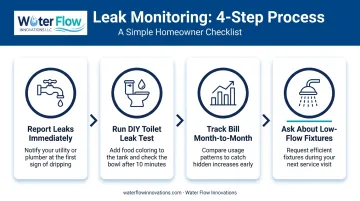
Habits alone won't catch a leak. This is where vigilance pays off:
- Report leaks immediately. A dripping faucet or running toilet should go to maintenance the day you notice it, not the day you remember to mention it.
- Run a DIY toilet leak test. Drop food coloring into the tank, wait 10 minutes without flushing. Color in the bowl means you've got a silent leak.
- Track your bill month-to-month if you can access usage data. A sudden spike is much easier to explain and fix while it's fresh.
- Ask about low-flow fixtures. If your leasing office hasn't installed WaterSense showerheads or faucet aerators, request them. It costs you nothing to ask.
Strategies That Depend on Building-Level and Infrastructure Factors
Some of the biggest cost drivers aren't yours to fix. Old plumbing, building-wide leaks, and inaccurate metering live at the property level, not the unit level.
Start by confirming what you're actually billed for. Ask your leasing office exactly which utilities are included in rent versus billed separately. There's no point obsessing over shower length if water is a flat fee you can't influence.
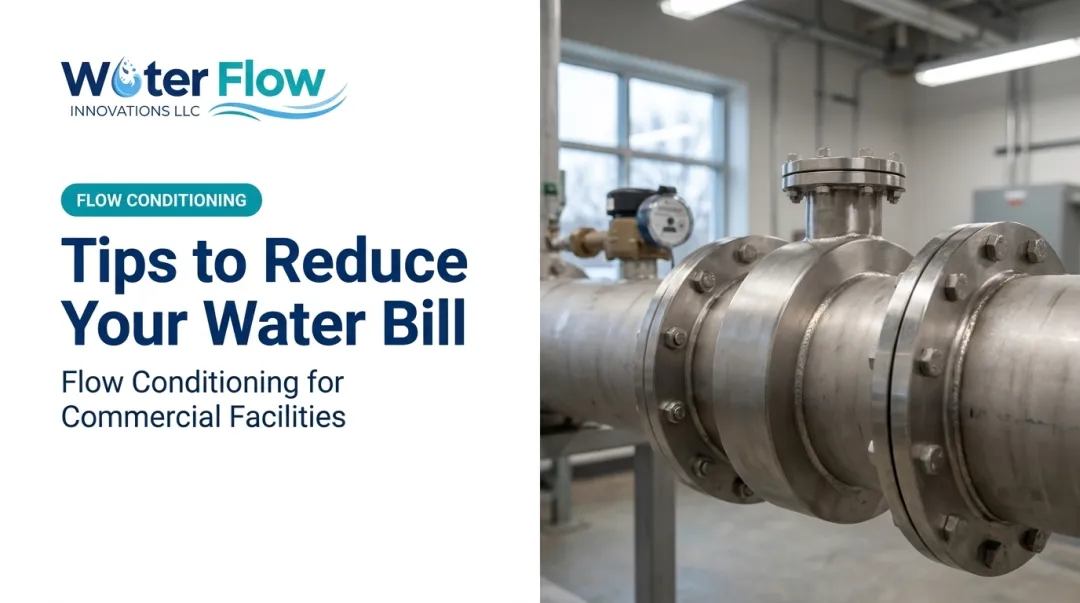
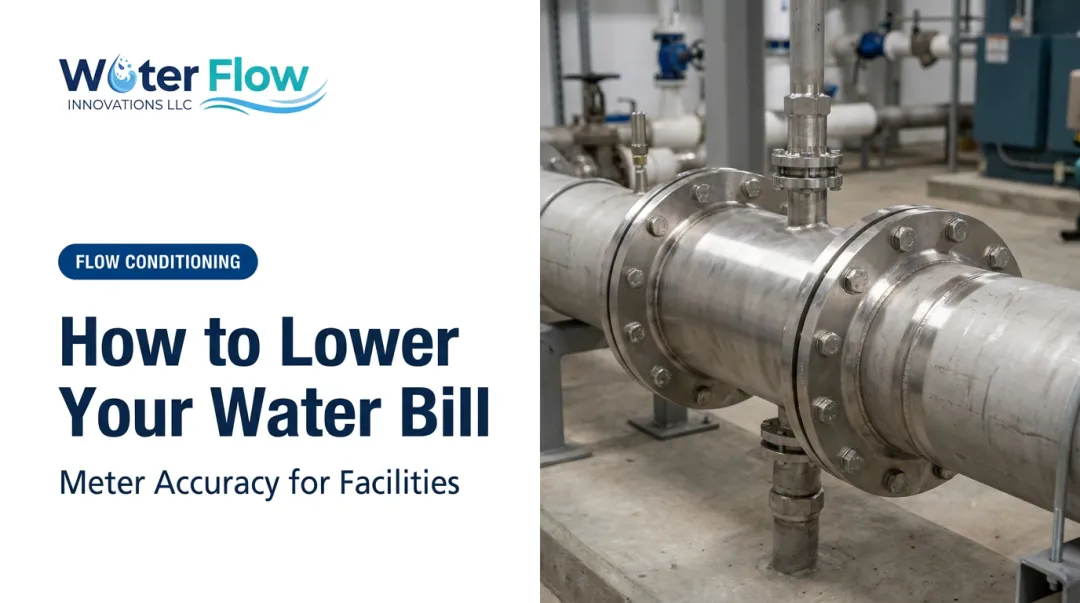
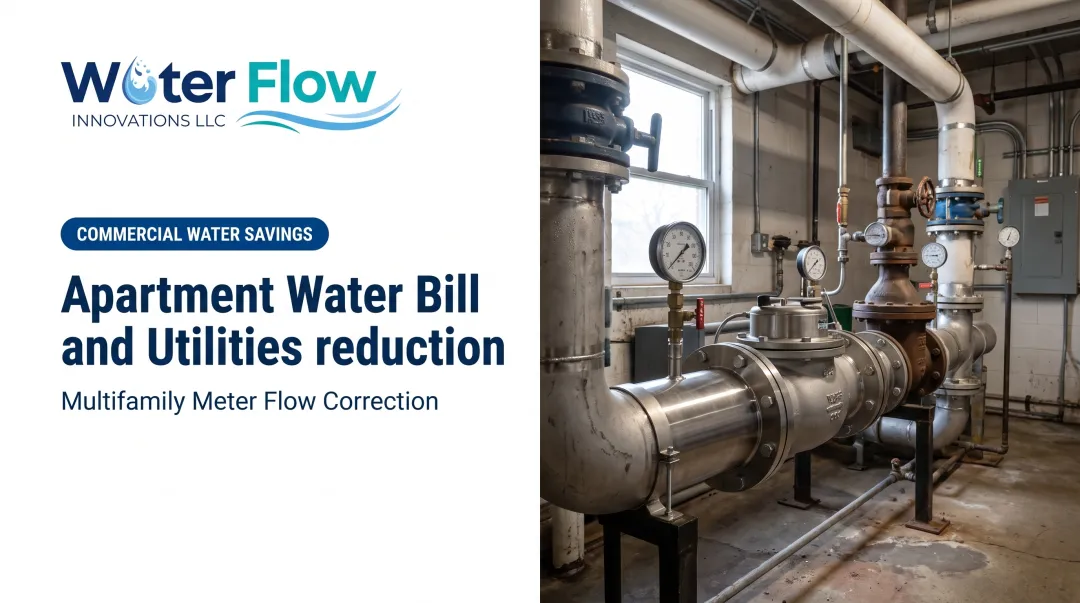
Meter accuracy is a bigger issue than most renters realize. Commercial water meters can over-read due to air entrainment, micro-bubbles, and turbulent flow in the pipes, registering billable volume that was never actually delivered as water.
This happens at the master meter, before water ever reaches individual units. No amount of careful showering fixes that.
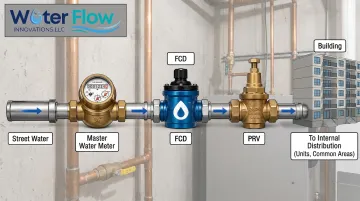
This is where flow conditioning technology comes in, and it's information worth passing along to your property manager rather than something you'd handle yourself. Water Flow Innovation offers a certified Flow Conditioning Device (FCD) that installs immediately after a building's master meter and corrects this over-reading at the source. Because it sits upstream of the entire internal distribution system:
- Every unit, common area, and amenity benefits from a single installation
- Water pressure and delivery to residents stay completely unchanged
- Savings show up on the very next billing cycle, not months later
Properties using the FCD have documented 5–30% average reductions in combined water and sewer costs, with some cases reaching 46%. High-rise buildings with booster pumps and multiple risers tend to see savings toward the higher end of that range. Those systems simply generate more turbulence at the meter to begin with.
If you're in a building with consistently high bills despite genuinely efficient habits, this is worth raising with property management as a possible fix, not something you install yourself, but something worth putting on their radar. The device carries IAPMO, NSF, ANSI, CAN 61, KIWA, GMP, and SQF certifications, so a skeptical property manager has plenty to verify independently.
If you live in an HOA or larger multifamily community, ask whether submetering or a building-wide efficiency audit is being considered. These decisions affect every resident's bill, not just yours.
Final Thoughts
Lowering your apartment water bill isn't about finding one big fix. It's about identifying which cost driver — a habit, a leak, an old fixture, or building infrastructure — is actually responsible for your number.
Renters get the best results by pairing consistent daily habits with proactive maintenance requests, while staying realistic about what depends on property-wide upgrades. Fix what's yours to fix. Flag what isn't. If your building's water costs still seem high after your own fixes, that's often a sign of aging meters or plumbing infrastructure — something only your property manager or landlord can address on a building-wide level.
Frequently Asked Questions
How can I lower my water bill in an apartment?
Combine shorter showers, prompt leak reporting, full laundry and dishwasher loads, and requesting low-flow fixtures from your leasing office. These habits compound into meaningful monthly savings without any cost to you.
What uses the most water in an apartment?
Showers, toilets, and laundry typically account for the largest share of household water use. EPA estimates the average American uses about 82 gallons per person per day at home.
Is my landlord responsible for high water bills caused by leaks?
Yes, generally. Landlords are typically responsible for fixing leaks and faulty plumbing under habitability laws. Report issues promptly in writing, since delays can increase costs shared across the building.
Do low-flow showerheads actually save money?
Yes. Standard showerheads use 2.5 GPM, while WaterSense-certified models cap at 2.0 GPM or less. EPA estimates this can save an average family over 2,700 gallons and $70 annually.
Why is my water bill high even though I'm careful with usage?
Hidden leaks, inefficient building infrastructure, or meter over-reading can inflate bills independent of your personal habits. If this persists, raise it with property management as a building-level issue.
Does my apartment complex include water in the rent?
It varies by property and lease. Some buildings use flat fees, others use RUBS or individual submeters. Confirm directly with your leasing office which utilities are covered and how they're billed.
What can property management do that residents can't?
Correct the building's master meter. Multifamily and apartment communities, HOAs, and luxury high-rise buildings run booster pumps and tank fills that entrain air, making the meter over-register. Building-wide flow conditioning fixes that at the source, with documented reductions averaging 5–30%.
Why is the sewer charge on our building's bill so high?
Most utilities calculate sewer as a percentage of metered water intake, typically 80–120% of the water charge. Every phantom gallon is therefore billed twice, once as water and once as sewer, even though it never entered a drain. Because the sewer line is derived from the water reading, a master-meter error inflates both before any allocation to units happens.