
Home » Savings Guides »
Why the FCD (Flow Conditioning Device)
Reduces Water Cost More When Placed Ahead of the PRV (Pressure Reducing Valve)
The best location is usually simple: install the FCD (Flow Conditioning Device) after the water meter and before the PRV (Pressure Reducing Valve). This lets the FCD work on the higher-pressure incoming water first, before the PRV lowers and regulates the pressure downward for the building.
Direct answer: The Flow Conditioning Device (FCD) installs upstream of a facility's pressure-reducing valve (PRV) and other internal plumbing, directly at the water meter connection. This placement lets the FCD correct turbulence and entrained air at the earliest point in the system — before a PRV, pump, or tight piping configuration has a chance to introduce the very conditions that cause meter over-registration. Installation causes negligible pressure loss, requires approximately one hour with water off, and is performed by a licensed plumber or mechanical contractor. All downstream pressures, temperatures, and flow rates — including PRV operation — remain completely unchanged.
Best Setup: Water Meter → FCD → PRV → Building
In Simple terms
A PRV, or pressure reducing valve, lowers incoming water pressure before the water enters the building plumbing system. If the FCD is installed after the PRV, it is working with pressure that has already been reduced.
When the FCD is installed ahead of the PRV, it works with the full incoming water pressure. This allows it to act upon the higher-pressure ahead of the water meter, which greatly increases water cost reduction performance .
In simple terms: The FCD placed ahead of the PRV can add an additional savings in water / sewer bill cost reduction of up to 50% differential. That is worth repiping for.
50% Savings
More pressure to work with at 120 psi before PRV vs. 80 psi after PRV system = approx a 50% differential in savings.
Best Setup vs. Less Effective Setup
The difference is not just where the FCD is installed. The difference is whether the FCD conditions the incoming water before or after the PRV changes the pressure.
Best Setup
Higher incoming pressure
✓ Best setup showing street water flowing through the water meter,FCD, PRV, and then into the building with pipes and flow arrows
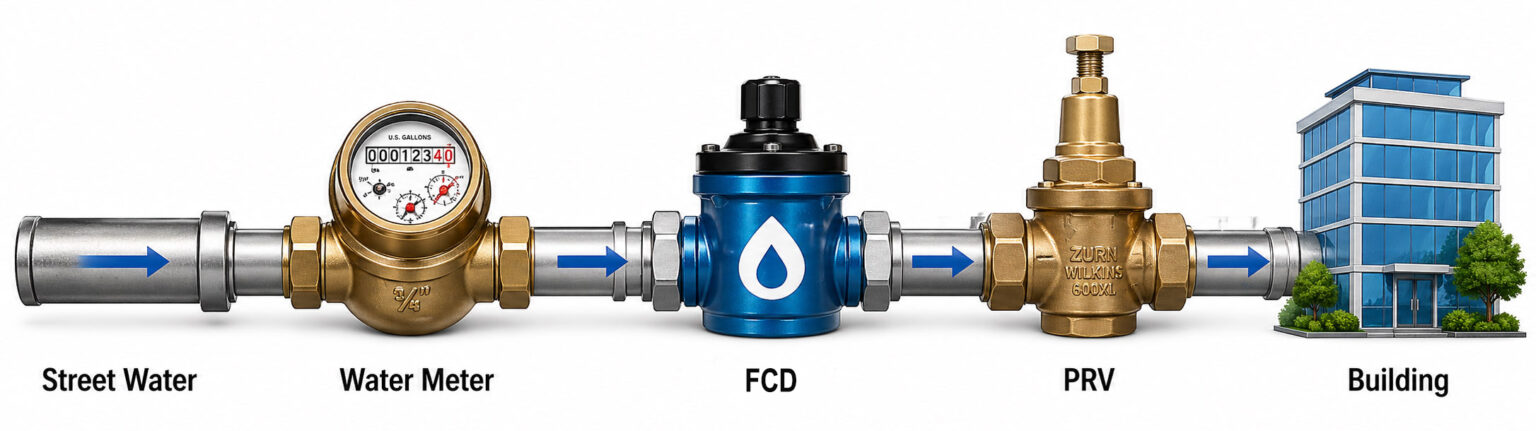
1The FCD works on the higher-pressure incoming water first.
2 It helps smooth and stabilize the water near the meter.
3That means it can better reduce turbulence and air/gas effects before the pressure is lowered.
4Then the PRV lowers the pressure for the building.
5Provides the greatest reduction in water cost without lowering water usage.
Result: Better overall performance because the FCD acts before the PRV changes the pressure.
Less Effective Setup
Lower regulated pressure
✓ Less effective setup showing street water flowing through the water meter, PRV, FCD, and then into the building with pipes and flow arrows
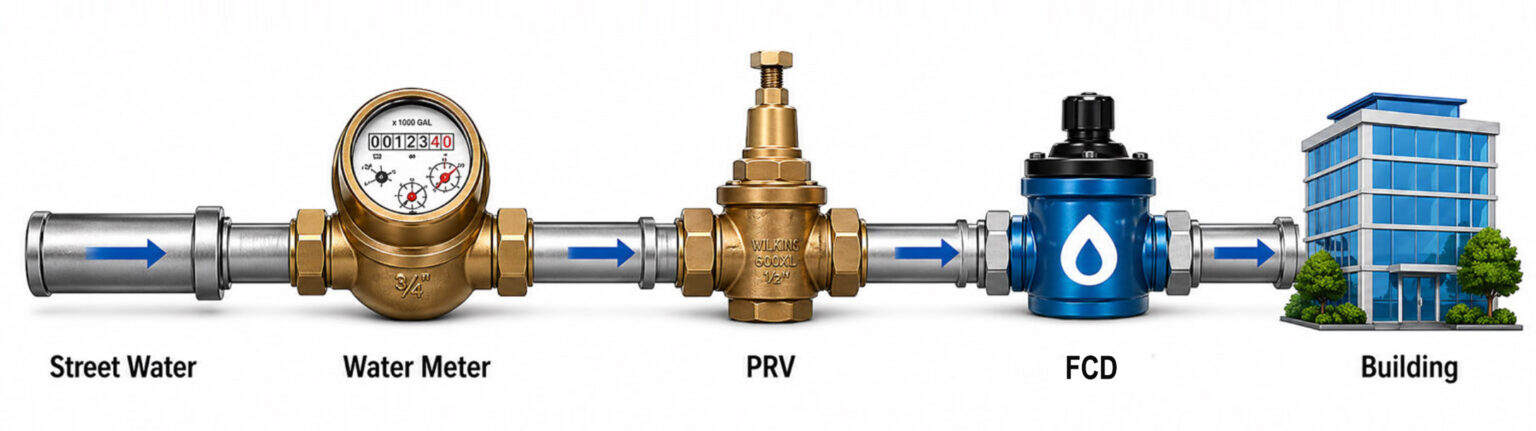
1The PRV lowers and controls the pressure first.
2After that, the FCD has less pressure to work with.
3It is also farther from the meter, where the main flow issues matter most.
4So the FCD usually has less effect in this position.
5Reduces water cost too, but usually not as much without lowering water usage.
Result: Usually weaker performance because the FCD is working after the PRV has already reduced the pressure.
The FCD is installed after the water meter and before the PRV for better water cost reduction performance
The 120 PSI vs. 80 PSI Example
When the incoming pressure is 120 psi before the PRV and 80 psi after the PRV, the FCD has a major pressure advantage when installed before the PRV.
Before PRV
120 psi
Higher incoming pressure available to the FCD.
After PRV
80 psi
Lower regulated pressure after the PRV has already done its job.
Pressure Advantage
50%
More pressure to work with when the FCD is installed before the PRV.
Important: A 50% pressure advantage does not automatically mean 50% more savings. Actual water-cost reduction depends on flow rate, water meter conditions, pipe size, turbulence, air/gas effects, water demand patterns, and the building’s plumbing setup.
What Greater Value Can a Buyer Expect?
In most real-world systems, installing the FCD before the PRV will almost always deliver noticeably better performance than installing it after the PRV.
| Scenario | Estimated Greater Value From Best Setup | In Plain Terms |
|---|---|---|
| Conservative case | 10% to 20% better | Definite savings because the FCD conditioned the water before pressure is reduced. |
| Normal range | 20% to 40% better | Common range when pressure, flow, and meter conditions support the installation. |
| Strong high-flow case | 40% to 60% better | Greater savings when there is high water demand, turbulence, air/gas effects, or meter-side disturbance. |
Cost Cutting Advantage: In a 120 psi before PRV / 80 psi after PRV system, the FCD has a 50% differential pressure advantage before the PRV. In many applications, that can translate into approximately 20% to 40% greater water-cost reduction performance compared with installing it after the PRV. Therefore it is of great value if possible to have the PRV relocated in order to receive deeper perpetual water cost reductions and shorter ROI.
Why This Matters to Building Owners
The goal is not to make the building use less water. The goal is to lower the water and sewer cost while maintaining normal water usage and pressure.
Better Meter-Side Conditions
Installing before the PRV allows the FCD to work closer to the water meter, where flow disturbance, turbulence, and air/gas effects matter most.
Higher Pressure Advantage
Before the PRV, the FCD can condition the stronger incoming pressure instead of the lower pressure already regulated by the PRV.
PRV Still Does Its Job
After the FCD conditions the incoming water, the PRV can still reduce and regulate pressure for the building plumbing system.
FCD to Prv Placement Frequently Asked Questions
Where should the Flow Conditioning Device (FCD) usually be installed?
The preferred location is usually after the water meter and before the PRV. This allows the FCD to condition the incoming water before pressure is reduced for the building.
Will installing before the pressure reducing valve (PRV) reduce water pressure inside the building?
The PRV still regulates the pressure for the building. The advantage of placing the FCD before the PRV is that it reduces more of your water cost when placed there. The PRV still continues to control downstream building pressure as normal.
Does a 50% pressure advantage mean 50% more savings?
No. The 50% differential figure refers to the pressure advantage in a 120 psi before PRV / 80 psi after PRV example. Actual cost reduction depends on site conditions, flow rate, pipe size, water meter behavior, and water-use patterns. Once a Site-Survey is completed, we can see the approximate savings.
Can the FCD still reduce my water cost after the PRV?
Yes. However, It normally reduces the water cost savings less when installed after the PRV. Why? Because the PRV has already lowered the pressure before the water reaches the FCD as revealed in the Best Setup section above.
Who should consider this setup?
Commercial, industrial, multifamily, hospitality, healthcare, campus, and high-water-use facilities should consider this setup when they want to lower water and sewer cost without lowering normal water usage. Even though any user can benefit, the greatest benefits occur when full-discharge (open-valve) situations occur. Such as CIP (clean in place), water sprinklers, high water usage, etc.).
Want to Know How Much You Can Cut
Your Water / Sewer Bill Cost?
Send us your facility information and current water bill details. Water Flow Innovations will review your setup and help determine whether the FCD may lower your water and sewer cost.