
Quick answer: Your sewer charge is almost never measured directly. Utilities estimate it from your water meter, so the only ways to lower it are to cut the metered water that genuinely goes down the drain, remove water that never reaches the sewer from the billed volume, or correct a reading or rate that is wrong. The fixed base charge does not move. Commercial and industrial accounts have the most levers: deduct meters, evaporation credits, rate classification, strength pretreatment, and correcting meter over-registration. Residential accounts work leaks, winter averaging, and credits.
Most advice on lowering a sewer bill stops at “use less water.” That only helps on the part of the bill tied to volume, and it ignores the larger structural moves that change the charge itself. Below are eleven methods that actually move the number, split into what works for a commercial or industrial account and what works for a home. For the structure these methods act on, see what a sewer charge is and how a sewer bill is calculated.
First, understand what you can and cannot change
A sewer bill is usually built from two parts: a fixed base or service charge set by meter size, and a volumetric charge tied to how much water you used. Because there is no meter on the pipe leaving your property, the utility estimates your discharge from the water that came in. The Metropolitan Sewer District of Greater Cincinnati states it plainly: sewer bills are “generally based on water meter size and the amount of water used by a property.”
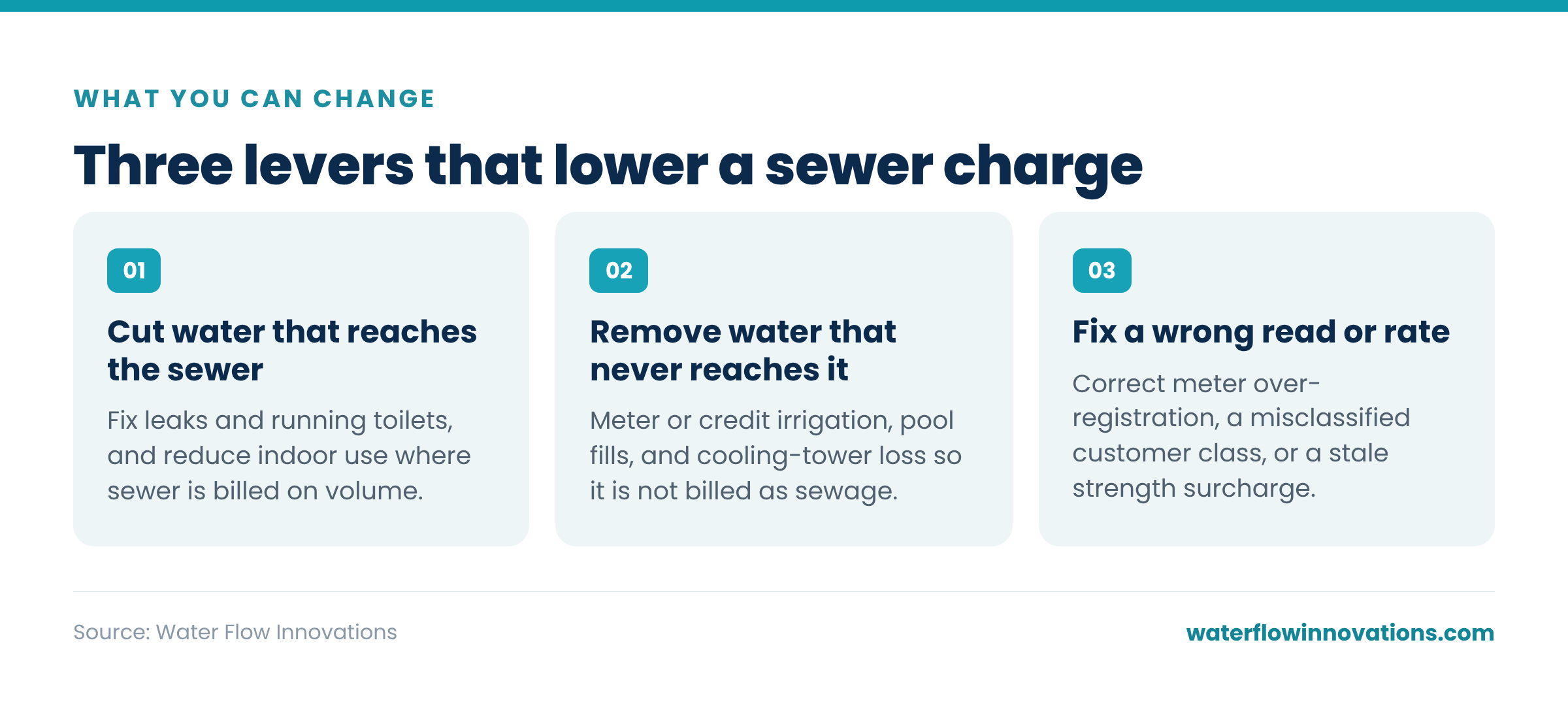
Two things follow. First, the fixed base charge does not respond to anything you do with water, so no method below touches it. Cincinnati’s MSD, for example, sets a 2026 base charge of $43.06 for a 5/8-inch meter before a single extra unit is billed, and a commodity rate of $6.277 per hundred cubic feet above the included amount. The base does not move no matter how little you use. Second, every method that works does one of three things: it lowers the metered water that really does reach the sewer, it carves out water that never reaches the sewer so it stops being billed, or it fixes a reading or rate classification that was wrong. Keep that frame in mind as you work down the list, and match the method to how your account is billed rather than reaching for conservation by reflex.
Commercial and industrial methods
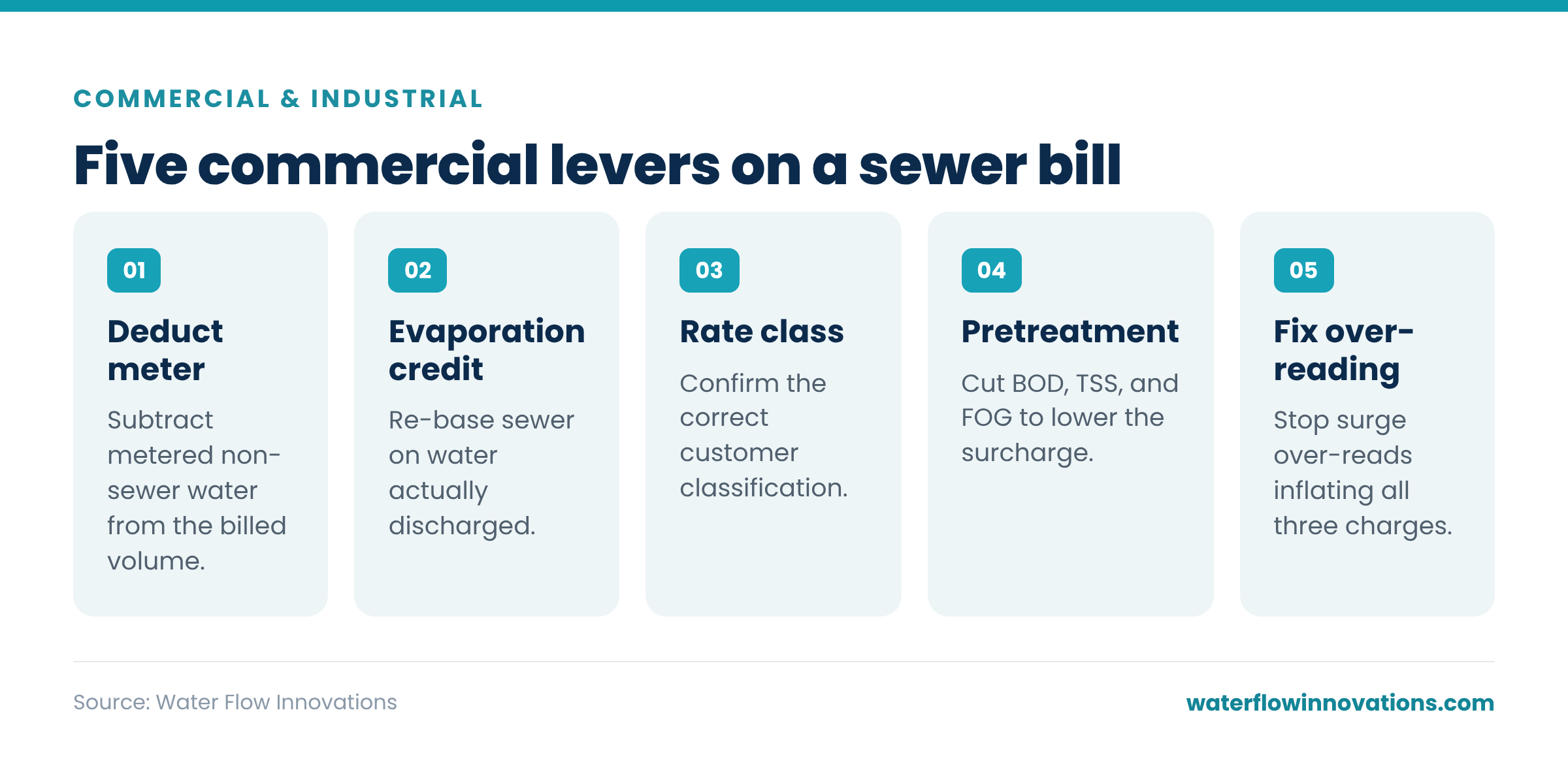
1. Install a deduct or irrigation meter
The single clearest commercial move is to meter water that never enters the sewer and have it subtracted from the billed volume. Johnson County Wastewater describes its program as “a voluntary program for commercial customers who install a deduct meter for water not entering the sanitary sewer.” Irrigation systems and cooling towers are common qualifying uses. Utilities set conditions: the deduct water must be continuously metered, often in gallons with a straight-reading register, protected by a backflow preventer, and meeting AWWA standards. Monthly readings and a photo are typically required, and credit is not granted retroactively. See deduct meters and, for landscape water specifically, a dedicated irrigation meter.
2. Claim a consumptive-use or evaporation credit
A facility with a cooling tower, boiler, or evaporative process loses a large share of its water to the air, not the drain, yet a standard account is billed sewer on all of it. A consumptive-use or evaporative-loss credit re-bases the sewer charge on water actually discharged. For a tower that runs hard through a long season, the evaporated share is the majority of make-up water, so the credit is an ongoing reduction. See the evaporation sewer credit.
3. Verify your rate classification
Commercial accounts are billed by customer class, and a misclassified account can pay the wrong rate for years. Confirm your account is in the correct class for your use, that any strength surcharge is based on current sampling rather than a stale default, and that one-time or standby charges on the bill actually apply to you. A reclassification request, backed by your own usage data, can lower the rate the whole bill multiplies by. Because most sewer rates are set locally rather than by the state, the classes and thresholds differ from one utility to the next, so the only reliable reference is your own utility’s tariff. Pull it, read the class definitions, and compare them to what your facility actually discharges. (Water Flow Innovations does not review rate classes or tariffs; your utility’s tariff is the reference.)
4. Pretreat to cut the strength surcharge
Restaurants, breweries, food processors, and many industrial accounts pay a high-strength surcharge on top of the volumetric charge when their wastewater carries more organic load or solids than ordinary sewage. Cincinnati’s MSD, for example, bills commercial and industrial customers a surcharge for high-strength discharge on top of base and commodity charges. Pretreatment lowers it: a properly sized grease interceptor cuts fats, oils, and grease, while screening, equalization, and dissolved-air flotation reduce the measured load. See the sewer strength surcharge.
5. Correct meter over-registration
Every charge above is computed on the volume your water meter records, so if that meter over-reads, the inflated figure flows into the water charge, the volumetric sewer charge, and any strength surcharge at once. During demand surges water speeds up through the meter, pressure inside it drops, dissolved gas comes out of solution and vapor forms, and the meter counts that volume as water. The meter is not faulty. It reports what physically passed through it, and because sewer is billed from the same reading, the over-recorded volume is billed twice. A Flow Conditioning Device installs immediately after the meter and creates a small, controlled back-pressure that extends back through the meter, holding pressure up during demand surges so far less gas and vapor form and are counted as water, with pressure loss under 0.8 psi. See water meter over-registration and how the FCD works.
Residential methods
These apply to homes and small residential-style accounts. Most come down to removing water that never belongs on the sewer line, or catching water that should never have run through the meter.
6. Fix running toilets and silent leaks
A running toilet or worn flapper can pass thousands of gallons a month, billed as both water and sewer. Dye-test toilets, check whether the meter moves with every fixture off, and repair before the next read.
7. Find out whether your utility uses winter averaging
Many utilities cap residential sewer at winter water use. San Antonio Water System averages water use “over three consecutive billing periods between mid-November and mid-March to calculate the monthly sewer charges for the year.” If yours averages, keep winter use low, since it sets the sewer charge for the rest of the year. See winter averaging.
8. Request a leak adjustment
Most utilities grant a one-time credit for a documented leak. Raleigh allows one adjustment per twelve months, adjusting only the water charge for an accessible leak like a toilet, and both water and wastewater for a non-accessible leak such as an underground line. Keep the plumber’s receipt.
9. Ask about a pool-fill credit
Pool fill water never reaches the sewer, so some utilities credit it. Raleigh adjusts wastewater back to the monthly average for a pool filled once between March and October.
10. Lower indoor water use where sewer is volumetric
If sewer is billed on metered volume with no winter cap, efficient fixtures and shorter cycles lower it directly. On a winter-averaged account, summer indoor savings won’t move the sewer line.
11. Separate or credit outdoor water
Irrigation, car washing and pond top-offs never enter the sewer. On a home, ask about an irrigation or pool credit; on a larger property, a second meter can make sense (see method 1).
Which method fits your account
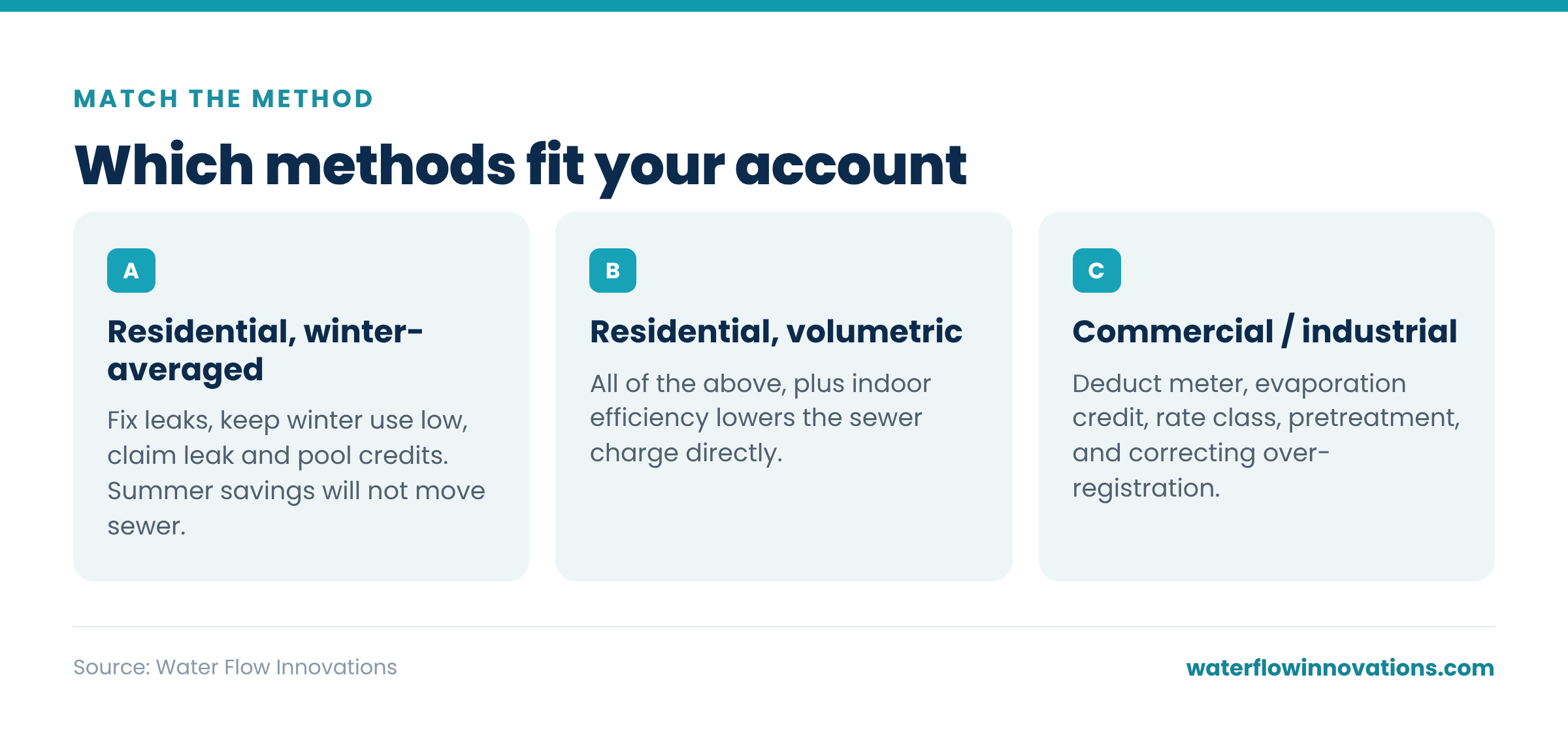
Match the method to how your sewer is billed. If you are commercial, start with the structural moves: meter the water that never reaches the sewer, claim the evaporation credit if you have a tower or process loss, confirm your rate class, pretreat to cut the surcharge, and check the meter that multiplies all of it. If you are residential and winter-averaged, the leak, winter-use, and pool or irrigation credits are your levers, and summer indoor savings are not. If you are residential and billed on metered volume year-round, indoor efficiency also helps. For a full commercial walk-through, see commercial water and sewer bill reduction, and for apartments and condos see the multifamily guide.
What to do next
Pull your last twelve months of bills and identify how your sewer line is calculated: base plus volumetric, winter-averaged, or flat. Then work the methods that match. For a commercial account, send us your bills and we’ll check whether meter over-registration is inflating every charge on them, the water, the sewer, and any surcharge.
Get a free sewer charge review or call 1-(844)-934-8258. Water Flow Innovations LLC, 2651 Route 412, Coopersburg, PA 18036.
Frequently asked questions
Can you actually lower a sewer bill, or is it fixed?
You can lower the volumetric portion, not the fixed base charge. Because sewer is estimated from your water meter, anything that cuts metered water reaching the sewer, removes water that never reaches it, or corrects a wrong read or rate lowers the charge. The base or service charge set by meter size does not change.
Does using less water lower my sewer bill?
Only where sewer is billed on metered volume. If your utility uses winter averaging, your sewer charge is set by winter water use, so cutting summer use lowers water but not sewer. Check how your account is billed before relying on conservation alone.
What is a deduct meter and who should use it?
A deduct meter measures water that never enters the sewer, such as irrigation or cooling-tower make-up, so the utility subtracts it from your billed sewer volume. It is a commercial method. Utilities require continuous metering, a backflow preventer, AWWA-standard meters, and regular reported readings.
Will a leak adjustment refund my sewer charge?
Often yes, but it depends on the leak. For an accessible leak like a toilet, many utilities adjust only the water charge. For a non-accessible leak such as an underground line, they adjust both water and wastewater. Most allow one adjustment per twelve months and require proof of repair.
Why would a commercial sewer bill be too high even after conservation?
Because the volume it is billed on can be wrong. During demand surges a water meter can over-register, and that inflated volume raises the water charge, the volumetric sewer charge, and any strength surcharge together. Correcting the over-registration fixes all three at once.
Sources
- Indiana Office of Utility Consumer Counselor, Understanding Sewer Rates: https://www.in.gov/oucc/watersewer/tips-and-publications/understanding-sewer-rates
- Metropolitan Sewer District of Greater Cincinnati, Your Sewer Bill: https://msdgc.org/customers/residential-customers/your-sewer-bill/
- San Antonio Water System, Winter Averaging: https://www.saws.org/service/winter-averaging/
- Johnson County Wastewater, Sewer Use Credit: https://jocogov.org/department/wastewater/commercial-customers/sewer-use-credit
- City of Raleigh, Request an Adjustment on Your Utility Bill: https://raleighnc.gov/leak-adjustment
0 Comments