
Laundry Gallons Per Pound: Is Your Water Meter Inflating It?
3–4
≤2
2X
<0.8 psi
Direct answer: Gallons per pound is the water a laundry buys divided by the pounds of linen it processes, and the water figure comes from the utility meter. Typical washer-extractors use about 3 to 4 gallons per pound; efficient tunnel washers use about 2 or less. Laundries put the meter through constant demand surges: large fill valves opening at full flow, several machines filling at once, and tunnel baths and reuse tanks refilling. During each surge, pressure inside the meter drops, dissolved gas comes out of solution and vapor forms, and the meter counts that volume as water. Efficient equipment lowers the water you use per pound. The Flow Conditioning Device (FCD) corrects what the meter counts, on both water and sewer.
The Benchmark Laundries Use
Commercial laundry efficiency is measured in gallons of water per pound of fabric, not per load or per cubic foot. It’s the number laundry managers, hotel and hospital engineers, and equipment suppliers use to compare machines and track performance.
- Typical washer-extractors: about 3 to 4 gallons per pound.
- Washer-extractors with rinse-water reuse: under about 2.5 gallons per pound.
- Efficient tunnel washers: about 2 gallons per pound or less, and some laundries reach below 1.5.
EPA’s WaterSense at Work guidance estimates a laundry’s water use the same way: gallons per pound, times pounds per load, times loads per year. Because sewer is usually calculated from the same metered water, every gallon per pound also shows up on the sewer line.
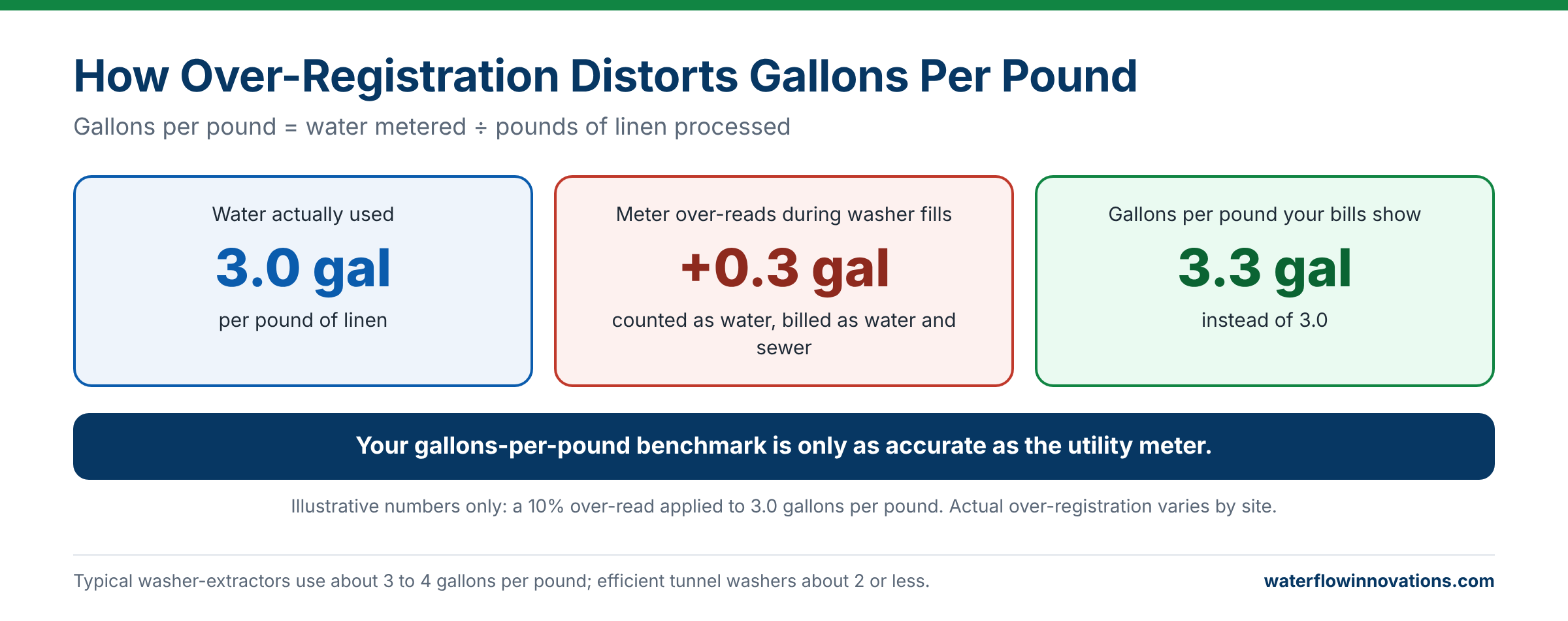
Why Laundries Make Meters Over-Read
Laundry water use comes in bursts. Washer-extractors fill through large valves at full flow, several machines often fill at the same moment, tunnel washers refill baths, and reuse and hot-water tanks top up on demand. Each fill is a sharp demand surge through the utility meter.
During a surge, water speeds up through the meter and pressure inside it drops. Dissolved gas comes out of solution and vapor forms, and the meter counts that volume as water. This is water meter over-registration. The meter isn’t broken; it’s counting what passes through it, including volume that was never water. Laundries that run many machines on tight cycles see the most surges per day.
Real Use or Over-Registration? How to Tell
- Compare with machine specs. Your washers’ programmed fill volumes, times loads run, give an expected total. A utility meter that consistently runs well above it deserves a look.
- Track gallons per pound monthly. Divide metered gallons by pounds processed. The Gallons Per Unit tracker works with pounds as the unit.
- Rule out leaks and stuck valves. Run an overnight meter test with the laundry shut down, and check that fill and reuse valves close fully.
- Watch your busiest days. If gallons per pound climbs on heavy-production days without a change in programs, surge-driven over-registration is a likely cause.
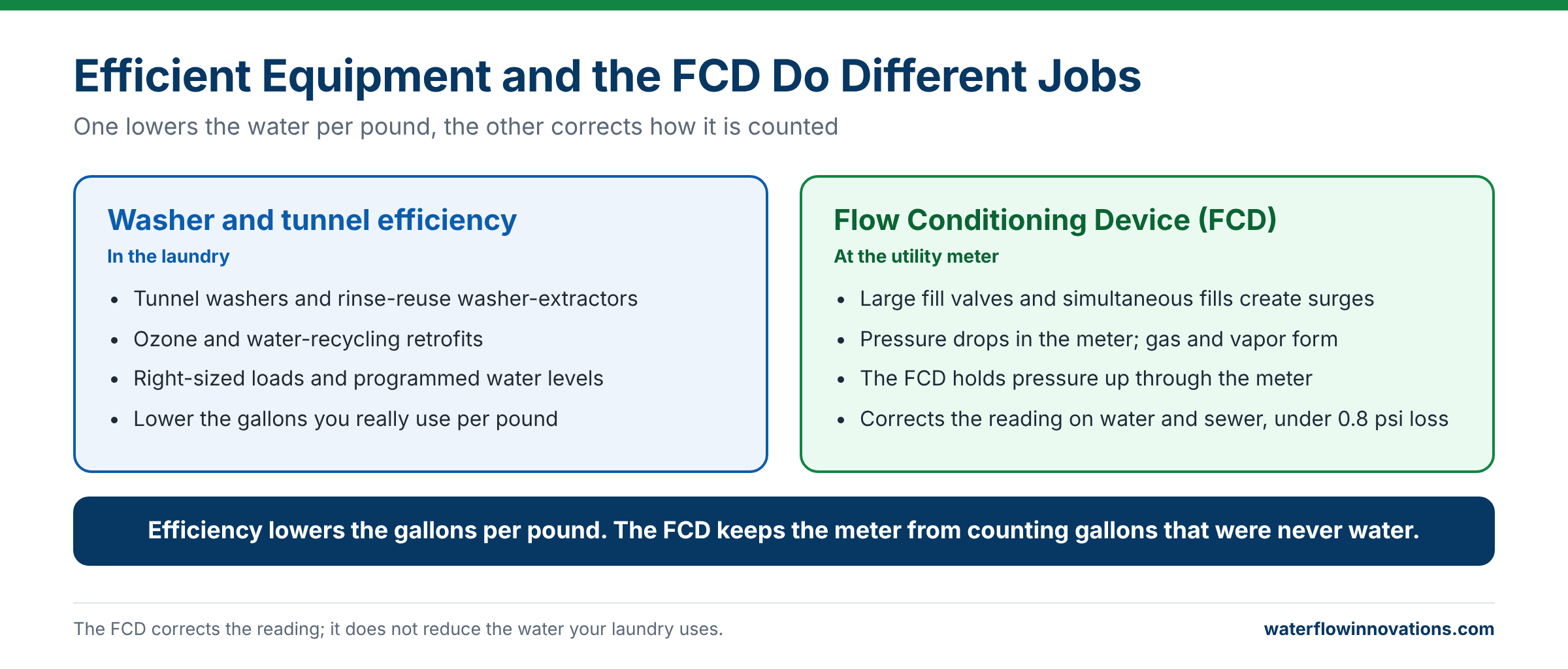
Efficiency and Accuracy Work Together
Use less water per pound. Tunnel washers, rinse-water reuse, ozone systems and programmed water levels lower what each pound really takes.
Count the water correctly. The Flow Conditioning Device (FCD) installs immediately after the utility meter and creates a small, controlled back-pressure that extends back through the meter, holding pressure up during demand surges so far less gas and vapor form and are counted as water. Pressure loss is under 0.8 psi, and nothing downstream changes: fill times, water levels and wash chemistry stay the same. It corrects what the meter records; it doesn’t reduce the water your laundry uses. Documented installations typically show up to a 30% reduction in combined water and sewer costs (46% highest documented, a rare case); results vary by site.
For the physics, see Back Pressure on Meters. Running an on-premises laundry in a hotel or hospital? See also Hotels and Healthcare.
Part of our laundry coverage. For the industry overview, see Laundromats.
Sources and Standards
- U.S. EPA, WaterSense at Work, Laundry Equipment (gallons per pound of fabric; washer-extractors with rinse reuse under 2.5 gal/lb; tunnel washers about 2 gal/lb or less).
- Pollution Prevention Information Clearinghouse, commercial laundry water efficiency (typical washer-extractors 3 to 4 gal/lb; 2 gal/lb considered good; some laundries below 1.5).
- American Petroleum Institute, Manual of Petroleum Measurement Standards, Chapter 5.3 (minimum back pressure after liquid meters).
Standards and manufacturer guidance describe industrial practice. Water Flow Innovations applies the same principles to commercial water service; results vary by building.