
Home » Essential Guides »
Essential guides · Flow conditioning
Anti-Cavitation Devices: How Oil, Gas, Power and Naval Systems Control Pressure Drops
Wherever a liquid takes a sharp pressure drop, it can partly boil and then violently collapse. Industries from oil and gas to submarines have spent decades controlling it. The same physics shows up, on a smaller scale, inside commercial water meters.
Decades
Of anti-cavitation engineering in industry
Staged
How big pressure drops are split up
4
Results: noise, vibration, erosion, mismeasurement
<0.8 psi
FCD pressure loss across all flow conditions
Direct answer: Anti-cavitation devices keep a liquid from partly turning to vapor where its pressure drops. In control valves, multi-stage trims split one large pressure drop into several smaller ones, and downstream restrictors back up the outlet pressure. Oil and gas, power, nuclear and naval systems rely on them to prevent noise, vibration and erosion. The Flow Conditioning Device (FCD) isn’t a control valve, but it applies the related principle at the water meter: it holds pressure up through the meter during demand surges.
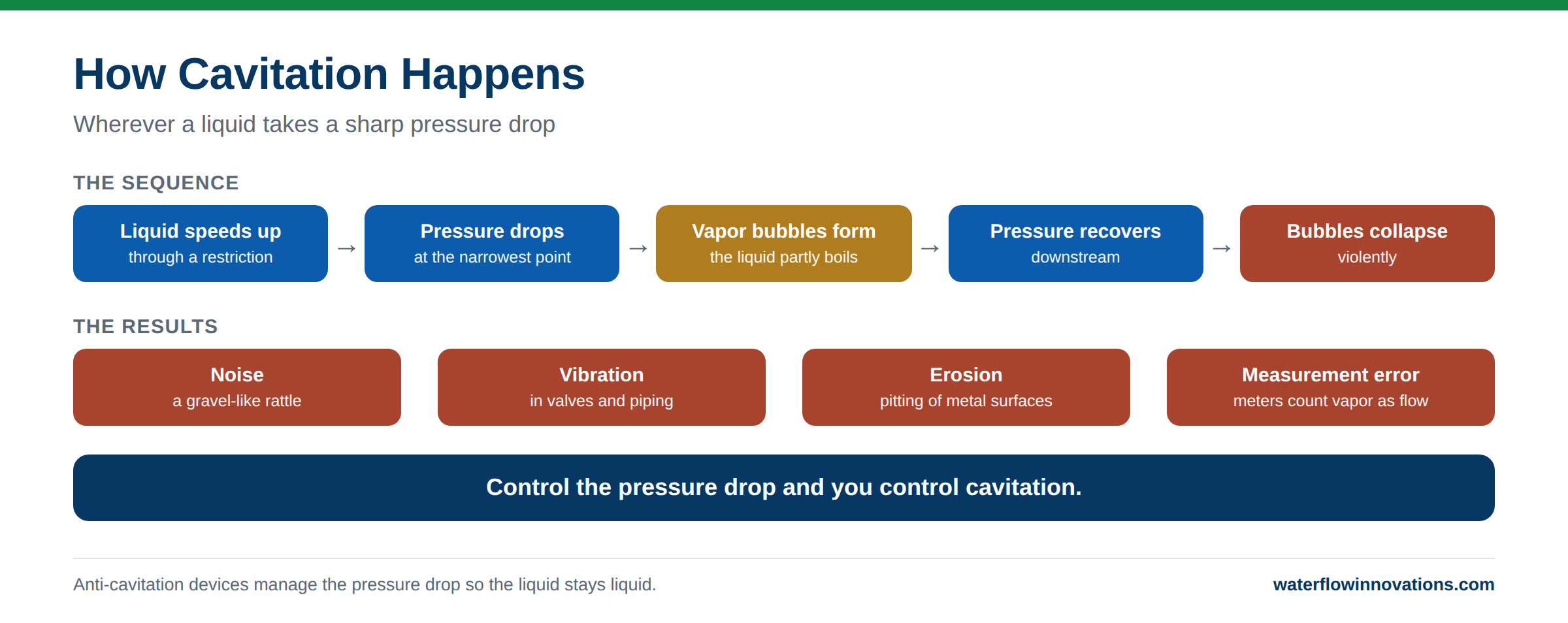
Control the pressure drop and you control cavitation.
What Cavitation Is
When a liquid squeezes through a restriction, such as a partly open valve, an orifice or the measuring element of a meter, it speeds up and its pressure drops. If the pressure drops far enough, small vapor bubbles form in the liquid. Moments later, as the liquid slows and pressure recovers, the bubbles collapse. Each collapse is tiny, but there are millions of them, and they hit nearby metal surfaces hard.
The result is a familiar list: a gravel-like rattle, vibration in valves and piping, pitting and erosion of metal, and, in meters, volume that gets counted as flow even though it isn’t liquid.
How Industries Prevent It
- Multi-stage valve trims. Instead of one big pressure drop across a valve seat, the flow passes through a cage, a stack of drilled disks or a labyrinth that takes the drop in several smaller steps. No single step drops the pressure far enough for vapor to form.
- Downstream restrictors and back-pressure valves. A restriction after a valve or meter backs up the outlet pressure, keeping the low-pressure point inside the device higher.
- Hardened materials. Hard-faced trims resist the damage, but they don’t stop the cavitation itself.
- System design. Placing valves where pressure is higher, and sizing pumps and valves so they don’t run in cavitating conditions.
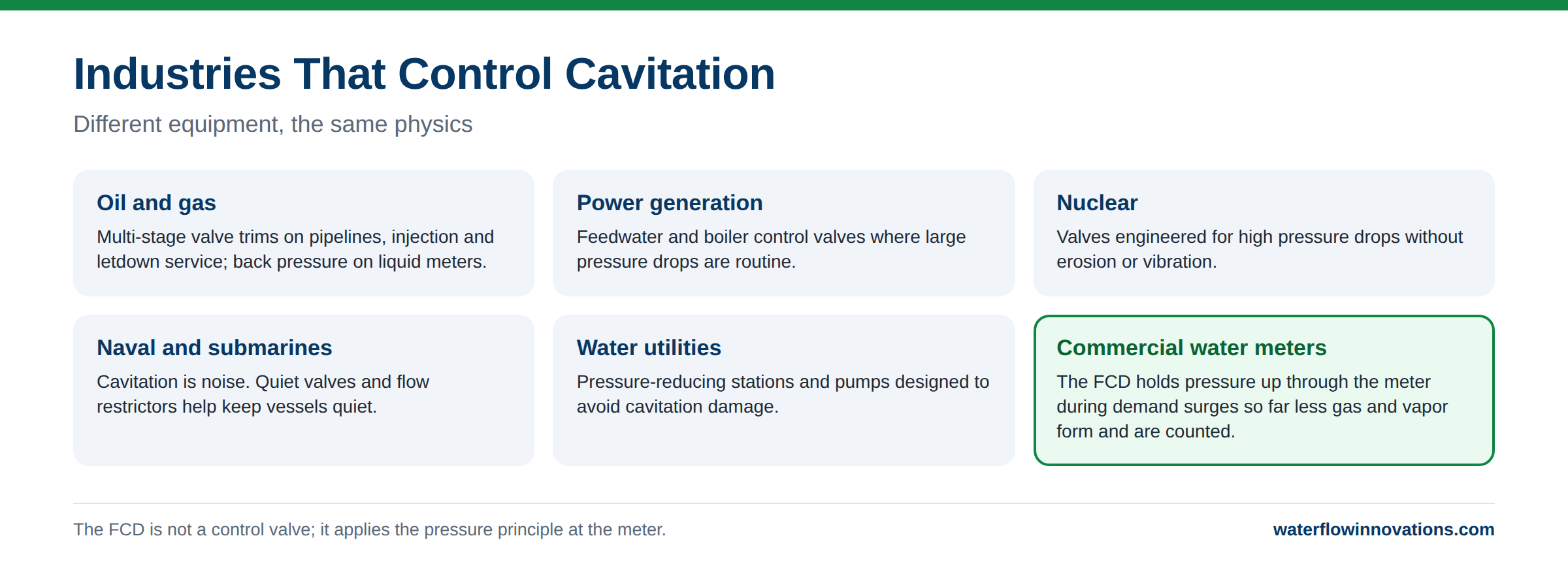
Where You’ll Find Anti-Cavitation Engineering
- Oil and gas: pipeline control, injection and letdown service, and back pressure on liquid meters. See Back Pressure on Meters.
- Power generation: feedwater and boiler control valves, where large pressure drops are routine.
- Nuclear: valves engineered to take high pressure drops without erosion or vibration.
- Naval and submarines: cavitation is noise, and noise gives a vessel away, so quiet valves and flow restrictors are part of the design.
- Water utilities: pressure-reducing stations and pumps designed to avoid cavitation damage.
What This Has to Do With Water Meters
A commercial water meter isn’t a control valve, and it doesn’t take the large pressure drops that power plant valves do. But the same physics applies on a smaller scale. During demand surges, flow through the meter jumps and pressure inside it drops. Dissolved gas comes out of solution and vapor forms, and the meter counts that volume as water. This is water meter over-registration.
The Flow Conditioning Device (FCD) applies the pressure principle at the meter. The FCD installs immediately after the meter and creates a small, controlled back-pressure that extends back through the meter, holding pressure up during demand surges so far less gas and vapor form and are counted as water. Pressure loss is under 0.8 psi, and nothing downstream changes. It corrects the reading; it doesn’t reduce the water you use.
It isn’t an anti-cavitation valve and doesn’t stage large pressure drops; it holds pressure up through the meter so it counts water, not gas and vapor.
Sources and Standards
- ISA-RP75.23, Considerations for Evaluating Control Valve Cavitation.
- Control valve manufacturer literature on multi-stage anti-cavitation trims (cages, stacked disks, labyrinth paths) for oil and gas, power and nuclear service.
- U.S. patent literature on anti-cavitation valve trims and multi-stage flow restrictors, including restrictors incorporated into submarine valves.
- American Petroleum Institute, Manual of Petroleum Measurement Standards, Chapter 5.3 (minimum back pressure on liquid meters to prevent cavitation).
Standards and manufacturer guidance describe industrial practice. Water Flow Innovations applies the same principles to commercial water service; results vary by building.
Common Questions
What is cavitation?
What is an anti-cavitation device?
Which industries use anti-cavitation devices?
How does a multi-stage valve trim prevent cavitation?
Is the FCD an anti-cavitation valve?
Does cavitation affect water meter readings?
Flow Conditioning Across Industries: the series
Find Out What Your Meter Is Counting
Send twelve months of water and sewer bills plus your meter make, model and size. We’ll tell you whether your meter is over-registering and what it’s costing you.