
Home » Essential Guides »
Not to Be Confused With: Water Conditioners, PRVs, Backflow Preventers and Air Release Valves
9
1
After
<0.8 psi
Direct answer: A flow conditioner and a water conditioner are different things. A water conditioner or softener changes the water’s chemistry, such as hardness and scale. A flow conditioner works on how water moves through a pipe or meter. The Flow Conditioning Device (FCD) is a specific kind: it installs immediately after the water meter and holds pressure up through it during demand surges, so the meter counts water instead of gas and vapor. PRVs, backflow preventers, air release valves, water hammer arrestors and aerators each do a different job, and none of them corrects meter over-registration.
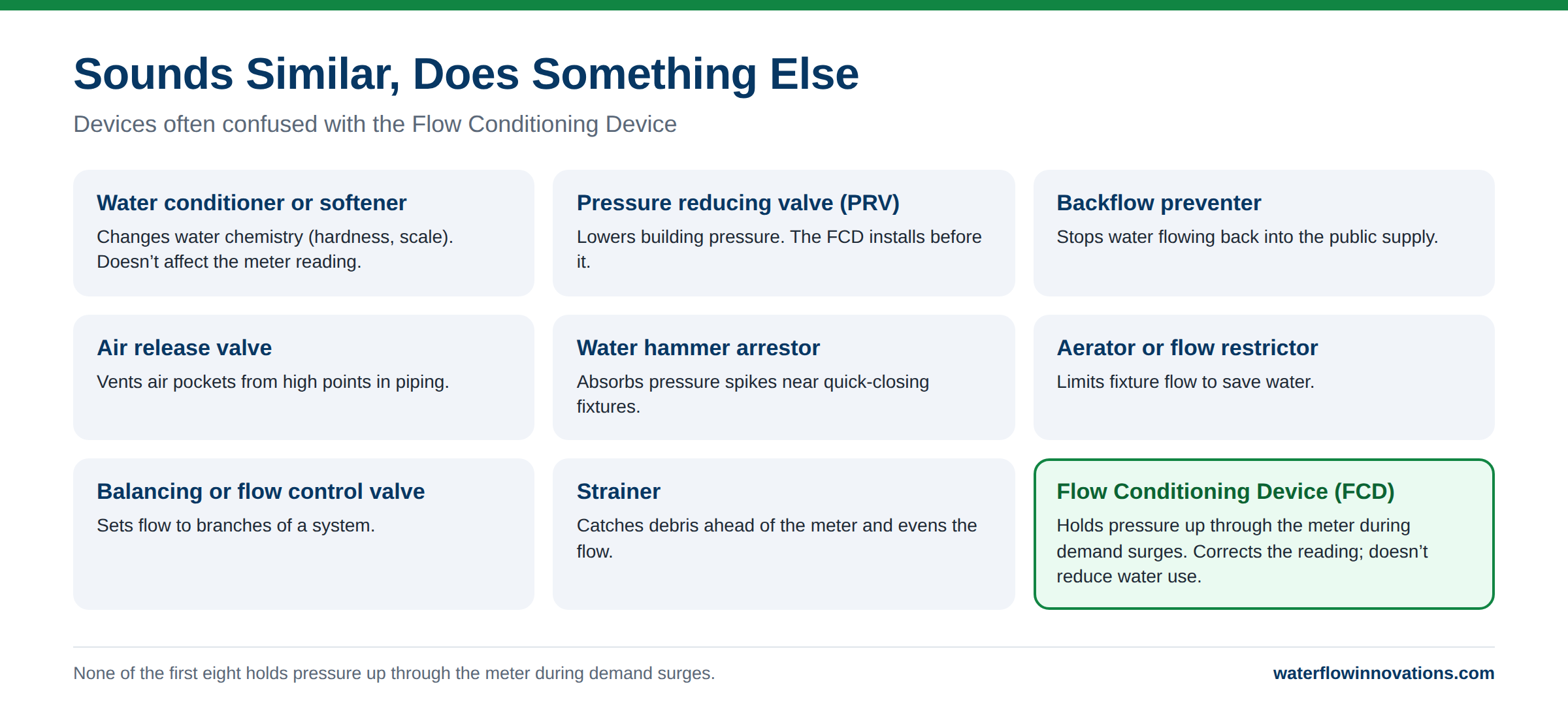
Side by Side
| Device | What it does | Where it’s installed | Why it isn’t an FCD |
|---|---|---|---|
| Water conditioner or softener | Changes water chemistry: hardness, scale, sometimes taste | Inside the building, after the meter set | Treats the water; doesn’t affect what the meter records |
| Pressure reducing valve (PRV) | Lowers and steadies building pressure | After the meter (and after the FCD) | Lowers pressure downstream; the FCD holds it up through the meter |
| Backflow preventer | Stops water from flowing back into the public supply | After the meter | A safety device; doesn’t change the reading |
| Air release valve | Vents air pockets that collect at high points | High points in piping | Over-registration isn’t caused by air pockets waiting to be vented |
| Water hammer arrestor | Absorbs pressure spikes from quick-closing valves | Near fixtures and solenoid valves | Works at the fixtures, not at the meter |
| Aerator or flow restrictor | Limits flow at a fixture to save water | At faucets and showerheads | Reduces water use; the FCD doesn’t |
| Balancing or flow control valve | Sets the flow to branches of a system | Heating and cooling loops, branches | Divides flow inside the building |
| Strainer | Catches debris and evens the flow entering the meter | Immediately before the meter | Shapes the incoming flow; doesn’t hold pressure up through the meter |
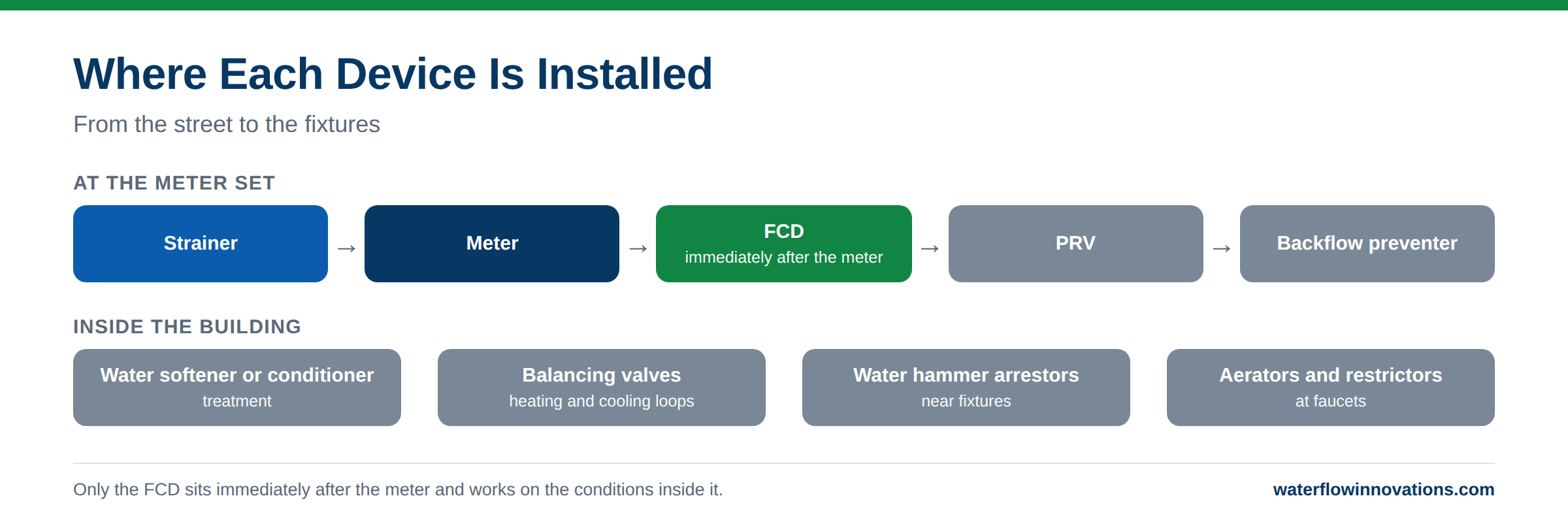
| Flow Conditioning Device (FCD) | Holds pressure up through the meter during demand surges so far less gas and vapor form and are counted | Immediately after the meter, before the PRV and backflow preventer | — |
The Two Mix-Ups We Hear Most
“We already have a water conditioner.” A water conditioner or softener treats the water inside the building. It has no effect on how the utility meter registers volume during demand surges.
“Isn’t this just about air in the lines?” Air pockets at high points are real, and air release valves handle them. Meter over-registration is different: during demand surges, pressure inside the meter drops, dissolved gas comes out of solution and vapor forms, and the meter counts that volume as water. See water meter over-registration.
What the FCD Does, in One Paragraph
The FCD installs immediately after the meter and creates a small, controlled back-pressure that extends back through the meter, holding pressure up during demand surges so far less gas and vapor form and are counted as water. Pressure loss is under 0.8 psi, and nothing downstream changes. It corrects the reading; it doesn’t reduce the water you use. Documented installations typically show up to a 30% reduction in combined water and sewer costs (46% highest documented, a rare case).
Related: Water Meter Strainers and After-Meter Valves Explained.
Sources and Standards
- Manufacturer and code references for each device type: pressure reducing valves, backflow prevention assemblies, air release valves, water hammer arrestors and fixture aerators.
- NSF/ANSI 61, Drinking Water System Components – Health Effects.
Standards and manufacturer guidance describe industrial practice. Water Flow Innovations applies the same principles to commercial water service; results vary by building.