
Quick Answer
A sewer charge is what your utility bills to carry wastewater away and treat it. On almost every commercial account it is calculated from your water meter, not from anything measured at the drain. It has three parts: a fixed charge set by your meter or service size, a volumetric charge for the water assumed to return to the sewer, and often a strength surcharge when your discharge is high in organic load or suspended solids. Because it is metered off the water going in, two things follow that catch facilities out. A commercial account usually gets no winter averaging and no return-to-sewer allowance, the way a residential account does, so you are billed for close to every gallon the meter records. And any error in that meter reading is billed twice, once as water and again as sewer. On many commercial tariffs the sewer side is the larger of the two.
What a Sewer Charge Actually Pays For
The sewer charge, sometimes called a wastewater or sewer service charge, covers the collection system that carries used water away from your building and the treatment plant that cleans it before discharge. It is a separate service from potable water, often billed on the same statement, and on a commercial account it is frequently the larger line of the two.
The reason it feels invisible is that nothing at your building measures it. There is no meter on the drain. The utility assumes that the water it delivered is the water you sent back, and it bills the sewer charge from the reading on your water meter. That single assumption, that water in equals water out, is the key to understanding both how the charge is built and where it goes wrong.
It is also worth knowing that water and sewer are often run by two different bodies. In many systems a water utility delivers the water while a separate wastewater or sanitary authority treats what comes back, and the two simply share the meter reading. That split is one reason the sewer charge is easy to overlook and hard to question: the organization billing it never measured the flow it is billing you for.
How a Commercial Sewer Charge Is Calculated
Three components stack up. Two are calculated from the water meter reading; the third is set by the size of the meter itself.
1. THE FIXED CHARGE
A base charge set by your meter size or service size. You pay it every cycle regardless of how much water you use, including a cycle with zero flow. It scales steeply with service size, which is why an oversized service quietly costs money on both the water and the sewer side.
2. THE VOLUMETRIC CHARGE
The volume part is your metered water multiplied by a return-to-sewer factor, the share the utility assumes reaches the sewer. The City of Chula Vista, for example, applies a 90 percent factor to commercial accounts and bills sewer from the water meter readings directly. Many utilities use 100 percent for commercial and industrial accounts, meaning every gallon metered is billed as sewage.
3. THE STRENGTH SURCHARGE
If your discharge is stronger than ordinary wastewater, you pay extra. Dallas Water Utilities, for instance, surcharges commercial and industrial establishments that routinely discharge biochemical oxygen demand (BOD) or total suspended solids (TSS) above 250 mg/L, with the rate applied to water consumption or metered wastewater volume. Restaurants, food and beverage plants, laundries and metal finishers commonly sit above that line.
Stacked together, the three parts compound. Take a facility that meters 800,000 gallons in a cycle. The fixed charge lands before a single gallon moves. The volumetric charge applies the sewer rate to all 800,000 gallons at a full return factor. And if the discharge carries a strength surcharge, a third charge applies to the load tied to that same volume. The volumetric charge and any strength surcharge are both anchored to the water meter reading, so the reading is not one input among several. It is the number most of the sewer bill is built on.
Why Commercial Gets No Winter Average and No Allowance
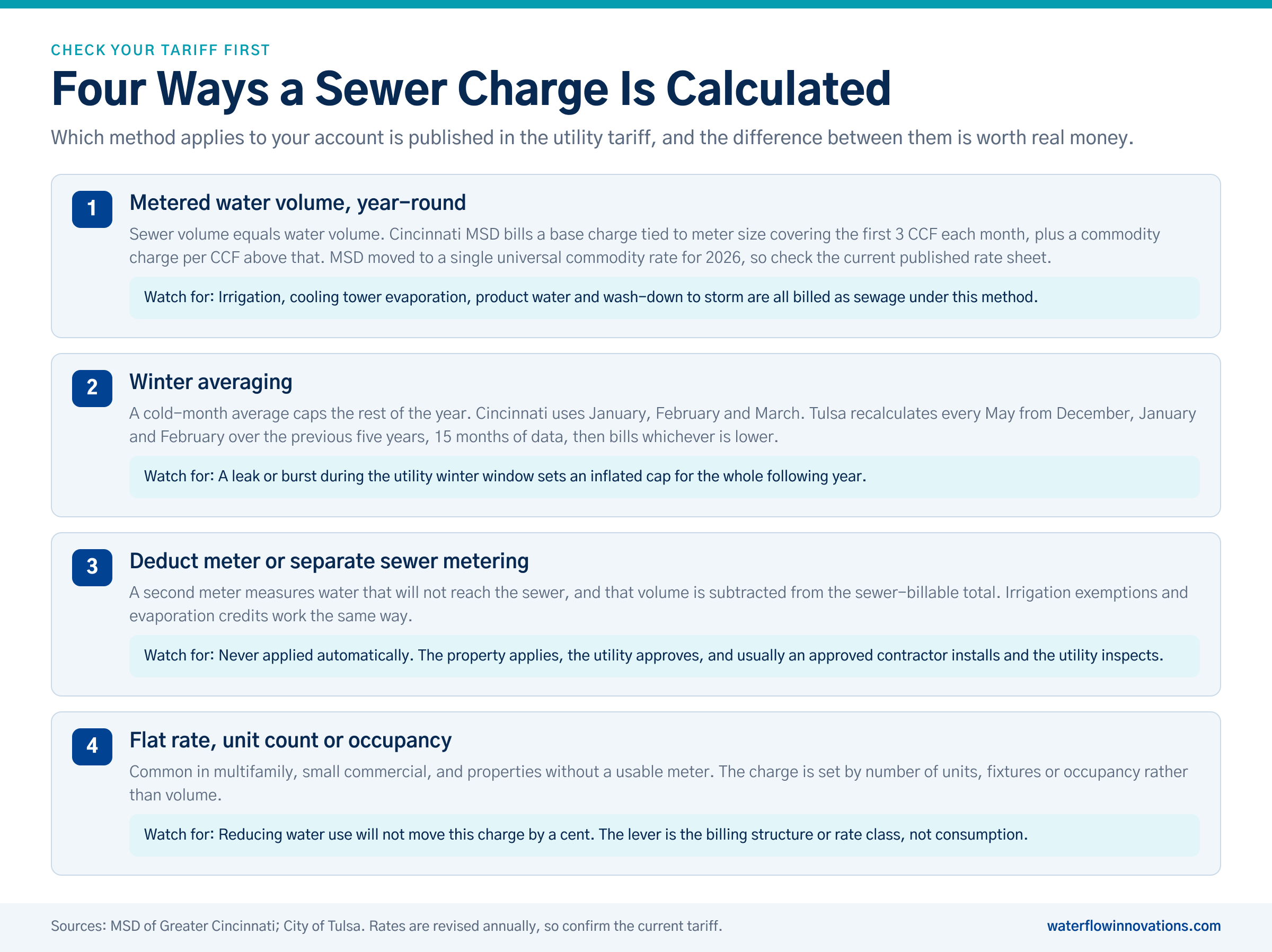
This is where a commercial account differs from a residential one, and it works against you. On residential accounts, utilities know that summer water goes to irrigation and never reaches the sewer, so they protect the customer with winter averaging: they take the lowest water reading from the winter months, when almost all water goes down the drain, and cap the sewer charge at that level for the whole year.
The City of Fulshear, Texas, states it plainly: winter averaging is for residential customers only. Chula Vista averages residential water from November through April and takes the lowest reading. A commercial account gets neither. It is billed on actual metered water every cycle, in every season, at or near a 100 percent return factor.
The consequence is simple and expensive. On a commercial account there is no cushion. Whatever the meter reads, you pay sewer on nearly all of it, summer and winter alike. That is why the two levers that matter on a commercial sewer bill are the volume that genuinely never reaches the sewer, which you can subtract, and the volume the meter is reading wrong, which you can correct.
The Double Hit: One Reading, Two Charges
Because the sewer charge is calculated from the water meter, the water meter reading drives both halves of the bill. Every gallon the meter records is charged once on the water line and again on the sewer line, and if your discharge carries a strength surcharge, a third time on the pounds of load tied to that volume.
That is manageable when the reading is accurate. It becomes costly when the reading is high. Over-registration at the meter, gas and vapor that form during high-demand periods and get counted as water, does not just inflate the water charge. It passes straight through to the sewer charge at the same volume, and through any volume-based surcharge on top. A two percent meter error on a facility that meters a million gallons a month is twenty thousand gallons, billed as both water and sewage, every month. At a combined water and sewer rate of twelve dollars per thousand gallons, that is about two hundred and forty dollars a month, or roughly twenty-nine hundred dollars a year, on volume that never existed.
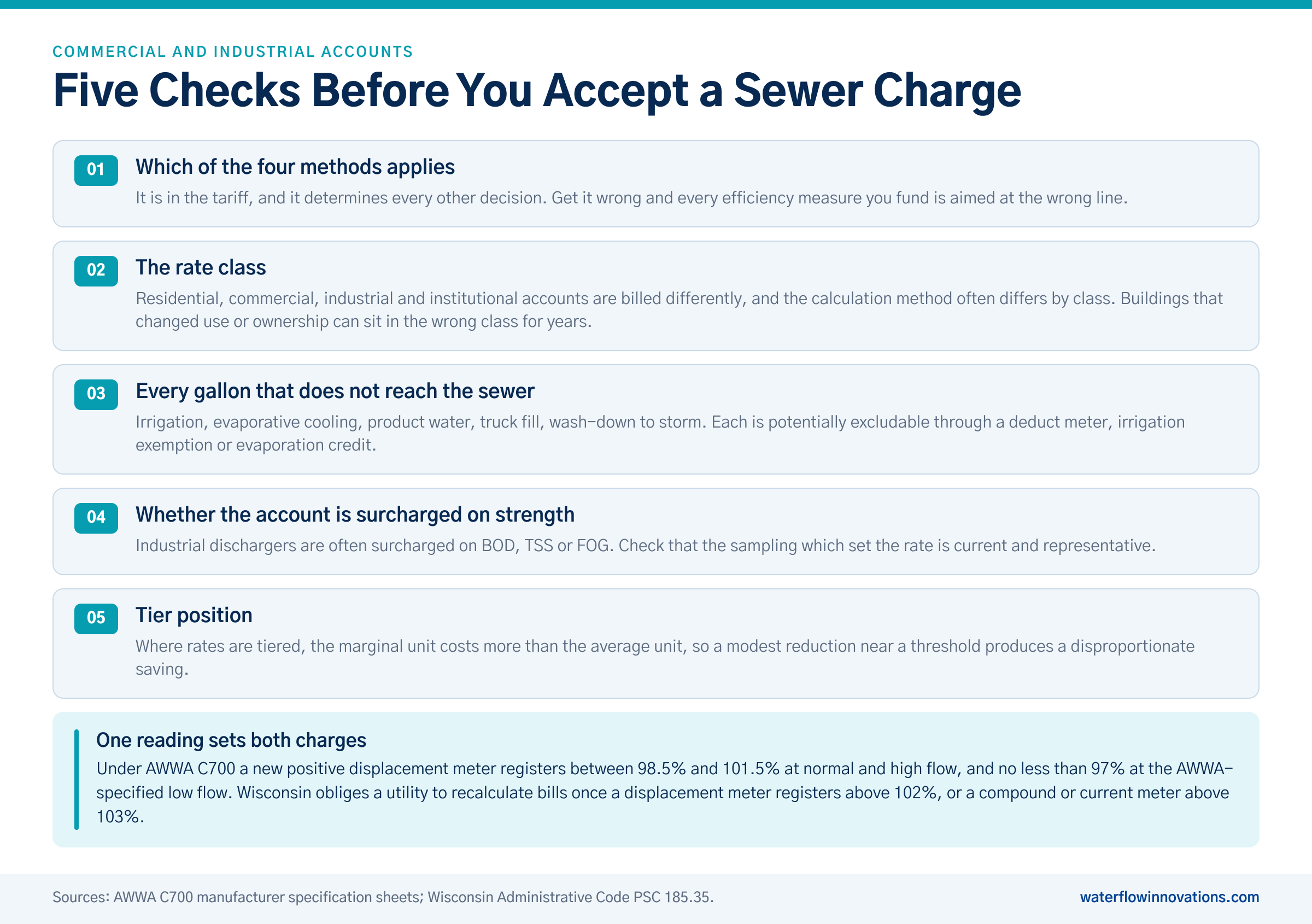
This is the mechanical reason the sewer side is so often the bigger half, and why the sewer double impact is the single most useful idea on a commercial water bill. Fix the reading and both charges fall together.
What You Can Subtract and What You Can Correct
Two levers, in order.
- Subtract what never reaches the sewer. Water that leaves the site by a non-sewer route, irrigation, evaporation, cooling tower blowdown, product that ships out as liquid, can be excluded from the sewer charge with a deduct meter. The credit is never applied automatically; the property has to meter it and claim it. See Deduct Meters for how that works.
- Correct what the meter is reading wrong. If the volume the whole calculation starts from is inflated by over-registration, every downstream charge is inflated with it. Correcting the reading at the meter lowers the water charge, the sewer charge and any volume-based surcharge at once. See Water Meter Over-Registration.
Both start from the same place: reconcile the bill to the tariff, confirm the service size and rate class, then check whether the volume the meter reports is the volume you actually used. A commercial bill review does exactly that.
The order matters because the two levers are not equal in reach. A deduct meter only removes the specific volume you can prove leaves by a non-sewer route, and nothing more. Correcting over-registration reaches further, because it lowers the number that every part of the bill is calculated from: the water charge, the volumetric sewer charge, and any strength surcharge tied to that volume all fall at once. On a commercial account with no winter average and no allowance to soften the reading, the accuracy of that one number is worth more than almost anything else on the statement.
Frequently Asked Questions
How is a commercial sewer charge calculated?
From your water meter, not from the drain. It is a fixed charge by service size, plus a volumetric charge equal to metered water times a return-to-sewer factor, plus a strength surcharge if your discharge is high in BOD or suspended solids.
Why is my sewer charge higher than my water charge?
On many commercial tariffs the sewer volumetric rate is higher than the water rate, and commercial accounts are billed at or near a 100 percent return factor with no winter averaging. So the sewer side is often the larger of the two.
Do commercial accounts get winter averaging?
Usually not. Winter averaging is typically a residential protection. Fulshear, Texas, limits it to residential customers; commercial accounts are billed on actual metered water year-round.
What is a strength surcharge?
An extra sewer charge for discharge that is stronger than ordinary wastewater. Dallas Water Utilities surcharges BOD and TSS routinely above 250 mg/L. Restaurants, food and beverage plants and metal finishers commonly exceed it.
Can I reduce the sewer charge without using less water?
Yes, two ways. Subtract water that never reaches the sewer with a deduct meter, and correct any over-registration at the meter so the volume the whole bill is built on is accurate. Neither changes how much water you use.
Does fixing my water meter lower my sewer bill too?
If the meter is over-registering, yes. Because the sewer charge is calculated from the water reading, correcting the reading lowers the water charge and the sewer charge together, plus any volume-based surcharge.
What is the return-to-sewer factor?
The share of your metered water the utility assumes reaches the sewer. Residential factors are often below 100 percent to account for irrigation; commercial accounts are frequently billed at or near 100 percent.
Find Out What Your Sewer Charge Is Really Built On
Water Flow Innovations reviews water and sewer billing and meter data for commercial, industrial and multifamily facilities. Send twelve months of bills plus your meter make, model and size, and we will show you how your sewer charge is calculated, what you can exclude, and whether the volume the whole calculation starts from is being measured correctly.
Water Flow Innovations LLC, 2651 Route 412, Coopersburg, PA 18036. Call 1-844-934-8258.
Sources
City of Chula Vista, Sewer Billing (metered-water basis and 90% commercial return factor). City of Fulshear TX, Winter Water Averaging (residential-only scope). Dallas Water Utilities, Pretreatment Surcharge Program (BOD and TSS above 250 mg/L). Water Flow Innovations, How Is a Commercial Sewer Bill Calculated and Sewer Double Impact Billing.
0 Comments