
Quick Answer
On most commercial accounts, every gallon your water meter records is billed as sewage. The utility meters the water going in and assumes it all comes back out, and most commercial and industrial tariffs carry no return-to-sewer allowance to soften that assumption. A deduct meter is the mechanism that breaks it. It is a second meter, installed at your cost on the line carrying water that genuinely never enters the sewer, and its reading is subtracted from your billable sewer volume. Johnson County Wastewater states the requirement plainly for commercial and industrial customers: “in order to receive credit for water not entering the sanitary sewer, JCW requires that this water be continuously metered.” The credit exists on most tariffs. It is never applied for you. The property applies, pays for the install, and reads the meter every month.
What Is a Deduct Meter?
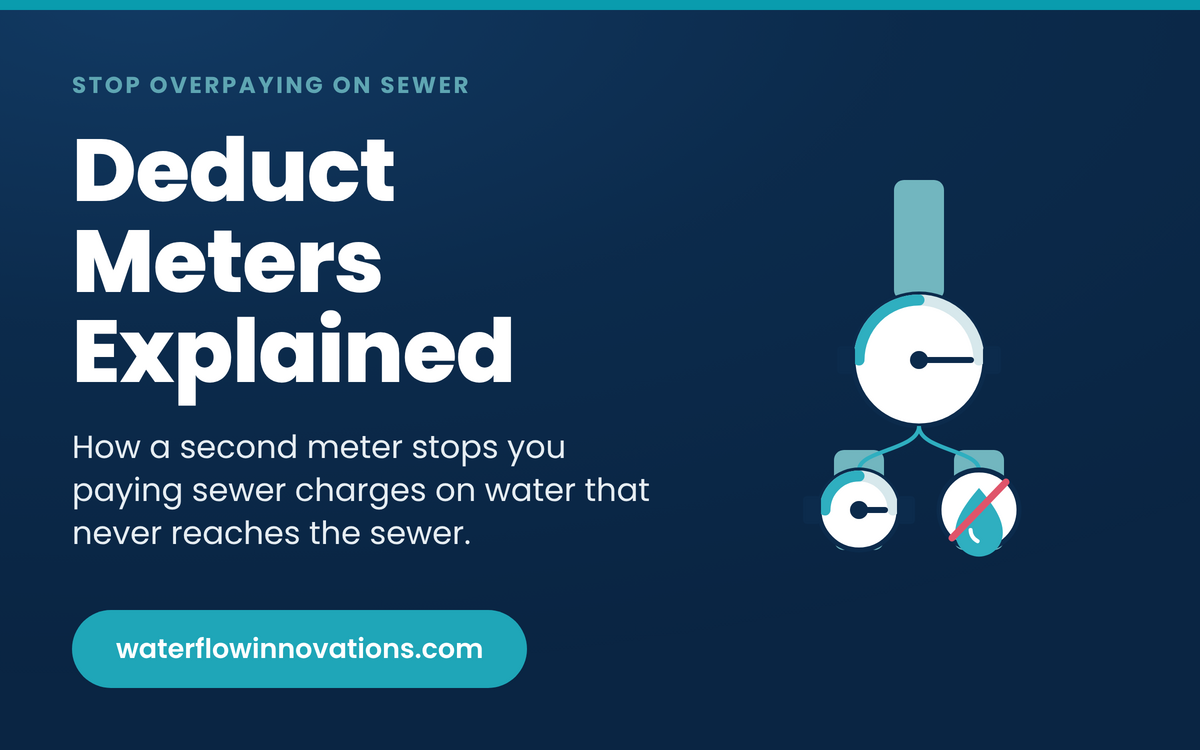
A second water meter, downstream of the utility’s main meter, measuring only water that leaves the site by a route other than the sanitary sewer. Each billing period its registered volume is deducted from the volume used to calculate your sewer charge.
It is sometimes called a sub meter, an irrigation meter, an evaporation meter or a sewer credit meter depending on the utility and what it is measuring. The mechanism is identical in every case.
What it does not do is reduce your water charge. You still used the water and you still pay for it. The credit applies only to the sewer side. Aqua, in its published deduct meter program, states the limit precisely: the credit applies to “sewer bills for water which is used but does not enter the Company’s system.” On many commercial tariffs the sewer volumetric rate is higher than the water rate, so the saving is often the larger half of the bill, but the distinction matters when you model the payback.
What Water Actually Qualifies?
Anything metered that demonstrably does not return to the sanitary sewer. On a commercial or industrial site that is usually more than the facility team expects.
- Irrigation and landscape watering. The most common qualifying use, and the easiest to meter because it is already on a separate line in many buildings.
- Cooling tower evaporation and drift. Significant on any site with a tower. The make-up water goes in, a large share leaves as vapor, and only the blowdown reaches the sewer.
- Water incorporated into a product. Beverages, food, concrete, chemical manufacturing. It leaves the site in a container or a truck.
- Process water hauled off site. Anything collected and removed by tanker rather than discharged.
- Truck and vehicle fill. Water leaving in a tank.
- Wash-down that drains to storm. Only where the drainage is genuinely separate and permitted.
- Boiler and process make-up lost to steam. Where the condensate is not returned to the sanitary sewer.
What does not qualify: anything that reaches the sanitary sewer by any route, and in most tariffs anything you cannot meter continuously. An estimate will not do. Johnson County Wastewater requires the deduct meter to “register in ‘gallons’ (not cubic feet)” and to comply with AWWA standards, with “straight-reading type” registers.
How Much Is a Deduct Meter Worth?
It depends entirely on how much of your volume leaves by a non-sewer route, which is why the first step is a measurement rather than an application.
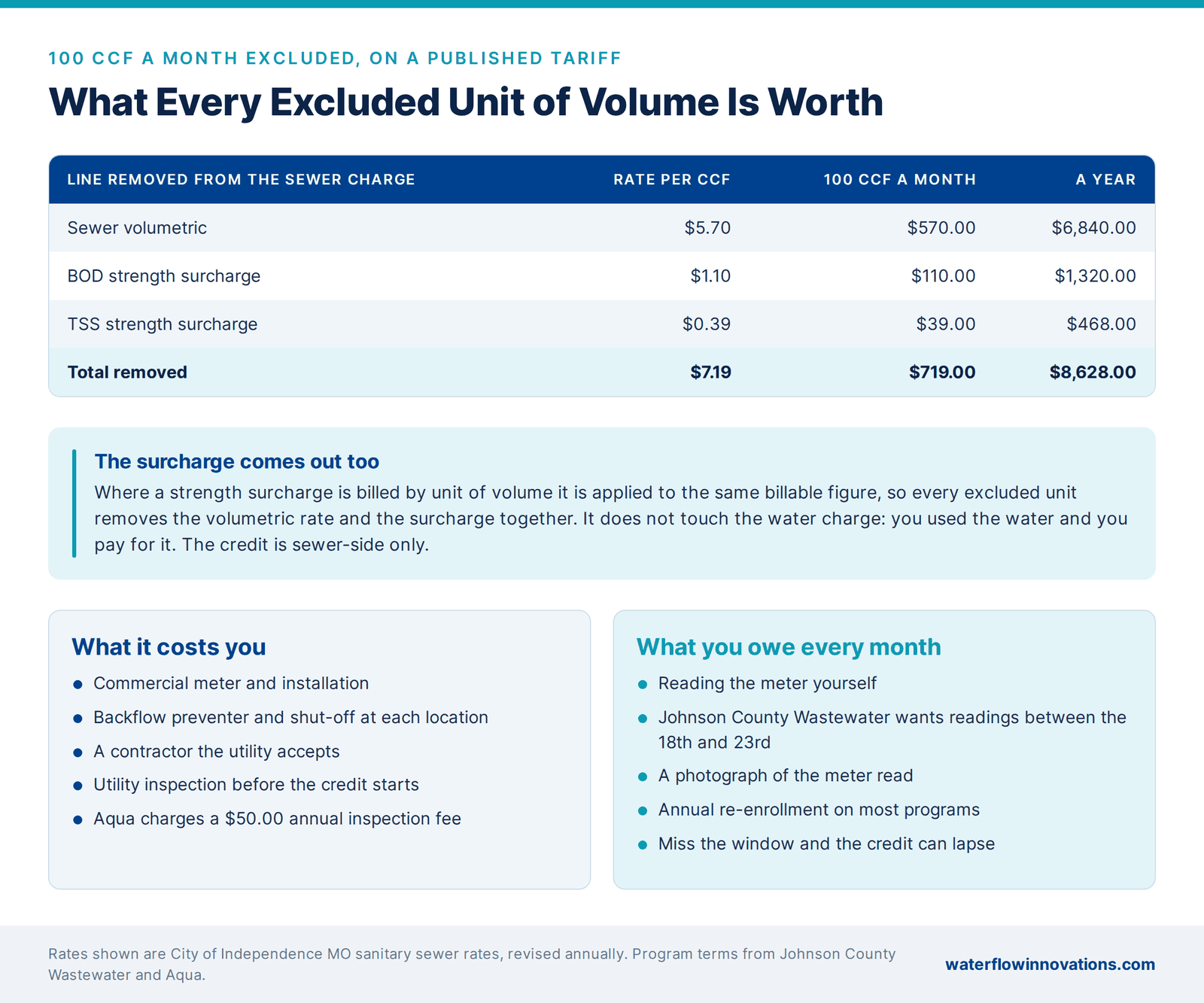
The arithmetic is simple. Take your sewer volumetric rate, multiply by the volume you believe is being excluded, and compare it against the install cost plus the ongoing administrative fee. On a tariff charging $5.70 per CCF, excluding 100 CCF a month removes $570 a month, or $6,840 a year, from the sewer charge alone.
Two things make that number larger than it first looks on a commercial account.
The excluded volume also comes out of any strength surcharge billed by unit of volume, because that surcharge is applied to the same billable figure. On a tariff adding $1.10 per CCF for BOD and $0.39 for TSS, each excluded CCF is worth another $1.49 on top of the volumetric rate.
And the saving is permanent and monthly. Unlike a billing refund, which is a one-off recovery inside a limitation window, a deduct meter keeps paying for as long as the facility operates. Over a five-year hold it is usually the larger of the two by a wide margin.
Who Pays for It, and Who Maintains It?
You do, on both counts. This is the part that catches facilities off guard, and it is consistent across published programs.
Johnson County Wastewater is explicit: “Property owners will be responsible for setting, reading and maintaining the deduct meter,” and “Johnson County Wastewater (JCW) will not be responsible for any costs associated with the installation or maintenance.” Installation must include “a backflow preventer and shut off” at each location, and JCW performs a final inspection once the work is complete.
There is often an ongoing cost as well. Aqua charges a $50.00 annual administrative inspection fee, billed automatically in March for re-enrollment, and inspects the meter at installation and annually to maintain eligibility.
So the real cost model is: a commercial meter and its installation, a backflow preventer, a licensed contractor, a utility inspection, and an annual fee. Against a saving that is monthly and permanent. For a site with meaningful irrigation or a cooling tower, the payback is usually short. For a site excluding a trickle, it is not worth the administration.
What Is the Application Process?
Six steps, and the order is set by the utility rather than by you.
- Measure what you are claiming before you apply. Temporary metering or a defensible calculation of cooling tower evaporation. Applying on a guess wastes the inspection.
- Submit the application with a building schematic. Johnson County Wastewater asks for the schematic, the meter specifications and the contractor information together, and says it “will contact you within two weeks of receipt.”
- Confirm the meter specification before you buy. Units, standard and register type are prescribed. A meter registering in cubic feet where the tariff requires gallons is a meter you will be replacing.
- Install with the required protection. A backflow preventer and shut-off at each location, by a contractor the utility accepts.
- Pass the inspection. The credit does not start until the utility has inspected and approved.
- Read it every month, on their schedule. Johnson County Wastewater requires readings “between the 18th and 23rd of each month along with a photograph of the meter read.” Miss the window and you can lose the credit for that period.
That last step is where deduct meters quietly fail. The meter is installed, the credit runs for a year, a facility manager changes, the readings stop being submitted, and the credit lapses without anyone noticing. When reviewing an account, always compare billed sewer volume against raw meter volume to check the credit is still being applied. That comparison is part of any serious water and sewer bill review.
Where Does a Deduct Meter Fit Against Everything Else?
It belongs in a sequence, and running it out of order wastes money.
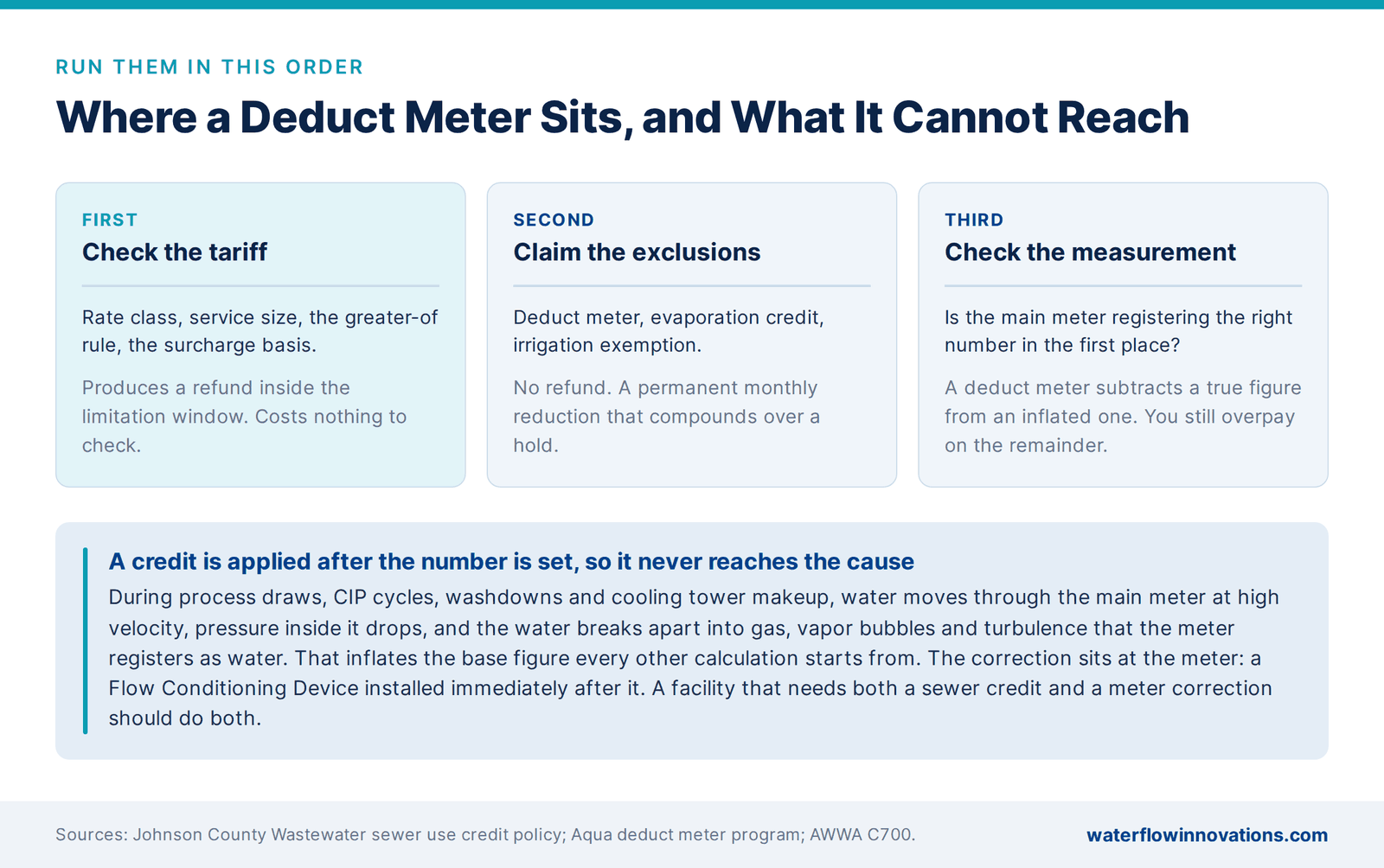
First, check the tariff. Rate class, service size, the greater-of rule, the surcharge basis. These are errors that produce refunds, and they cost nothing to check. The full method is in our guide to how a commercial sewer bill is calculated.
Second, claim the exclusions. A deduct meter sits here, alongside evaporation credits and irrigation exemptions. No refund, but a permanent monthly reduction, and it is the substance of ongoing water and sewer bill reduction work.
Third, check the measurement itself. A deduct meter reduces the volume you are billed sewer on. It does nothing about whether the main meter is measuring correctly in the first place. If the main meter is registering high, the deduct meter subtracts a true number from an inflated one, and you are still overpaying on the remainder, on both bills.
That third point is worth sitting with. On a commercial service, the main meter’s reading is commonly pushed high at peak demand: process draws, CIP cycles, washdowns, and the same cooling tower makeup the deduct meter is measuring. At those peaks, water moves through the meter at high velocity, the pressure inside it drops, dissolved gas comes out of solution and vapor forms, and the meter registers that volume as water. That inflates the base figure every other calculation starts from. A deduct meter is a correction applied after that figure is set, so it never reaches the cause. Meter over-registration and a sewer credit solve different halves of the same bill, and a facility that needs both should do both.
The measurement half is corrected at the meter. A Flow Conditioning Device (FCD) installs immediately after the main meter and creates a small, controlled backpressure that extends back through it, keeping the water intact at peak demand so the meter registers water only. Because sewer charges are commonly based on that same reading, the correction carries through to both bills. It corrects the reading; it does not reduce the water the facility actually uses. For the physics behind it, see How the FCD Works.
Frequently Asked Questions
What is a deduct meter?
A second water meter, installed at the property’s cost downstream of the utility meter, measuring water that does not enter the sanitary sewer. Its registered volume is subtracted from the volume used to calculate the sewer charge.
Does a deduct meter reduce the water bill as well?
No. You used the water and you pay for it. The credit applies to the sewer charge only. Because the sewer volumetric rate is higher than the water rate on many commercial tariffs, it is often the larger half of the saving.
What water qualifies for a sewer credit?
Metered water that demonstrably does not reach the sanitary sewer: irrigation, cooling tower evaporation, water incorporated into a product, process water hauled off site, truck fill, and wash-down to a permitted storm drain. It has to be continuously metered, not estimated.
Who pays for a deduct meter?
The property. Johnson County Wastewater states that the owner is responsible for setting, reading and maintaining it, and that the utility carries no installation or maintenance cost. A backflow preventer and shut-off are normally required, and there may be an annual fee, such as Aqua’s $50.00 administrative inspection charge.
Will the utility apply the credit automatically?
No. Deduct meters, evaporation credits and irrigation exemptions exist on most tariffs but none is applied on the utility’s initiative. The property applies, the utility approves, a contractor installs and the utility inspects.
How much can a deduct meter save?
Multiply your sewer volumetric rate by the excluded volume, then add any volume-based strength surcharge. On a tariff at $5.70 per CCF plus $1.10 BOD and $0.39 TSS, each excluded CCF is worth $7.19, so excluding 100 CCF a month is worth $719 a month.
Can a deduct meter credit lapse?
Yes, and it often does. Most programs require monthly readings submitted in a set window and an annual re-enrollment. Compare billed sewer volume against raw meter volume to confirm the credit is still being applied.
Related reading
- Why a commercial sewer bill runs high
- The sewer double impact: one reading, two charges
- How to read a commercial water and sewer bill
Find Out What Your Facility Can Exclude
Water Flow Innovations reviews water and sewer billing and meter data for commercial, industrial and multifamily facilities. Send 12 months of bills plus your meter make, model and size, and we will identify which exclusions your tariff allows, what they are worth at your rate, and whether the volume the whole calculation starts from is being measured correctly.
Water Flow Innovations LLC, 2651 Route 412, Coopersburg, PA 18036. Call 1-844-934-8258.
0 Comments