
Car Wash Gallons Per Car: Reclaim Cuts the Water, the FCD Corrects the Meter
65-85
~30
2X
<0.8 psi
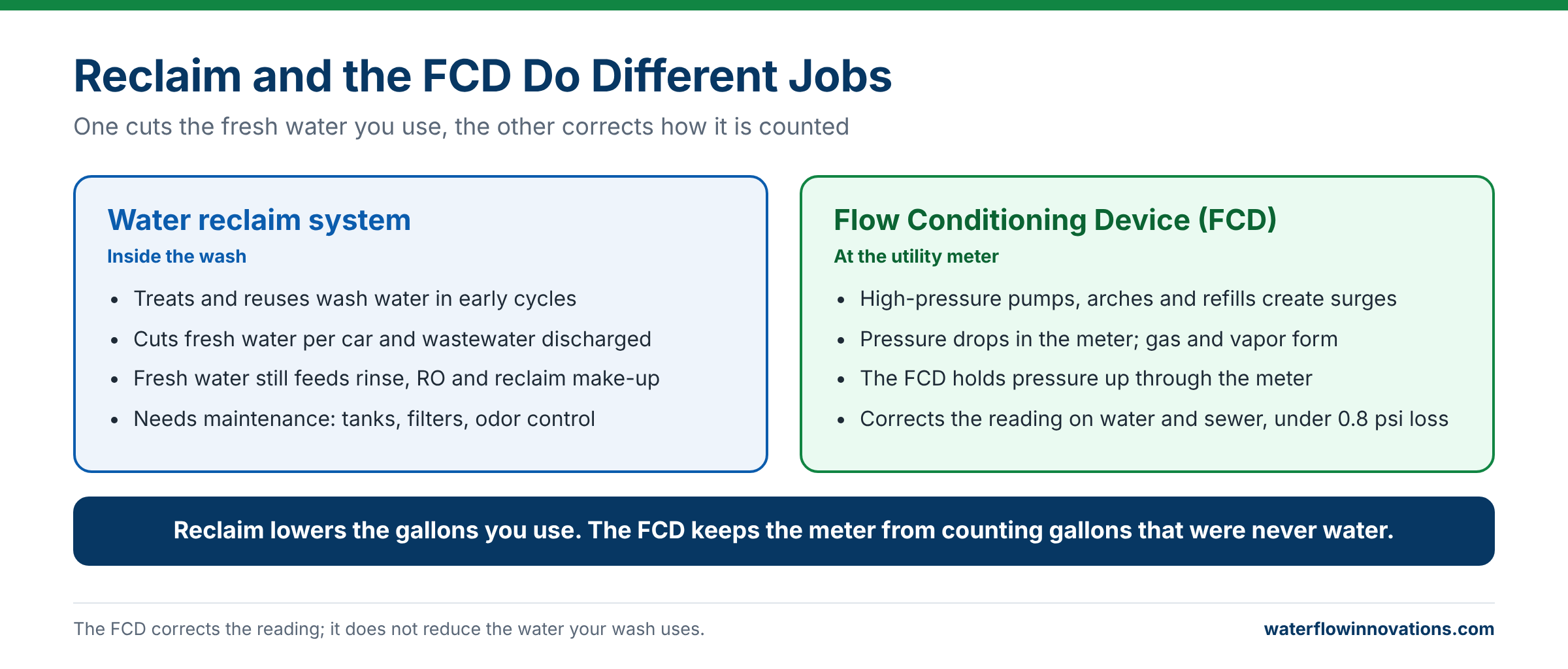
Direct answer: Gallons per car is fresh water metered divided by cars washed, so it is only as accurate as the utility meter. Car washes put that meter through constant demand surges: high-pressure pumps cycling, arches and solenoid valves opening, and reclaim and RO tanks refilling. During each surge, pressure inside the meter drops, dissolved gas comes out of solution and vapor forms, and the meter counts that volume as water. A reclaim system lowers the fresh water you use. The Flow Conditioning Device (FCD), installed immediately after the utility meter, corrects what the meter counts on the fresh water that’s left, on both the water and sewer lines.
The Number Every Wash Operator Tracks
Gallons per car (also called gallons per vehicle) is the car wash industry’s core water metric: the fresh water bought from the utility divided by the number of cars washed. It drives cost per car, reclaim payback, and how a site compares with others.
- Without reclaim: EPA’s WaterSense at Work guidance puts fresh water at roughly 66 gallons per vehicle for friction washes and about 85 for frictionless washes.
- With reclaim: the same guidance shows fresh water can drop to as low as about 8 gallons per vehicle for friction washes and about 17 for frictionless.
- Typical conveyor washes: industry studies have averaged roughly 30 to 34 gallons of fresh water per vehicle.
Because sewer is usually calculated from the same metered water and billed as its own line, every gallon per car shows up on both the water and sewer charges.
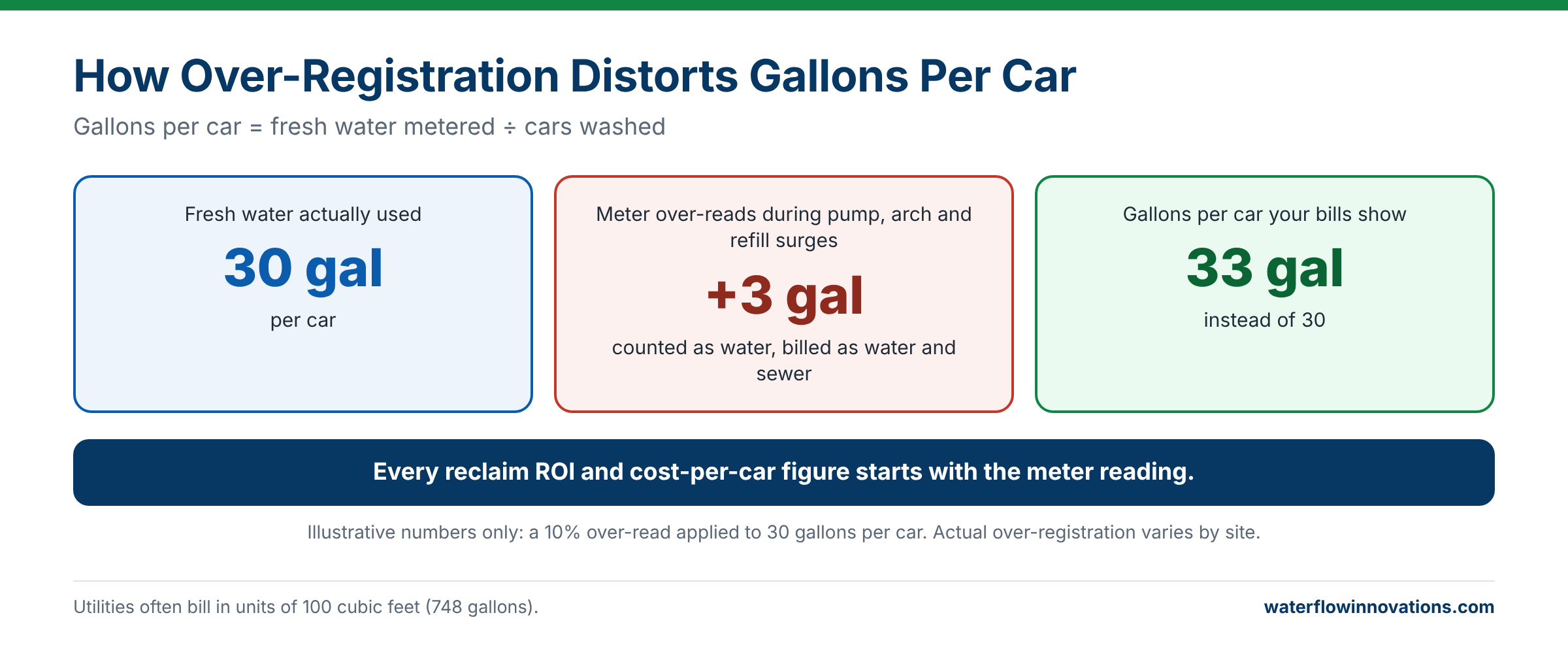
Why Car Washes Make Meters Over-Read
Few businesses use water in sharper bursts. High-pressure pumps start and stop with every vehicle, arches and solenoid valves snap open and closed, spot-free RO systems draw in batches, and reclaim and fresh-water tanks refill on demand. On a busy Saturday that can mean thousands of surges through the utility meter.
During each surge, water speeds up through the meter and pressure inside it drops. Dissolved gas comes out of solution and vapor forms, and the meter counts that volume as water. This is water meter over-registration. The meter isn’t faulty; it’s counting what passes through it at that speed, including volume that was never water.
Reclaim ROI Starts With the Meter Reading
When an operator weighs a reclaim system, the math starts with the current gallons per car and the cost per gallon of water and sewer. If the meter is over-reading, both the “before” number and the projected savings are off, and after installation the fresh water that’s left is still being over-counted.
That’s why reclaim and the FCD aren’t competing choices. Reclaim cuts the fresh water you use and the wastewater you discharge. The Flow Conditioning Device (FCD) installs immediately after the utility meter and creates a small, controlled back-pressure that extends back through the meter, holding pressure up during demand surges so far less gas and vapor form and are counted as water. Pressure loss is under 0.8 psi, and nothing downstream changes: pumps, arches, RO and reclaim all see the same supply. It corrects the reading; it doesn’t reduce the water your wash uses.
How to Check Your Own Gallons Per Car
- Match meter reads to car counts. Read the utility meter at the same time each day and divide by the controller’s car count. Track it week by week.
- Compare with your equipment’s design numbers. Your equipment supplier can tell you roughly what each package should use. A meter that consistently runs well above that deserves a look.
- Rule out leaks and stuck valves. Run an overnight meter test with the wash shut down; also check that reclaim make-up and RO valves close fully.
- Watch busy days. If gallons per car rises on your highest-volume days without an equipment change, surge-driven over-registration is a likely cause.
Documented FCD installations typically show up to a 30% reduction in combined water and sewer costs (46% highest documented, a rare case); results vary by site. For the physics, see Back Pressure on Meters.
Part of our car wash coverage. For the full industry overview, see Car Wash.
Sources and Standards
- U.S. EPA, WaterSense at Work, Section 5.4: Vehicle Washes (fresh water per vehicle with and without reclamation; conveyor wash averages).
- Professional Carwashing & Detailing, articles on water and sewer cost per car and reclaim evaluation (sewer billed on water consumption; units of 100 cubic feet).
- American Petroleum Institute, Manual of Petroleum Measurement Standards, Chapter 5.3 (minimum back pressure after liquid meters).
Standards and manufacturer guidance describe industrial practice. Water Flow Innovations applies the same principles to commercial water service; results vary by building.