
Home » Essential Guides »
Water Meter Strainers: The Flow Conditioner Your Meter Already Has
2"+
Upstream
About half
After
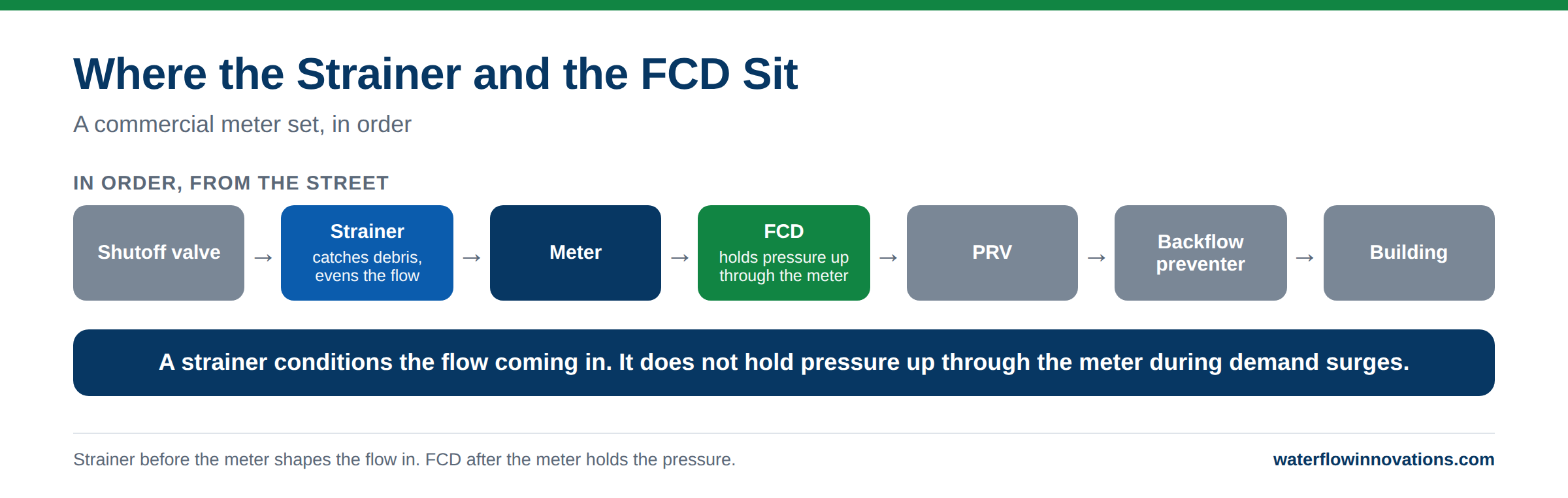
Direct answer: A water meter strainer is a screen installed immediately ahead of a commercial turbine or compound meter. It catches debris that could damage the measuring element and evens out the flow entering the meter, which is why meter makers allow less straight pipe upstream when one is used. In other words, it’s a flow conditioner your meter already has. What it doesn’t do is hold pressure up through the meter during demand surges, which is when over-registration happens. That’s the job of the Flow Conditioning Device (FCD), installed immediately after the meter.
What a Strainer Does
- Protects the meter. Turbine and compound meters have a spinning measuring element that debris can jam or damage. The strainer screens it out.
- Conditions the flow. Its vanes and screen even out the flow entering the meter, reducing the distortion caused by valves and fittings upstream.
- Shortens the straight pipe the meter needs. Meter makers allow a shorter straight run ahead of the meter when a strainer is installed.
Water industry guidance and meter makers commonly call for a strainer ahead of turbine and compound meters, usually on services above 2 inches.
The Straight-Pipe Rule
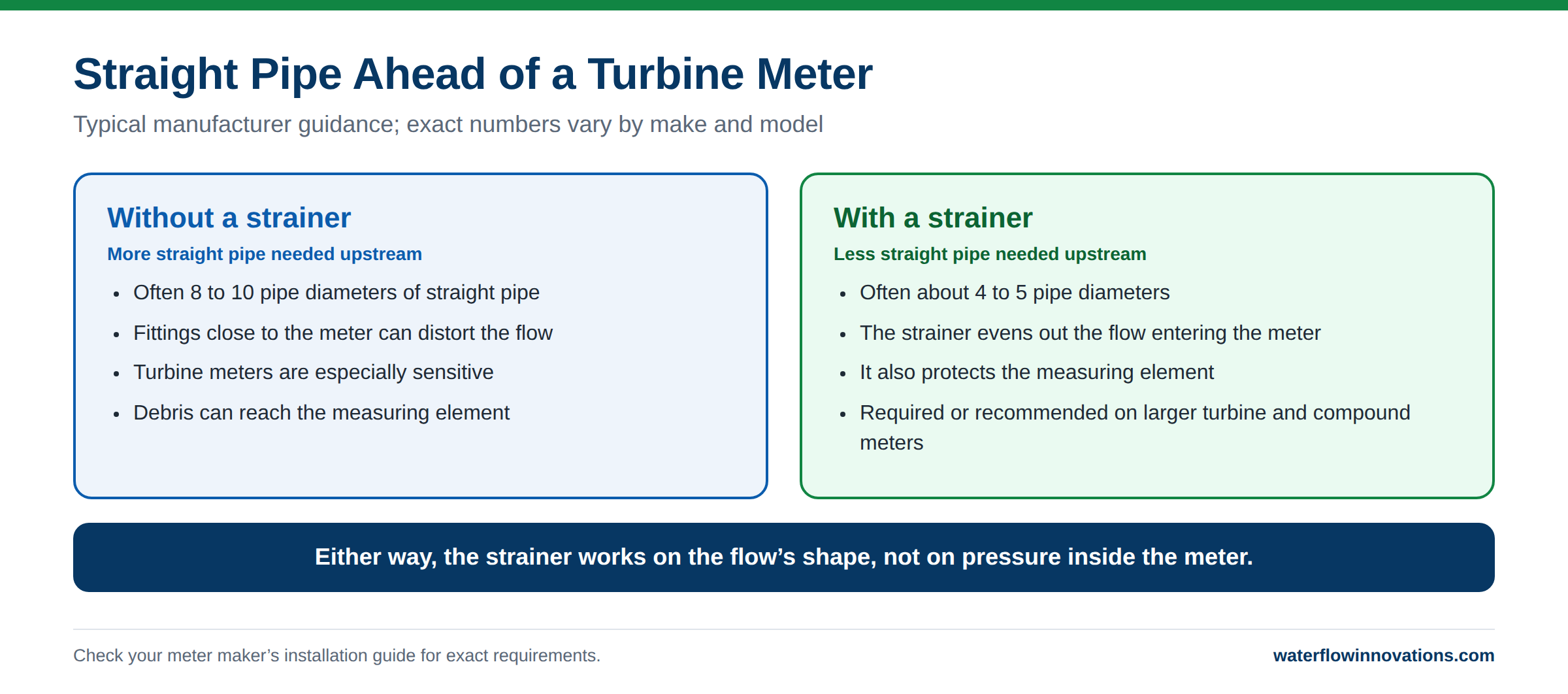
Turbine meters read best when flow arrives straight and even. Elbows, tees and valves close to the meter leave the flow swirling or lopsided. The traditional fix is straight pipe: manufacturer guidance for turbine meters commonly calls for something like 8 to 10 pipe diameters of straight pipe ahead of the meter without a strainer, and about 4 to 5 with one. The exact numbers vary by make and model, so always check the installation guide for your meter
What a Strainer Can’t Do
A strainer works on the shape of the flow coming in. It doesn’t change what happens to the pressure inside the meter when demand jumps. During demand surges, such as pumps starting, valves opening, tanks filling or shift changes, flow through the meter jumps and pressure inside it drops. Dissolved gas comes out of solution and vapor forms, and the meter counts that volume as water. A meter with a perfect strainer and a perfect straight run can still over-register this way.
That’s also why replacing the meter rarely helps: a new meter in the same spot, behind the same strainer, sees the same surges. See water meter over-registration.
The Strainer and the FCD Work Together
The two devices do different jobs at opposite ends of the meter. The strainer conditions the flow going in; the FCD holds the pressure through it. The FCD installs immediately after the meter and creates a small, controlled back-pressure that extends back through the meter, holding pressure up during demand surges so far less gas and vapor form and are counted as water. Pressure loss is under 0.8 psi, and nothing downstream changes. It corrects the reading; it doesn’t reduce the water you use.
Keep the strainer clean on the schedule your utility or meter maker recommends: a clogged screen restricts flow and should be cleaned like any other strainer. Related: Back Pressure on Meters and Not to Be Confused With.
Sources and Standards
- AWWA C701, Cold-Water Meters – Turbine Type, for Customer Service, and AWWA C702, Cold-Water Meters – Compound Type.
- Neptune Technology Group, TRU/FLO compound meter installation manual and strainer product sheet (straight-run requirements with and without a strainer).
- Master Meter, turbine meter installation guide (straight pipe upstream with and without an AWWA C701 strainer).
- Badger Meter, Recordall Compound Series data sheet (strainer required for flow conditioning and protection).
Standards and manufacturer guidance describe industrial practice. Water Flow Innovations applies the same principles to commercial water service; results vary by building.