
Quick answer: On top of the volume-based sewer charge, many utilities add a high-strength surcharge when your wastewater carries more organic load or solids than ordinary sewage, measured as BOD and TSS, and sometimes FOG, phosphorus, or ammonia. It hits restaurants, breweries, food processors, and industrial accounts hardest. You lower the surcharge itself through pretreatment, but because the surcharge is calculated on your metered discharge volume, an over-registered meter inflates it along with every other line on the bill.
If your sewer bill runs higher than a neighboring business of the same size, the strength surcharge is often the reason. It is the part of the bill most owners have never heard of, it does not appear on a residential account, and it is driven by what is in your wastewater rather than how much of it you send.
What a strength surcharge actually is
Treating sewage costs money in proportion to how dirty it is. Ordinary domestic wastewater sits within a normal range, and the base volumetric sewer rate is set to cover treating water at that strength. When a business discharges wastewater that is stronger than normal, the utility has to work harder to treat it, so it bills the extra as a surcharge. For the structure the surcharge sits on top of, see what a sewer charge is and how a commercial sewer bill is calculated.
Strength is measured on a few parameters:
- BOD, biochemical oxygen demand, the organic load that consumes oxygen as it breaks down. High in food, beverage, and process waste.
- TSS, total suspended solids, the solid particles carried in the water.
- FOG, fats, oils, and grease, which clog lines and foul treatment. Common from kitchens and food production.
- Sometimes phosphorus and ammonia, nutrients that drive additional treatment.
Each parameter has a threshold. Discharge below it and no surcharge applies on that parameter. Go above it and you are billed for the excess.
How the surcharge is calculated
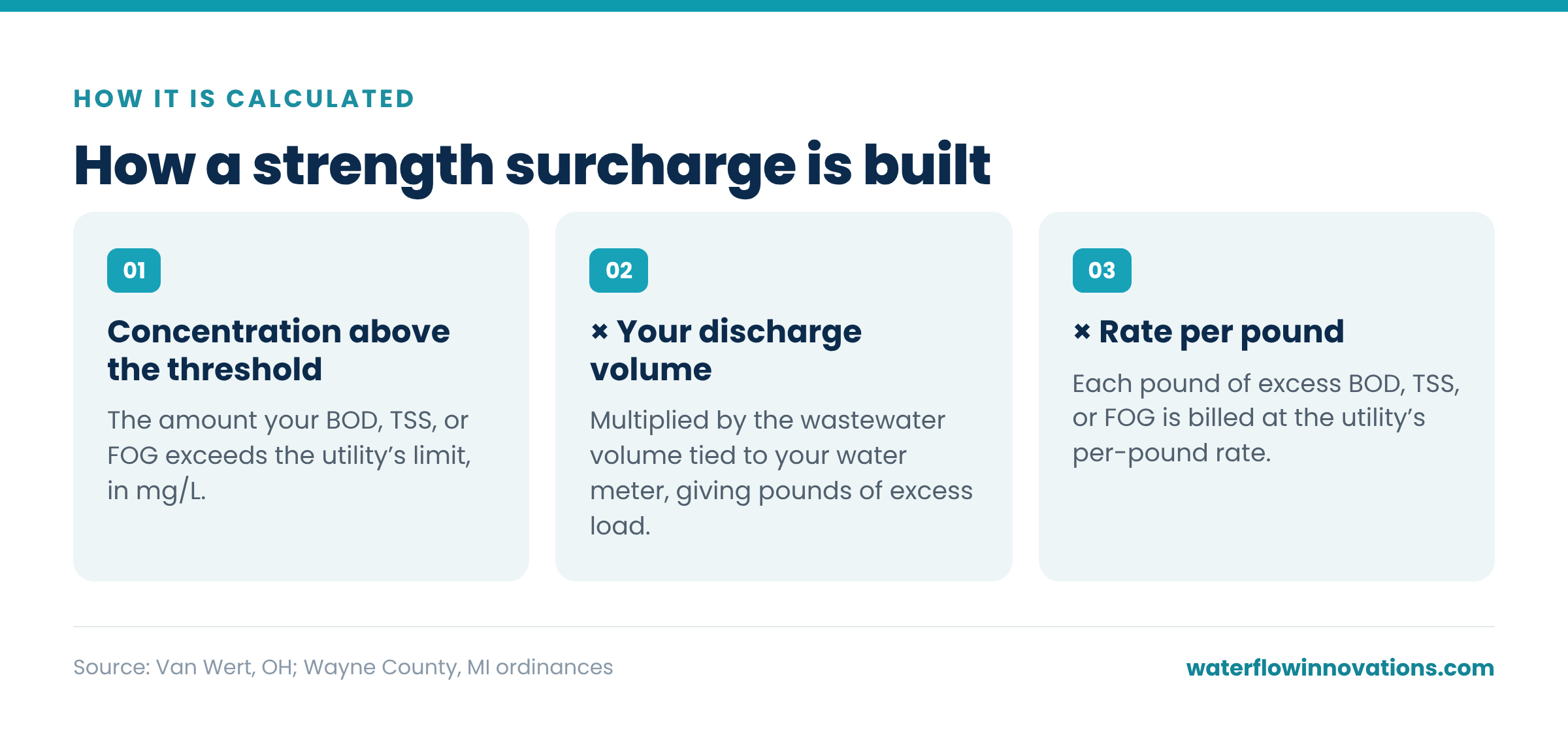
The formula is consistent across utilities even though the numbers differ. The utility takes the amount by which your concentration exceeds the threshold, multiplies it by your discharge volume to get pounds of excess load, and multiplies that by a rate per pound.
Van Wert, Ohio sets its thresholds at 216 mg/L for BOD and 260 mg/L for suspended solids. Its surcharge works out the pounds as the concentration above the threshold, times the wastewater volume in thousands of gallons, times 0.0083, then charges $0.37 per pound of BOD and $0.27 per pound of suspended solids (Van Wert Codified Ordinances).
Wayne County, Michigan uses higher thresholds and a combined formula. Its surcharge is SC = 0.0624 x V x ( a(BOD-275) + b(TSS-350) + c(P-12) ), where V is the discharge volume, with rates of $0.082 per pound of BOD, $0.083 per pound of TSS, and $1.321 per pound of phosphorus (Wayne County Code 1040.33).
Two things stand out. First, thresholds and rates vary widely between utilities, so the same wastewater can be billed very differently depending on where you operate. Second, and this is the part that connects to your meter, every one of these formulas multiplies by volume.
Why it lands on specific industries
The surcharge is written for exactly the businesses whose waste is strong. A full-service restaurant or commercial kitchen generates high FOG and BOD. A brewery or winery discharges spent process water with very high BOD. A food or beverage processor sends out organic load far above domestic levels. A metal finisher or manufacturer may trip solids or metals limits. These accounts can see the surcharge become a large share of the total sewer bill.
Many utilities pair the surcharge with a pretreatment or industrial waste program. Above certain limits you may be required to sample your discharge, install a grease interceptor, hold a discharge permit, and report results. The surcharge and the permit go together: the monitoring establishes your concentrations, and the concentrations drive the surcharge.
How to reduce the surcharge, and the two different levers
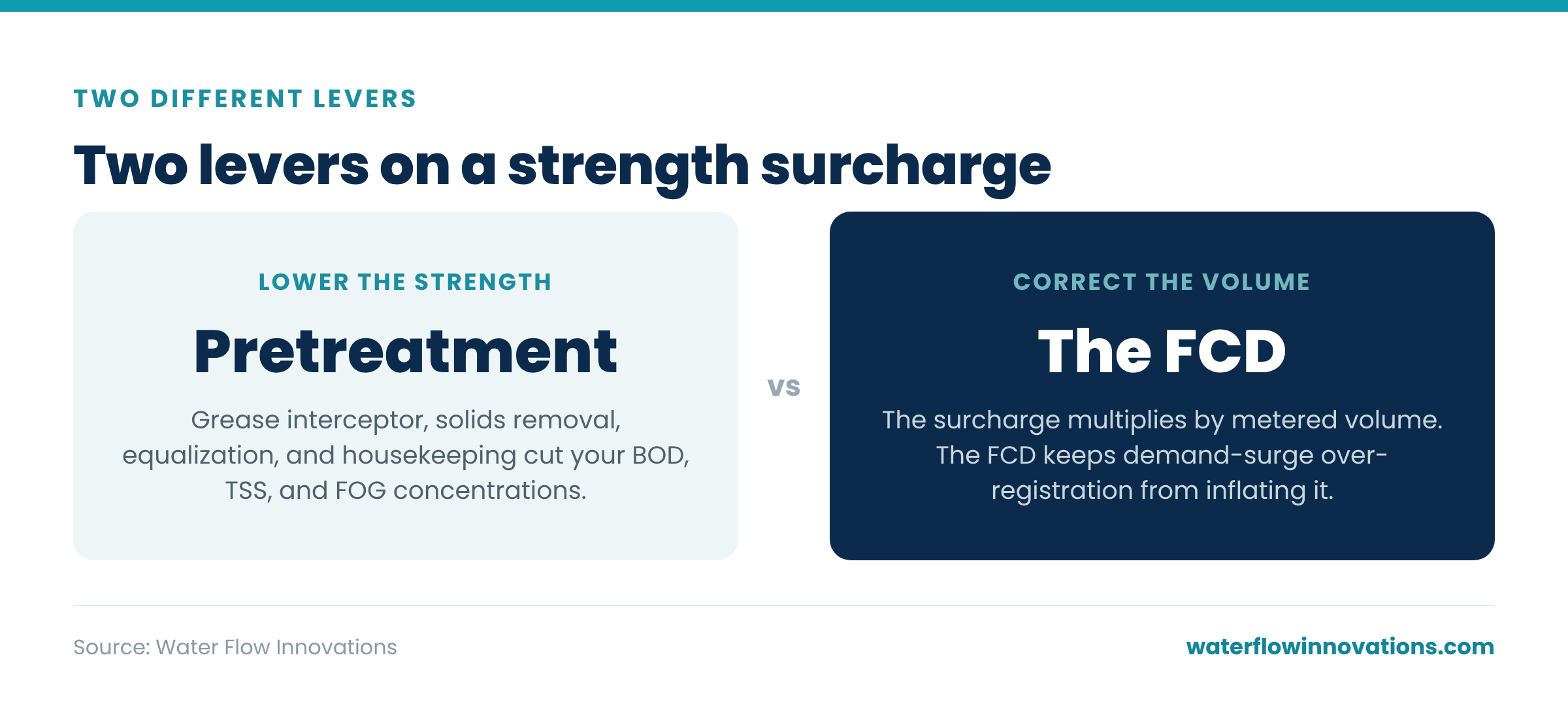
There are two separate levers here, and confusing them is where money gets left on the table.
The first lever lowers the strength itself, and it is a pretreatment question. A properly sized and maintained grease interceptor cuts FOG. Screening or settling removes solids before they reach the sewer. Equalization and dissolved-air flotation reduce BOD and TSS on heavier industrial streams. Better housekeeping, dry cleanup instead of hosing, and catching high-strength batches rather than dumping them all lower your measured concentrations, and therefore the pounds you are surcharged for. This is the right and only way to reduce the surcharge rate component.
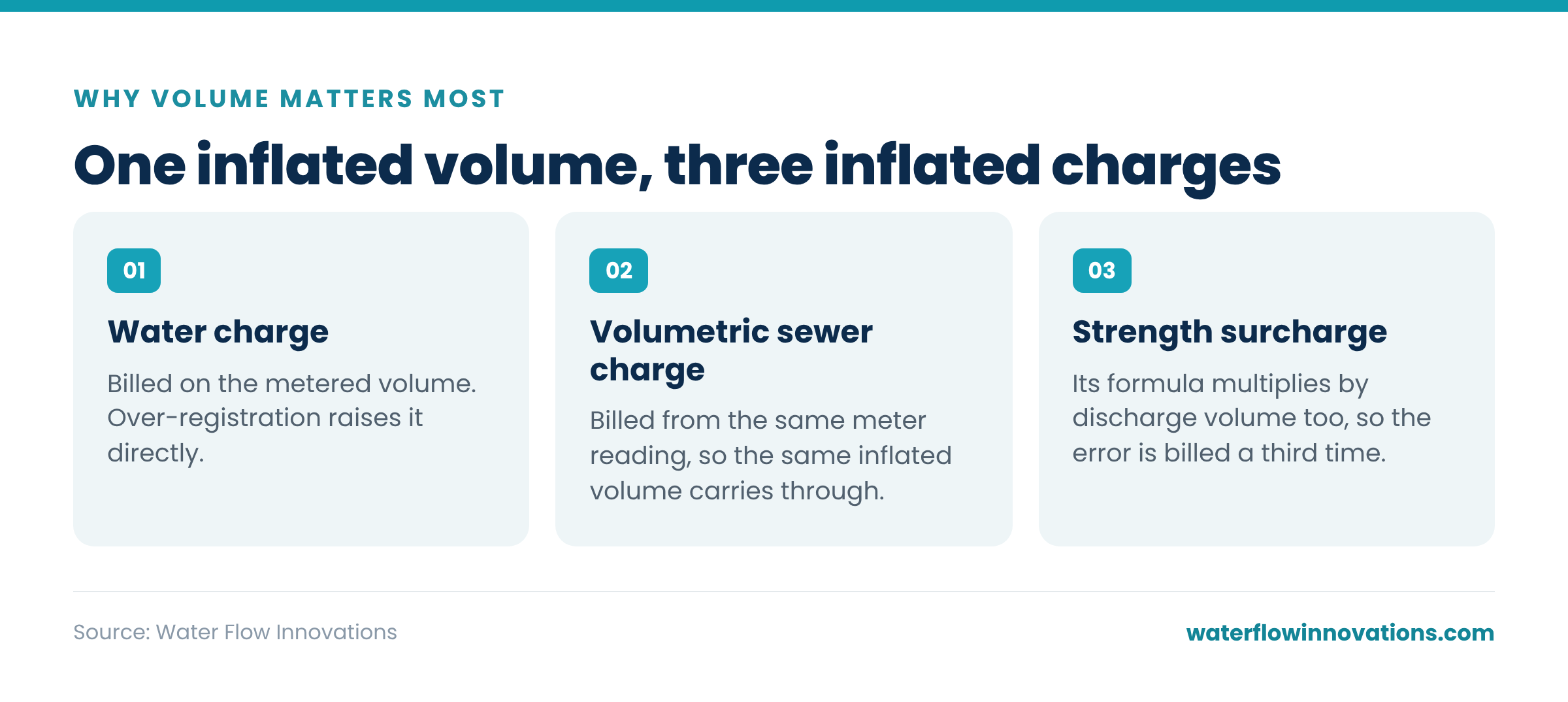
The second lever is the volume every one of those formulas multiplies by. Your water charge, your volumetric sewer charge, and your strength surcharge are all computed on the volume tied to your water meter. (A fixed base or service charge isn’t, since it doesn’t change with volume.) If that meter over-registers, the inflated volume flows into all three at once. Pretreatment will not catch that, because the concentrations are correct, it is the volume that is wrong.
Where the meter comes in
During demand surges water speeds up through the meter, pressure inside it drops, dissolved gas comes out of solution and vapor forms, and the meter counts that volume as water. The meter is not faulty. It reports what physically passed through it at that velocity. Because your sewer charge is calculated from that same reading, the over-recorded volume is billed twice, once as water and once as sewer, and on a high-strength account it is billed a third time through the surcharge, which multiplies by the same inflated volume. See water meter over-registration and sewer double-impact billing.
A Flow Conditioning Device installs immediately after the meter and creates a small, controlled back-pressure that extends back through the meter, holding pressure up during demand surges so far less gas and vapor form and are counted as water. It corrects the reading, not your actual water use, and its pressure loss is under 0.8 psi. See how the FCD works.
So a high-strength account has the most to gain from getting the volume right, because a single over-registered volume figure inflates three charges rather than two. Fix the strength with pretreatment, and fix the volume with the FCD.
What to do next
Pull your sewer bill and your pretreatment or industrial waste statement and find the strength surcharge line, with your BOD, TSS, and FOG results against the thresholds. Work the pretreatment side to bring concentrations down. Then check whether the discharge volume those charges multiply by is being inflated by demand-surge over-registration. Send us your bills and we will model the volume piece.
Get My Quote or call 1-(844)-934-8258. Water Flow Innovations LLC, 2651 Route 412, Coopersburg, PA 18036.
Frequently asked questions
What is a sewer strength surcharge?
It is an extra sewer charge applied when your wastewater is stronger than ordinary sewage, measured on parameters like BOD, TSS, and FOG. You are billed for the load above each parameter’s threshold, multiplied by your discharge volume and a rate per pound.
Which businesses pay it?
Accounts with high-strength waste: restaurants and commercial kitchens, breweries and wineries, food and beverage processors, and many industrial and manufacturing facilities. Thresholds and rates vary by utility, so the same operation can be billed differently in different cities.
How do I lower a strength surcharge?
Reduce the strength through pretreatment, a maintained grease interceptor, solids removal, equalization, and better housekeeping, which lowers your measured concentrations. Separately, make sure the discharge volume the surcharge multiplies by is not inflated by meter over-registration.
Does over-registration affect the strength surcharge?
Yes. The surcharge formula multiplies by discharge volume. When the meter over-registers during a demand surge, the inflated volume raises the water charge, the volumetric sewer charge, and the strength surcharge together.
Can a Flow Conditioning Device lower my strength surcharge?
Indirectly, through volume. The FCD corrects the metered volume that every charge multiplies by, including the surcharge. It does not change your wastewater’s strength, which is a pretreatment matter.
Sources
- Van Wert, Ohio, Codified Ordinances, Extra Strength Surcharges (51.096): https://codelibrary.amlegal.com/codes/vanwert/latest/vanwert_oh/0-0-0-20520
- Wayne County, Michigan, Code 1040.33, Commercial and Industrial Waste Pollutant Strength Surcharge: https://codelibrary.amlegal.com/codes/wayne/latest/wayne_mi/0-0-0-41764
0 Comments