
Quick answer
Your sewer bill is high because it is almost never measured. In most of the United States the sewer charge is calculated from your water meter reading, not from anything that happens downstream of your building. Whatever volume the meter records gets billed twice: once at the water rate, once at the sewer rate.
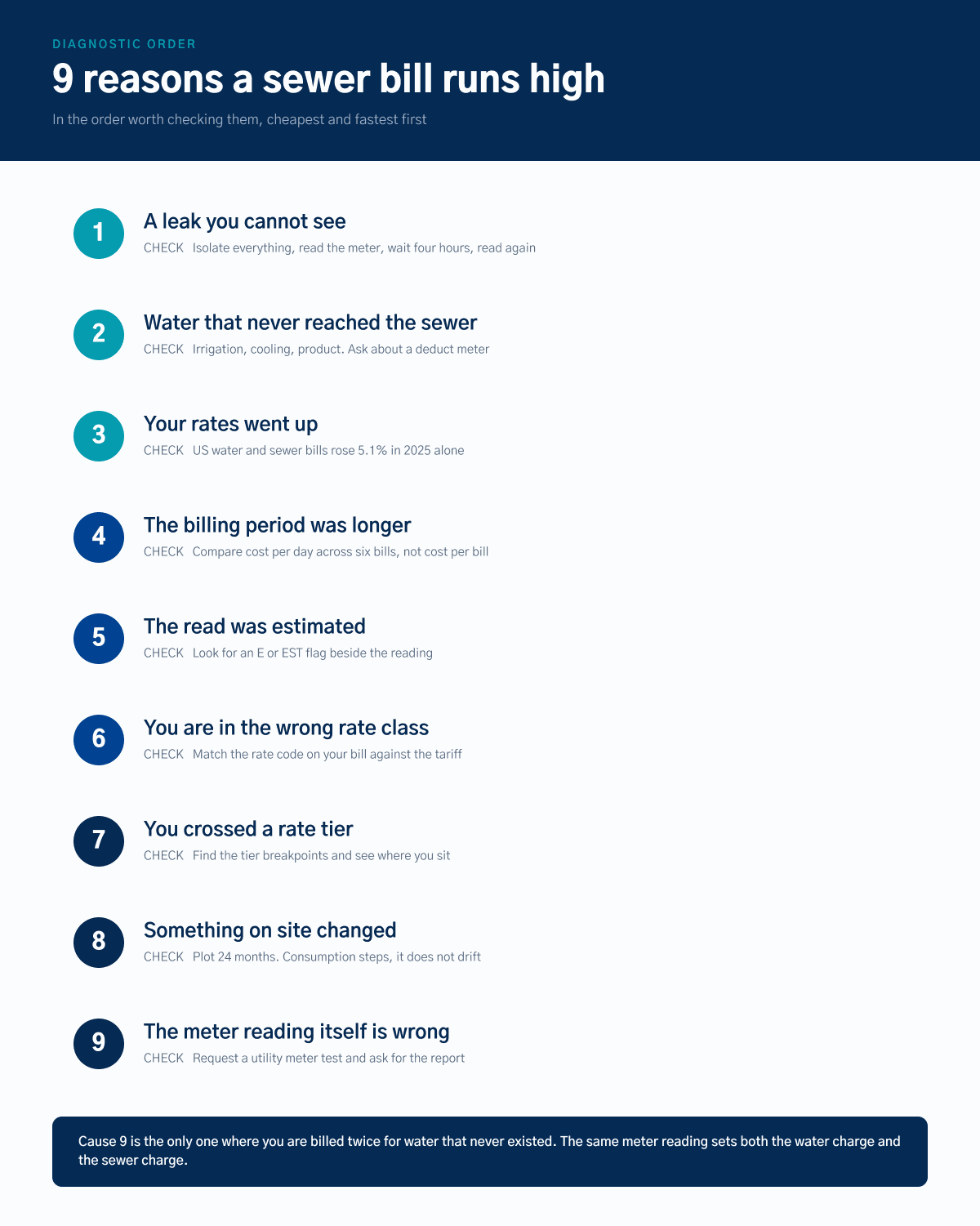
So a high sewer bill points to one of three things. Your water volume genuinely went up, the rate or the billing structure changed, or the meter reading itself is wrong. The nine causes below are set out in the order worth checking them, cheapest and fastest first, and each has a check you can run yourself.
What is a sewer charge actually calculated from?
There is no meter on your sewer line. Almost nobody has one. If you want the plain definition first, start with what a sewer bill is and who sets the rate.
Utilities bill wastewater by assuming that whatever water entered your property eventually leaves it through the drain. That assumption is close enough for a house. It gets expensive for a facility that irrigates, runs a cooling tower, or puts water into a product.
Look at how the Metropolitan Sewer District of Greater Cincinnati describes it. Sewer bills are “generally based on water meter size and the amount of water used by a property.” There is a minimum base charge tied to meter size that covers the first 3 CCF each month, then a commodity charge of $6.277 per CCF on everything above that as of 2026.
That structure is typical. Two components, one fixed and one volumetric, with the volumetric half driven entirely by your water meter.
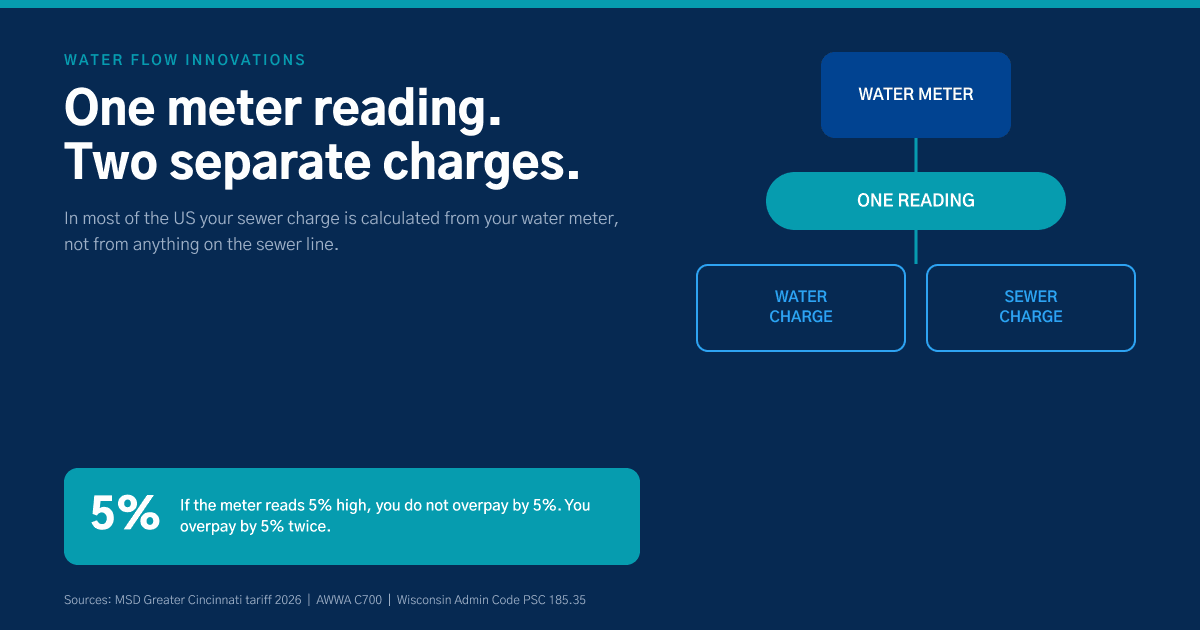
Here is the part most people miss. The water meter reading is a shared input. If that number is 8 percent too high, you are not overpaying by 8 percent on one line item. You are overpaying by 8 percent on both.
That is why sewer problems are worth more attention than their line item suggests.
The full breakdown of how a sewer bill is calculated
How the same reading gets charged twice: the sewer double impact calculator
Is that line on your bill even sewer?
There is a second line on many bills that people read as sewer and it is not. It is stormwater, and it does not behave like anything else on the bill.
Stormwater fees are not calculated from water consumption at all. They are calculated from impervious surface area, meaning roof, driveway, parking lot, anything that stops water soaking into the ground.
Greensboro, North Carolina publishes the mechanics clearly. One ERU, or Equivalent Residential Unit, equals 2,543 square feet of impervious area, which is the average for a single-family property there. Non-residential properties divide their impervious area by 2,543 and pay a monthly charge per ERU, with partial ERUs rounded up to a whole one.
Two things follow from that, and both matter for a commercial site.
Reducing water use will not reduce this charge by a cent. If your bill went up and the increase sits on the stormwater line, every efficiency measure in this article is aimed at the wrong number.
Credits exist and they are rarely automatic. Greensboro offers stormwater credits to non-residential owners who build stormwater control measures into the site, such as detention ponds, bioretention areas or sand filters. Most utilities running a stormwater utility have some version of this. Almost none apply it without an application.
For a large-footprint property, a warehouse, a distribution center, a retail park, a manufacturing site, the stormwater line can be a bigger number than people expect, because it scales with parking and roof rather than with anything you do inside the building.
CheckFind the stormwater line on your bill
Then find your utility’s stormwater tariff and its credit policy. Confirm the impervious area they have on file for your parcel is actually correct. Parcels get measured once and then inherited through ownership changes, and a demolished building or a re-surfaced lot does not update itself.
Why is the sewer rate higher than the water rate?
This surprises people, and it is normal.
The Boothbay Harbor Sewer District in Maine explains the economics well. Drinking water moves through pressurized pipe, so it can run uphill and follow the terrain at a depth of five or six feet. Wastewater mostly moves by gravity, which means sewer lines have to be built to a fixed slope. In hilly ground that means cutting deep trenches through rock, and trench excavation is the largest single cost in building a pipeline. Where gravity runs out you need pump stations. Boothbay Harbor operates 19 of them.
There is also a customer-base effect. Because of fire protection requirements, most communities extend water service further than sewer service, so outlying properties stay on septic. The water utility spreads its fixed costs across more accounts. The sewer utility spreads the same kind of costs across fewer.
Add treatment. Wastewater treatment in 1900 meant screening out the large objects. Since the Clean Water Act in 1972 it has become biological treatment, filtration, and disinfection, to the point where treated effluent is often cleaner than the stream receiving it. That capability was built and it has to be paid for.
None of this is a billing error. A sewer rate above the water rate is normal across much of the country.
What makes a sewer bill go up? Nine causes, in the order worth checking them
1. A leak you cannot see
Rule this out first, because it is cheap to check and it is the cause utilities and plumbers see most often.
EPA WaterSense puts the average family’s leak losses at 180 gallons per week, or 9,400 gallons per year. Nationally, household leaks waste close to 900 billion gallons annually, roughly the total household water use of 11 million homes. Toilets are the usual culprit, and they account for nearly 30 percent of indoor water use in an average home even when working correctly.
CheckThe four-hour isolation test
- Turn off every water-using fixture and appliance. That includes ice makers, humidifiers, water softeners mid-regeneration, and irrigation controllers.
- Read your meter and write down the full number including the small sweep hand or leak indicator.
- Leave it four hours with nothing running, ideally overnight.
- Read it again.
Four hours, not fifteen minutes. A leak small enough to be invisible is also small enough to be invisible over a short test. Any movement means water is going somewhere. On most meters a small triangle, star, or gear will spin at even a very low flow rate, so watch that indicator rather than the main digits.
For toilets specifically, put food coloring in the tank and leave it 15 minutes without flushing. Color in the bowl means the flapper is leaking.
2. Water that never reached the sewer
You get billed for sewer on irrigation, on evaporative cooling, on water that ends up in a product, and on anything filling a pool. None of it enters the sewer system. All of it is on your sewer bill.
For commercial and industrial sites this is often the largest recoverable item on the bill, and most utilities have a formal process for correcting it.
The fixes have names: sewer deduct meters, irrigation exemptions, and cooling tower evaporation credits. A deduct meter measures water that bypasses the sewer, and the utility subtracts that volume from your sewer-billable total. Cincinnati’s winter averaging does the same job differently, using your January to March average as a monthly ceiling for April through December on the assumption that summer excess went onto a lawn.
Not every utility offers all three. Most offer at least one. Almost nobody applies them automatically, which means you have to ask.
3. Your rates went up
They almost certainly did.
Bluefield Research tracks water and sewer rates across utilities in 50 US cities covering about 20 percent of the population. Their 2025 index found combined household water and sewer bills rose 5.1 percent in a single year, a five-year high. Water rose 6.0 percent, wastewater 4.8 percent. Over five years the cumulative increase reached 24.2 percent. Between January 2000 and December 2025, prices for these services climbed 207 percent against 93 percent for overall inflation.
Average monthly combined bills now run about $147 in the Northeast and $143 in the West.
CheckPrice the same volume twice
Find your utility’s current rate schedule, then find last year’s. Multiply the same volume by both. If the difference explains your increase, you have your answer and the problem is budgetary rather than technical.
4. Your billing period was longer than usual
A quarterly account that got read at 97 days instead of 89 will show a 9 percent jump with no change in behavior at all.
CheckCost per day, not cost per bill
Compare the service period dates on this bill against the last four. Divide each bill by the number of days it covers. This one takes two minutes and resolves more disputes than people expect.
5. The reading was estimated, not actual
When a meter cannot be read, most utilities estimate. Then the next actual read corrects the whole accumulated difference in one bill.
CheckLook for the estimate flag
Look for an “E”, “EST”, or “estimated” marker on the bill, sometimes in small print near the reading. Two or three estimates followed by an actual read is the classic pattern behind a bill that seems to come out of nowhere.
6. You are in the wrong rate class
Utilities classify accounts as residential, commercial, industrial, or institutional, and the rates differ. So do the sewer calculation methods attached to them.
Misclassification happens after a change of use, a change of ownership, a building conversion, or simply an old record nobody revisited.
CheckMatch the rate code to the tariff
Find the rate code on your bill and match it against the utility’s published tariff. If your building is a converted warehouse, a mixed-use property, or has changed hands in the last few years, this is worth 10 minutes.
7. You crossed into a higher tier
Many utilities use tiered rates where the price per unit steps up past a threshold. Cross the line and the marginal gallon costs materially more than the average gallon.
CheckFind your tier position
The tier breakpoints are in the tariff. Compare your consumption against them. If you are sitting just above a threshold, a modest reduction produces a disproportionate saving. Worth separating the two halves of the charge while you are in there: base charge and usage charge behave differently, and only one of them responds to consumption.
8. Something changed on site and nobody logged it
New equipment. A process change. Higher occupancy. A cooling tower cycling more in a hot month. A new tenant. Somebody replaced a fixture with a less efficient one.
CheckLook for the step, not the drift
Overlay 24 months of consumption on a chart. Consumption changes usually step rather than drift. Find the month it stepped, then find what happened that month.
9. The meter reading itself is wrong
This is last on the list because it is the least common. It is also the one nobody else on this page will mention, and the one with the largest financial consequence when it is true, because the error is billed twice.
Water meters are accurate within a defined tolerance, not perfectly accurate. Under AWWA C700, a new displacement meter is expected to register between 98.5 and 101.5 percent at normal and high flow rates, and between 97 and 101.5 percent at the AWWA specified low flow.
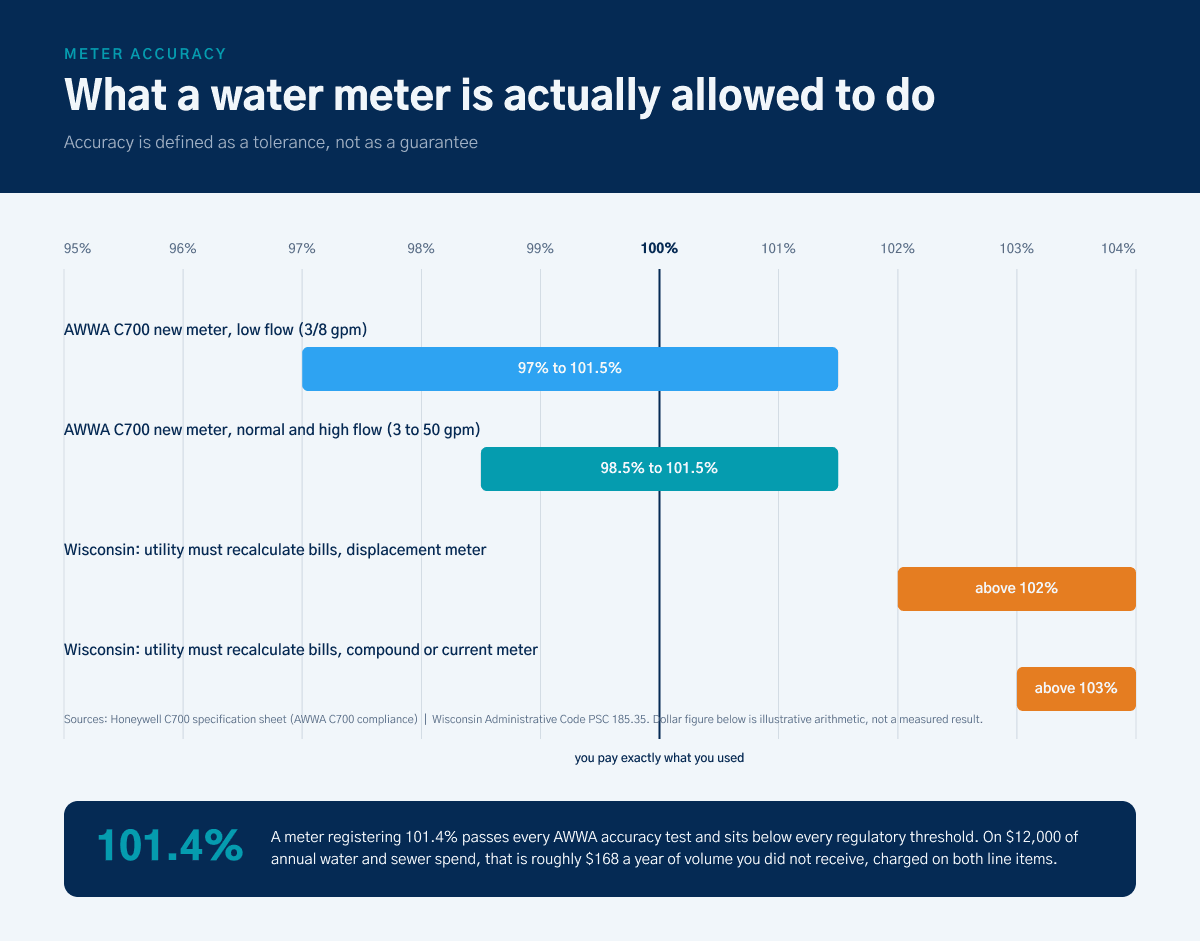
Those are the limits for a meter in new condition. Mechanical meters wear.
Regulators set thresholds for when a reading becomes actionable. In Wisconsin, if a displacement meter registers above 102 percent, or a compound or current meter registers above 103 percent, the utility must recalculate bills for the period of inaccuracy using the average percent error above 100. Refunds are required where the recalculated overcharge exceeds $5 for a current customer or $10 for a former one.
Flow conditions matter too. In a 2010 complaint decision, the California Public Utilities Commission recorded a meter manufacturer’s confirmation that “the performance of a positive displacement water meter can be affected by the presence of air,” with possible effects including “over-registration of usage by the meter.”
The honest version of that story. Read the rest of that decision and the customer’s complaint was largely denied. He received a $500 adjustment and still owed $2,143.10, and the Commission ordered an independent engineering study to establish where the problem actually was. Air can cause over-registration. Proving it in a specific installation is a different job, and it requires evidence.
CheckAsk your utility to test the meter
Most will, and most charge a modest fee that is often refunded if the meter fails. New Haven, Indiana publishes a $30 fee. Check your own utility’s tariff for the figure that applies to you. Ask for the test report, not just the verdict, and ask specifically what flow rates were tested at. A meter that passes at 15 gallons per minute can still misbehave at the low flows or the surge conditions your facility actually runs at.
If your meter reading itself is wrong, the sewer charge is only half the problem. The same reading is inflating the water charge too, and the diagnostic path for that is set out in what to check when the bill is high and there is no leak.
What should a commercial, industrial or multifamily property check?
Everything above still applies. Five more things apply only to you, and they are usually worth more.
Your meter may be oversized. Meters are often specified for a fire-flow or peak-demand number that the building never approaches in normal operation. A meter running most of the time at the very bottom of its range is operating where accuracy tolerances are widest. Compound meters exist precisely because low flow and high flow need different measurement, and a single large meter handling both is a known weak point.
Your sewer formula may not be volumetric at all. Some utilities bill multifamily on unit count or occupancy rather than metered consumption. If that is your situation, reducing water use will not reduce the sewer bill by a single dollar, and anyone who tells you otherwise has not read your tariff. The lever in that case is the billing structure, not the water.
You may qualify for credits you have never claimed. Cooling tower evaporation, irrigation, process water incorporated into product, and truck-fill operations are all commonly excludable from sewer volume. The application process exists. It just does not run itself.
Industrial surcharges may be misapplied. If your discharge is surcharged on strength (BOD, TSS, FOG), check that the sampling that set your surcharge rate is current and representative. Surcharge rates set during an atypical period can persist for years.
Meter type matters as much as size here. Compound, turbine and ultrasonic meters behave differently at low flow, which is where most commercial services actually spend their time.
Flow conditions at your meter are worth measuring. Large-diameter service, high draw rates, open-discharge events like tank filling or clean-in-place cycles, and air entering the line after a shutdown all create conditions at the meter that differ from a residential service. These conditions almost always create excessive water charges, even up to 30 percent, and the highest recorded is 46 percent. This can be evaluated from auditing the water and sewer bills from your site.
Where to start, by property size
The first move changes with scale, because investigation cost has to be proportionate to what is at stake.
Single building, under 10 units. Four-hour meter test, then cost per day across six bills. That resolves most cases without anyone visiting.
10 to 100 units. Add rate class and tier position. At this size a misclassification compounds every month. Establish whether sewer is billed on metered volume or on unit count, because if it is unit count no amount of water-side work will move the charge.
Over 100 units, or any industrial site. Start at the meter. Sizing, type and flow profile determine whether the number the entire bill is built on is correct. Confirm the sewer formula and every exclusion you might qualify for before touching consumption.
Multi-site portfolios. Compare cost per unit of production, per square foot or per occupied unit across sites on the same tariff. The outlier tells you where to look, faster than auditing all of them.
Commercial and industrial water and sewer bill reduction
What a commercial water and sewer bill review covers
Why sewer bills run high in apartments and multifamily properties
How do you request a sewer adjustment or a credit?
“Ask the utility” is advice that goes nowhere without a process. Here is the process.
- Establish the baseline before you call. Pull 24 months of billing and work out your normal consumption for the same month in prior years. A request that says “this bill is high” gets a different answer to one that says “this period is 240 percent of the same period in the previous two years.”
- Identify which mechanism you are asking for. Deduct meter, irrigation exemption, evaporation credit, leak adjustment, rate reclassification. They are not interchangeable and utilities handle them through different desks.
- Put it in writing and reference the tariff. Cite the section of the utility’s own rate schedule or policy that creates the mechanism you are claiming. A request that quotes the policy back gets processed differently to one that does not.
- Ask what the deadline is. Many adjustment policies have a limit on how far back they will go, often 12 months. Delay costs money directly.
- Get the decision in writing, including a denial. A written denial tells you which mechanism was considered and on what grounds, which is what you need to appeal or to apply under a different mechanism.
Most utilities publish this. Very few advertise it.
What to do this week
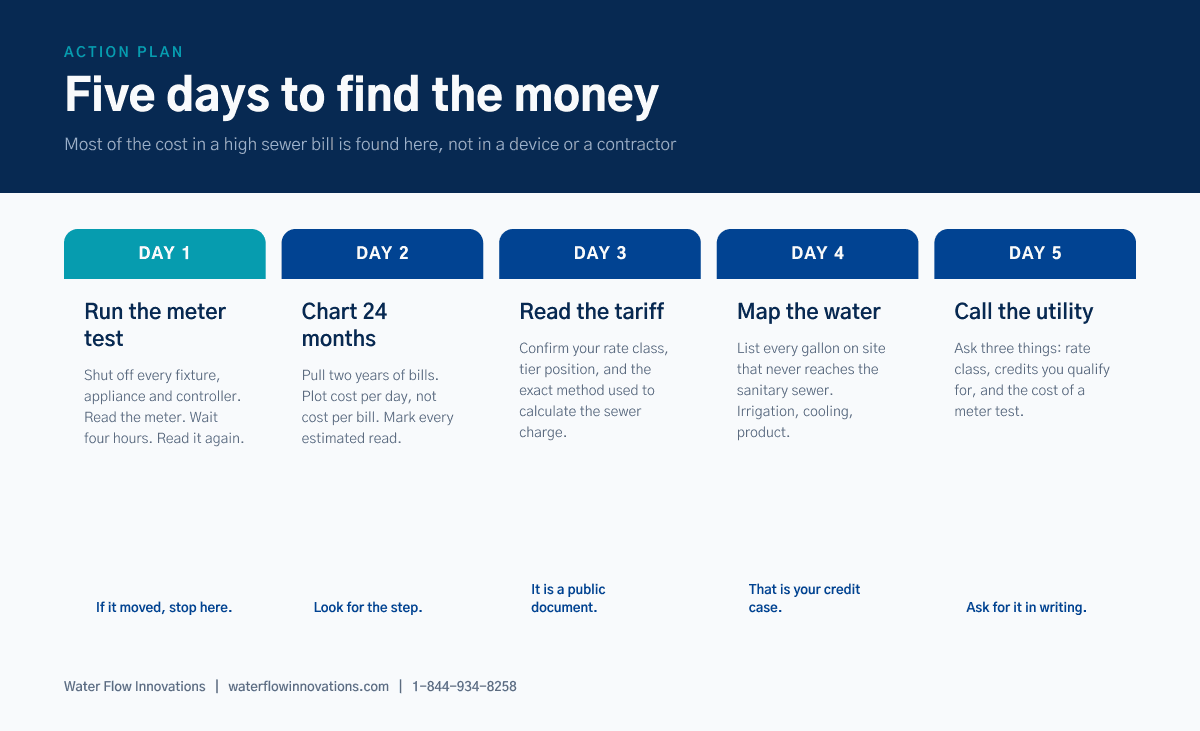
Day 1. Run the four-hour meter test. If the meter moves with everything off, stop here and find the leak.
Day 2. Pull 24 months of bills. Chart cost per day, not cost per bill. Mark every estimated read.
Day 3. Download your utility’s current tariff. Confirm your rate class, your tier position, and the exact method used to calculate your sewer charge.
Day 4. List every gallon on your site that does not reach the sewer. Irrigation, cooling, product, wash-down that goes to storm.
Day 5. Call the utility. Ask three questions: what is my rate class, what credits or deduct meter programs am I eligible for, and what does a meter accuracy test cost.
Frequently asked questions
Because the sewer rate per unit is often higher than the water rate. Both charges usually come from the same meter reading, so if the volume is identical and the sewer charge is larger, the difference is rate, not usage. Sewer service costs more to deliver in most systems because gravity collection requires deeper construction, pump stations, and a smaller customer base than water service.
In order of typical return: fix leaks, claim any deduct meter or irrigation exemption you qualify for, verify your rate class and tier position, correct estimated reads, and confirm your meter is registering accurately. Reducing consumption only helps if your utility bills sewer volumetrically. If it bills on unit count or occupancy, consumption changes will not move the charge.
There is no national figure that applies to a specific property, because rates and calculation methods vary by utility. As a reference point, Bluefield Research put average combined household water and sewer bills at roughly $147 per month in the Northeast and $143 in the West in 2025. Commercial and industrial bills scale with volume, meter size, and discharge characteristics.
Almost certainly not. In most systems the sewer charge is derived from the water meter reading. That is why water meter accuracy affects two line items rather than one.
Yes. The process varies by utility and by state, but every regulated utility has one. Most states also require the utility to test a meter on customer request and to recalculate bills when the meter is found outside tolerance. Wisconsin’s threshold of 102 percent for displacement meters is one published example.
The most common causes of a sudden jump are a corrected estimate following several estimated reads, a longer billing period, a rate change taking effect, or a leak that started between billing cycles. Check the service dates and the read type on the bill before assuming anything about consumption.
Have your bills reviewed
Water Flow Innovations analyzes commercial, industrial and multifamily water and sewer bills. Send 12 months of billing along with your meter make, model and size, and we will tell you what is driving the charge and whether anything on this page applies to your site. If the answer is that your billing is correct and your meter is accurate, we will tell you that too.
Request a bill review Sewer Double Impact CalculatorSources: MSD Greater Cincinnati sewer rate schedule 2026 · City of Greensboro stormwater ERU and credit policy · Boothbay Harbor Sewer District · EPA WaterSense · Bluefield Research US water and wastewater rate index 2025 · Honeywell C700 specification sheet (AWWA C700 compliance) · Wisconsin Administrative Code PSC 185.35 · CPUC Decision, complaint C.10-05-012 · City of New Haven, Indiana meter test fee schedule.
Water Flow Innovation LLC, 2651 Route 412, Coopersburg, PA 18036. Call 1-844-934-8258.
0 Comments