
Quick answer: Water used for landscape irrigation soaks into the ground and never reaches the sewer, but a standard commercial or multifamily account is billed sewer on it anyway, because sewer is calculated from the main water meter. A dedicated irrigation meter measures that outdoor water on its own line so it is not charged sewer. For a property with meaningful irrigated landscaping, that is an ongoing reduction on every summer bill. It is the irrigation-specific case of the broader deduct-meter approach, and it pairs with, rather than replaces, correcting over-registration on the water your building actually uses.
For a property manager, landscape irrigation is one of the few places where you are provably paying a sewer charge on water that cannot possibly be sewage. The grass drinks it. None of it returns to the treatment plant. Yet unless the irrigation is metered separately, the utility bills it as sewer along with everything else.
Why you pay sewer on water that never reaches the sewer
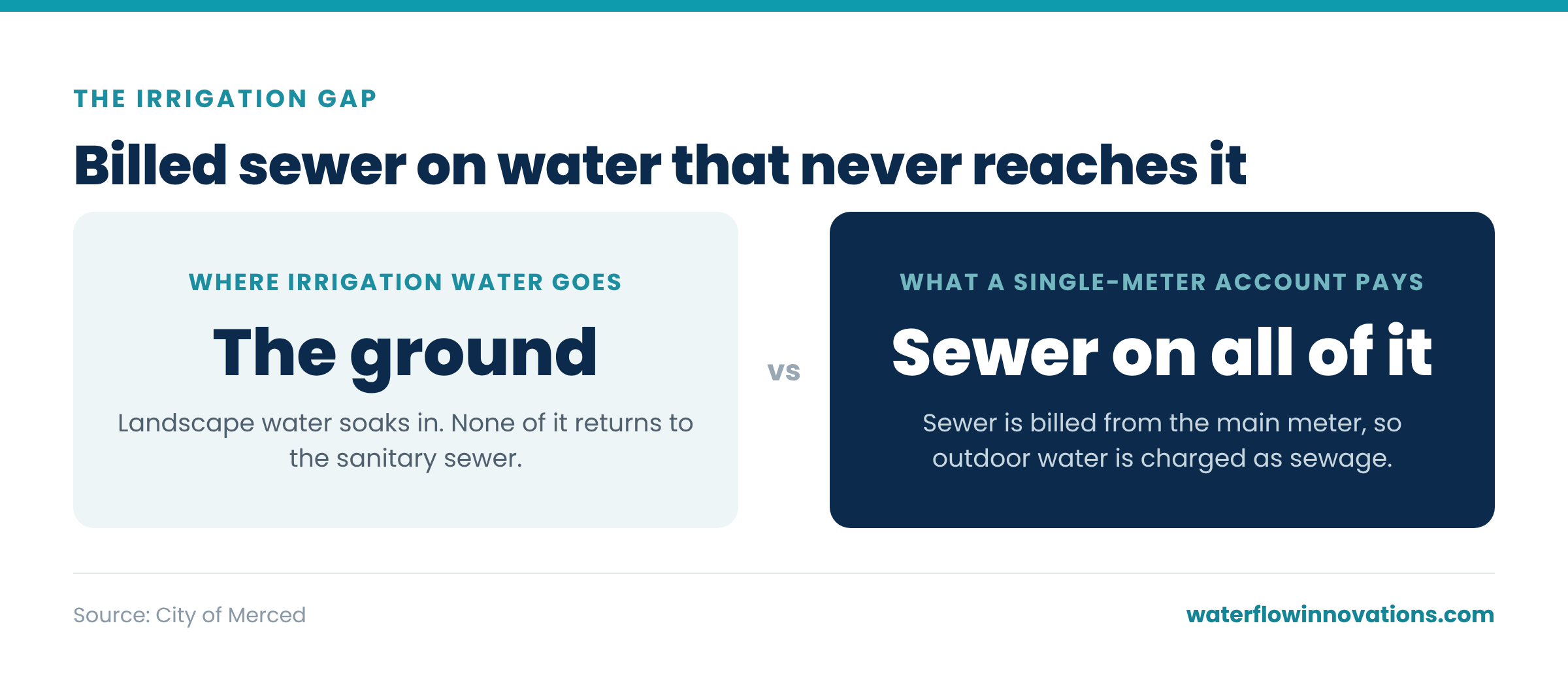
Sewer is almost never measured. Utilities estimate it from your water meter, because metering actual wastewater at every connection would be impractical. On a typical commercial account that means the sewer charge is applied to the full volume recorded by the main meter, indoor and outdoor water alike.
Most tariffs acknowledge that some of that water is irrigation and bake in a small allowance. The City of Merced, for example, notes that its standard commercial sewer rate already assumes about 10 percent of metered water is irrigation (City of Merced). For a property with real landscaping, a nursery, a campus, an apartment community, a business park, that 10 percent assumption is far too low. You irrigate well above it in the warm months and pay sewer on all of it.
What a dedicated irrigation meter does
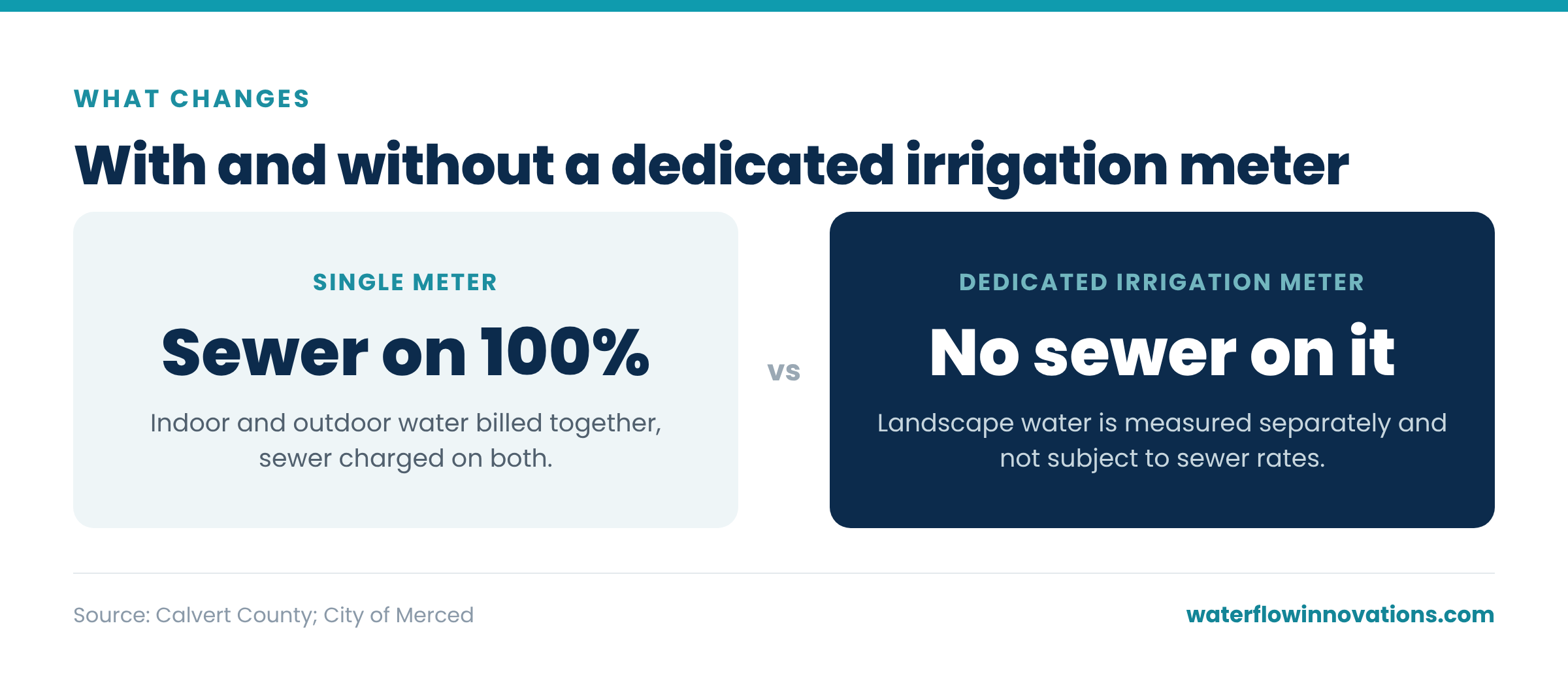
A dedicated irrigation meter, sometimes called an irrigation deduct meter, is a second meter installed on the line that feeds only your irrigation system. Because that water is measured separately and is known not to enter the sewer, the utility does not apply sewer charges to it.
Calvert County states the principle cleanly: “with none of the water returning to the sanitary sewer system, wastewater charges do not apply to irrigation meter usage,” and the irrigation volume shows as its own line item on the bill (Calvert County). Merced describes the same outcome for a separate landscape meter: “the water measured by it will not be subject to sewer rates” (City of Merced).
You still pay for the irrigation water itself, since you used it. You stop paying the sewer charge stacked on top of it.
Is it worth it for your property?
The meter has an upfront cost, so the question is how long it takes to pay back. You can estimate that from your own bills before spending anything.
Compare a cold-weather sewer charge, when little or nothing is irrigated, against a peak summer charge. The gap is a rough measure of what you are paying in sewer on outdoor water. Calvert County recommends exactly this: request your account history and “compare a fall or winter sewer bill, a proxy for indoor use, with a summer bill, when you water outside” (Calvert County). Multiply the monthly gap across your irrigation season and you have an annual savings estimate to set against the install cost.
Properties where this tends to pay off fastest share a few traits: significant irrigated acreage, a long warm season, a high sewer rate, and a sewer charge that clearly climbs in summer. If your summer and winter sewer charges are nearly identical, you irrigate little and the meter may not be worth it.
How to get one
The process is a utility and plumbing exercise, and the details vary, but the shape is consistent.
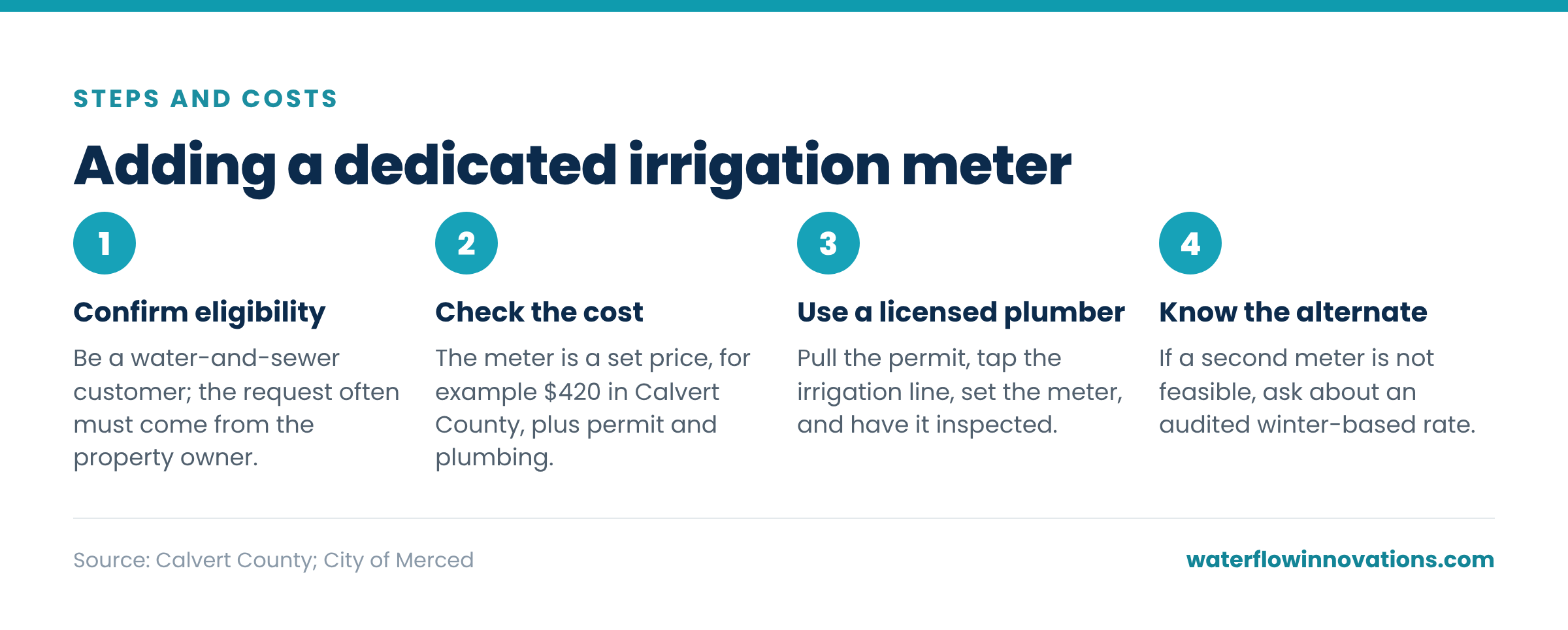
- Confirm eligibility with your utility. You generally must be a water-and-sewer customer of that utility, and the request often must come from the property owner. Calvert County requires that the requester be the property owner and that you receive service from the county.
- Check the cost. The meter itself is a defined price, for instance $420 purchased from Calvert County (as of 2026), plus a permit and separately billed plumbing to install it. Merced instead charges for a water audit, $50 per hour of staff time with a $150 minimum deposit, where a separate meter is not feasible.
- Use a licensed plumber and pull the permit. The irrigation line is tapped and the meter set on it. Most utilities require a licensed plumber and a permit, with the county inspecting the connection.
- Know the alternate if a meter is not feasible. Where a second meter is physically or financially impractical, some utilities offer an alternate sewer rate based on audited winter usage instead. Merced limits this to accounts where irrigation exceeds the standard 10 percent assumption and a separate meter is infeasible, and requires a water audit and at least twelve months of history. For why commercial accounts rarely get winter-based relief, see Winter Averaging: Why Your Commercial Sewer Bill Rarely Gets the Break.
Where it fits with deduct meters and over-registration
A dedicated irrigation meter solves one specific thing: sewer charges on landscape water. It is the most common case of a broader idea, which is separating any water that leaves your site without entering the sewer. Cooling-tower evaporation, water that leaves in a product, and other process losses follow the same logic on their own deduct meters. If your site has those, start with the full picture in deduct meters, and treat this article as the irrigation chapter of it.
What an irrigation meter does not touch is the water that genuinely runs through your building and is billed on both the water and sewer lines. That water is still exposed to over-registration. During demand surges water speeds up through the meter, pressure inside it drops, dissolved gas comes out of solution and vapor forms, and the meter counts that volume as water. The meter is not faulty. It reports what physically passed through it, and because sewer is billed from the same reading, the over-recorded volume is billed twice.
A Flow Conditioning Device installs immediately after the main meter and creates a small, controlled back-pressure that extends back through the meter, holding pressure up during demand surges so far less gas and vapor form and are counted as water. It corrects the reading, not your actual use, with pressure loss under 0.8 psi. See how the FCD works and water meter over-registration. The two measures are complementary: the irrigation meter removes sewer on water that never reaches the sewer, and the FCD corrects over-registration on the water that does.
What to do next
Pull a winter and a summer sewer charge and measure the gap. If your property irrigates enough that the summer charge climbs noticeably, price a dedicated irrigation meter with your utility and run the payback against that gap. While you are reviewing the account, have the over-registration on your main meter checked as well. Send us your bills and we will model it.
Get My Quote or call 1-(844)-934-8258. Water Flow Innovations LLC, 2651 Route 412, Coopersburg, PA 18036.
Frequently asked questions
Will a dedicated irrigation meter remove all sewer charges on my outdoor water?
It removes sewer charges on the water that passes through it, since that water does not return to the sewer. You still pay for the irrigation water you use. Calvert County confirms that wastewater charges do not apply to irrigation meter usage.
How much does an irrigation meter cost?
It varies by utility. As a reference point, Calvert County sells the meter for $420 (as of 2026), plus a permit and separately billed plumbing. Some utilities instead charge for a water audit when a separate meter is not feasible and offer an alternate rate.
How do I estimate my savings before installing one?
Compare a winter sewer charge, which reflects mostly indoor use, with a peak summer charge, and multiply the difference across your irrigation season. That gap approximates the sewer you are paying on outdoor water today.
Is this the same as a deduct meter?
It is the irrigation case of the same idea. A deduct meter separates any water that leaves your site without reaching the sewer, including cooling and process water. For landscape water specifically, a dedicated irrigation meter is the common form.
Does an irrigation meter fix over-registration too?
No. It removes sewer on outdoor water. Over-registration affects the water that runs through your main meter during demand surges and is a separate issue that a Flow Conditioning Device corrects.
Sources
- Calvert County, Irrigation Meters and Irrigation Systems: https://www.calvertcountymd.gov/3633/Irrigation-Meters-and-Irrigation-Systems
- City of Merced, Alternate Sewer Service Charges: https://www.cityofmerced.gov/utilities-services/wastewater/alternate-sewer-service-charges
0 Comments