
Can a Simple Device Really Cut Your Water Bill Up to 30%? The Physics Has Been
Proven for Decades.
It sounds too simple. Many facility managers don’t believe a simple device after the meter can cut a water and sewer bill by up to 30%. But oil, gas, and naval engineers have relied on the same physics for decades. Water is just catching up.
Decades
Up to 30%
46%
Under 0.8 psi
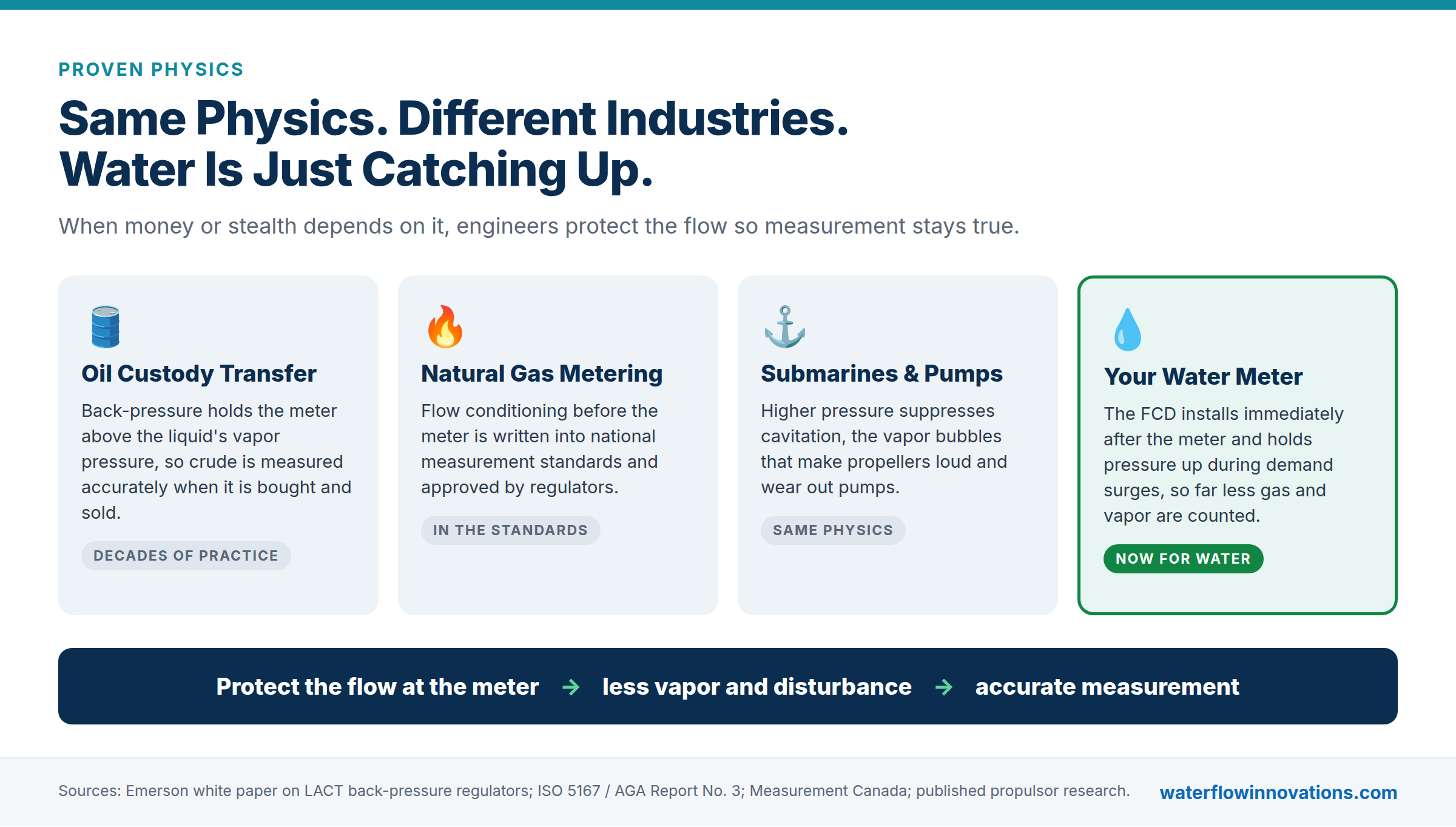
Direct answer: Yes, a simple fix can work, because the physics behind it is not new. In oil custody transfer, back-pressure has long been held on meters so the liquid stays above its vapor pressure and is measured accurately. Natural gas metering conditions the flow before the meter as part of its standards, and naval and pump engineers keep pressure up to suppress cavitation. The Flow Conditioning Device (FCD) applies that same principle to commercial water meters: it installs immediately after the meter and holds pressure up during demand surges, so far less gas and vapor are counted as water.
Same Physics. Different Industries.
The Doubt Is Reasonable
If one small device after the meter could cut a water and sewer bill this much, wouldn’t everyone already be using it? It’s a fair question, and it deserves a real answer. The answer is that the principle isn’t new at all. Industries where measurement accuracy is worth millions have been using it for decades. Commercial water meters are simply the last place it hasn’t been applied.
Oil and Gas: Pressure on the Meter Whenever Money Changes Hands
When crude oil is bought and sold by meter reading, called custody transfer, both sides need the meter to be right. Oil-field measurement skids use a back-pressure regulator downstream of the meter to hold the liquid above its vapor pressure. If pressure drops below that point, vapor forms in the meter and the reading goes wrong. Equipment makers describe this back-pressure as essential to accurate measurement of the quantity transferred.
Meter manufacturers have even patented systems that adjust a valve to keep enough back-pressure on a mass flow meter so the liquid does not flash to vapor inside it, specifically to improve measurement accuracy.
Some governments write the principle into law. Canada’s weights and measures regulations require liquid meters to be installed so the release of dissolved air and gas, and the vaporization of the liquid, are kept to a minimum during measurement.
That is the same physics behind the FCD: hold pressure up at the meter, and far less gas and vapor form to be counted.
Natural Gas: Conditioning the Flow Is Part of the Standards
In natural gas pipelines, conditioning the flow before it reaches the meter is standard practice. Measurement standards such as ISO 5167 and AGA Report No. 3 describe flow conditioners, like tube bundles, installed ahead of the meter to isolate it from piping disturbances. Measurement Canada has a formal approval process for flow conditioners used in natural gas custody-transfer metering.
Gas flow conditioners work differently from the FCD (they mainly correct swirl and distorted flow), but the lesson is the same: the conditions the meter sees decide how accurately it measures.
Submarines and Pumps: Pressure Keeps Vapor From Forming
Navies spend enormous effort on cavitation, the vapor bubbles that form when pressure drops around a fast-moving propeller. Cavitation is noisy, and noise gives a submarine away, so propulsion engineers design specifically to suppress it. Research on submarine propulsors has found that cavitation decreases as depth increases, because higher surrounding pressure keeps vapor from forming.
Pump designers follow the same rule. Every pump needs enough pressure at its inlet, known as net positive suction head, to keep the liquid from flashing to vapor and damaging the pump.
Why Water Meters Were Left Out
Municipal water meters are installed to measure flow at the lowest practical cost, without any device to hold pressure on the meter during demand surges. When valves open suddenly, pumps start, or many fixtures run at once, pressure inside the meter drops, dissolved gas comes out of solution and vapor forms, and the meter counts that volume as water. Because most sewer charges come from the same reading, the over-count is billed twice. It’s not your meter. It’s your pipes.
The FCD Brings Proven Physics to Your Water Meter
The FCD installs immediately after the water meter and creates a small, controlled back-pressure that extends back through the meter, holding pressure up during demand surges so far less gas and vapor form and are counted as water. Pressure loss across the FCD is under 0.8 psi across all flow conditions, and nothing downstream of the meter changes.
The FCD itself is newer. The principle behind it isn’t. Patented by AquaFlow Technologies, Inc., it brings decades-old measurement physics to commercial water meters. Documented installations typically show up to a 30% reduction in water and sewer costs (46% highest documented, a rare case), starting on the next full billing cycle.
Common Questions
Do water bill reduction valves really work?
Has the FCD itself been used in oil fields, gas pipelines, or submarines?
If this physics is so well known, why haven't water utilities done it already?
Is the FCD the same as a flow straightener or flow conditioner used in gas metering?
How much can the FCD reduce a water and sewer bill?
Does the FCD reduce the water my building uses?
References
Emerson (Fisher), “The Role of Backpressure Regulators in Lease Automatic Custody Transfer Units,” white paper.
Itron, Inc., “Dynamic-adaptive vapor reduction system in a mass flowmeter,” European Patent Application EP 2 365 298.
Government of Canada, Weights and Measures Regulations (C.R.C., c. 1605), Volumetric Liquid Meters: laws-lois.justice.gc.ca.
ISO 5167, Measurement of fluid flow by means of pressure differential devices; American Gas Association, AGA Report No. 3.
Measurement Canada, specifications for flow conditioners in natural gas custody-transfer metering.
Published research on submarine pump-jet propulsor cavitation and noise (e.g., Journal of Applied Fluid Mechanics).
See What Proven Physics Can Do for Your Bill
Model your building’s 24-hour flow pattern in the free calculator, or send us your bills for a free savings analysis before you commit to anything.