
Quick answer: Winter averaging caps the sewer charge using cold-weather water use as a stand-in for indoor flow, so summer irrigation is not billed as sewage. It is usually a residential benefit. Commercial and industrial accounts usually do not get it, and are billed sewer on their full metered water year-round. That means every gallon your meter records is charged twice, as water and as sewer, with no seasonal relief, which is exactly why over-registration and water that never reaches the sewer are worth so much to a commercial account.
If you have ever wondered why a nearby residential account pays sewer on a fraction of its summer water while your facility pays on all of it, this is the reason. The billing method is different by customer class, and the commercial class draws the version with no cap. For the basics of how the charge is built, see What Is a Sewer Charge?.
What winter averaging actually is
Sewer is hard to measure directly, so utilities estimate it from water. The near-universal formula is a fixed charge plus a volumetric rate applied to some figure of billable gallons. The only thing that changes between utilities is how those billable gallons are set. One industry explainer lists six common methods: full metered water, a percentage of metered water, winter average, winter average with a cap, a flat fee, and a separate sewer or irrigation meter (Water Calculator).
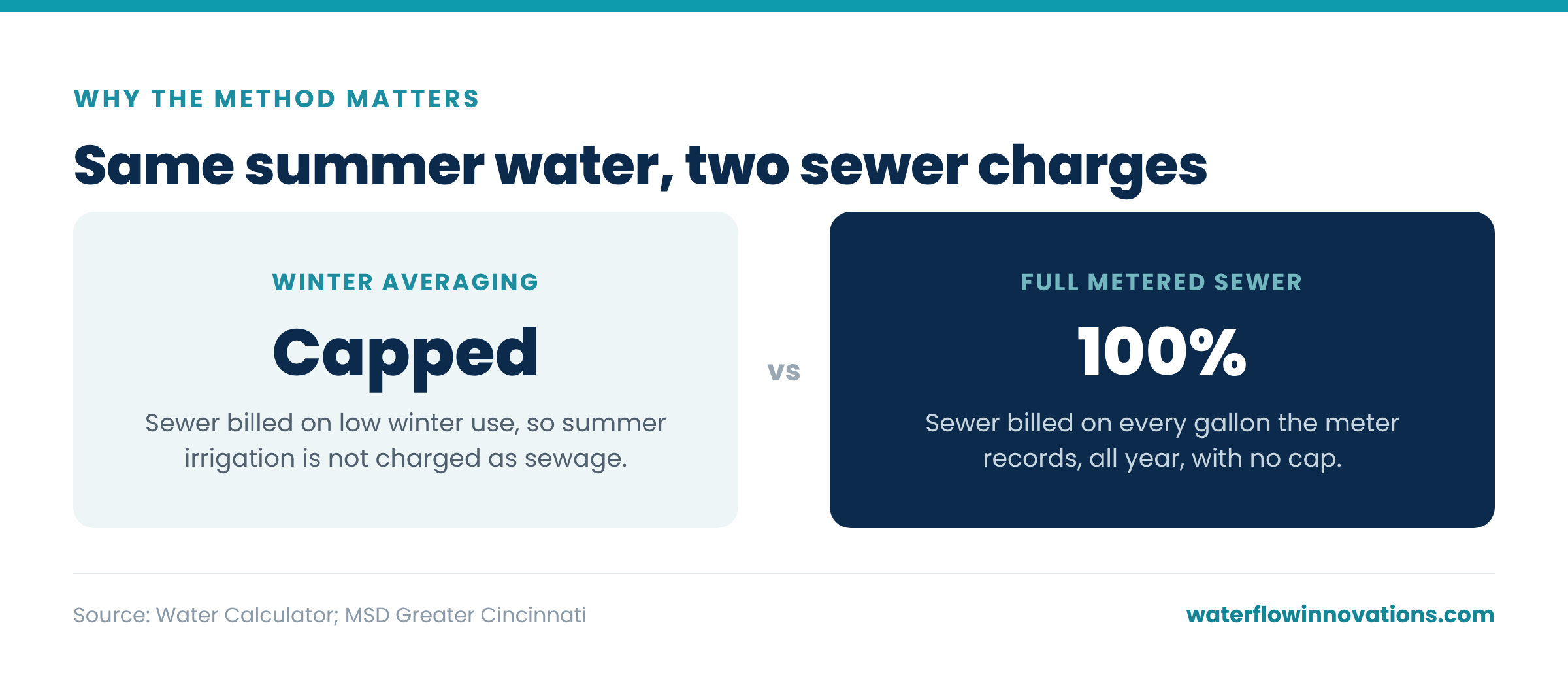
Winter averaging is the method built to be fair about irrigation. It “uses the months when almost no one waters a lawn as a stand-in for your indoor use,” then bills sewer on that winter figure for the rest of the year, or bills the lower of the winter average and actual warm-season use (Water Calculator). The assumption is that water used outdoors in summer soaks into the ground and never enters the sewer, so charging sewer on it would be unfair. Winter use, when little or nothing is watered outside, is treated as the true indoor baseline. For the arithmetic with real utility tariffs, see How Is a Commercial Sewer Bill Calculated?.
Why the break is built for residential, not commercial
The method is written around the residential class, and many utilities say so in the tariff. The Metropolitan Sewer District of Greater Cincinnati applies a “winter period” that uses “average water consumption during the winter months of January, February, and March” as a monthly cap from April through December, so summer irrigation is not billed as sewage. That winter period “applies only to single-family and two-family homes” (MSD Greater Cincinnati).
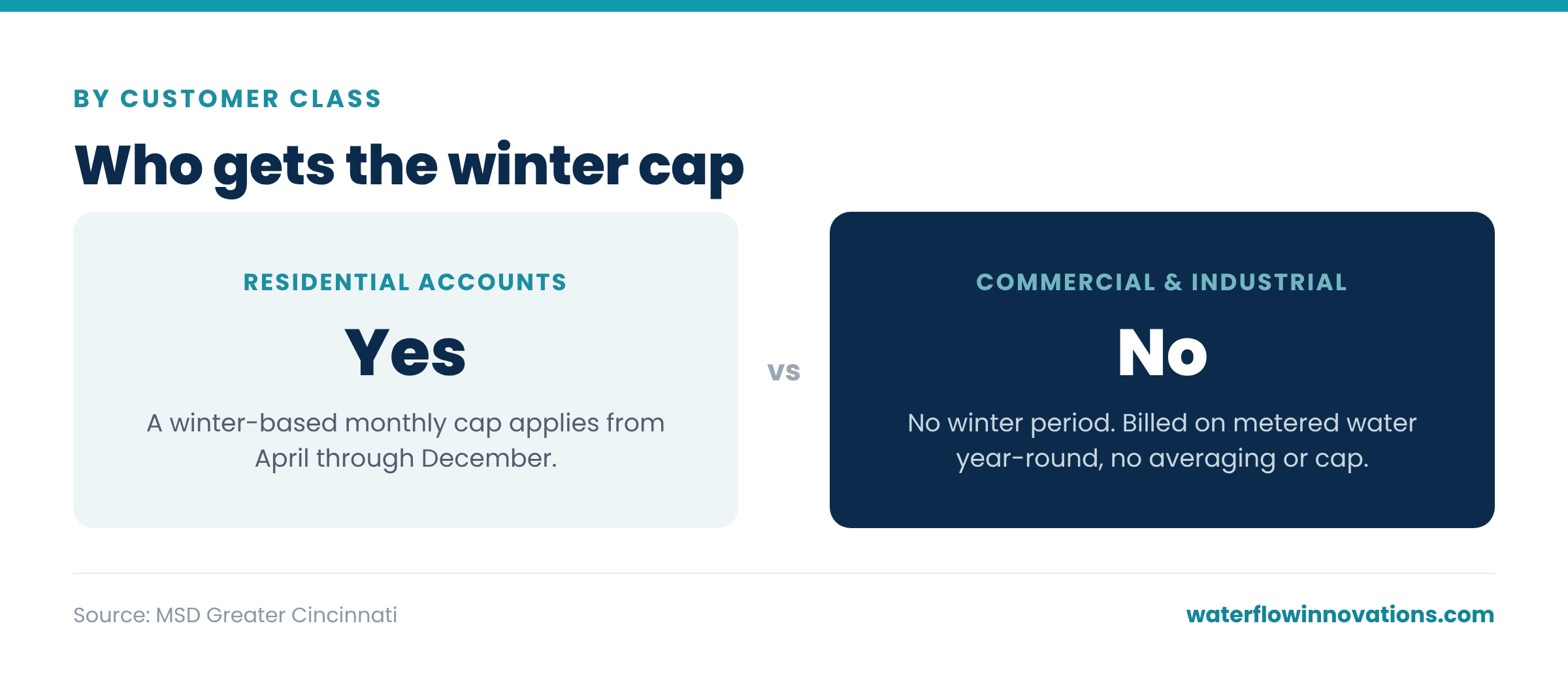
For commercial accounts the same tariff is blunt. MSD states that “commercial and industrial customers do not have a winter period,” so the April-to-December cap does not apply to them. Their volumetric sewer charge is based on water use above the base allowance, every month of the year, with no averaging and no seasonal ceiling.
The reasoning is that commercial water use does not follow the clean indoor-versus-outdoor pattern that averaging assumes. A business can run water heavily in any season for processes, cooling, washdown, or production, so utilities decline to treat winter as a reliable proxy for the rest of the year. Whatever the rationale, the outcome for you is the same: no cap.
What “no winter period” costs you
Billed on full metered water year-round, a commercial account pays sewer on every gallon the meter records, including gallons that arguably never reach the sewer and gallons the meter should not have recorded at all. There is no month where the sewer charge steps down, no averaging to smooth a heavy period, and no ceiling.
That structure turns two things into recurring money. The first is water that genuinely leaves the site without entering the sewer, such as landscape irrigation, cooling-tower evaporation, or water that leaves in a product. On a residential winter-averaged account, summer irrigation is already handled by the cap. On your commercial account it is not, so you pay sewer on it unless you separate it out. See what a sewer charge is and deduct meters for the ways to carve that volume off the sewer side.
The second is over-registration, and because there is no cap, it is billed in full every month.
The double hit: over-registration billed on water and sewer
Because sewer is calculated from the same meter reading, any over-registration is billed twice, once as water and once as sewer. During demand surges, pressure inside the meter drops, dissolved gas comes out of solution and vapor forms, and the meter counts that volume as water. On a winter-averaged account a summer spike could still be capped; on a commercial account with no winter cap, nothing limits it in heavy months. See Sewer Double-Impact Billing.
What a commercial account can actually do
You will not get winter averaging, so the levers are different. Three are worth checking in order.
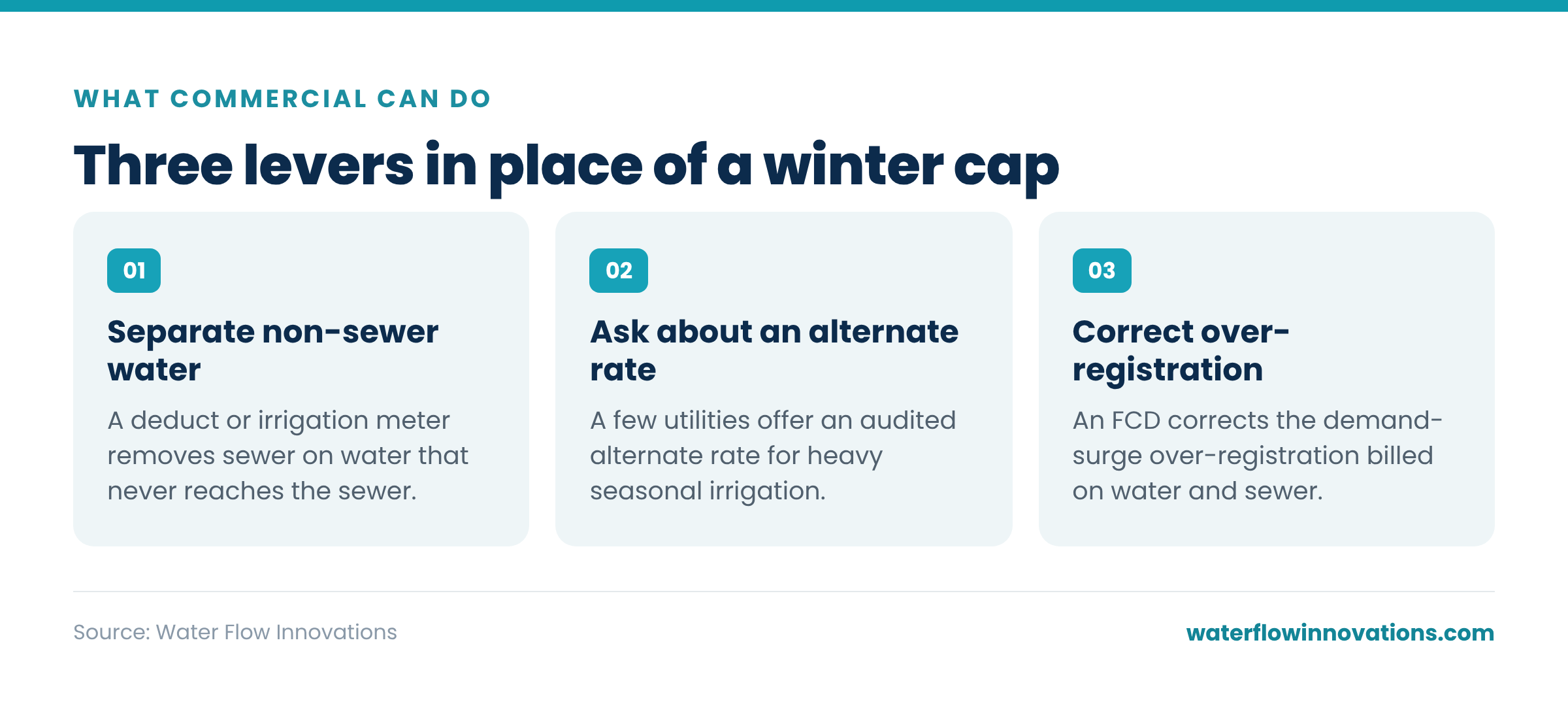
- Separate the water that never reaches the sewer. A dedicated irrigation or deduct meter removes sewer charges on landscape, cooling, or process water that leaves the site. This is the commercial substitute for the irrigation relief that averaging gives residential accounts. Start with deduct meters. For landscape water specifically, see A Dedicated Irrigation Meter Stops Sewer Charges on Landscape Water.
- Ask whether your utility offers any alternate commercial method. A few utilities offer a limited winter-based or audited alternate rate for commercial accounts with large seasonal irrigation swings, usually with eligibility tests and an application. It is worth one phone call to confirm whether yours does.
- Correct over-registration on the water that is billed. For the water that genuinely runs through your building and is billed on both lines, the FCD corrects the demand-surge over-registration the meter records. A Flow Conditioning Device installs immediately after the meter and creates a small, controlled back-pressure that extends back through the meter, holding pressure up during demand surges so far less gas and vapor form and are counted as water. It corrects the reading, not your actual water use, and its pressure loss is under 0.8 psi. See how the FCD works.
What to do next
Pull a summer and a winter sewer charge off your statements and compare them. If they are nearly identical, you are on full metered sewer with no winter relief, which is the commercial norm. From there, separate any water that never reaches the sewer, ask the utility about any alternate commercial rate, and have the over-registration on your billed water checked. Send us your bills and we will model the piece we handle.
Get My Quote or call 1-(844)-934-8258. Water Flow Innovations LLC, 2651 Route 412, Coopersburg, PA 18036.
Frequently asked questions
Can a commercial account get winter averaging?
Usually not. Many tariffs restrict winter averaging to residential accounts. Cincinnati’s sewer tariff states that commercial and industrial customers do not have a winter period. A few utilities offer a separate alternate rate for commercial accounts with heavy seasonal irrigation, so it is worth asking yours.
Why does residential get the break and commercial does not?
Winter averaging assumes winter water use is a reliable stand-in for indoor use, which fits a typical residential account. Commercial water use can be heavy in any season for processes, cooling, or washdown, so utilities generally decline to treat winter as a proxy for the rest of the year.
If I cannot get averaging, how do I lower my commercial sewer bill?
Separate water that never reaches the sewer with a deduct or irrigation meter, ask the utility about any alternate commercial rate, and correct demand-surge over-registration on the water that is billed. These are the commercial levers in place of a winter cap.
How does over-registration affect my sewer bill specifically?
Sewer is billed from the metered water reading. When the meter over-registers during a demand surge, the over-recorded volume is billed as water and again as sewer. With no winter cap on a commercial account, there is nothing to limit that in heavy months.
Does a Flow Conditioning Device reduce water or sewer charges?
It reduces both. The FCD corrects the meter reading, and because sewer is billed from that same reading, correcting it lowers the water and sewer lines together. It does not reduce your actual water consumption.
Sources
- Metropolitan Sewer District of Greater Cincinnati, Your Sewer Bill: https://msdgc.org/customers/residential-customers/your-sewer-bill/
- Water Calculator, What Is the Sewer Charge on My Water Bill: https://watercalculator.us/blog/water-costs/sewer-charge-explained
0 Comments